
Most people who move to The Woodlands from Houston proper say the same thing within the first few months: the shift in how the city feels — quieter streets, visible patrols, neighbors who actually know each other — is as striking as the difference in the numbers. That feeling is not imaginary, and the crime statistics back it up. But safety in The Woodlands is not uniformly distributed across all 121,002 residents and the community's dozen-plus villages, and that distinction matters if you're choosing a neighborhood.
The Woodlands sits in Montgomery County roughly about 45 minutes to Downtown Houston via I-45, which puts it squarely in commuter-suburb territory. That geography — planned, wooded, deliberately designed to keep commercial corridors separate from residential streets — shapes its safety profile in ways that raw citywide numbers alone don't fully capture. The community is governed by The Woodlands Township, which funds its own dedicated law enforcement programs, a nationally recognized neighborhood watch system, and a fire department that holds a classification virtually no department in the country achieves.
The headline figures are genuinely favorable. With a typical home price of $630,000, buyers are paying a premium — and part of what they're paying for is a safety infrastructure that goes well beyond a sheriff's deputy on patrol. That said, no suburb of 121,002 people is crime-free, and theft in high-traffic commercial areas is real enough that knowing where it concentrates is useful before you settle on a specific part of the city.
This guide breaks down The Woodlands' violent and property crime rates against state and national benchmarks, maps the east-to-southwest safety gradient that local residents understand intuitively, explains who actually patrols the streets and how, and gives you the honest version of what to expect — including where the risk is lowest and what the data can't tell you.
The Woodlands Crime Rate vs. Texas and the Nation
The Woodlands carries a violent crime rate of 2.864 per 1,000 residents and a property crime rate of 14.52 per 1,000 residents — both meaningfully below where Texas and the country sit as a whole.
The state violent average is 4 per 1,000; the national figure is 3.7 per 1,000. On property crime, Texas averages 20.7 per 1,000 and the national figure is 18.4 per 1,000. The Woodlands falls below every one of those benchmarks, and by a margin that isn't close on the property crime side — the community's rate is roughly a third lower than the Texas state average.
Among Houston-area suburbs, The Woodlands is consistently grouped with communities like Sugar Land and Friendswood as among the safer options in the metro. Houston's own citywide crime figures run considerably higher on both measures, so the contrast for someone relocating from inside the city limits is immediate and legible in the data.
All figures above are sourced from the Bureau of Justice Statistics, Crime Known to Law Enforcement, 2024 (tables 2 and 3). This page shows a comparison table from this data — look for it below this section.
The most important caveat: these are community-wide averages. They smooth over real variation between the eastern commercial corridors and the quieter southwest residential villages, and understanding that gradient is more useful for choosing a neighborhood than the citywide rate alone.
The East-to-Southwest Safety Gradient Locals Know
Ask a longtime resident which part of The Woodlands they'd choose for the lowest crime exposure, and almost everyone points southwest. That intuition matches the data.
The eastern and southeastern portions of The Woodlands — closer to the commercial strips, retail centers, and higher-traffic corridors near I-45 — see the highest total incident counts. The southwest, which covers quieter residential villages set deeper into the wooded lots, sees the fewest incidents annually by a wide margin. This is a directional pattern, not a bright line, and it holds across both violent and property crime categories.
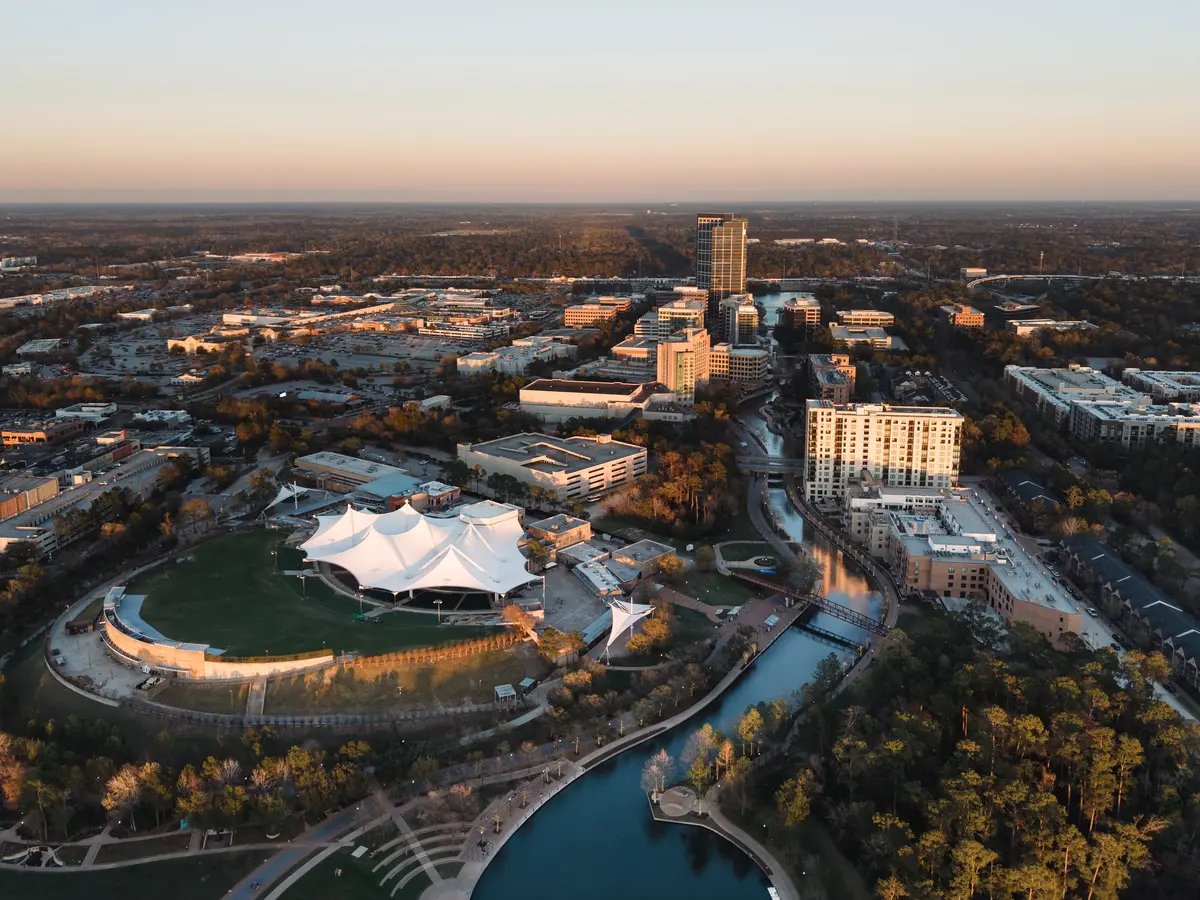
There's an important distinction to make here between raw incident counts and residential safety. Elevated totals in the east partly reflect the concentration of commercial activity: The Woodlands Mall, restaurant rows, entertainment venues, and high-volume retail all generate traffic and, with it, a higher incidence of opportunistic property crime. A crime that happens in a parking lot near the Cynthia Woods Mitchell Pavilion is not the same risk profile as a crime in a cul-de-sac in Sterling Ridge or Cochran's Crossing.
Crime heat maps that show red clusters around Town Center are frequently misread by people researching the area online. Those clusters largely represent commercial-zone theft and visitor-related incidents, not conditions in the surrounding residential neighborhoods. If a map is showing you the retail corridor as a hot zone, that's not a reason to avoid the neighborhoods nearby — it's a reason to understand what kind of activity is driving the count.
For a closer look at how each village's character differs, the neighborhoods page covers the texture of Alden Bridge, Grogan's Mill, Sterling Ridge, and the rest in detail.
Where Incident Counts Are Highest — and Why
The southeast sections of The Woodlands see the highest total incident volume, driven substantially by commercial activity rather than residential conditions. The southwest sees the lowest, consistent with its land use: deeper residential, lower through-traffic, fewer commercial attractors.
Panther Creek and Indian Springs sit in the older, more central parts of the community and occupy the middle of this gradient — established neighborhoods with lower traffic than the eastern retail zones, though not as removed from commercial corridors as the newer southwest villages.
Creekside Park and College Park (which includes Harper's Landing, Grogan's Forest, and Windsor Hills) are generally considered among the quieter, lower-incident parts of the community. The key question when researching a specific village is always: how much commercial activity surrounds it, and how much residential buffer exists between the homes and the main arterials?

Who Patrols The Woodlands — and How
The Woodlands is an unincorporated community, which means it doesn't have its own police department. What it has instead is a layered public safety structure that most incorporated suburbs its size can't match.
Montgomery County Sheriff's Office — Primary Coverage
The Montgomery County Sheriff's Office is the primary law enforcement provider, and it maintains a dedicated Woodlands Township division. That division handles patrol, crime prevention, community engagement, and criminal investigations specifically within The Woodlands — it's not a general county unit that happens to cover this territory as an afterthought. Parts of The Woodlands that fall inside Harris County are served by the Harris County Constable's Office.
Town Center Rangers
A team of 48 Park and Town Center Rangers patrols The Woodlands Mall, the Cynthia Woods Mitchell Pavilion, and surrounding retail districts. They operate daily, covering a very long service window each day, year-round. Rangers use electric vehicles, handle visitor assistance, watch for suspicious activity, and function as a visible deterrent throughout the commercial core.
The A&O Mounted Patrol
For more than 25 years, the A&O Mounted Patrol has provided a distinctly visible presence on horseback throughout The Woodlands. The patrol logs approximately 367 hours per week and coordinates directly with the Montgomery County Sheriff's Office and mall security. Few suburbs anywhere in the country maintain a mounted patrol program at this scale or longevity.
Fire and Emergency Services
The Woodlands Fire Department earned an ISO Public Protection Class 1 rating in 2022 — the highest possible classification, held by a very small fraction of fire departments nationally. The department runs eight stations with a fully career staff. For homeowners, that rating matters practically, not just as a point of pride: insurers factor it into their risk models.
Looking to buy in The Woodlands? Estimate your payment.
Enter your numbers to see an estimated monthly mortgage payment.
Estimate only. Excludes HOA fees and mortgage insurance. The interest rate above is a starting point, not a quoted rate — replace it with your own to see real numbers. Insurance is a flat placeholder, not a The Woodlands quote.
The Woodlands Watch: Community-Level Safety Programs
The Township's investment in community safety goes beyond sworn officers and fire stations. The Woodlands Watch program is one of the most comprehensive neighborhood-engagement systems in the Houston metro, and it earned The Woodlands Township First Place recognition from the National Association of Town Watch in the category for communities of 100,000 to 300,000 residents.
The program runs six distinct tracks: Neighborhood Watch for residential areas, Apartment Watch for multi-family communities, Campus Watch, Senior Watch, Dog Walker Watch, and a Vacation Watch service. That last one is worth knowing before you leave for an extended trip — residents can register their home, and local law enforcement will conduct additional patrols specifically on their property while they're away.
What makes this structure meaningful beyond the marketing is the participation rate. The Woodlands has the kind of community density — connected neighborhoods, active HOAs, residents who've lived here for decades — that neighborhood watch programs actually require to function. A program that exists on paper in a transient suburb produces different results than one embedded in a place where neighbors genuinely know each other's routines.
The Dog Walker Watch component in particular is a good signal of how seriously the Township takes granular coverage: dog walkers are among the most consistent observers of neighborhood conditions, and enrolling them as informal observers is the kind of operational detail that distinguishes a program built for outcomes from one built for a press release.
For context on the broader community character that supports these programs, see the living in The Woodlands overview.
What the Data Doesn't Tell You — Honest Caveats
The Woodlands looks excellent on paper, and on most measures it genuinely is among the safer places to live in this part of Texas. But a few honest caveats are worth stating plainly before you settle on a specific village.
Theft Is the Dominant Crime Category
Property crime — specifically theft — is the most prevalent crime type in The Woodlands, consistent with patterns across comparable planned suburban communities nationally. This is not unique to The Woodlands, but it is real: unlocked cars, packages, and opportunistic retail theft account for a meaningful share of the incidents that push the property crime rate above zero. Residents who treat their cars and homes as they would in any major metro — locked, not leaving valuables visible — report far fewer incidents than those who assume the zip code does the security work for them.
The Six-Month Surprise: Heat Maps Don't Mean What You Think
Newcomers consistently arrive with a mental map built from online crime tools, and those maps routinely flag Town Center as a problem area. Within the first few months, most discover that the red zones on those maps correspond to the parking lots around The Woodlands Mall and Market Street — not the residential streets. Understanding that commercial activity inflates incident counts in those zones, without making the surrounding neighborhoods meaningfully less safe, is the single most important recalibration for anyone who did their research primarily through a crime-mapping website.
The Eastern Corridor Deserves Closer Attention
If you're considering neighborhoods in the eastern portion of The Woodlands — including areas closer to the commercial and retail spine — the data warrants a closer look than the citywide averages suggest. The east-to-southwest gradient is real, documented, and consistent across both crime categories. That doesn't make eastern villages unsafe by any reasonable standard; it means the citywide averages represent something closer to the southwest's experience than to the east's, and you should check neighborhood-level conditions specifically rather than assuming the aggregate applies uniformly. The best neighborhoods page walks through each village's character in more detail.
No Incorporated City, No City Police Department
The absence of a dedicated municipal police force is genuinely unusual for a community of 121,002 people. The Montgomery County Sheriff's dedicated Woodlands division functions effectively as one, but the governance structure matters if you're comparing response capacity or accountability mechanisms with incorporated cities. Most residents consider the arrangement a non-issue in practice; it's worth understanding before you move rather than after.
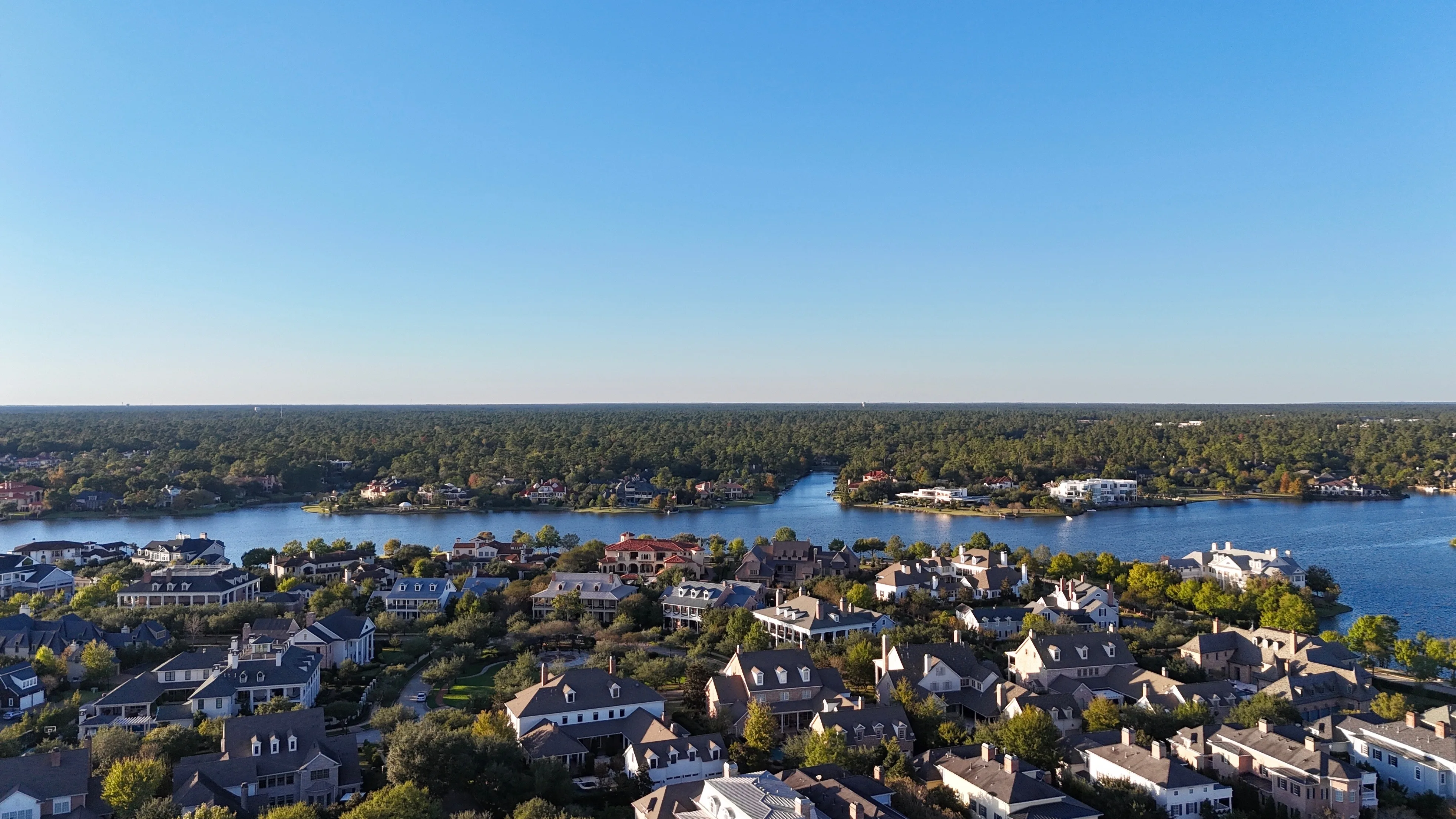
Local Expert Takeaway: The Woodlands is among the safer suburbs in the Houston metro by any reasonable measure — the violent and property crime rates both run below state and national benchmarks, the Township funds a public safety infrastructure that goes well beyond what most unincorporated communities maintain, and the community-level watch programs have real participation behind them. The honest nuance is the east-to-southwest gradient: the commercial corridors near the retail core see higher incident counts, and buyers who factor that into their neighborhood research — rather than relying on the citywide average alone — end up with a more accurate picture. For most families, the southwest villages represent the lowest-crime residential environment, and theft prevention habits that would be common sense anywhere apply here too.
Quick Takeaways & FAQs
✅ The Woodlands carries a violent crime rate of 2.864 per 1,000 residents — well below both the Texas state average of 4 per 1,000 and the national average of 3.7 per 1,000.
⚠️ Crime risk is not uniform across the city: the eastern commercial corridors see substantially higher incident totals than the quieter southwest residential villages, so the citywide average understates the gradient.
📍 The Woodlands Fire Department holds an ISO Public Protection Class 1 rating — the highest classification possible — and the Township's Woodlands Watch program earned First Place nationally from the National Association of Town Watch.
Is The Woodlands safe compared to Houston?
Which part of The Woodlands has the lowest crime?
Does The Woodlands have its own police department?
What is the most common crime in The Woodlands?
Are the red zones on crime maps in The Woodlands something to worry about?
Moving to Texas?
Tell us what you need help with and we'll connect you with local resources.
