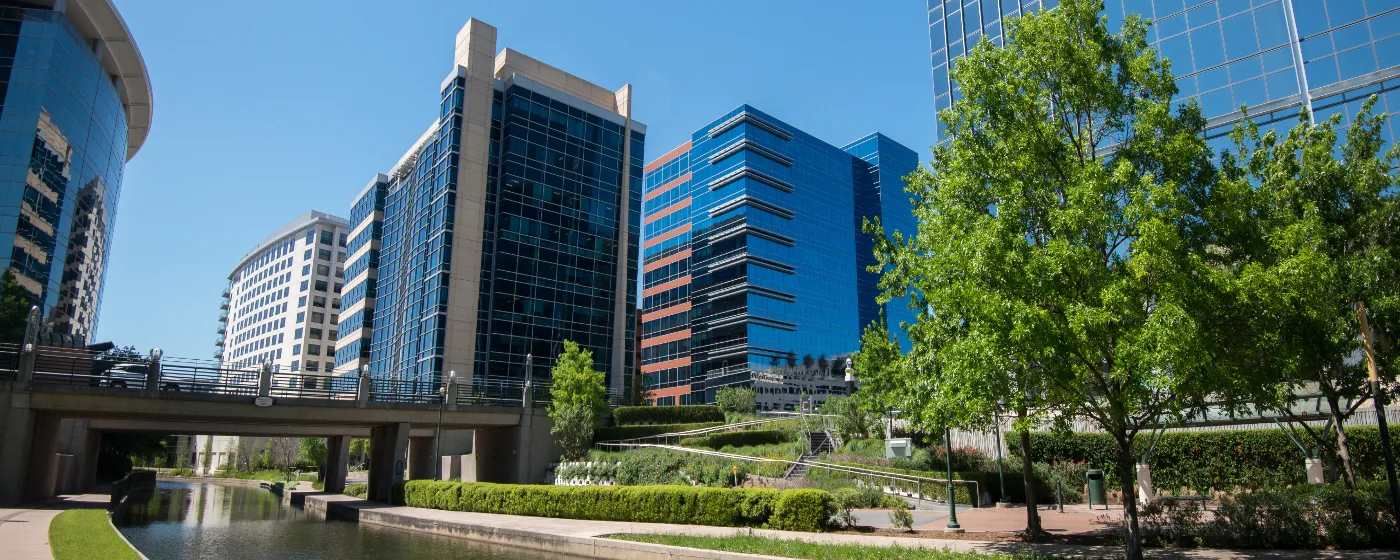
You've run the numbers. California's top state income tax rate of 13.3% is the highest in the nation — and even at a modest income, the state takes a significant cut before you pay federal taxes. The Woodlands offers a fundamentally different fiscal environment: Texas has no state income tax, constitutionally, and the community itself is one of the most deliberately built places in the country. Founded in 1974 and spanning over 28,000 acres of preserved pine forest north of Houston, The Woodlands is not a suburb that grew organically. Every trail, pool, and commercial district was designed before the first house went up — and for Californians moving here, that intentionality is either exactly what they wanted or slightly unsettling in how planned everything feels.
The community's population of 121,002 is anchored by major employers in the energy and chemical industries — Chevron Phillips Chemical, Huntsman Corporation, and a regional presence tied to the broader Houston energy economy. The Conroe Independent School District serves the area and holds a B rating, according to the Texas Education Agency. Families relocating from California typically cite the school system and the master-planned structure of the village design as primary draws, and the neighborhood design — with its 220 miles of trails and 151 parks woven directly into residential areas — reinforces that instinct. George Bush Intercontinental Airport is about 23 miles away, keeping the community genuinely connected despite its forested remove from central Houston.
The cost calculus is compelling but not simple. The Woodlands sits modestly above the national average in overall cost of living, with housing carrying most of that premium. What disappears entirely is state income tax — replaced in part by higher property taxes that Californians should understand before assuming the move is an unambiguous financial win. For most middle- and upper-income earners, it still is. But the shift is real, not magical: Texas funds its government differently, and the line items look different on your annual tax bill. The sections below break down the full picture — home prices, the tax comparison, schools, the lifestyle trade-offs Californians specifically notice, and what The Woodlands actually looks and feels like once you've unpacked.
The Home Price Reality: What Your California Equity Actually Buys
The single most common reaction from Californians who close on a home in The Woodlands is that they feel like they got away with something. That reaction is understandable, and it's mostly accurate — but the gap is narrower than the headline comparison suggests.
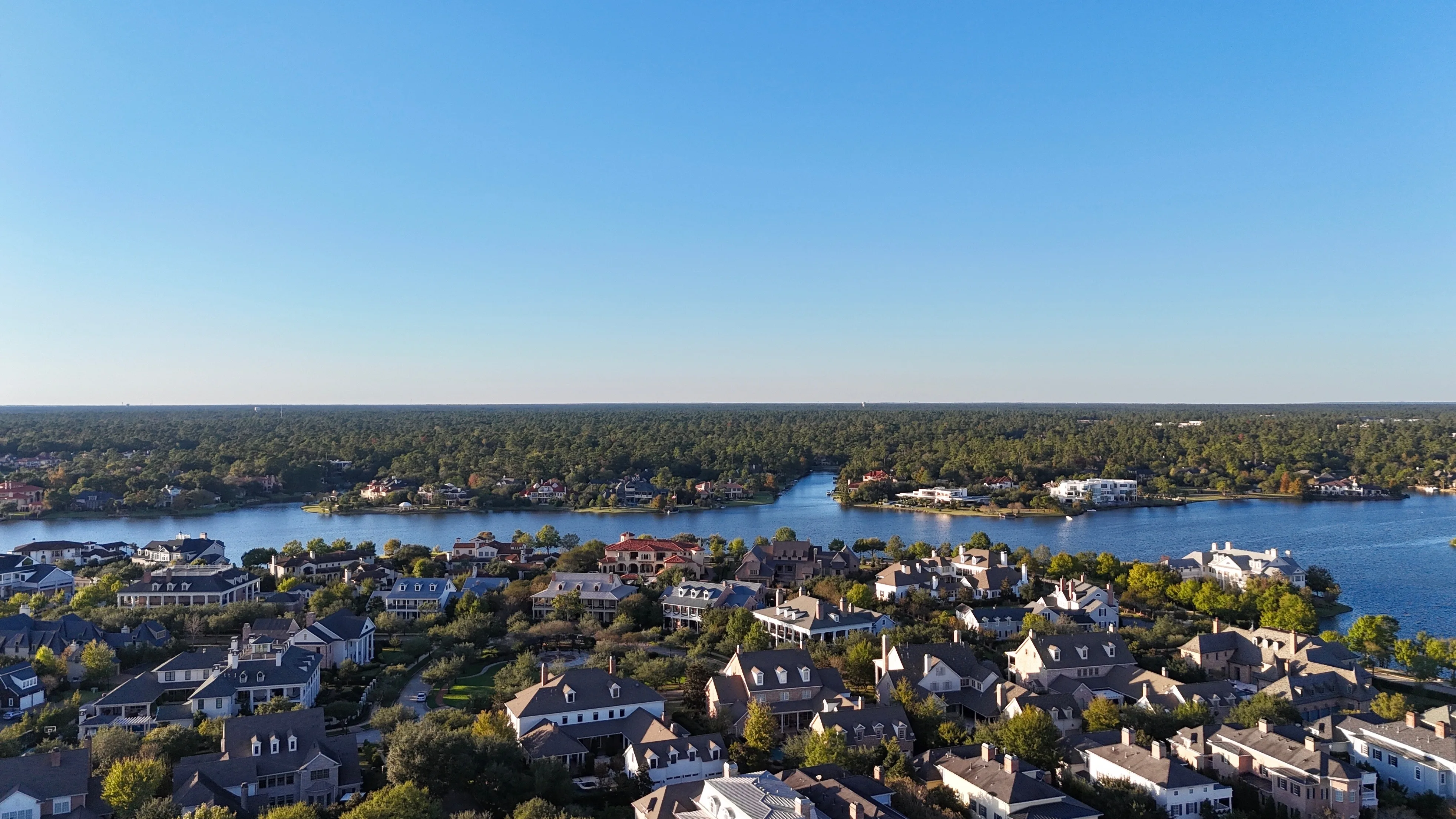
California's statewide typical home value sits meaningfully above the typical home price in The Woodlands — see the cost of living page for the current figures on both. What that price point gets you in The Woodlands is also structurally different from California: newer construction on average, more square footage, and a garage are standard at this price point. The comparison isn't just dollars — it's what the dollars build.
The honest caveat is that The Woodlands is not the entry point into the Houston metro. Neighboring Spring and Conroe both carry typical prices noticeably lower than The Woodlands, and buyers who genuinely need to stretch their budget sometimes find that the master-planned premium pushes them to those adjacent communities. For more on neighborhood character and what differentiates the villages from each other, the best neighborhoods guide goes deeper on that.
One thing to prepare for: the median household income here is $140,701 — which is strong, but still below what's needed to comfortably carry the typical home at current rates. The Woodlands is a community where a lot of buyers are coming in with significant equity from a prior sale or a dual professional income. California equity, in particular, frequently covers a substantial down payment that changes the monthly math considerably.
What the Prop 13 Comparison Actually Means
California buyers who owned for more than a few years have likely been benefiting from Proposition 13's assessment cap — annual increases limited to 2% regardless of what the market did. That protection disappears the moment you sell. A California buyer purchasing in The Woodlands pays the full rate on today's market value, just like any other new buyer in California would after a sale triggers reassessment.
In Texas, there's no Prop 13 equivalent, but assessed values are subject to a 10% annual cap on increases for homesteaded properties. The systems are different in structure; the effective outcomes for a new buyer are closer than most people expect. For the full breakdown of how property taxes, income taxes, and other local costs compare, see the cost of living page.
The Tax Shift: Income, Property, and Sales
No state income tax is the headline. It deserves to be, because California's top state income tax rate of 13.3% applies to the highest earners and represents a genuinely significant annual obligation. Even well below the top bracket, California residents pay rates most Texans never encounter. Texas has constitutionally prohibited a state income tax — a statewide voter referendum would be required to enact one, which functions as a structural guarantee rather than a policy that changes with administrations.
The income-tax savings favor high earners most directly. Many middle-income households, once the higher Texas property tax is factored in, pay about the same or modestly more in total state-and-local tax burden — and that's before factoring in California's treatment of capital gains. California taxes capital gains as ordinary income at full state rates, with no preferential rate for long-term gains. For anyone who has sold a business, liquidated a portfolio, or is sitting on significant stock compensation, the difference between California and Texas on capital gains alone can be the most meaningful number in the move.
The Property Tax Trade-Off
The trade-off is real and worth stating plainly. The Woodlands carries an effective property tax rate of 1.38% — nearly double California's effective property tax rate of 0.71%, which is itself depressed by long-time Prop 13 holders. A California buyer who is new to the market and paying close to 1% on current value will see a less dramatic jump than the headline rates suggest, but the difference is still meaningful at The Woodlands's price point.
This is where Californians sometimes feel the welcome mat pulled slightly back. The income tax savings are real and immediate. The property tax line on your annual statement is also real. Most higher-income buyers — the demographic that makes up a significant share of California transplants — come out meaningfully ahead on net. Retirees on fixed incomes or buyers closer to entry-level should model the full picture carefully rather than assume the headline savings apply to them.
Sales Tax: A Smaller Gap Than You'd Think
California's statewide base sales tax rate of 7.25% is, in major metros, often not what Californians actually pay. Local add-ons routinely push combined rates to 9.5% or higher in Bay Area and Los Angeles cities. Texas's state sales tax is 6.25%, with local additions capped at 8.25% in most of the state — meaning The Woodlands sits close to or below what many California transplants were paying at the register. Groceries are not taxed in Texas, which is a meaningful daily difference for families.

Schools, Safety, and the Master-Planned Promise
The Conroe Independent School District holds a B rating, according to the Texas Education Agency — a district-wide assessment from the 2025 A-F accountability cycle. The district 72,757 students enrolled in 2025-26, making it one of the larger suburban districts in the Houston metro. On 2024-25 state assessments, 58% of students reached math proficiency and 64% reached reading proficiency — figures that sit close to state averages and are worth understanding clearly before assuming the district matches what California's better-rated systems deliver.
For Californians moving from higher-performing districts, the school picture is nuanced. The Woodlands's village schools are generally well-regarded within the district, and the community infrastructure — the trails, the pools, the extracurricular options tied to the community's governing structure — supplements what the schools offer in ways that matter for families. Active UIL athletics programs and a strong community investment in youth activities mean kids have options well beyond the classroom. The schools page has the full breakdown by campus.
Safety in a Planned Community
The Woodlands posts a violent crime rate of 2.864 per 1,000 residents — below both the Texas state rate of 4 per 1,000 and the national rate of 3.7 per 1,000. A property crime rate of 14.52 per 1,000 residents similarly falls below the Texas state figure of 20.7 per 1,000 and the national figure of 18.4 per 1,000. These are genuinely favorable numbers, and they reflect in part the physical design of the community — the village structure, the trail connectivity, and the limited commercial intrusion into residential areas all contribute to a different feel than most suburban Texas communities.
The master-planned structure also means you're not likely to accidentally buy into a neighborhood that backs up to an industrial corridor or a poorly lit commercial strip. That predictability is something Californians who've navigated more organically developed cities consistently appreciate after six months here.
Looking to buy in The Woodlands? Estimate your payment.
Enter your numbers to see an estimated monthly mortgage payment.
Estimate only. Excludes HOA fees and mortgage insurance. The interest rate above is a starting point, not a quoted rate — replace it with your own to see real numbers. Insurance is a flat placeholder, not a The Woodlands quote.
What Californians Specifically Notice After Moving Here
Month three is when the humidity lands. Not as a concept but as a physical fact — the kind of August in Houston's pine forest that no amount of research fully prepares you for. The Woodlands gets 203 sunny days a year, but those sunny summer days are also 95 degrees with 80% humidity, and a California transplant from the Bay Area or San Diego will find the acclimatization takes a full summer. The saving grace is that the tree canopy — preserved as part of the master plan — genuinely moderates temperatures in residential areas in ways that open Texas subdivisions don't.
The second adjustment is car-dependency. Everything in The Woodlands is connected by trail, but the trails connect to parks and neighborhoods, not to grocery stores and offices. Daily errands require a car, and the commute to Downtown Houston — about 45 minutes — is an interstate commute that most Californians are already familiar with, just in a different direction. I-45 is the main artery, and peak-hour traffic on it is real.
What Stays Better Than Expected
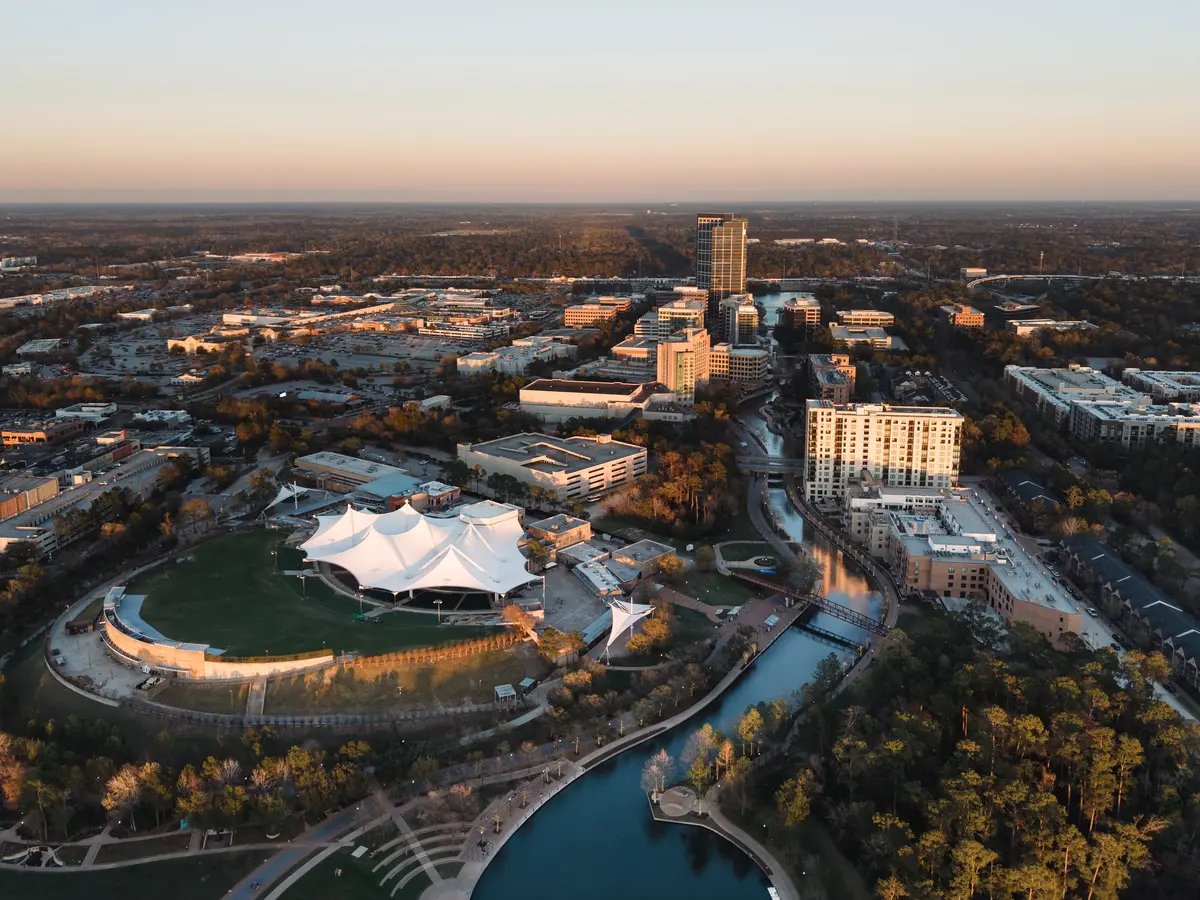
The outdoor infrastructure genuinely surprises people. George Mitchell Nature Preserve, Rob Fleming Park, Northshore Park, and Lake Woodlands together provide a recreational footprint that most California suburbs can't match on a per-resident basis — 220 miles of trails, 14 community pools, and more than 7,665 acres of preserved open space woven through a functioning community of 121,002 people. The Riva Row Boat House on the Woodlands Waterway offers kayak and paddleboard rentals that put the waterway to use in a way most newcomers don't expect from a Texas planned community.
The weekend rhythm also comes as a pleasant surprise. Market Street and the area around Cynthia Woods Mitchell Pavilion give the community a genuine gathering center that many master-planned communities in this price range lack. The Woodlands Farmers' Market draws a consistent crowd through the warm months. Californians who were braced for a purely car-dependent, strip-mall existence tend to find The Woodlands is doing something more considered than that.
What People Come to Grips With
The Woodlands is HOA-governed in a way that has real teeth. Architectural standards, yard maintenance requirements, and community rules are enforced consistently. For Californians accustomed to older housing stock in neighborhoods without active HOA oversight, the adjustment is cultural as much as practical. Most residents come to appreciate the consistency — it's part of why property values hold — but the learning curve in year one is real.
Health insurance premiums and routine care costs run noticeably below what most California residents were paying, which is a meaningful budget line for self-employed transplants or anyone leaving an employer plan behind. The honest catch is that the Houston metro's specialist network, while substantial, means you may drive farther for advanced care than you did in a major California metro. The retiring page covers the healthcare picture in more detail.
Weekends and Local Life in The Woodlands
The social center of The Woodlands is the Waterway — a 1.25-mile stretch of pedestrian paths, restaurants, and gathering spots that runs through the Town Center and gives the community something California master-planned suburbs rarely manage: a place people actually walk to on a Saturday. The Cynthia Woods Mitchell Pavilion draws major touring acts and is genuinely one of the better outdoor amphitheaters in the South, a fact that surprises Californians who assumed the cultural calendar would be thin.
For coffee, Third Gen Coffee, Blue Door Coffee Company, Conduit Coffee, Ruah Café, and Bluestone Lane The Woodlands Cafe are all operating in the community — a range that runs from a serious specialty roaster to a neighborhood spot with reliable wifi. None of them are in the same part of the community, which reflects the village structure: amenities are distributed rather than concentrated.
Dinner options lean toward polished casual and Texas-inflected. LOCAL Public Eatery - The Woodlands, The Kitchen, The Republic Grille, Schilleci's New Orleans Kitchen, and Morton's Grille are all well-regarded local anchors. The dining density is not what you'd find in a California coastal city, but it's considerably better than what the forested, suburban surroundings might suggest, and it continues to grow as the community's population expands.
The trail system is where The Woodlands earns its strongest reviews from Californians who miss the outdoor culture of home. George Mitchell Nature Preserve specifically — nearly 1,700 acres of protected woodland — delivers the kind of genuine nature immersion that is hard to find inside a community of this size. For a population that includes a lot of people who moved partly to afford more space, having that space right outside the door matters more than the square footage inside it.
Local Expert Takeaway: The Woodlands delivers on the Texas tax promise — no state income tax is real, permanent by constitutional design, and meaningful at most income levels. The property tax rate is higher than California's effective rate, but most California transplants still come out ahead on net, particularly at higher income levels. What people underestimate is the lifestyle shift: this is a planned community with real HOA governance, real summer humidity, and a car-dependent daily rhythm. Those aren't dealbreakers — for most of the 121,002 people who live here, they're features — but arriving prepared makes year one considerably smoother than arriving expecting California with lower taxes.
Quick Takeaways & FAQs
✅ Texas has no state income tax, and the Texas Constitution effectively makes that permanent — a genuine and significant financial advantage over California for most earners.
⚠️ The Woodlands's effective property tax rate of 1.38% is nearly double California's effective rate of 0.71%, and the offset against income tax savings needs to be modeled at your specific income level, not assumed.
📍 The Woodlands Farmers' Market, the Riva Row Boat House on the Waterway, and 220 miles of trails give the community a genuine outdoor and social life that surprises most California transplants who expected a purely car-dependent suburb.
How much will I actually save on taxes by moving from California to The Woodlands?
Is The Woodlands actually affordable compared to California?
How does the Conroe ISD compare to California school districts?
What is the commute like from The Woodlands to Houston?
What do Californians miss most after moving to The Woodlands?
Moving to Texas?
Tell us what you need help with and we'll connect you with local resources.
