
Maybe you've done the math a dozen times and the numbers keep pointing the same direction. California's statewide typical home value of $773,735 buys you something dramatically different in Houston — where the Zillow Home Value Index puts the typical home at $263,563 (July 2026). That gap is real, and it reshapes everything about what homeownership looks like for a California transplant. But Houston isn't a discount California with better barbecue. It's a genuinely different city with a different climate, a different relationship to cars, and a different set of trade-offs that catch Californians off guard within the first six months.
Houston is the largest incorporated city in Texas (U.S. Census), a sprawling metro of 2,397,315 people whose economy runs on energy, the Texas Medical Center, NASA's Johnson Space Center, shipping through the Port of Houston, and a manufacturing base that most coastal transplants underestimate. The Houston Independent School District — with 168,812 students enrolled in 2025-26 — holds a B rating, according to the Texas Education Agency. The people moving here from California tend to fall into a few predictable categories: energy-sector professionals following their industry's gravitational center eastward, remote workers arbitraging the cost of living, and families who got priced out of Southern California and want a house with a yard before their kids start school.
Houston's day-to-day costs run meaningfully below what most California metros produce. Groceries, utilities, and transportation all land noticeably below the California baseline — the full cost-of-living breakdown has the specifics. The trade-off that Californians most underestimate isn't the heat — it's the combination of higher property taxes, mandatory flood insurance in many neighborhoods, and homeowners insurance premiums driven up by Gulf Coast storm exposure. The income tax savings are real and substantial; the insurance reality softens them more than the brochures suggest.
Whether you're weighing a job offer, following a spouse's relocation, or simply deciding whether Houston can deliver the life you want at a price that works, the sections below break down the home price and tax picture, what to expect from Houston's neighborhoods and climate, the hidden costs of ownership here, and what daily life in the city actually looks like for someone arriving from the West Coast.
The Home Price Shock — in Reverse
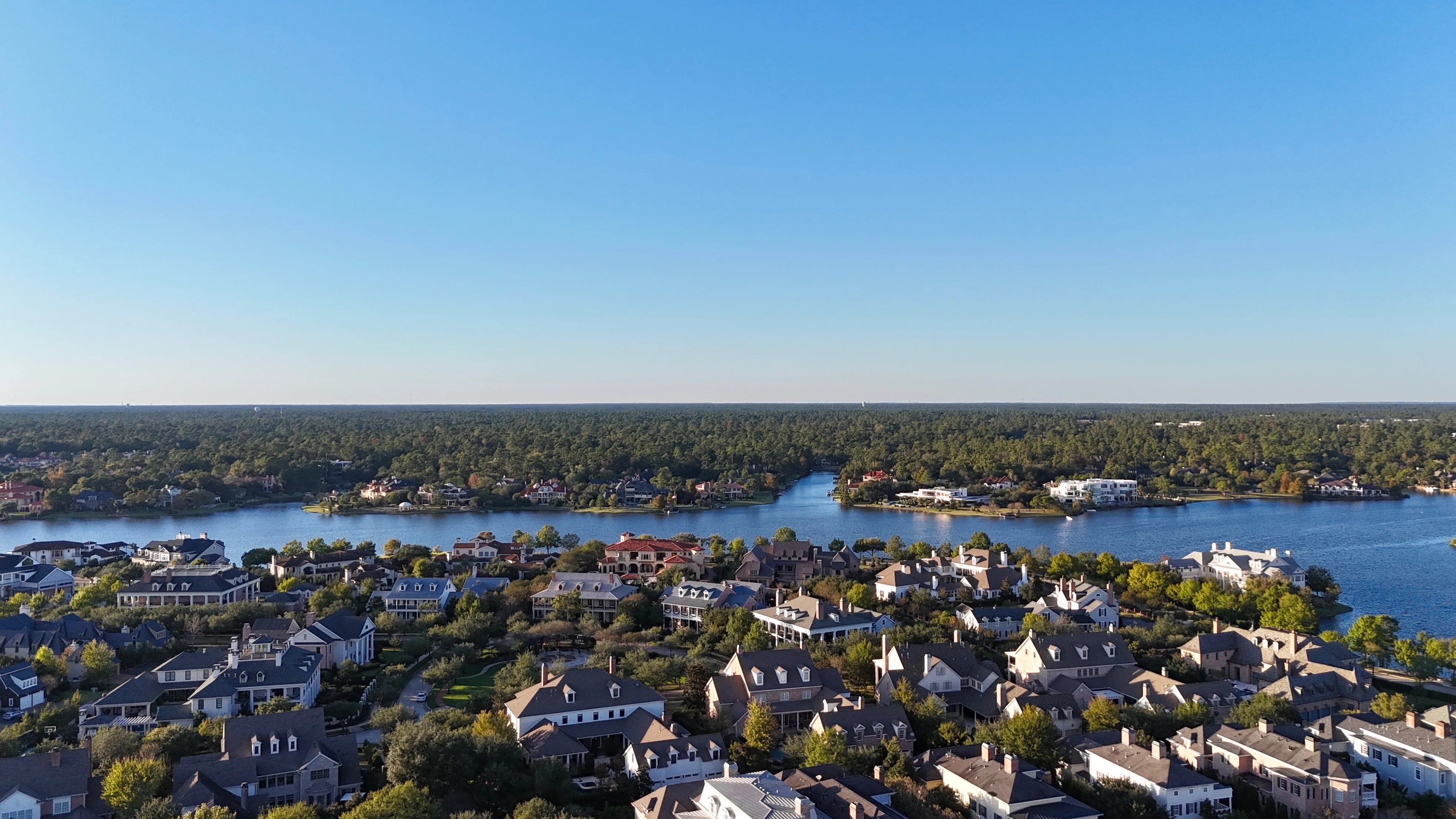
For most Californians, the first Houston Zillow session feels slightly unreal. California's statewide typical home value of $773,735 (Zillow Home Value Index) is roughly three times Houston's typical home value of $263,563 (July 2026). That ratio holds up even if you're coming from a mid-tier California market rather than the Bay Area or coastal Los Angeles.
In practical terms, what that gap buys you is a category jump in housing. The square footage that qualifies as entry-level in Houston — a three-bedroom, two-bath with a two-car garage — is the kind of home that would carry a price most California buyers couldn't finance without a substantial windfall. Down-payment dollars that felt thin against California prices can put you in a genuinely comfortable position here.
That said, Houston's price advantage is not uniformly distributed. Neighborhoods like River Oaks, Montrose, Memorial, and the Uptown/Galleria corridor run above the city-wide typical, and the premium can be significant — see the neighborhoods guide for a deeper breakdown. Sharpstown and parts of Greater Sharpstown offer entry points noticeably below the city median. The city-wide figure gives you the benchmark; where you land within it depends heavily on which pocket of the metro you're targeting.
Nearby suburbs carry their own premiums. Sugar Land, Katy, and The Woodlands each come in noticeably higher than Houston's city-wide typical — so buyers who assume a Houston suburb will be cheaper than the city itself sometimes find the opposite. The suburbs trade affordability for newer construction, different school districts, and more predictable flood exposure in certain areas.
One thing California buyers sometimes miss: the Houston market does not have a Proposition 13-style protection locking in your assessed value at purchase. Texas appraisal districts reassess annually using current market data. If Houston home values rise after you buy, your assessed value — and therefore your tax bill — can follow. The homestead exemption (recently raised to $140,000 for school district taxes following a November 2025 ballot measure) provides partial relief, but it is not the same ceiling California's Prop 13 created. Factor that into your long-term ownership math, not just your first-year budget.
The Texas Tax Advantage — and the Fine Print
Texas has no state income tax. That is not a loophole or a temporary policy — it is constitutionally prohibited, and between 2019 and 2025, Texas voters approved four separate constitutional amendments extending that prohibition to wealth taxes, capital gains taxes, estate taxes, and securities transaction taxes. Reversing it would require a two-thirds supermajority in both legislative chambers and a statewide voter referendum. For a California transplant, this is the single largest structural change to your financial life.
California's top state income tax rate of 13.3% applies only to the highest earners, but the state's progressive brackets begin taxing income at 1% and reach double digits well before most people think of themselves as high earners. At $100,000 in income, the difference between a Texas and California tax bill runs roughly $5,208 per year — and that figure compounds as income rises.
The catch is property tax. California's effective property tax rate of 0.71% — held artificially low by Proposition 13's acquisition-value cap — looks nothing like what Houston homeowners face. Houston's effective property tax rate runs at 1.46%, more than double California's effective rate. On Houston's typical home value of $263,563 (July 2026), that matters in a way that is easy to underestimate if you're budgeting from California assumptions. The full cost-of-living breakdown, including utilities and transportation, lives on the cost of living page.
Sales tax is broadly a wash. California's statewide base sales tax rate of 7.25% rises with local add-ons to an average around 8.85% total in most California metros. Houston charges the full 8.25% combined rate. The difference is small enough that sales tax should not drive anyone's relocation decision.
| Tax Category | California | Houston / Texas | Who Comes Out Ahead |
|---|---|---|---|
| State income tax | 1%–13.3% progressive | None (constitutionally prohibited) | Texas, significantly |
| Effective property tax rate | ~0.71% (Prop 13 protected) | 1.46% (annually reassessed) | California, significantly |
| Property tax assessment protection | Prop 13 caps increases at 2%/year until sale | No cap; market-rate annual reassessment | California |
| Homestead exemption (school taxes) | Varies by county | $140,000 exemption (as of November 2025) | Texas (partial offset) |
| Sales tax (combined) | ~8.85% avg total | 8.25% combined | Roughly comparable |
| Capital gains tax (state) | Taxed as ordinary income (up to 13.3%) | None | Texas, significantly |
For most California transplants, the income tax savings dominate the math — especially for higher earners, remote workers, or anyone who cashed out California equity and plans to invest it. The property tax rate is the honest counter-weight that deserves its own line in your budget.

The Insurance Reality Nobody Warns You About
The single biggest financial surprise for Californians moving to Houston is not the heat or the traffic — it is the insurance stack. Two policies, both larger than most West Coast buyers expect, combine to make Houston ownership more expensive than the sticker price implies.
Homeowners Insurance
Texas homeowners pay some of the highest average premiums in the country. Gulf Coast hurricane exposure, frequent hail storms, and a high overall storm-claim frequency push average annual premiums for $300,000 in dwelling coverage to roughly $4,668 per year — compared to a national average of about $2,868 for the same coverage level (Insurify, August 2026). California's own premiums have risen sharply in wildfire-exposed areas, but for buyers coming from non-fire-zone California markets, the Houston premium may be a genuine shock.
Flood Insurance
Houston sits on flat terrain underlaid by clay-rich soil, laced with a network of bayous, and positioned close enough to the Gulf of Mexico that ordinary rain events — not just named storms — routinely cause neighborhood flooding. Flood insurance is not bundled into a standard homeowners policy. It is a separate purchase, and for properties in high-risk flood zones (FEMA designations AE or VE), federally backed mortgage lenders require it. NFIP flood insurance for a single-family home in Houston often runs around $1,000 per year but can reach more than $2,000 annually depending on a property's specific flood zone and elevation. Most NFIP policies carry a 30-day waiting period before coverage activates — which means arranging it before you have a contract in hand, not the week before closing.
FEMA is finalizing updated flood maps for Harris County that would significantly expand designated high-risk areas, potentially reclassifying properties that are currently in lower-risk zones. If you are buying before those maps are finalized, ask your agent specifically which flood zone the property sits in today and what reclassification could mean for your required coverage and premium. This is not a hypothetical — it is an active regulatory process that could change your ownership costs after you close.
The practical advice: when you are budgeting for Houston ownership, add both the homeowners premium and a flood insurance estimate to your monthly cost calculation before you decide what you can afford. The home price advantage over California is real; so is the insurance overhead that partially offsets it.
Looking to buy in Houston? Estimate your payment.
Enter your numbers to see an estimated monthly mortgage payment.
Estimate only. Excludes HOA fees and mortgage insurance. The interest rate above is a starting point, not a quoted rate — replace it with your own to see real numbers. Insurance is a flat placeholder, not a Houston quote.
Climate, City Size, and the Adjustment That Takes Longest
Californians adjusting to Houston almost universally underestimate the summer. June through September in Houston is not merely hot — it is hot and humid simultaneously, a combination that makes a 95-degree day feel fundamentally different from a 95-degree day in Sacramento or the Inland Empire. The dew point, not the thermometer, is what humbles newcomers.
Houston averages 204 sunny days a year — fewer than most California metros and a real psychological adjustment for transplants who organized their lives around year-round outdoor activity. The weather is not uniformly bad: winters are mild, spring and fall are genuinely pleasant, and the city's parks are usable for more of the year than the summer-dominant narrative suggests. But if your outdoor life in California ran on mild evenings and weekend hikes, expect a genuine recalibration between June and September, with most outdoor activity shifting to early mornings or after sunset.
The city's scale is its own adjustment. Houston spans more than 600 square miles, and there is no single urban core that organizes daily life the way a downtown does in a smaller city. Buffalo Bayou Park, Hermann Park, and Memorial Park are the green anchors that Houstonians orient around — each substantial enough to matter, none of them a substitute for transit-accessible neighborhood density. Most errands and most commutes involve driving, full stop. The freeway network — including I-10, I-45, I-69, and the Loop 610 — carries enormous daily volumes, and the distances between things are real.
What surprises people after six months is usually not what they expected to miss. Most California transplants make peace with the heat faster than they expected and find the city's food scene and cultural breadth genuinely impressive. What catches them longer is the sprawl: the realization that "close to work" and "close to friends" and "close to a park you actually like" may require choosing two of three, and that the choice of neighborhood determines your daily logistics as much as any other single decision you make.
Houston's diversity — one of the most ethnically varied large cities in the country — tends to be a genuine positive for California transplants, who arrive expecting homogeneity and find the opposite. The Houston Museum District, the energy around the Texas Medical Center, the international dining scene, and the scale of the Galleria corridor all land differently than the stereotypes suggest. The city is larger, louder, and more cosmopolitan than the Texas-as-flyover narrative prepares people for.
Weekends and Local Favorites in Houston
Houston's size means the weekend experience depends almost entirely on which part of the city you've landed in — but a few anchors pull residents from across the metro.
Buffalo Bayou Park is the closest thing Houston has to a civic front yard: several miles of trails running along the bayou, open green space, public art, and skyline views that read as genuinely dramatic. Memorial Park sits adjacent to some of Houston's most established neighborhoods and draws serious runners, cyclists, and families on any non-summer morning. Hermann Park anchors the Museum District, where the concentration of museums, gardens, and the Hermann Park Conservancy makes for an afternoon that costs almost nothing.
Discovery Green, the downtown park adjacent to the convention district, hosts a regular calendar of outdoor events and serves as the social center for the Midtown and downtown residential crowd.
The farmers market scene is well established. The Houston Farmers Market operates year-round with a broad vendor base, and the Urban Harvest Farmers Market draws a loyal following among gardeners and local food enthusiasts.
For coffee and dining, the verified local anchors worth knowing: Lost & Found, JOEY Uptown, the Aquarium Restaurant, Taste of Texas, and Provaré each represent a different register of the Houston experience — from the kind of Texas steakhouse that justifies the genre to more contemporary options. The broader restaurant scene spans dozens of cuisines in a way that reflects the city's genuine diversity rather than a curated approximation of it. A handful of well-regarded independent coffee shops round out a scene that punches above what most transplants expect from a Texas city.
Daikin Park for Astros games, Toyota Center for the Rockets, and NASA Johnson Space Center as a weekend destination for families round out the civic calendar. The Space Center is not a tourist trap — Houstonians actually go, and it lands differently once you understand how much of the actual mission infrastructure still operates on-site.

Local Expert Takeaway: The California-to-Houston financial case is strongest for higher earners who were paying meaningful state income tax — the zero-rate difference compounds fast and California's top state income tax rate of 13.3% is a real number, not a marginal edge case. But the full picture requires running your budget with Houston's 1.46% effective property tax rate, a realistic homeowners insurance estimate reflecting Gulf Coast storm exposure, and a flood insurance line item before you decide what you can afford. Buyers who model only the sticker price of Houston homes and the income tax savings often undershoot their actual monthly costs by a meaningful margin. Get a flood zone determination on any property you're seriously considering — and get it before you fall in love with the house.
Quick Takeaways & FAQs
✅ Texas has no state income tax — constitutionally prohibited and protected by four voter-approved amendments — which is the single largest financial shift for most California transplants.
⚠️ Houston's 1.46% effective property tax rate, combined with required flood insurance and above-average homeowners premiums, means the true cost of ownership runs noticeably higher than the home's purchase price alone suggests.
📍 FEMA is actively finalizing updated flood maps for Harris County that could reclassify properties currently in lower-risk zones — ask for a current flood zone determination on any home you make an offer on.
How much cheaper is buying a home in Houston compared to California?
Does Texas really have no state income tax?
What about property taxes? I've heard they're high in Texas.
Do I need flood insurance in Houston?
What surprises California transplants most after they've actually moved to Houston?
Moving to Texas?
Tell us what you need help with and we'll connect you with local resources.
