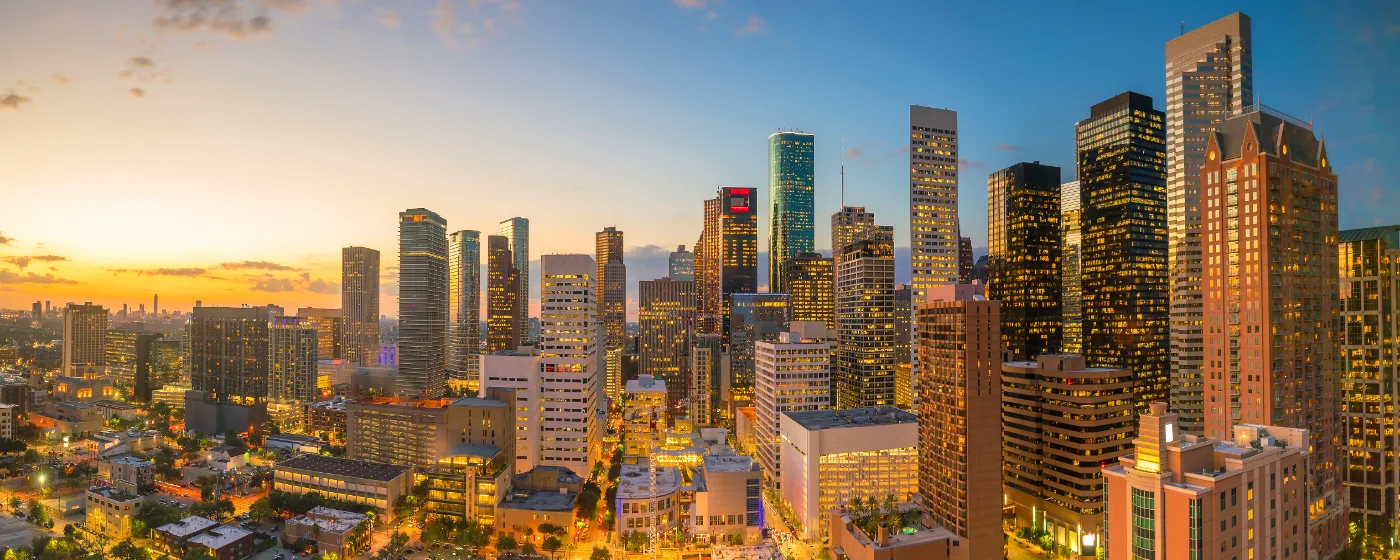
Houston is the largest incorporated city in Texas, and that size is the first thing that catches newcomers off guard. With 2,397,315 residents spread across a metro that dwarfs most American cities, the question is never simply "Houston or not Houston" — it is which Houston. The I-610 Loop divides the city into two fundamentally different living experiences: inside the loop, older neighborhoods with character, walkable streets, and higher price tags; outside, sprawling car-dependent communities where square footage gets cheaper but every errand is a drive. I-10, I-45, I-69, and US-59 all radiate outward from the core, shaping how residents experience traffic on a daily basis and making the choice of which side of the loop you land on one of the most consequential decisions a relocating buyer can make.
The economic backbone here is broad and genuine. Houston Methodist, UT MD Anderson Cancer Center, and NASA Johnson Space Center anchor three of the city's defining industries — healthcare, aerospace, and research. Shell USA represents the energy sector that has shaped Houston's identity for generations, while the City of Houston and the Houston Independent School District together form the backbone of public-sector employment. Houston Independent School District holds a B rating, according to the Texas Education Agency, and 168,812 students enrolled in 2025-26 — making it one of the largest urban districts in the country. On 2024-25 state assessments, 47% of students reached math proficiency and 52% reached reading proficiency, with significant variation between individual campuses that makes school-boundary research essential before you make an offer.
The typical home price in Houston sits at $263,563 (Zillow Home Value Index, July 2026), which puts the city noticeably below nearby Sugar Land, Katy, and The Woodlands. That figure is misleading without context: the median household income of $64,813 falls short of what a buyer needs to comfortably carry the typical home here, so affordability is real in relative terms but not automatic. Renters pay a city-wide typical of $1,561 per month. Houston's effective property tax rate of approximately 1.46% is worth factoring into every budget conversation, because Texas has no state income tax and funds local services through property taxes instead. Day-to-day life runs on the car — Buffalo Bayou Park, Memorial Park, and Hermann Park give the city genuine green space, but only a handful of inner-loop neighborhoods offer genuine on-foot access to daily errands.
Whether you are weighing a corporate relocation or escaping a pricier market, the sections below break down Houston's neighborhoods, buyer types, common purchasing mistakes, and the rental zones worth knowing before you sign anything.
The Houston Reality
The I-610 Loop is not just a highway — it is the single most important geographic fact for any buyer in Houston. Properties inside the loop sit closer to major employers like the Texas Medical Center, Downtown Houston, and the Museum District, and they tend to hold value differently than neighborhoods outside it. The trade-off is density, older infrastructure, and prices that run above the city-wide typical. Outside the loop, you get more house for the money, but you give up proximity and often any realistic alternative to driving for every errand.
School boundaries inside the Houston Independent School District are the second reality buyers underestimate. HISD serves the entire city, but individual campus quality varies enormously from one zip code to the next. A house three blocks outside a sought-after attendance zone feeds into a completely different school than its neighbor — and in Houston, those lines are not always intuitive. Families who do not map their specific address against current HISD boundary data before going under contract regularly discover this the hard way.
Flooding is the third variable that does not appear on a neighborhood's marketing materials. Harris County contains FEMA-designated flood zones that cut across nearly every part of the city, including some of the most desirable inner-loop addresses. Checking a specific property's flood zone status and its claims history is not optional in Houston — it is foundational. No neighborhood name, no matter how established, exempts a buyer from doing that research.
Neighborhoods at a Glance
| Neighborhood | Best For | Vibe |
|---|---|---|
| The Heights (Houston Heights) | Walkable Families | Victorian bungalows, independent shops along 19th Street, strong block-level community identity |
| Montrose | Walkable Renters | Houston's most walkable district — dense with galleries, independent restaurants, and foot traffic on Westheimer |
| River Oaks | Luxury Privacy | Estate-scale lots, landmark architecture, the city's most prestigious zip code — sustained for a century |
| Memorial / Memorial Villages | Families Luxury Nature | Wooded, quiet, governed by six independent municipalities — park-adjacent and car-first by design |
| Uptown / Galleria | Commuter Luxury | High-rises, The Galleria at the center, international energy — feels more like a vertical city than a neighborhood |
| Midtown | Transit Renters | METRORail-connected, nightlife-heavy, young-professional core just south of Downtown |
| Sharpstown / Greater Sharpstown | Value First-Time | Houston's original master-planned community — diverse, affordable, fully car-dependent outside the loop |
Houston typical home price: $263,563 (Zillow ZHVI, July 2026). Typical rent: $1,561/mo (Zillow ZORI, July 2026). Neighborhood tiers on this page are relative to these figures.
Best Neighborhood by Buyer Type
| Buyer Type | Best Neighborhood | Why |
|---|---|---|
| First-Time Buyer | Sharpstown / Greater Sharpstown | Home prices sit below the city-wide typical, making it one of the few inner-city areas where ownership is realistically within reach for buyers at or near the median income. |
| Luxury Buyer | River Oaks | Five of the ten most expensive Harris County homes sold in 2025 were within one square mile of each other here — the market depth and architectural pedigree are unmatched in Texas. |
| Walkability Seeker | Montrose | At the intersection of Westheimer Road and Montrose Boulevard, daily errands, dining, and entertainment are genuinely accessible on foot — no car required for most daily needs. |
| Families with Kids | Memorial / Memorial Villages | Large wooded lots, low-traffic streets, and the 1,466-acre Memorial Park create a physical environment that families with school-age children specifically seek out. |
| Commuters | Uptown / Galleria | Loop 610 and US-59 converge here, giving direct highway access to every major employment corridor in the metro. |
| Large-Lot Buyers | Memorial / Memorial Villages | The six independent Memorial Villages municipalities preserved the large-lot zoning character that the City of Houston's looser rules would have eroded elsewhere. |
| Renters | Midtown | METRORail access to Downtown and the Texas Medical Center, combined with a dense apartment stock, makes Midtown the most transit-practical rental base in the city. |
Looking to buy in Houston? Estimate your payment.
Enter your numbers to see an estimated monthly mortgage payment.
Estimate only. Excludes HOA fees and mortgage insurance. The interest rate above is a starting point, not a quoted rate — replace it with your own to see real numbers. Insurance is a flat placeholder, not a Houston quote.
Most Popular Neighborhoods in Houston
The Heights (Houston Heights)
Founded in 1891 as Texas' first planned community, the Heights operated as its own independent city — with its own mayor, schools, and fire department — for nearly three decades before Houston annexed it in 1919. That self-sufficient identity never fully disappeared: the 19th Street corridor, where Victorian-era buildings now house independent coffee shops, antique dealers, and craft breweries, still feels like a main street rather than a commercial strip. The catch is that the Heights' popularity has pushed prices well above what many first-time buyers can absorb, and the streets closest to White Oak Bayou carry flood risk that requires serious due diligence.
Best for: Buyers who want inner-loop walkability with a genuine neighborhood personality rather than a high-rise lifestyle.
Montrose
Montrose sits at the corner of Westheimer Road and Montrose Boulevard — two of the city's most commercially dense corridors — which is why it consistently records Houston's highest on-foot access scores. The Menil Collection (free admission), the Rothko Chapel, and the Houston Center for Photography are all within walking distance of one another, giving the area a cultural weight that few American neighborhoods this size can match. Home prices here run above the city-wide typical, and the neighborhood's density means parking and street noise are real daily factors, not occasional ones.
Best for: Art-oriented buyers, walkability seekers, and anyone who wants to live where Houston's independent restaurant culture is thickest.
River Oaks
Developed in the 1920s by brothers William and Michael Hogg across roughly 1,100 acres, River Oaks became Houston's most exclusive residential address within a generation and has stayed there ever since — it has never experienced the resident exodus to suburbs that reshaped comparable neighborhoods in other Texas cities. The architecture ranges from American Colonial and Tudor Revival estates by noted Houston architect John F. Staub to contemporary mansions, and the lots are large enough that even a significant home feels tucked away. Prices run dramatically above the city median, and the neighborhood's prestige means buyers compete against a small number of available properties in any given season.
Best for: Buyers for whom Houston's top address and architectural legacy matter as much as the house itself.
Memorial / Memorial Villages (Piney Point, Hunters Creek, Bunker Hill, Spring Valley)
Memorial / Memorial Villages is technically six independent municipalities — Bunker Hill, Hedwig, Hilshire, Hunters Creek, Piney Point, and Spring Valley — each with its own governance, positioned between I-610 and BW-8 with I-10 forming the northern boundary. The result is large, wooded lots and a quiet, car-first atmosphere that the surrounding City of Houston's more permissive development rules have not touched, anchored by the 1,466-acre Memorial Park on the eastern edge. Prices sit well above the city median, and the area is entirely car-dependent — the trade-off for that leafy privacy is that every grocery run and school pickup happens behind a steering wheel.
Best for: Families with school-age children who want space, trees, and proximity to Memorial Park without leaving the inner metro.
Uptown / Galleria
Uptown's identity is built around The Galleria, the largest shopping center in Texas, and the neighborhood wears that commercial energy in every direction — consulates, international restaurants, luxury high-rise apartments, and professional services cluster here at a density found nowhere else in the city. Loop 610 and US-59 converge in the neighborhood, making it one of the best-connected points in the metro for anyone whose work pulls them to multiple parts of the city. The downside is that the Galleria corridor generates significant traffic that residents absorb whether they are heading to the mall or not, and the neighborhood's high-rise character means buyers seeking a yard or a front porch are largely looking at the wrong zip code.
Best for: Buyers who want a vertical, urban lifestyle with strong highway connectivity and a global commercial environment at the front door.
Midtown
Midtown functions as Houston's young-professional staging ground — dense with apartments, nightlife, and METRORail stops that connect residents to Downtown and the Texas Medical Center without a car. The METRORail connection is a genuine differentiator in a city where transit is otherwise an afterthought, and buyers who work along that corridor find the commute math compelling. The honest trade-off is that Midtown's nightlife energy is not background noise — it is the neighborhood's defining feature, which makes it an excellent fit for some buyers and a poor one for others, and that character becomes obvious on a Friday night even if the listing photos were taken on a Tuesday morning.
Best for: Young professionals and renters who want METRORail access and a walkable social scene over square footage or yard space.
Sharpstown / Greater Sharpstown
Sharpstown holds a specific historical distinction as Houston's first master-planned community, and today it is one of the few neighborhoods inside the city where home prices sit below the city-wide typical — making it one of the more realistic entry points for buyers who want to own inside the city limits without stretching their budget. The neighborhood is fully car-dependent, located outside the I-610 Loop on the city's southwest side, and buyers should plan accordingly for every errand and commute. The area's diversity is genuine and well-established, and the value proposition is real, but buyers accustomed to inner-loop walkability will find the lifestyle shift significant.
Best for: First-time buyers and value-focused purchasers who want city ownership at a price point the inner loop cannot offer.
Common Mistakes Buyers Make in Houston
Treating the Loop as a Uniform Address
"Inside the loop" covers a remarkable range of neighborhood characters, price points, and flood exposure. Buyers who hear "inner loop" and assume uniformity routinely end up in pockets of Midtown or Montrose that differ dramatically from the Heights or River Oaks in daily feel, school access, and resale dynamics. Map each specific street against HISD boundary data and FEMA flood maps — not just the neighborhood name — before making any assumptions.
Underestimating the Westheimer / US-59 Commute
The Uptown / Galleria area looks geographically central on a map, and Loop 610 and US-59 converge there with direct access to the rest of the metro. What buyers discover after moving in is that the Westheimer corridor and the interchange around US-59 generate some of the densest congestion in Houston during peak hours. Buyers who work in the Texas Medical Center or Downtown and assume the highway proximity translates to a fast commute are frequently wrong — the living in Houston guide covers this in more detail.
Skipping the Flood-Zone Check on Historic Neighborhoods
The Heights, Montrose, and Midtown all sit near Buffalo Bayou and its tributaries. Victorian bungalows on a tree-lined block do not tell you whether that block sits in a flood zone — Harris County's topography is flat enough that a few feet of elevation change determines a property's risk profile. Buyers who skip a flood-zone check and a claims-history review on specific addresses, assuming a desirable neighborhood implies low risk, regularly absorb surprises at the insurance quote stage or after a significant rain event.
Chasing Square Footage Outside the Loop Without Checking School Boundaries
Sharpstown and the broader southwest side of Houston offer real square footage at prices the inner loop cannot match. The mistake is assuming that a larger house at a lower price is a straightforward upgrade. Sharpstown feeds into HISD campuses that vary significantly in profile from those serving Memorial or the Heights, and the campus boundary for any specific address needs to be confirmed directly with the district — not assumed from the neighborhood name or the zip code.
Best Areas to Rent in Houston
| Area | Ideal For | Trade-off |
|---|---|---|
| Midtown | Young professionals, METRORail commuters to Downtown and the Texas Medical Center | Nightlife noise is constant on weekends; not a quiet residential retreat |
| Montrose | Renters who want genuine on-foot access and a dense independent food and arts scene | Parking is competitive; street noise on Westheimer comes with the territory |
| The Heights | Renters who want neighborhood character without the high-rise feel | Rental inventory is tighter than in Midtown or Uptown; options go quickly |
| Uptown / Galleria | Renters who want luxury high-rise living with strong highway connectivity | Traffic around The Galleria is a daily reality; the environment is commercial, not residential in feel |
| Sharpstown / Greater Sharpstown | Renters prioritizing affordability inside city limits | Fully car-dependent; every errand requires driving, and the area lacks the walkable amenities of inner-loop zones |
Houston's city-wide typical rent of $1,561 per month (Zillow ZORI, July 2026) masks significant variation across these zones — inner-loop areas and high-rise corridors like Uptown run noticeably above that figure, while Sharpstown sits below it. For a full breakdown of city-wide cost figures, see the Houston cost of living page.

Local Expert Takeaway: The single most useful thing a buyer new to Houston can do is decide which side of the I-610 Loop their life actually belongs on before they fall in love with a specific house. Inner-loop neighborhoods — the Heights, Montrose, River Oaks, Midtown — deliver character, walkability, and proximity to the Texas Medical Center and Downtown, but they price accordingly and carry flood-zone complexity that requires address-level research. Outside the loop, Sharpstown offers real ownership entry points below the city-wide typical home price of $263,563 (July 2026). The buyers who make the clearest decisions are the ones who map school boundaries, flood zones, and a realistic commute route on a specific address before they ever book a showing.
Quick Takeaways & FAQs
✅ Houston's inner-loop neighborhoods — Montrose, the Heights, and Midtown — offer genuine on-foot access to daily errands that is rare in a city this car-dependent, making them a strong fit for buyers who prioritize walkability.
⚠️ The I-610 Loop divides Houston into two fundamentally different markets: inside it, higher prices and neighborhood character; outside it, more square footage but full car dependence — and most buyers don't fully reckon with that divide until after they've moved.
📍 Flood-zone status varies street by street in Harris County, and even the most desirable neighborhoods near Buffalo Bayou and its tributaries carry risk that doesn't show up in a listing photo — checking a specific address against FEMA maps is non-negotiable before making an offer.
What is the most walkable neighborhood in Houston?
What is the most affordable neighborhood to buy a home in Houston?
Which Houston neighborhood is best for families with kids?
Is River Oaks worth the price premium for luxury buyers?
Do I need to worry about flooding in Houston's most popular neighborhoods?
Moving to Texas?
Tell us what you need help with and we'll connect you with local resources.
