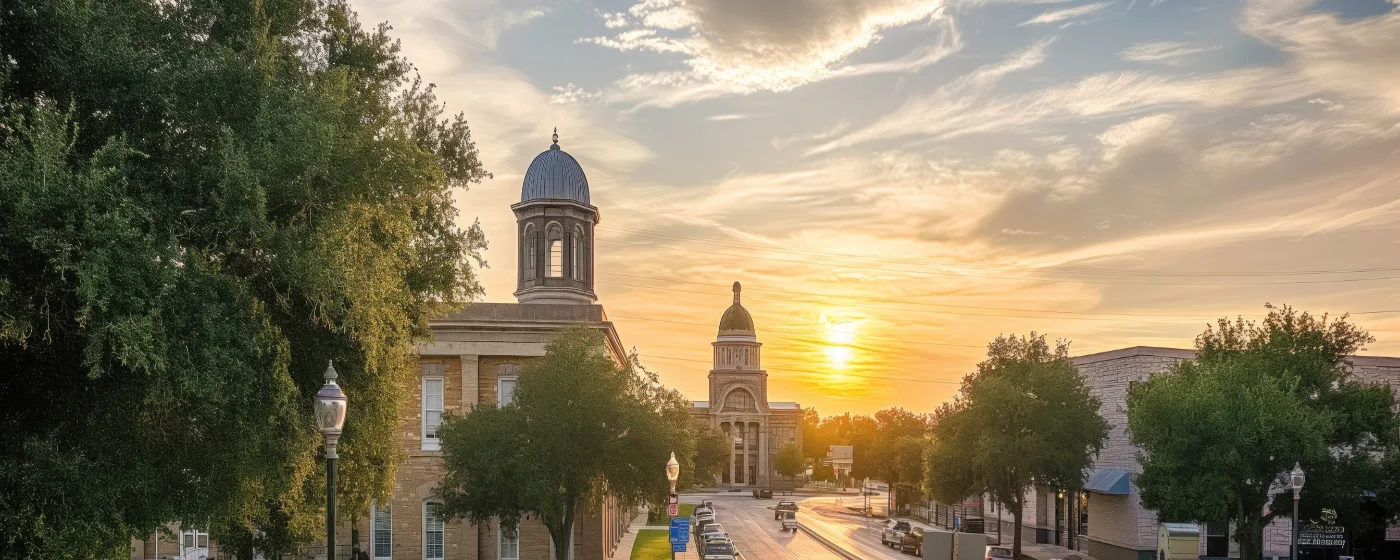
Georgetown has become one of the fastest-growing retirement destinations in Central Texas not by accident, but because it offers something that is genuinely hard to find: a small-city feel with a preserved historic downtown, a hospital inside city limits, and one of the most elaborate 55+ master-planned communities in the country — all within about 40 minutes to Austin, TX. At 106,907 residents, it is large enough to have real healthcare infrastructure and a dining and arts scene, but it has not yet lost the walkable town-square character that makes daily life feel like something other than a sprawling suburb.
The city's economic base is anchored by Georgetown Independent School District, the City of Georgetown, Williamson County, St. David's Georgetown Hospital, and Southwestern University — Texas's oldest institution of higher learning, founded in 1840. That mix of government, education, and healthcare creates the kind of civic stability retirees value: clean streets, maintained parks, and a community calendar that does not evaporate when the economy softens. The population skews toward established households, and the retiree community here is large enough that you will not feel like an outlier.
Texas's tax posture is genuinely favorable for retirees: no state income tax on Social Security or pension income, and Georgetown-specific senior property-tax freezes that can meaningfully cap your annual bill once you hit 65. The typical home price stood at $427,174 as of July 2026 — noticeably more affordable than Austin proper, and broadly comparable to what you would pay in Leander. The outdoor network of Blue Hole Park, the San Gabriel River Trail System, Lake Georgetown, and Garey Park means 228 sunny days a year translate into real recreational use, not just a marketing line.
Whether you are weighing Sun City Texas against a downtown condo, trying to understand what Georgetown's healthcare infrastructure can actually handle, or comparing this city against Round Rock or Cedar Park, the sections below cover what you need to know: healthcare depth, the retiree tax picture, walkability, downsizing options, and how Georgetown stacks up against its neighbors.
Why Retirees Are Choosing Georgetown
Georgetown fits a specific retiree profile well: someone who wants a real town rather than a generic suburb, values having a hospital close by, and is comfortable driving for most daily errands. The preserved Victorian square, the San Gabriel River greenway, and the cultural programming from Southwestern University give life here a texture that newer master-planned communities in the metro rarely match.
The typical home price of $427,174 (July 2026, Zillow Home Value Index) puts Georgetown within reach for many buyers downsizing from higher-cost markets, while the city's senior-specific property tax programs reduce the long-term carrying cost in ways that matter on a fixed income. Sun City Texas — one of the largest Del Webb communities in the country — means Georgetown has an enormous built-in peer group for retirees who want structured social life from day one.
The honest counterpoint: if you need to walk to a pharmacy or a grocery store without a car, Georgetown will frustrate you. The city is car-dependent citywide, and most of the growth has happened in large, spread-out subdivisions connected by arterials rather than sidewalks. Retirees who prioritize walkable daily errands, dense transit, or proximity to a major academic medical center should look hard at Austin or consider whether Georgetown's downtown square — genuinely lovely, but not a full daily-living substitute — is enough. For everyone else, the combination of price, tax treatment, healthcare access, and community depth makes a serious case.
Healthcare & Medical Access in Georgetown
What's Inside City Limits
St. David's Georgetown Hospital is the closest hospital — it sits inside Georgetown's city limits, which matters when every minute counts. It is a 118-bed facility operating within the St. David's HealthCare network, with a 24-hour emergency department and a Level IV Trauma Center. For retirees, the relevant capabilities go further than the ER: the hospital carries a Certified Primary Stroke Center designation, cardiac catheterization and imaging, inpatient and outpatient surgery including robotics, orthopedics and joint replacement, acute and outpatient rehabilitation, and advanced pulmonary and critical care programs.
That is a meaningful roster for a community hospital its size. Most age-related surgical and cardiovascular needs can be handled without leaving Georgetown. The stroke certification in particular — not universal at community hospitals — is a genuine asset for a population where stroke response time is one of the most consequential healthcare variables.
Specialty Depth and Primary Care
Beyond St. David's, primary-care networks have expanded steadily in Georgetown. Lone Star Circle of Care, Ascension, and Baylor Scott & White all have a presence in the area, giving residents the ability to choose a network that aligns with their insurance without being locked into a single system.
The Honest Limitation
For high-complexity cases — transplants, Level I or II trauma, quaternary cardiac surgery, advanced oncology — Georgetown relies on Austin. That drive, about 40 minutes to Austin, TX under normal conditions, becomes a real planning variable in a medical emergency on I-35 during peak hours. Retirees managing a serious chronic condition or anticipating complex care should think through what their access looks like when I-35 is congested, and whether proximity to a major academic medical center belongs higher on their priority list than Georgetown currently offers.
The Retiree Budget in Georgetown
Texas's Tax Advantage for Retirees
Texas has no state income tax. Social Security benefits, pension distributions, IRA withdrawals, and investment income are not taxed at the state level — a genuine and significant advantage for retirees moving from states like California, Oregon, or Minnesota. Groceries and prescription drugs are also exempt from the state sales tax, which reduces the pinch on a fixed-income household's most predictable spending.
Senior Property Tax Programs
Georgetown layers three stackable relief programs on top of the standard homestead exemption for homeowners 65 and older. First, a Georgetown Independent School District school tax freeze locks your school portion of the property tax bill at the amount it was in the year you qualified — it cannot rise even if the district's rate increases or your home's appraised value climbs. Second, the City of Georgetown has its own tax freeze, approved by voters in 2004, that does the same for the city's portion. Third, Williamson County offers an over-65 exemption. All three are administered through the Williamson Central Appraisal District.
The programs got more valuable in 2026. Texas voters approved Propositions 11 and 13 in November 2025, raising the statewide school district homestead exemption to $140,000 for all homeowners. Seniors 65 and older receive an additional $60,000 exemption on top of that, for a combined $200,000 school district exemption. Both changes are retroactive to the 2025 tax year and are reflected in 2026 tax bills. That is a material reduction in assessed value before the freeze even kicks in.
Georgetown's effective property tax rate runs approximately 1.53%. That figure looks high to buyers moving from low-rate states, but the senior freeze programs mean the rate you see today is not necessarily the rate you will pay in year ten — your school and city portions are locked at the year you qualify, which is the structural protection that matters most on a fixed income. For a fuller breakdown of how the rate compares to the rest of the cost picture, see the cost of living page.
Daily Cost of Living
Georgetown sits noticeably below Austin on most daily-cost measures: housing, dining, and services are cheaper, and the local restaurant and coffee scene keeps regular spending reasonable without requiring a drive to the city. Georgetown operates its own municipal electric utility along with city water and wastewater systems, which gives residents a single local point of contact for core utilities rather than dealing with the fragmented provider landscape common elsewhere in Central Texas.
Looking to buy in Georgetown? Estimate your payment.
Enter your numbers to see an estimated monthly mortgage payment.
Estimate only. Excludes HOA fees and mortgage insurance. The interest rate above is a starting point, not a quoted rate — replace it with your own to see real numbers. Insurance is a flat placeholder, not a Georgetown quote.
Walkability, Community & Staying Active in Georgetown
The Walkability Reality
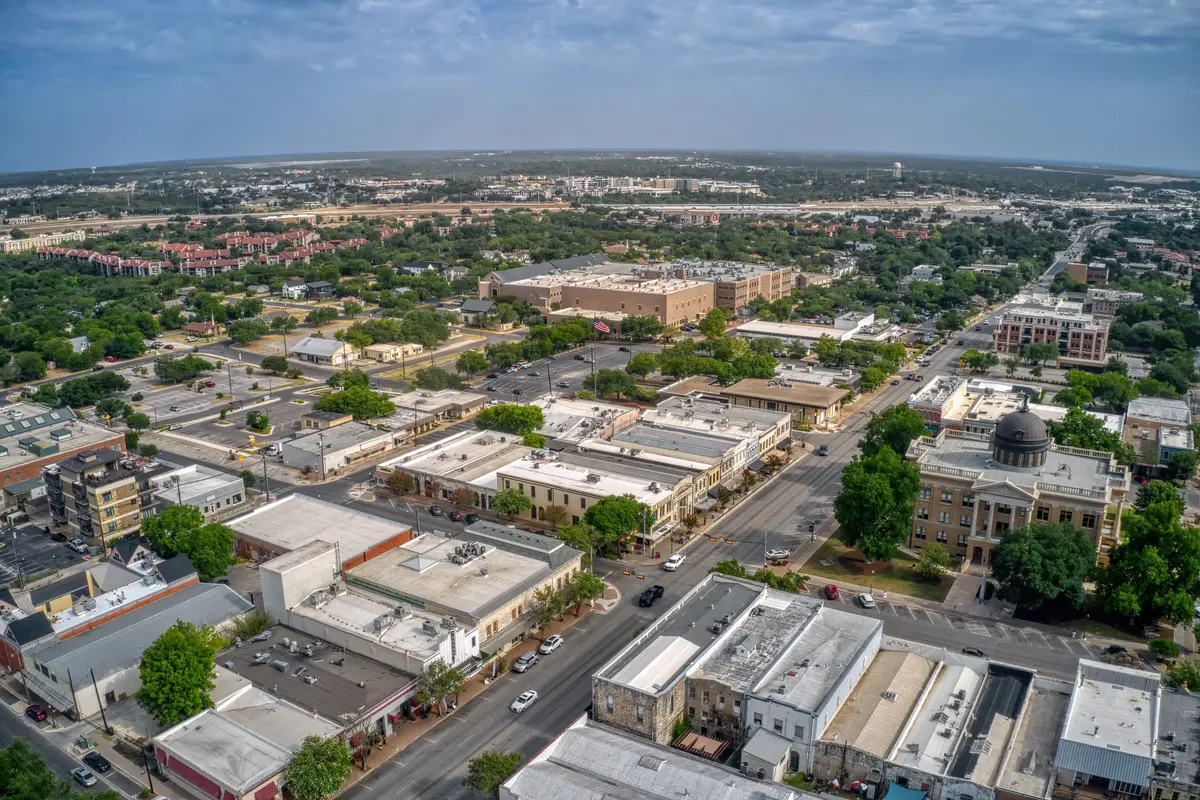
Georgetown is car-dependent for most of the city — errands, groceries, and medical appointments require a car in virtually every neighborhood outside the historic core. The one genuine exception is the Downtown Historic Square, where independent retailers, restaurants, art galleries, wine tasting rooms, and coffee spots concentrate within a walkable block radius anchored by the 1911 Williamson County Courthouse. In 1997, Georgetown became the first city in Texas designated a Great American Main Street City by the National Trust for Historic Preservation, and the square has maintained that character.
For retirees whose retirement plan includes a daily walk to coffee or an evening stroll past Victorian storefronts, the square genuinely delivers. For retirees who need to walk to a pharmacy or a grocery, it does not. That distinction is worth making before you buy.
Outdoor Life
Georgetown's outdoor network is a legitimate draw for active retirees. Blue Hole Park sits along the San Gabriel River and draws steady use from residents who want easy access to water and shade. The San Gabriel River Trail System provides miles of paved path for walking, cycling, and birdwatching. Lake Georgetown, just outside the city core, offers boating, fishing, and hiking. Garey Park rounds out a network that keeps most outdoor needs inside city limits, and with 228 sunny days a year, the calendar for using it is long. For a full breakdown of what the parks system offers, see the parks and recreation page.
Community and Social Life
Southwestern University brings a consistent calendar of lectures, performances, and cultural events that retirees can attend — the kind of intellectual programming that a pure retirement community cannot replicate. The university's presence also keeps Georgetown from feeling like a city that only exists for retirees, which many people find valuable after a few months.
The downtown farmer's market at Wolf Ranch Shopping Center draws a regular crowd and functions as an informal community gathering point through the warm months. The restaurant row around the Williamson County Courthouse and surrounding blocks gives retirees a genuinely local dining scene rather than a chain-dependent strip. For residents inside Sun City Texas, the social infrastructure is so deep it functions almost as a separate city within the city, complete with an on-site Senior University offering classes and lectures.
Right-Sizing: Downsizing in Georgetown
What the Market Offers
Georgetown has more single-level housing inventory than most Texas cities its size, largely because of how much of its growth has been driven by the retirement and active-adult market. Patio homes and single-story builds are a real part of the landscape here — not a niche category you have to hunt for. That said, the newer subdivisions like Wolf Ranch and MorningStar mix single-level and two-story product, and you will need to filter deliberately if a single-level floor plan is a medical necessity rather than a preference.
Condos and attached housing are a smaller part of the market than you might expect for a city this size. The historic downtown area has some upper-floor units and smaller attached properties, but Georgetown is overwhelmingly a detached-single-family market. If a lock-and-leave lifestyle is the goal, the 55+ communities offer the closest thing — maintenance-included or low-maintenance options with HOA structure built in.
The 55+ Communities
Sun City Texas is the dominant option and one of the largest Del Webb communities in the country. Spanning roughly 10,646 acres, it includes three 18-hole golf courses — Legacy Hills, White Wing, and Cowan Creek — three amenity centers with indoor and outdoor pools, tennis and pickleball courts, a lakeside amphitheater, walking and biking trails, and an on-site Senior University. Arts-and-crafts facilities include ceramic, stained glass, and woodshop studios. On-site travel advisors plan group and individual trips for residents. The community's price tier runs below the city median, making it one of the more accessible entry points into Georgetown homeownership — see the neighborhoods page for more context on where Sun City sits in the city's pricing landscape.
Heritage Oaks and Oaks at Wildwood are Georgetown's other named 55+ communities. Both are smaller and more conventionally scaled than Sun City — better suited for buyers who want the age-qualified structure without the scale and programming density of a Del Webb campus. If you are drawn to Georgetown but find Sun City's size overwhelming, these offer a real alternative worth exploring.
One practical note on HOA fees across all three: they exist and are meaningful, and you should request current figures directly from each community before budgeting. HOA costs move frequently enough that any figure in print is likely to be stale before it is useful.
Georgetown vs Nearby Retirement Destinations
| City | Cost vs Georgetown | Primary Hospital | Walkability | Senior Living Depth | Overall Retirement Fit |
|---|---|---|---|---|---|
| Georgetown | Anchor | St. David's Georgetown Hospital (in city) | Car-dependent citywide; walkable square downtown | Very high — Sun City Texas, Heritage Oaks, Oaks at Wildwood | Strong all-around, especially for active-adult buyers |
| Round Rock | Somewhat lower | Regional medical center nearby | Car-dependent; more retail density | Moderate — fewer dedicated 55+ communities | Good value; less retirement-community infrastructure |
| Leander | About the same | No hospital inside city; relies on nearby systems | Car-dependent; newer, spread-out layout | Growing but limited compared to Georgetown | Younger-skewing city; fewer retiree amenities |
| Cedar Park | Somewhat higher | Regional access; no hospital inside city limits | Car-dependent; some retail walkability | Limited dedicated 55+ options | Good schools and retail; not a retirement-focused market |
| Liberty Hill | Noticeably cheaper | No hospital inside city; rural access | Very car-dependent; minimal pedestrian infrastructure | Very limited | Appeals to buyers wanting rural space and lower price |
| Austin | Noticeably pricier | Multiple major hospitals including academic medical centers | Genuinely walkable in central neighborhoods | Broad range of senior living options | Better healthcare depth and walkability; significantly higher cost |
Round Rock offers the clearest value play for retirees who want urban convenience at a noticeably lower price than Georgetown, though it lacks the 55+ community infrastructure and historic town character that draw many buyers here in the first place.
Austin wins on healthcare depth — the academic medical centers there handle what St. David's Georgetown cannot — and on walkability in its central neighborhoods, but the cost premium is significant and the retirement-community ecosystem is more fragmented.
Liberty Hill appeals to buyers who genuinely want acreage and lower prices, but the trade-off is rural healthcare access and almost no senior-living infrastructure. Leander is fast-growing but skews young; it is not a city that has built itself around the retirement market the way Georgetown has.
For most retirees doing this comparison, the decision comes down to how much you value having Sun City Texas's social infrastructure versus how much you want to pay, and whether the drive to Austin for complex medical care is an acceptable variable in your life. Georgetown sits at the intersection of those two questions better than any of its neighbors.
Local Expert Takeaway: Georgetown's strongest argument for retirement is the combination of things that rarely exist in the same city: a hospital inside city limits with a stroke center and cardiac cath lab, three stackable senior property-tax freezes that cap your bill the year you turn 65, Sun City Texas's unmatched active-adult infrastructure, and a genuine historic downtown where the Williamson County Courthouse square gives daily life a sense of place. The catch is that you will drive for almost everything outside that square, and for complex medical care you will eventually drive to Austin. Know those two facts going in and Georgetown is a very strong choice.
Quick Takeaways & FAQs
✅ Georgetown layers three stackable senior property-tax freeze programs — school district, city, and county — that lock portions of your tax bill the year you qualify at 65, on top of a combined $200,000 school district exemption passed by Texas voters in November 2025.
⚠️ The city is car-dependent outside the historic square, and the drive to Austin for high-complexity medical care (transplants, Level I trauma, advanced oncology) is a real planning variable retirees should think through before committing.
📍 Sun City Texas spans roughly 10,646 acres with three golf courses, three amenity centers, a Senior University, and on-site travel advisors — one of the most fully built-out active-adult communities in the country, and it sits below the city's typical home price.
Is Georgetown, TX a good place to retire?
What property tax breaks do seniors get in Georgetown, TX?
What hospital serves Georgetown, TX retirees?
What 55+ communities are in Georgetown, TX?
How does Georgetown compare to Round Rock or Cedar Park for retirement?
Moving to Texas?
Tell us what you need help with and we'll connect you with local resources.
