
What Is Living in Liberty Hill, Texas Like?
Liberty Hill went from a quiet Williamson County crossroads of roughly 3,600 people to a city of 13,317 in the span of five years — a growth rate Mayor Crystal Mancilla has pegged at around 185%. That kind of expansion almost always creates friction: roads that can't keep up, schools bursting at the seams, a small-town identity straining against master-planned subdivisions that materialize seemingly overnight. But Liberty Hill has also handled it better than most, and the people moving here aren't arriving by accident. They're choosing this Hill Country edge intentionally, trading urban density for space, stone, and a pace that Austin proper stopped offering years ago.
The economic backbone here is still foundational rather than corporate. Liberty Hill Independent School District — with 10,469 students enrolled in 2025-26 — is the city's largest single employer, and the district holds a B rating, according to the Texas Education Agency. The City of Liberty Hill itself is a significant employer. Residents looking for corporate work overwhelmingly commute, with Dell Technologies in Round Rock being the biggest draw in the broader corridor. The households moving here tend to be dual-income, with a median household income of $115,096 — families with school-age children who want a yard, a Hill Country backdrop, and a legitimate sense of community rather than just a subdivision with a name.
On cost, Liberty Hill sits at an interesting moment. The typical home price of $488,964 (Zillow Home Value Index, July 2026) puts it above where a median income can comfortably land — the gap between what households earn and what buying requires here runs about $27,000. Georgetown and Leander both come in somewhat lower; Cedar Park prices out at roughly the same level. For details on the full cost of living in Liberty Hill, including property taxes, rent, and how it compares to the metro, that page breaks it down. What the numbers don't capture is what 228 sunny days a year and San Gabriel River Park on a Tuesday morning actually feel like — and for a lot of families, that's the closer call.
Whether you're seriously considering a move or just starting to research the area, the sections below cover Liberty Hill's neighborhoods, housing market, commute realities, schools, safety, and what weekends here actually look like.

Liberty Hill at a Glance
Looking to buy in Liberty Hill? Estimate your payment.
Enter your numbers to see an estimated monthly mortgage payment.
Estimate only. Excludes HOA fees and mortgage insurance. The interest rate above is a starting point, not a quoted rate — replace it with your own to see real numbers. Insurance is a flat placeholder, not a Liberty Hill quote.
Why Are People Moving to Liberty Hill?
The case for Liberty Hill is straightforward once you've driven it: Hill Country terrain, new construction with actual square footage, and a community that feels more like a small town than a suburb — for now. The case against it is shorter but worth reading before you sign anything.
The Growth Reality
Liberty Hill is the 213th-largest incorporated city in Texas, which means it is genuinely small — but it is scaling at a pace that changes what that means every year. Williamson County is among the state's fastest-growing counties, and Liberty Hill sits at the leading edge of that expansion. Williamson County approved a master-planned community of more than 1,800 homes across 764 acres — a project that will reshape what Liberty Hill looks like within the next decade.
The city's Downtown Master Plan signals something important: city leadership is trying to keep the core from being swallowed by subdivision sprawl. The plan focuses on Main Street and Myrtle Lane, with Myrtle Lane slated to become a pedestrian corridor and distinct districts taking shape around Church Street and Stubblefield. It's an investment in identity, and it matters to the people choosing Liberty Hill specifically over Cedar Park or Leander.
Who Actually Moves Here
| Buyer Type | Why Liberty Hill Works | What to Know |
|---|---|---|
| Families | Newer construction, large lots, strong district growth | School campuses are growing fast; new elementary planned in the incoming large development |
| Austin Commuters | TX-183A now runs signal-free to northwest Austin | about 40 minutes to Austin — longer at peak hours on surface roads |
| First-Time Buyers | New construction entry points below central Austin | Median income gap means financing math requires attention |
| Outdoor Enthusiasts | Hill Country access, San Gabriel River, Balcones Canyonlands nearby | In-city trail access is growing but still limited |
| Small-Town Seekers | Historic downtown, local sculpture park, genuine community events | Retail is still catching up — a serious shopping run means driving out of town |
| Hill Country Lovers | Terrain, sky, and space that the inner suburbs don't offer | Distance from major medical and entertainment hubs is real |
The honest friction: retail is arriving (a Target-anchored development was approved, and national chains are already building in the Heritage Ridge area), but Liberty Hill is still a place where you will be ordering online for anything the local shops don't carry.
What Surprises People After Six Months
Most newcomers underestimate how fast Liberty Hill proper fills up on the weekends — not with tourists, but with its own residents, all discovering the same coffee shops and the same downtown stretch at the same time. The city is small enough that it can feel crowded before it has the infrastructure to handle it. That tension isn't going away soon, and it's worth factoring in before you assume small-town equals quiet.
Liberty Hill's crime picture is genuinely strong: the city posts a violent crime rate of 1 per 1,000 residents and a property crime rate of 3.8 per 1,000 residents — well below the Texas state violent rate of 4 per 1,000 and property rate of 20.7 per 1,000.
What Daily Life Feels Like in Liberty Hill
The Rhythm of the Place
Liberty Hill runs on an early schedule. Morning commuters are on US-183 or TX-183A before 7 a.m. Parents shuttling kids to Liberty Hill ISD campuses fill the school-zone corridors by 7:30. By 8 a.m. the town feels quieter than you'd expect for a city that added ten thousand people in five years.
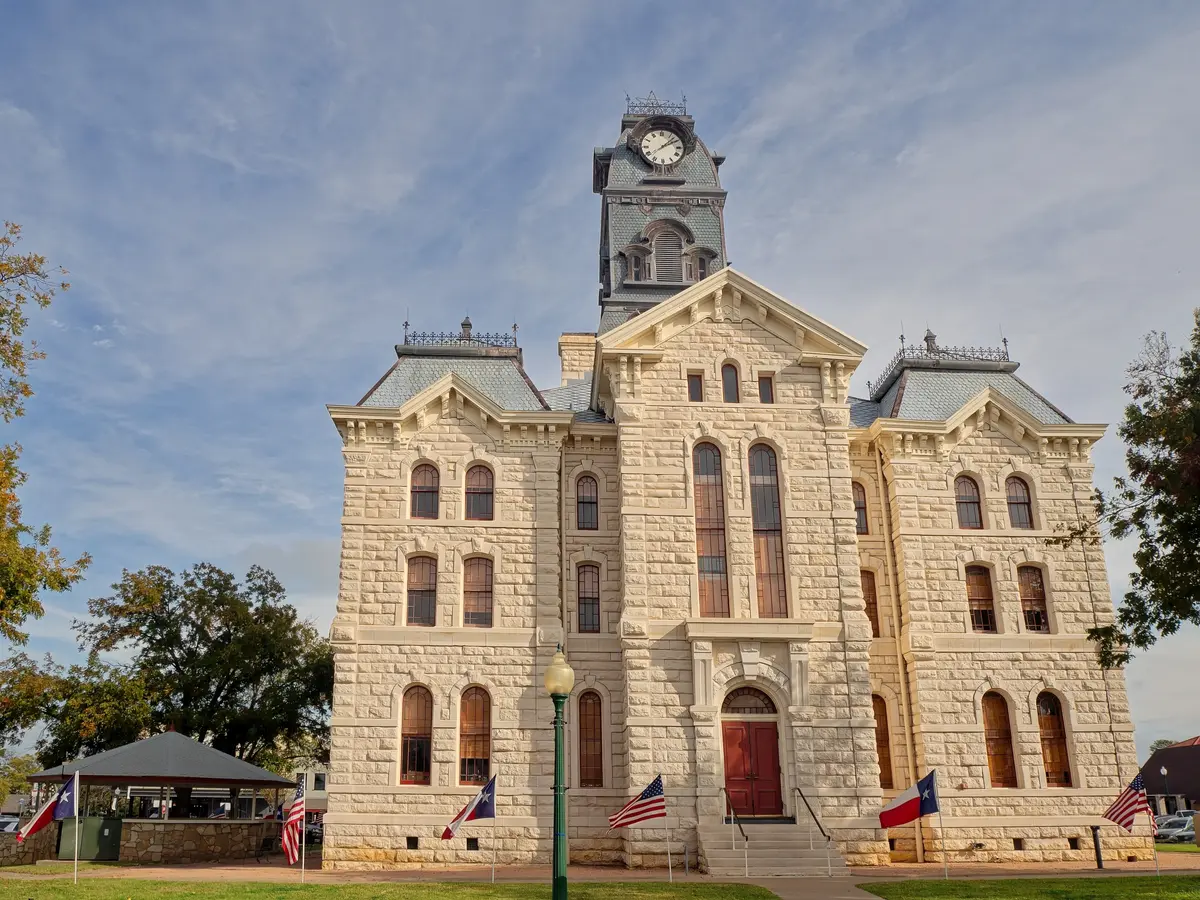
The downtown Historic District is genuinely walkable in the small-Texas-town sense: a few blocks of restored stone buildings, independent spots mixed with newer arrivals, and enough foot traffic on a weekend afternoon to feel alive without feeling overwhelming. The original stone architecture dates to Liberty Hill's founding in the 1840s, and several of those structures are still standing. That's not a marketing line — you can see the age in the limestone.
The International Sculpture Park
Liberty Hill carries something almost no Texas city its size has: an internationally recognized sculpture collection. The International Sculpture Park holds 27 pieces by artists from six countries — France, Germany, Italy, Japan, Canada, and the United States — all registered with the Smithsonian Institution. The collection originated from a 1976 symposium organized by local artist Mel Fowler, and in 1977 it earned the first Texas Arts Award for a city with a population under 100,000. An annual Sculpture Festival each October at Lions Foundation Park keeps that tradition alive with free admission. It's the kind of cultural anchor that doesn't show up on a spreadsheet comparison, but longtime residents will tell you it's part of why the city has always punched above its weight.
Schools in Daily Life
Liberty Hill ISD is growing as fast as the city itself. With 10,469 students enrolled in 2025-26, the district is building capacity while maintaining a B rating, according to the Texas Education Agency. On 2024-25 state assessments, 55% of students reached math proficiency and 67% reached reading proficiency. UIL athletics run deep here — Friday night football is genuinely the social anchor of fall, with the stands filling in a way that a city this size rarely produces. For a full breakdown of schools and boundary details, the Liberty Hill schools page has everything parents need before choosing a neighborhood.
The Commerce Shift
Liberty Hill is mid-transition on retail. The independent food and coffee scene downtown is real and worth supporting. At the same time, an approved 35-acre retail development anchored by a Target, plus national chain restaurants arriving in the Heritage Ridge area, means the city's commercial footprint is changing quickly. Residents who moved here three years ago for the small-town feel are watching that shift happen in real time — and opinions about it are divided.
The Liberty Hill Housing Market Right Now
The typical home price in Liberty Hill is $488,964 (Zillow Home Value Index, July 2026). That figure reflects a market shaped almost entirely by new construction — master-planned communities with structured HOAs, builder warranties, and the kind of square footage that Austin proper stopped offering at this price point years ago.
The median household income of $115,096 is meaningful context: the gap between what the typical Liberty Hill household earns and what carrying the typical home here requires runs about $27,000. That doesn't mean buying is impossible, but it does mean financing decisions matter, and the math deserves honest attention before you fall in love with a floor plan. If you want to dig into what that means practically, the first-time homebuyer page covers loan programs and down-payment options.
What the Inventory Looks Like
New construction drives most of the market. Builder communities — Santa Rita Ranch, Morningstar, Northgate Ranch, and others — offer structured purchasing processes that look different from a traditional resale transaction. Some areas command more than the city-wide typical price; others come in below it. The neighborhoods page breaks down what each community actually feels like to live in.
The typical rent citywide runs $2,232 per month (Zillow ZORI, July 2026), which reflects the newer construction stock. Rental options are more limited than in established suburbs, and much of what's available is in the same master-planned communities where people are buying.
What's Coming
A large incoming development — more than 1,800 homes on 764 acres, approved by Williamson County — will be the biggest single addition to Liberty Hill's housing stock in its history. Buyers watching the market should understand that a pipeline this large will shape pricing and competition across the whole city over the next several years.
The effective property tax rate of 1.53% is the figure to use when modeling total carrying costs — for a full picture of taxes, utilities, and living costs, the cost of living page has the complete breakdown.
Liberty Hill Neighborhoods
Liberty Hill has several distinct areas — each with its own character and appeal. Here’s a breakdown to help you narrow down where to focus your home search.
🏡 Santa Rita Ranch
One of Liberty Hill's flagship master-planned communities, Santa Rita Ranch draws families with school-age children through its internal trail network and strong HOA amenities. The housing stock skews newer and the community feel is intentional — organized around resident-facing programming in a way that makes it one of the most cohesive neighborhoods in the city.
🏠 Morningstar
Morningstar sits on the eastern edge of the Liberty Hill growth corridor and appeals to buyers who want new construction without the wait of a build-to-order. The community has a quieter, more residential feel than some of the larger planned communities, and its location keeps commute options straightforward.
🌳 Northgate Ranch
Northgate Ranch offers a mix of lot sizes and floor plans that give it slightly more flexibility than the larger planned communities. Parents with school-age children are the core buyer here, drawn by the neighborhood's established feel and proximity to Liberty Hill ISD campuses.
🏘 Butler Farms
Butler Farms is one of the more established residential pockets in Liberty Hill, with a character that leans quieter and slightly less HOA-intensive than the largest master-planned developments. It suits buyers who want the Liberty Hill address without the full amenity-complex footprint.
🏔 Clearwater Ranch
Clearwater Ranch is a smaller community that tends to attract buyers looking for a more intimate neighborhood scale — fewer residents, more open space between properties. The Hill Country setting is pronounced here, which is a genuine draw for those who moved to Liberty Hill specifically for the landscape.
🌆 Lariat
Lariat occupies a position closer to the downtown historic core than most of Liberty Hill's master-planned communities, making it one of the more walkable options within the city. Buyers here often cite access to the downtown district as a meaningful part of the decision.
Pros & Cons of Living in Liberty Hill
The Pros
- Top-rated, fast-improving school district
- Scenic Texas Hill Country setting with room to grow
- Small-town charm with historic downtown
- Proximity to major Austin-area employers and tech investment
The Cons
- Explosive growth is straining roads and infrastructure
- Property tax burden is relatively high for the county
- Limited local retail, dining, and hospital services still catching up to population growth
Getting Around & Commuting in Liberty Hill
The 183A Factor
The single most consequential infrastructure development for Liberty Hill commuters in recent memory: the TX-183A Phase III extension, a $259 million project that opened April 9, 2025. It created 16 miles of non-stop, signal-free travel between Liberty Hill at TX-29 and northwest Austin at SH 45. Before this, the commute corridor was a grinding series of signals through Cedar Park and Leander. After it, getting to northwest Austin is a fundamentally different experience — and it's the main reason the city's growth accelerated when it did.
The standard commute is about 40 minutes to Austin. That figure holds reasonably well with TX-183A in the mix, but add rain, an incident, or the tail end of the school rush and it stretches. People who commute five days a week to central or south Austin should make that drive — including at 7:15 a.m. on a Tuesday — before committing to a neighborhood. The drive shapes your life here more than almost anything else.
The Road Infrastructure Push
The city is actively expanding its road network to match its population growth. Freedom River Parkway, a new two-lane road completed in late 2025 at a cost of $14.44 million and funded through the voter-approved 2019 Williamson County Road Bond, connects RM 1869 to Bagdad Road. It's one of several projects in a broader push to relieve internal congestion as new subdivisions come online.
US-183 carries most of the north-south traffic, and TX-29 handles the east-west movement through town. TX-183A is the commute corridor toward Austin. Those three routes are the skeleton of how Liberty Hill connects to the metro, and understanding which one your home sits closest to matters more than the neighborhood's marketing name.
Getting Around Without a Highway
Within Liberty Hill itself, daily errands mean a drive. The downtown core is genuinely walkable once you're in it, but the distance between a master-planned community on the city's edge and downtown is almost always a car trip. Austin-Bergstrom International Airport (AUS) is 42 miles away — a realistic trip if you travel for work, but one that adds up on Sunday nights.
Remote work has softened the commute calculus for a meaningful slice of residents here. A lot of people choose Liberty Hill specifically because they work from home most days and only head toward Austin occasionally — which makes the TX-183A access feel like insurance rather than a daily obligation. If your role requires five days in an Austin office, the math is different, and the 40-minute figure deserves stress-testing.
Major Employers in the Commute Picture
| Employer | Sector | Location Note |
|---|---|---|
| Liberty Hill ISD | Education | In Liberty Hill — the city's largest local employer |
| City of Liberty Hill | Municipal government | In Liberty Hill |
| Dell Technologies | Technology | Located in Round Rock — a significant commute anchor for residents |
Beyond these, residents work across the Austin tech corridor, in Georgetown, and in Cedar Park. The employer base in Liberty Hill itself is thin outside of the district and city government, which is why remote work or a reliable commute corridor isn't a nice-to-have — it's the foundational assumption most households are making when they buy here.
Schools in Liberty Hill
Families relocating to Liberty Hill have public, private, and higher-education options nearby. Here’s a quick overview.
🎓 School District
Liberty Hill Independent School District serves K–12 students across Liberty Hill and the surrounding area. Rated B (source: Texas Education Agency, 2025 A-F accountability rating (2024-25 school year)).
🏆 Graduation Rate
The 4-year high-school graduation rate here is approximately 96.9%.
📚 Higher Education
Texas’s public universities — the University of Texas at Austin, Texas A&M University, and the University of Houston — offer four-year degrees statewide, with one of the largest community college systems in the country (50+ public community college districts) providing two-year and workforce programs.
🌐 Online Learning
UT Austin Online and Texas A&M University Online offer fully accredited online degrees for remote learners across the state.
Safety in Liberty Hill
A quick look at how Liberty Hill compares on the numbers that matter most when weighing a neighborhood or a move.
🛡 Violent Crime
Approximately 1 per 1,000 residents.
🔒 Property Crime
Approximately 3.8 per 1,000 residents.
Compared to the most recent national figures from the Bureau of Justice Statistics (2024), Liberty Hill’s violent crime is below the national average (about 3.7 per 1,000), and property crime is below the national average (about 18.4 per 1,000).
Against Texas as a whole, Liberty Hill’s violent crime is roughly a quarter of the state average, and property crime is roughly a quarter of the state average (Bureau of Justice Statistics, Crime Known to Law Enforcement, 2024 (tables 2 and 3)).
Crime rates can vary a lot within a single city, so the citywide numbers above are only a starting point. Some neighborhoods in Liberty Hill run well below these averages, while others run higher — the kind of block-by-block detail that matters most when you’re actually choosing where to live. The full guide below breaks it down neighborhood by neighborhood.
Working in Liberty Hill
Liberty Hill’s largest employers span several industries — here are some of the anchors of the local job market.
🎓 Liberty Hill Independent School District
Education
🏛 City of Liberty Hill
Municipal government
💻 Dell Technologies
Technology, located in Round Rock
Parks & Recreation in Liberty Hill
Some of the outdoor spaces that shape everyday life in Liberty Hill.
🌱 International Sculpture Park
Liberty Hill residents don’t have to go far for green space — spots like International Sculpture Park are part of everyday life here, whether that’s a morning walk, a weekend hike, or just somewhere to unwind outside. The full guide below covers more of what Liberty Hill has to offer for parks and outdoor recreation.
Retiring in Liberty Hill
Liberty Hill draws retirees for its balance of amenities, outdoor access, and cost. Here’s what to weigh.
🌤 Climate
Liberty Hill logs 228 sunny days a year, with hot summers that regularly push into the upper 90s and mild winters that occasionally dip below freezing — hard freezes happen but don't define the season. Spring and fall are the payoff months, with dry Hill Country air and temperatures that make outdoor life genuinely pleasant.
🍴 Lifestyle
The downtown Historic District gives retirees a walkable core with independent coffee shops and restaurants, anchored by the International Sculpture Park collection. The annual Sculpture Festival each October is a true community event. Outdoor options including San Gabriel River Park and trails within master-planned communities add to the day-to-day texture.
🏚 55+ Communities
No 55+ communities were found in Liberty Hill. Retirees moving here are largely choosing the same master-planned communities as younger families, drawn by newer construction and Hill Country access rather than age-restricted amenities.
✈ Getting Around
A car is essential for daily life in Liberty Hill. Austin-Bergstrom International Airport is 42 miles away — manageable for occasional travel but a real consideration for frequent flyers. Medical care is available at a regional medical center approximately 14 miles away.
🏛 Texas Taxes for Retirees — What to Know
- No state income tax — Texas has no personal income tax — constitutionally protected under Article VIII, Section 24. Social Security, pensions, 401(k)/IRA withdrawals, and annuity payments are all untaxed at the state level, with no state return to file.
- Sales tax is the tradeoff — The state sales tax is 6.25%, and local add-ons bring the combined rate in Liberty Hill to 8.25% (Texas Comptroller of Public Accounts, city sales and use tax rates, July 2026). Groceries and prescription drugs are exempt.
- Property taxes — the real tradeoff — Texas’s effective property tax rate averages about 1.40%, among the highest in the country, since property tax (not income tax) funds most local government and schools.
- Over-65 homestead exemption and school-tax freeze — Homeowners 65+ (or disabled) get an additional $60,000 exemption from their home’s value for school district taxes, on top of the general homestead exemption — $200,000 off school taxable value combined, following November 2025’s Proposition 11 (SB 23), which raised the over-65 exemption to $60,000, and Proposition 13 (SB 4), which raised the general homestead exemption to $140,000. Once claimed, your school district tax bill is frozen at that year’s amount and cannot increase as home values rise, and the ceiling can transfer if you move to a new home within Texas.
- Deferral option if cash is tight — Homeowners 65+ can defer property tax payment entirely for as long as they live in the home, rather than paying it currently — interest accrues, but no forced sale.
- No estate or inheritance tax — Texas has no estate tax, no inheritance tax, and no gift tax.
- No separate capital gains tax — Because Texas has no state income tax, capital gains — including on investments and home sales — are not taxed at the state level at all, unlike states such as Washington that tax capital gains separately from income.
Tax laws change frequently and individual situations vary. This is general information, not tax advice — always consult a qualified Texas tax professional or CPA for personalized retirement tax planning.
Weekends & Local Favorites in Liberty Hill
The Downtown Scene
The Downtown Liberty Hill Historic District is the city's social center on a weekend — original stone storefronts, a handful of independent restaurants, and coffee shops that double as community gathering spots. The pace is unhurried in the way that only genuinely small cities can still pull off, even as the city around it grows fast.
For coffee, Mojo Coffee Liberty Hill, Forrest Coffee, Michelle's Patisserie, and The Bebop Coffee Shop give the downtown area more independent coffee options than you'd expect. For food, Dahlia Cafe and Jardin Corona represent the local sit-down scene, while Agave BBQ handles the Central Texas barbecue requirement that no Hill Country city can skip. Slot-T Beer Co. and Liberty Hill Beer Market round out the local drink scene for evenings.
Outdoors and the Sculpture Park
San Gabriel River Park and the Rancho Sienna Trails and Santa Rita Ranch Trails give the in-city trail network real texture — these aren't just sidewalk loops. The San Gabriel River runs through the area's geography in a way that makes the landscape feel anchored to something older than the subdivisions around it.
A short drive opens up significantly more: Balcones Canyonlands National Wildlife Refuge protects rugged Hill Country terrain and habitat for the endangered golden-cheeked warbler and black-capped vireo, with 10 miles of foot trails and observation decks managed by the U.S. Fish & Wildlife Service. Lake Georgetown offers a 7.6-mile trail along its banks — hiking is free, and it's a regular weekend destination for Liberty Hill families.
Culture and Events
The annual Sculpture Festival each October at Lions Foundation Park is the city's signature cultural event — free admission, and a celebration of the International Sculpture Park collection that put Liberty Hill on the cultural map long before the subdivisions arrived. Twenty-seven sculptures by artists from six countries, registered with the Smithsonian Institution, give Liberty Hill something genuinely worth pointing to.
The city's founding dates to the 1840s, and the historic district carries that age in limestone and iron. The Downtown Master Plan — already approved by the City Council — will deepen that character over the next several years, with Myrtle Lane becoming a pedestrian corridor and distinct districts taking shape. What Liberty Hill is building downtown is the kind of core that most fast-growing Texas cities spend the next thirty years wishing they had planned earlier.
Local favorites in Liberty Hill
Restaurants
- Dahlia Cafe
- Jardin Corona
- Slot-T Beer Co.
- Agape BBQ
- Liberty Hill Beer Market
Outdoors
- San Gabriel River Park
- Rancho Sienna Trails
- Santa Rita Ranch Trails
- Lake Georgetown (nearby)
- Balcones Canyonlands National Wildlife Refuge
Coffee
- Mojo Coffee Liberty Hill
- Forrest Coffee
- Michelle's Patisserie
- The Bebop Coffee Shop
Top Things Locals Say About Liberty Hill
The best intel about a city comes from the people who actually live there. Here’s what Liberty Hill residents say when newcomers ask the questions everyone’s thinking.
“I drove the commute on a Wednesday morning before we made an offer, and I'm glad I did. The TX-183A makes a real difference — but I also didn't realize how much of daily life would just happen in Liberty Hill itself. We barely go into Austin anymore.”
— Recent Liberty Hill home buyer
“What's the most surprising thing about living in Liberty Hill?”
How fast it fills up on weekends. You move here expecting a quiet small town and then realize 13,000 people all discovered the same downtown coffee shops at the same time. The stone buildings and the Sculpture Park give it a real sense of place — that part surprised me — but don't expect to have it to yourself on a Saturday morning.
“What do locals love most about Liberty Hill?”
The Hill Country terrain and the sky. Sunsets here look different than they do in Cedar Park or Round Rock — there's actual elevation and open land around you, and on a clear evening the International Sculpture Park at golden hour is legitimately beautiful. The community also shows up for each other in a way that bigger suburbs don't — Friday night games, the October Sculpture Festival, the downtown events. It feels earned rather than manufactured.
“What should newcomers to Liberty Hill know?”
The TX-183A is your lifeline if you commute, and the TX-29 corridor through town backs up more than people expect when school lets out. Do the actual drive before you decide which neighborhood to live in — the difference between being near the 183A on-ramp and being on the far side of town from it is not small. Also: retail is coming, but it's not here yet at full scale. Build your errands list accordingly.
“How much do you need a car in Liberty Hill?”
For virtually everything, yes. The downtown core works on foot once you're in it, and the trails at Rancho Sienna and Santa Rita Ranch are walkable from those neighborhoods. But most daily errands — groceries, appointments, anything outside your immediate community — require a drive. A serious shopping run still means leaving Liberty Hill entirely for now, though the approved retail development will change that over the next few years.
Cities Near Liberty Hill
Other communities near Liberty Hill worth a look — each with its own character and price point.
| City | Distance | Best For | Vibe | Median Rent | Median Buy |
|---|---|---|---|---|---|
| Georgetown | 15 mi | History lovers & established buyers | Walkable square, slower pace | $1,657 | $427,174 |
| Leander | 12 mi | Commuters & transit access | Fast-growing, more connected | $1,922 | $427,012 |
| Cedar Park | 18 mi | Families seeking full amenities | Suburban, well-developed retail | $1,728 | $470,231 |
More Helpful Guides for Liberty Hill
Going deeper on Liberty Hill? Our blog series covers everything from first-time buying to retiring here — explore the guides below.
Local Expert Takeaway: Liberty Hill is one of the few fast-growing Texas cities where the original identity is fighting back against the growth, and currently winning. The downtown Historic District, the International Sculpture Park, the San Gabriel River, and a school district that the community genuinely rallies around give this place anchors that Leander and Jarrell don't have. The catch is real: about 40 minutes to Austin on a good day, a retail base still catching up, and a housing market where the median household income doesn't quite reach the typical home price. The TX-183A Phase III extension that opened in April 2025 changed the commute calculus meaningfully — but stress-test that drive yourself before you make an offer.
Quick Takeaways & FAQs
✅ The TX-183A Phase III extension, opened April 2025, created 16 miles of signal-free travel toward northwest Austin — the commute that used to grind now has a real alternative.
⚠️ The typical home price of $488,964 (July 2026) exceeds what the median Liberty Hill household income can comfortably carry, so financing decisions here require careful planning.
📍 Liberty Hill's International Sculpture Park — 27 works by artists from six countries, registered with the Smithsonian — earned Texas its first arts award for a small city back in 1977 and is still the most unexpected thing about living here.
How far is Liberty Hill from Austin?
What are homes selling for in Liberty Hill right now?
How are the schools in Liberty Hill?
Is Liberty Hill safe?
What neighborhoods are in Liberty Hill?
Helpful Links for Moving to Liberty Hill
Moving to Texas?
Tell us what you need help with and we'll connect you with local resources.
