
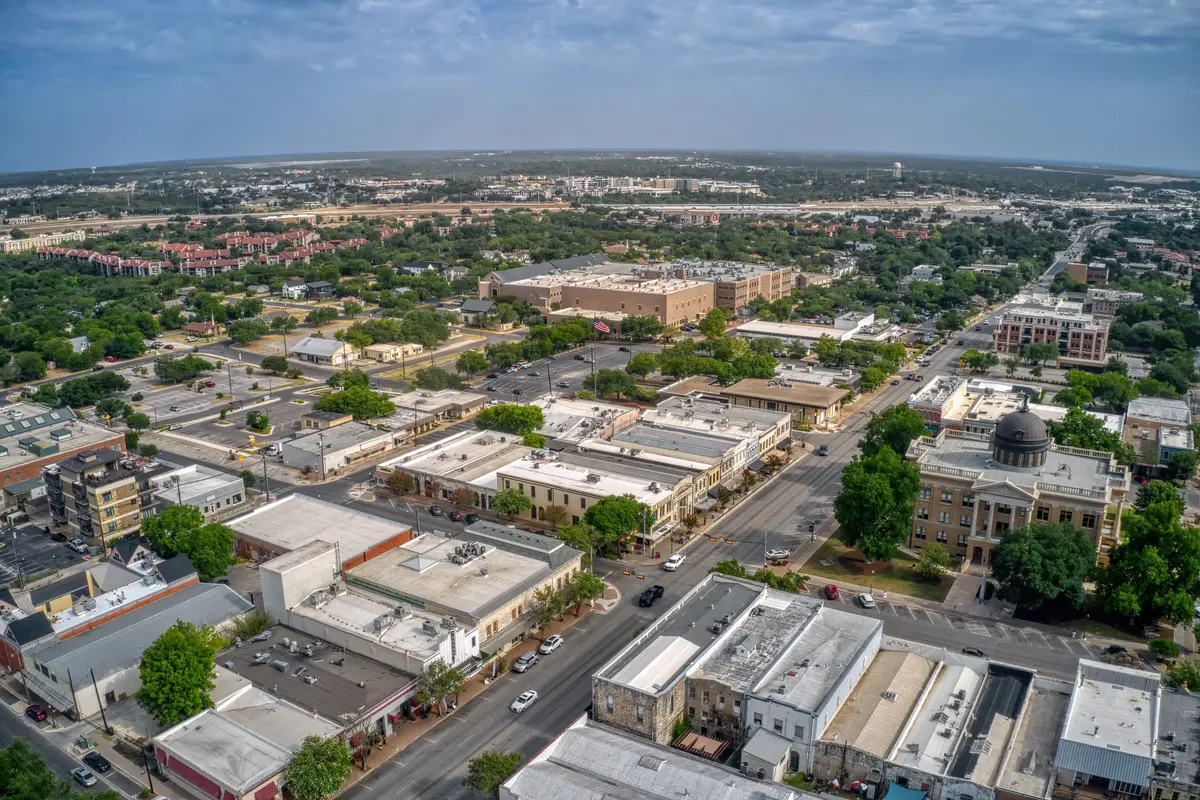
Georgetown doesn't fit neatly into the Texas affordability story most people expect. At 106,907 residents and growing fast along I-35 north of Austin, it carries the bones of a small Central Texas town — the limestone courthouse square, the San Gabriel River, the kind of city where you actually know your neighbors — but it prices like a city that knows exactly where it sits relative to the Austin tech corridor. Housing is the number that surprises most newcomers. Everything else lands at or below the national average. Housing does not.
The economic engine here is a mix of public-sector stability and Austin-adjacent private employment. Georgetown Independent School District, the City of Georgetown, Williamson County, and Southwestern University anchor the local job base. AirBorn, an aerospace defense manufacturer, rounds out the private side. A regional hospital serves a rapidly expanding patient population. Many residents, though, commute — about 40 minutes to Austin, TX — which shapes both the housing demand and the daily transportation budget in ways this guide gets specific about.
Strip housing out of the picture and Georgetown looks genuinely affordable: groceries run below the national average, utilities index modestly under the U.S. norm (even accounting for brutal Central Texas summers), and there is no state income tax in Texas, which quietly changes the math for anyone relocating from California, Colorado, or the Pacific Northwest. The catch is that the median household income — $95,062 — falls meaningfully short of what it takes to comfortably carry the typical home here. That gap is real, and it's worth understanding before you start making offers.
Whether you're choosing between Georgetown and Round Rock, trying to figure out whether buying beats renting right now, or just stress-testing your relocation budget, the sections below break down housing, everyday costs, the nearby-city comparison, and the tax picture — everything you need to run an honest number on life in Georgetown.

What It Really Costs to Live in Georgetown
The honest posture on Georgetown: cheaper than you'd expect on almost every line item except the one that matters most. Cost-of-living indexes that weight groceries, utilities, and transportation heavily tend to score Georgetown below the national average. Indexes that weight housing heavily score it above the Texas state norm. Both readings are correct — they're just measuring different things.
Housing is what drives the number here, and it's driven specifically by Georgetown's position as the northernmost affordable-ish landing spot in the Austin metro. Buyers who get priced out of Cedar Park or Round Rock push further up I-35 and land in Georgetown. That demand pressure has held home values well above what the local income base would typically support in a self-contained market. The result is a city where your grocery bill, electric bill, and gas costs feel reasonable — and your mortgage or rent does not.
For non-housing costs, the directional story is consistent: groceries run roughly 8% below the national average, utilities index at 94 out of 100, and gas prices come in about 6% below the U.S. norm. The transportation index sits just slightly above average at 103, largely because Georgetown is a car-dependent city and most residents are logging real miles. If you're budgeting a move here, anchor to housing first — the rest of the line items will largely take care of themselves. For a look at how Georgetown's crime numbers compare to the state, see the Georgetown safety page.
Housing: Rent vs Buy in Georgetown
The Zillow Home Value Index put Georgetown's typical home price at $427,174 as of July 2026. Entry-level homes — older construction, smaller lots, less finished — start meaningfully below that figure, giving first-time buyers a foothold that doesn't exist in many Austin-area markets. The Georgetown neighborhoods guide goes deeper on where those entry points cluster and what you get for the money in each part of the city.
The effective property tax rate is approximately 1.53% — the combined rate across city, school district, and county levies. That's the number to use in any honest budget calculation. For context, the city-only component is notably low by Austin-metro standards, but the school district and county layers bring the combined rate to a figure that meaningfully increases your monthly carrying cost compared to states like California or Colorado. There are no dollar-amount surprises here — the interactive calculator below will run the math at current rates — but the effective rate is the honest input to use.
Renting currently runs about $1,657 per month for a typical Georgetown unit (Zillow ZORI, July 2026). That makes renting roughly competitive with carrying costs on an entry-level purchase when you factor in property taxes and insurance, but the calculus shifts quickly once you move up the price ladder. Renting makes the most sense for people arriving for one to two years who aren't sure whether Georgetown or another Austin-suburb is the long-term fit, or for households whose income places the purchase side of this market out of reach. The affordability math here is worth being honest about: the median household income of $95,062 falls short of what it takes to comfortably carry the typical home at that price point. That gap pushes some buyers toward the entry tier or toward longer-commute alternatives like Jarrell or Liberty Hill, where prices ease further. For first-time buyer programs that can help close that gap, see the Georgetown first-time homebuyer page.
Everyday Costs Beyond Housing in Georgetown
| Category | Typical Monthly Cost | Notes |
|---|---|---|
| Housing (typical rent) | $1,657/mo | City-wide typical rent. Buying? Use the calculator above for a mortgage estimate. |
| Utilities | $190–$280/mo | Electricity, gas, water, sewer, trash |
| Groceries | $580–$780/mo | Food at home, household of 2–3 |
| Transportation & Gas | $200–$340/mo | Fuel, and transit where it is a real option |
| Phone & Internet | $110–$180/mo | Mobile plan plus home broadband |
| Misc / Discretionary | $250–$480/mo | Dining out, entertainment, subscriptions |
Non-housing figures are estimates for a household of two to three, not a sourced index; housing is the city-wide typical rent (Zillow ZORI, July 2026). Refreshed with the rest of the city data.
Georgetown's climate is the dominant variable in the non-housing budget. Summers here are long, hot, and unforgiving — electric bills frequently double in July and August compared to the moderate shoulder months of spring and fall. The city's utility system — Georgetown Utility Systems, a municipally owned provider — recently adopted FY 2026 rate adjustments: a 2% increase on electric, 9% on water, and 12% on wastewater. Those increases matter at the margin, though the overall utilities index still sits at 94, meaning Georgetown households pay modestly less than the national average across the full year. The city's electric utility also holds diamond-level status under the American Public Power Association's Reliable Public Power Provider program — the reliability track record is solid even when the bills spike.
Transportation is the other line item that can quietly run higher than residents expect. Georgetown is a car-dependent city: most daily errands require driving, and many residents are commuting on I-35 or a toll road toward Austin or Round Rock. Gas prices run about 6% below the national average, which helps, but the miles add up. One option worth knowing: Capital Area Rural Transportation System launched a weekday commuter bus route in March 2026 providing direct express service from Georgetown into downtown Austin — a genuine alternative to solo I-35 driving for residents who work in the urban core. On groceries, Georgetown benefits from real retail competition; prices run roughly 8% below the national average, and grocery items are exempt from Texas sales tax entirely.
Looking to buy in Georgetown? Estimate your payment.
Enter your numbers to see an estimated monthly mortgage payment.
Estimate only. Excludes HOA fees and mortgage insurance. The interest rate above is a starting point, not a quoted rate — replace it with your own to see real numbers. Insurance is a flat placeholder, not a Georgetown quote.
Georgetown vs Nearby Cities: Cost Comparison
| City | Typical Home Price | Typical Rent | Cost vs Georgetown |
|---|---|---|---|
| Georgetown (this city) | $427,174 | $1,657/mo | — |
| Round Rock | $405,249 | $1,734/mo | 5% lower |
| Leander | $427,012 | $1,922/mo | About the same |
| Cedar Park | $470,231 | $1,728/mo | 10% higher |
Source — home prices: Zillow ZHVI, July 2026; rent: Zillow ZORI, July 2026. Nearby-city figures are the same series, refreshed together.
Georgetown sits in a competitive band of Central Texas suburbs — close enough to Austin to feel connected, far enough to offer more house for the money than most addresses inside the metro's core. The table below shows how the city stacks up against Round Rock, Leander, Cedar Park, and others on home price, rent, and overall cost.
Taxes & the Bottom Line for Georgetown
Texas has no state income tax. That single fact restructures the budget comparison for almost everyone moving here from a state with meaningful income tax — it is a real, durable offset against Georgetown's property-tax burden, not a talking point.
The combined sales tax rate in Georgetown is 8.25%, made up of the Texas state rate of 6.25% and Georgetown's local 2% add-on. Grocery purchases are fully exempt from both layers, which keeps the food budget insulated from the headline rate. The sales tax applies to most goods, home furnishings, and services, so it's worth factoring into any large purchase budget.
On property taxes, the effective rate is approximately 1.53% — the number that matters for your monthly carrying cost once city, Williamson County, and Georgetown Independent School District levies are all combined. The city adopted the lowest city-only rate among Austin-area municipalities with more than 20,000 residents for FY 2026. The effective combined rate produces a meaningful annual bill on the typical home price, and that is worth building into your budget from the start rather than discovering it at closing. For a full look at the school district — which carries its own levy and its own story — the Georgetown schools page has the details.
The bottom line: Georgetown fits households that have a stable dual income or are relocating with equity from a higher-cost market, and who are comfortable accepting Texas's property-tax model in exchange for zero state income tax. It tends to be a stretch for single-income households buying at the typical price point without equity to work with. Buyers weighing a more affordable neighboring option — Round Rock comes in somewhat lower on price, while Cedar Park runs somewhat higher — will find the comparison table above useful. For retirees working through a fixed-income version of this budget, the Georgetown retiring page runs those numbers in a different frame.

Local Expert Takeaway: Georgetown's cost of living is genuinely reasonable on most lines — groceries, gas, and utilities all run at or below national averages — but housing is the number that drives the whole budget, and it prices like an Austin suburb, not a small Central Texas town. The no-state-income-tax advantage is real for relocators from high-tax states, and the city-only property tax rate is the lowest in the Austin area among comparable cities. The honest version of this market is: bring equity, plan for a meaningful property tax bill, and budget aggressively for summer electric costs. The rest of the monthly ledger will likely come in better than you expected.
Quick Takeaways & FAQs
✅ Texas's zero state income tax meaningfully offsets Georgetown's approximately 1.53% effective property tax rate for most relocating households.
⚠️ The median household income in Georgetown falls short of what's needed to comfortably carry the typical $427,174 home — the affordability gap is real and worth running the numbers on before committing.
📍 Capital Area Rural Transportation System launched a direct weekday commuter bus from Georgetown to downtown Austin in March 2026, giving I-35 commuters a genuine transit alternative for the first time.
Is Georgetown, TX cheaper than Austin?
What is the property tax rate in Georgetown, TX?
Does Texas have a state income tax that affects Georgetown residents?
What is the average rent in Georgetown, TX?
How much do utilities cost in Georgetown, TX?
Moving to Texas?
Tell us what you need help with and we'll connect you with local resources.
