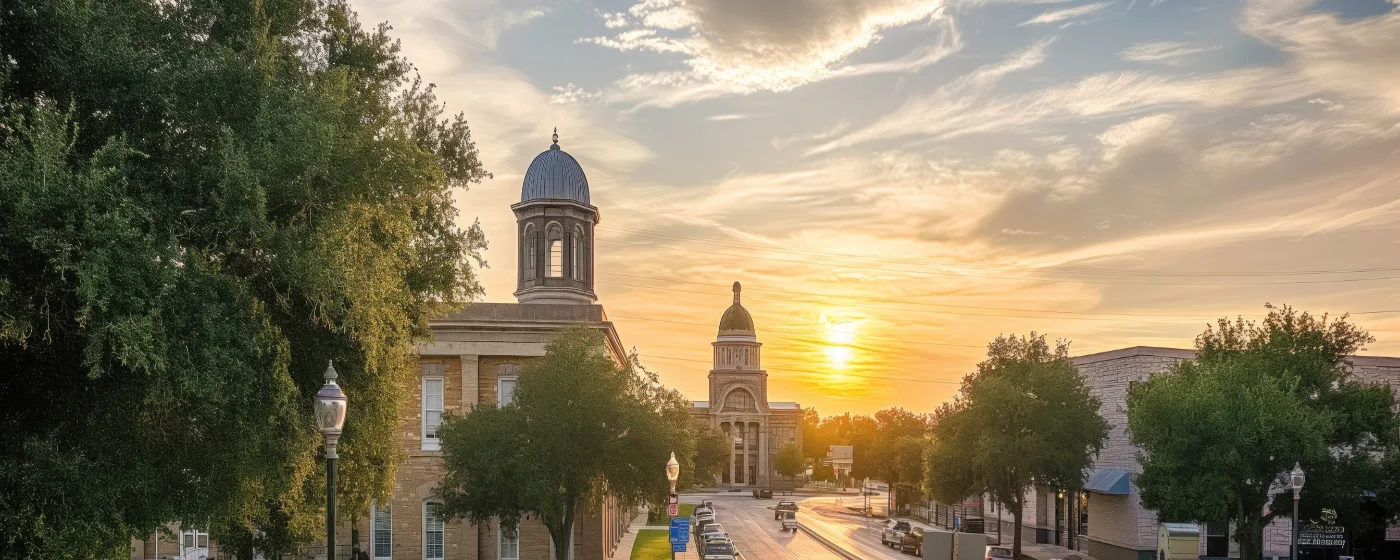
If you've been priced out of California, or your company is relocating you to the Austin corridor, Georgetown will look very good on a spreadsheet — and it largely delivers. The city of 106,907 sits about 40 minutes to Austin, TX along I-35, and it has grown at a pace that almost no California transplant fully anticipates before arriving. Georgetown added roughly 40,000 residents in five years, making it one of the fastest-growing cities in the entire country, and the physical evidence is everywhere: new subdivisions pushing toward the horizon, construction cranes over mixed-use developments, and a Victorian-era downtown square that somehow coexists with all of it.
The economic backbone here is genuinely diverse. Georgetown Independent School District and the City of Georgetown together anchor public-sector employment. Southwestern University provides a small-college atmosphere unusual for a city this size. AirBorn, an aerospace and defense manufacturer, has been part of the local industrial fabric for decades. And PEGATRON Corporation, a Global Fortune 500 electronics manufacturer, committed an $85 million investment to open its first U.S. manufacturing facility in Georgetown in 2025, adding manufacturing jobs that California's coastal economy has largely shed. The school district holds a C rating, according to the Texas Education Agency — something to weigh honestly if schools are a deciding factor in your move, and worth reading further on the Georgetown schools page.
The cost picture is what draws most Californians into serious conversations about Georgetown. Texas as a whole runs noticeably less expensive than California, and Georgetown's overall cost of living sits roughly 4% below the national average. The typical home price of $427,174 (Zillow Home Value Index, July 2026) will feel almost abstract if you've been watching California prices for the past several years. The trade-off is a property tax rate that is genuinely high — more on that below — and a city that is still building out the retail, restaurant, and cultural density that California buyers tend to take for granted. Georgetown is not yet the city it is becoming, but the construction underway — over $5 billion in registered development — is moving fast.
Whether you're comparing numbers from a distance or have already toured neighborhoods, the sections below break down the home price gap, the tax math, what daily life here is really like for California transplants, and the honest trade-offs you should know before making an offer.

The Home Price Gap: What Your California Equity Actually Buys Here
California's statewide typical home value of $773,735 (Zillow Home Value Index) is the number that makes most California buyers do a double-take when they first look at Georgetown. The typical Georgetown home price stands at $427,174 as of July 2026 — well below the California benchmark, and dramatically below what buyers face in the coastal metros where most California transplants are actually coming from.
What that gap means in practice: Californians who sell before moving often arrive in Georgetown with equity that covers a substantial down payment or eliminates a mortgage entirely. That's a structural advantage that changes the monthly calculus even before you account for Texas's income tax situation. Buyers coming from renting in California carry no equity but still step into a market where entry-level construction exists — something that has largely disappeared from California's coastal cities.
Georgetown's neighborhoods cover a real range in feel and price tier, though this page doesn't break down neighborhood-by-neighborhood pricing — that detail lives on the Georgetown neighborhoods page. What matters for the California comparison is that the city median sits at a level where a family arriving with California-sale proceeds can often buy outright or with minimal financing. That is not a situation most of those families experienced in the state they left.
What the Construction Pipeline Means for Buyers
Georgetown has more than 1,500 active registered construction and renovation projects representing an estimated $5.24 billion in total development value. Heirloom Georgetown, a 620-acre mixed-use development near the SH-29 and SH-130 corridor, will bring up to 3,000 homes plus commercial space and parkland, with the first phase set to begin construction in 2026 and complete in 2027. Southwestern University broke ground on a 560-acre mixed-use development that will add office space, retail, multifamily housing, and parks, with the first phase expected to complete in 2028.
For California buyers, this level of active supply is genuinely novel. Markets like Georgetown — where new construction is abundant and builders compete for buyers — behave very differently from California markets where supply has been constrained for decades. New-construction contingencies, builder incentives, and price-point flexibility are realistic here in a way they simply are not in most of California.
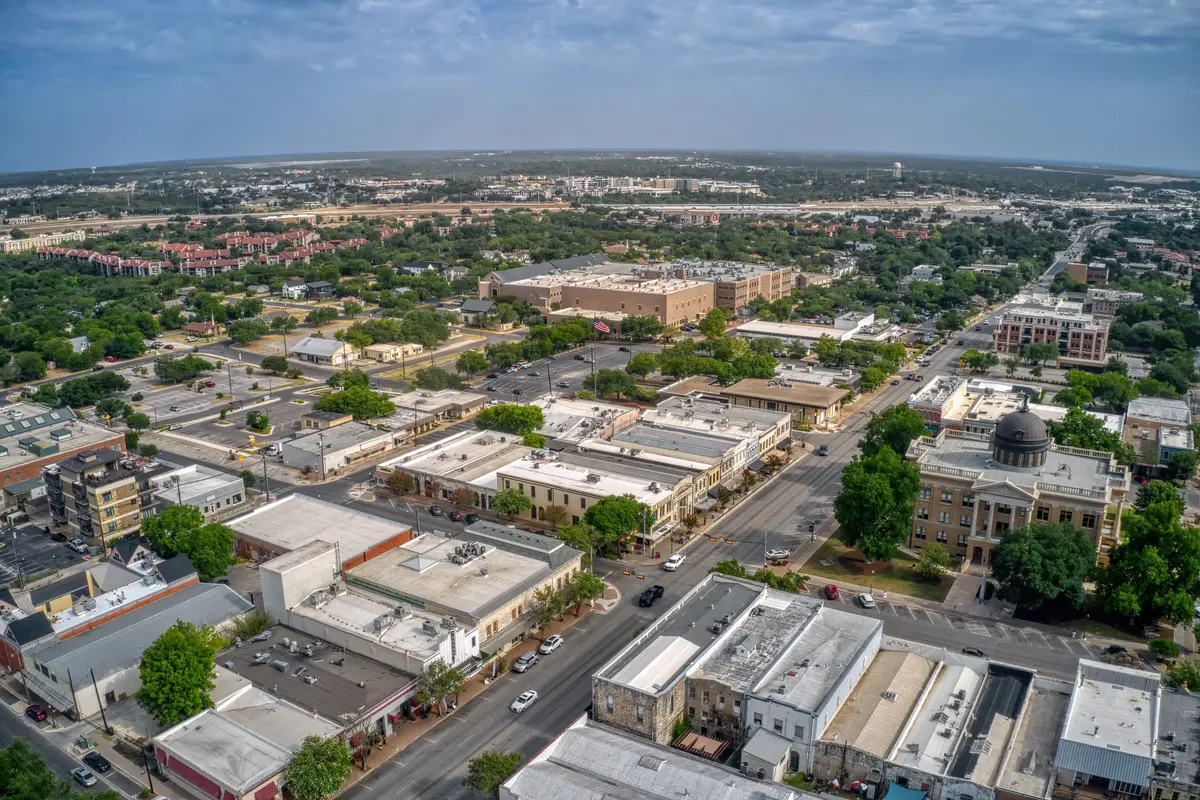
The honest note: Georgetown is still growing into its density. A California buyer accustomed to a mature urban grid with walkable retail and dining concentration will find some neighborhoods feel sparse. The Williamson County Courthouse and Georgetown Square give the city an authentic downtown anchor that many Texas suburbs lack, but the surrounding commercial landscape is still catching up to the residential growth.
The Tax Math: Where Texas Wins, and the One Place It Doesn't
The income tax comparison is real and large. Texas levies no state income tax. California's top state income tax rate of 13.3% applies only to the highest earners, but the progressive brackets mean that even middle-income Californians are paying meaningfully. For a single filer earning $100,000, the difference is roughly $5,055 per year in Texas's favor — money that stays in a paycheck every month rather than going to Sacramento.
California's statewide base sales tax rate of 7.25% (California Department of Tax and Fee Administration) is the highest base rate in the country, and local additions push the combined rate above 10% in many areas. Georgetown's combined sales tax rate is 8.25%, and Texas exempts groceries from sales tax entirely. On routine household spending, that gap adds up across a year in ways that don't show up on a single line-item comparison.
The Property Tax Reality
Here is the number that surprises almost every California transplant: Georgetown's effective property tax rate is 1.53% — more than twice California's effective property tax rate of 0.71% (Tax Foundation). That gap exists entirely because of Proposition 13, California's 1978 law that caps assessed value growth at 2% per year from the purchase price. A California homeowner who bought a decade ago is paying taxes on an assessed value far below what their home is actually worth. Texas does none of that.
Texas reassesses property at or near full market value annually. If Georgetown home prices rise over the years you own, your assessed value — and your tax bill — rises with them. There are protest and homestead exemption mechanisms that soften this, but the baseline expectation should be annual reassessment, not the predictable, capped increases California owners are used to. This is the adjustment that catches California transplants most off guard, and it's worth modeling carefully before closing.
The full property and income tax picture belongs on the Georgetown cost of living page, but the bottom line for most California buyers is this: the income tax savings are large and immediate. The property tax rate is higher, but it applies to a home price that is noticeably below what you were paying in California. For most middle- and upper-middle-income earners, the net tax position in Georgetown is favorable — though the honest caveat is that lower-income households sometimes find the total burden closer than the income-tax headline suggests.
Sales Tax and Everyday Spending
The grocery exemption in Texas is underrated. A California family spending $1,200 a month on groceries in a high-tax jurisdiction was paying local sales tax on much of that. In Georgetown, that line item goes to zero. It's a small number in isolation and a real one across a decade of household spending.
Daily Life After the Move: What California Transplants Actually Notice
Six months in, most California transplants name the same things. The space is the first adjustment — Georgetown's residential developments are built on a Texas scale, with lots and setbacks that feel extravagant to anyone coming from a coastal California neighborhood. The commute structure is different too: Georgetown is a car city, and the assumption is that you drive everywhere, including to Austin when the work requires it.
The weather is the second adjustment, and it cuts both ways. Georgetown averages 228 sunny days a year, which California buyers appreciate. What they do not always anticipate is Central Texas heat in July and August, which is a different animal than California's coastal warmth, and the periodic ice storms that arrive without much warning in winter. Californians from the inland valleys adjust faster; those from the coast sometimes take a full year to recalibrate their seasonal expectations.
What Newcomers Find at the Square
Old Town and the Georgetown Square give the city a social center that feels genuinely historic — the Williamson County Courthouse anchors it, and the surrounding blocks have the density of a real downtown. Monument Cafe, a Georgetown institution, sits within reach of the square and draws a consistent local crowd. The farmers market at Wolf Ranch Shopping Center runs through the growing season and gives the city something California buyers often look for in a new place.
The dining and coffee scene is more limited than what California buyers are leaving behind, but it is not absent. Lamppost Coffee, Mojo Coffee, and 309 Coffee give the city independent café options; Rivery Coffee & Bagels adds to that. For dinner, Tony And Luigi's and Wildfire serve as reliable locals' anchors, and Blue Corn Harvest Bar & Grill Georgetown and 2020 Market Scratch Kitchen & Bar round out a small but genuine local dining scene. BiG Cafe and Shop — Brookwood in Georgetown — is worth knowing: it operates as a vocational training program for adults with disabilities, and it has developed a genuine local following. None of this is San Francisco or Los Angeles, and pretending otherwise would be dishonest. But it is more than many Texas cities of this size can offer.
Outdoors and Recreation
Blue Hole Park sits on the San Gabriel River and is the city's most-photographed outdoor space — the spring-fed swimming area draws Georgetown residents through the warm months in a way that has no California equivalent at this price point. The San Gabriel River Trail System connects parks across the city. Lake Georgetown, a few miles outside the core, adds fishing, boating, and hiking to the weekend options. Garey Park offers a curated outdoor experience — open meadows, a working barn, and event space — that feels more Hill Country than suburb. For anyone leaving California in part for outdoor access, Georgetown's parks and green infrastructure hold up well.
The Honest Friction Points
Two things that California buyers consistently underestimate. First, the retail density gap: Georgetown is still building out its commercial infrastructure to match a population that doubled in five years, and a serious shopping trip often means driving out of town or ordering online. Second, the school district rating: Georgetown ISD holds a C rating, according to the Texas Education Agency, which is a real data point for families arriving from California districts with higher ratings. The district is growing — it broke ground on its fourth high school in 2025, with completion expected in 2027 — but growth alone doesn't resolve academic performance. Families with school-age children should read the full picture on the schools page before making a decision.
Health insurance premiums generally run noticeably below what California residents pay, though you may drive farther for specialist care than you were accustomed to at your California address.
Looking to buy in Georgetown? Estimate your payment.
Enter your numbers to see an estimated monthly mortgage payment.
Estimate only. Excludes HOA fees and mortgage insurance. The interest rate above is a starting point, not a quoted rate — replace it with your own to see real numbers. Insurance is a flat placeholder, not a Georgetown quote.
Who Georgetown Is Actually Right For — and Who Should Keep Looking
Georgetown works particularly well for California buyers in a few specific situations. Remote workers who can work anywhere and want to stretch their purchasing power — or arrive with California equity — find the math compelling almost immediately. The typical home price of $427,174 as of July 2026 is the entry point, not the ceiling, and equity from a California sale often makes the whole transaction feel structurally different from anything they experienced in California.
Retirees and pre-retirees moving to reduce fixed costs find Georgetown genuinely attractive. Sun City Texas is one of the most established 55+ active adult communities in Central Texas, purpose-built for this demographic with its own amenities and social infrastructure. Heritage Oaks and Oaks at Wildwood round out the 55+ options within the city. The combination of no state income tax on retirement income, lower home prices, and an active-adult community infrastructure that California's coastal suburbs rarely match makes Georgetown a real contender for this group. More detail on the retirement picture lives on the Georgetown retiring page.
Families With Kids: Read the School Numbers Carefully
Families arriving from California's stronger districts — particularly those in the Bay Area or suburban Los Angeles — should go in clear-eyed about Georgetown ISD. The district holds a C rating, according to the Texas Education Agency, and on 2024-25 state assessments, 37% of students reached math proficiency and 51% reached reading proficiency. Those numbers are below what California parents moving from higher-performing districts will be used to. The district is expanding — the fourth high school will relieve overcrowding — but expansion and academic improvement are different things.
That said, Georgetown has active UIL athletics programs, and Friday night football at Georgetown is a real community event in the way California high school sports often are not. The social and extracurricular fabric of the school system is strong even where academic metrics are not.
Who Should Keep Looking
California buyers who need a walkable urban environment or a mature dining and cultural scene in their immediate neighborhood will find Georgetown frustrating, at least for the next several years. Most errands require a car, and the cultural density gap relative to California's larger cities is real. Austin is about 40 minutes away — close enough for an occasional evening out, not close enough to substitute for living in a walkable city.
Buyers who are counting on I-35 to make the commute easy should model it honestly. I-35 carries the bulk of the Georgetown-to-Austin traffic, and peak-hour congestion is one of the most consistent complaints from residents who make that drive regularly. SH-130 provides a toll-road alternative that many Georgetown commuters use to bypass the worst of it, but it adds cost that accumulates across a work year.
Weekends and Local Favorites: What Georgetown Residents Actually Do
Georgetown's outdoor infrastructure is the starting point for most weekends. Blue Hole Park, on the San Gabriel River, is the kind of place that shows up in every local's directions: spring-fed, shaded, and genuinely beautiful in a way that is hard to manufacture. The San Gabriel River Trail connects the city's green spaces in a way that rewards walking and cycling. Lake Georgetown adds paddling, fishing, and swimming for residents willing to drive a few extra minutes from the core.
Garey Park sits apart from the standard suburb-park template — it is a working heritage farm as much as a recreation space, with open meadows and a genuine Hill Country character. Rivery Park gives the western side of the city its own green anchor.
The Square and What Surrounds It
Old Town Georgetown and the Williamson County Courthouse square are the social and architectural center of the city. The square draws people for its own sake — the historic architecture, the walkable blocks, and the sense that Georgetown is a real place with a real past, not a suburb assembled from nothing. Monument Cafe anchors the dining side with a legacy that predates Georgetown's growth boom. Blue Corn Harvest Bar & Grill Georgetown and 2020 Market Scratch Kitchen & Bar give the square's edges more contemporary options.
For coffee, 309 Coffee, Lamppost Coffee, Rivery Coffee & Bagels, BiG Cafe and Shop — Brookwood in Georgetown, and Mojo Coffee give the city a genuine independent café culture, which is not something every Texas city this size can claim. The Farmers Market at Wolf Ranch Shopping Center brings a weekly gathering of local producers and a community-market feel that California transplants in particular tend to seek out and appreciate.
Tony And Luigi's and Wildfire serve as evening anchors for residents who eat local. Neither is trying to be anything other than what Georgetown is — a mid-sized, growing Texas city with a real downtown and a community that shows up for itself. For California buyers arriving with expectations calibrated to Los Angeles or the Bay Area, that recalibration is part of the move. Most Georgetown transplants from California report that six months in, the square feels like theirs — and that the trade felt right.
Inner Space Cavern, just off I-35, is an underrated local asset: a commercial cavern tour that draws school groups and visiting families and gives Georgetown a genuinely unusual outdoor attraction that most Texas cities of this size don't have.
Local Expert Takeaway: Georgetown is the rare Texas city that gives California buyers three things at once: a genuine historic downtown at the Georgetown Square, a home price noticeably below California's statewide typical, and a construction pipeline large enough to keep supply available for the next several years. The income tax savings are real and immediate; the property tax rate is higher than California's Proposition 13 baseline, but it applies to a home price that California equity can often cover outright. The catch is honest: the school district holds a C rating from the Texas Education Agency, I-35 to Austin earns its congested reputation, and the city is still building out the retail and dining density that California buyers tend to expect. For remote workers, retirees, and equity-rich families who can be clear-eyed about those trade-offs, Georgetown delivers on the headline numbers — and then some.
Quick Takeaways & FAQs
✅ Texas levies no state income tax, saving a household earning $100,000 roughly $5,055 a year compared with California's progressive brackets.
⚠️ Georgetown's property tax rate of 1.53% is more than twice California's effective rate, and Texas reassesses annually — there is no Proposition 13 protection here.
📍 California equity from a home sale frequently covers a substantial down payment or the full purchase price of a Georgetown home, fundamentally changing the monthly financial picture for transplants.
How do Georgetown home prices compare to California right now?
Will I actually save money on taxes moving from California to Georgetown?
Is Georgetown a good place for families moving from California with school-age kids?
What is the commute from Georgetown to Austin actually like?
What do California transplants find most surprising about Georgetown after six months?
Moving to Texas?
Tell us what you need help with and we'll connect you with local resources.
