
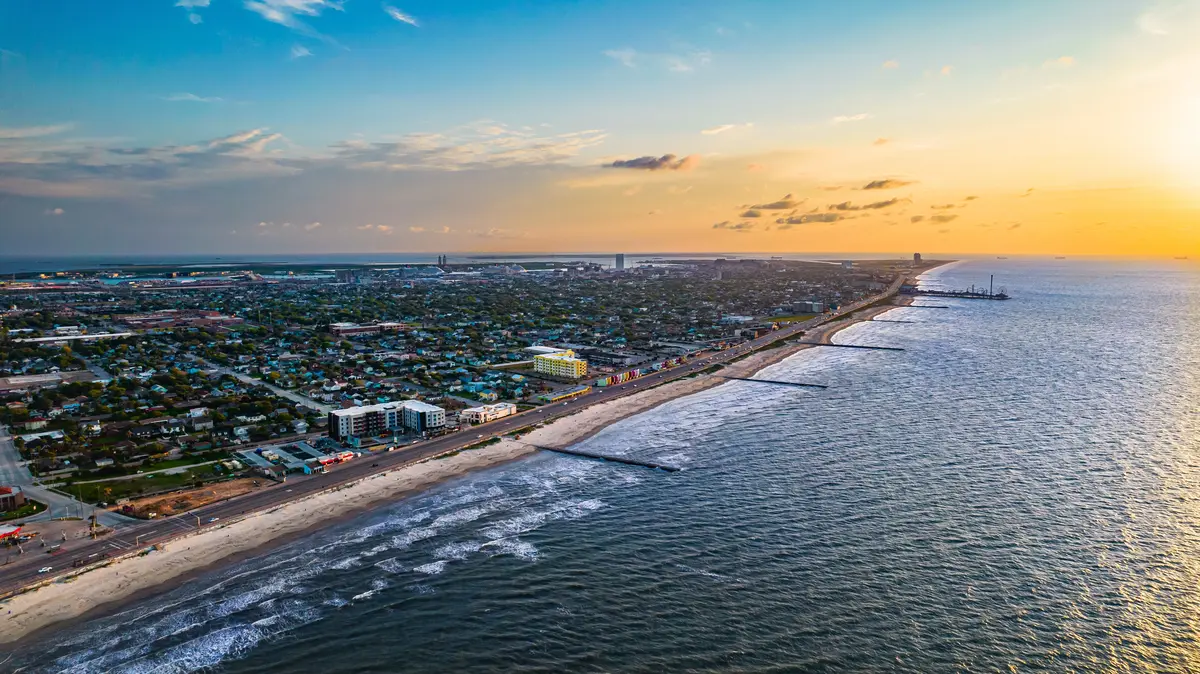
Most people who retire to Galveston arrive with a postcard version of the place — the Victorian architecture along Broadway, the Gulf breeze off Seawall Boulevard, the idea of living somewhere that feels like a vacation. What catches them off guard is how much the island functions as a real city. With a population of 53,636, Galveston has a working port, a major academic medical center, a historic downtown district, and neighborhoods that have been continuously inhabited for well over a century. It is not a retirement community disguised as a city; it is a city that happens to be a genuinely compelling place to retire — for the right person.
The economic and institutional backbone here is anchored by UTMB Health, one of the nation's oldest academic medical centers, which functions simultaneously as the island's largest employer and its primary healthcare system. That combination — a research hospital with dedicated geriatric services, right inside city limits — is unusual for a coastal community of this size and is the single most consequential fact for any retiree evaluating the move. The Galveston Independent School District, the City of Galveston, Galveston County, Texas A&M University at Galveston, and Galveston Wharves round out the employment base, giving the city a diversified civic and institutional character that keeps it functioning year-round rather than seasonally.
On cost, Galveston sits in interesting territory. The typical home price of $320,772 (Zillow Home Value Index, July 2026) is meaningful context for the full cost-of-living picture, but owning on the island carries additional layers — windstorm insurance, flood coverage, and coastal construction premiums — that mainland Texas buyers rarely encounter. Texas's retirement-income tax posture is favorable across the board, and homeowners 65 and older qualify for meaningful property-tax relief. The climate helps, too: 203 sunny days a year and January lows that rarely drop below 52°F make year-round outdoor life genuinely workable.
Whether you're deciding between Galveston and a mainland suburb, weighing the medical access question, or trying to figure out what downsizing actually looks like on an island with no 55+ communities, the sections below walk through healthcare, budget, walkability, and how Galveston stacks up against the retirement destinations closest to it.
Why Retirees Are Choosing Galveston
The retirees who land here and stay share a particular profile: they want walkable streets, they care about having serious medical care nearby, and they would rather live inside a layered, imperfect city than inside a manicured enclave. Galveston delivers on all three, in ways that the Houston suburbs generally do not.
The Gulf climate is a legitimate draw. January average lows around 52°F mean that the outdoor life — morning walks on the Seawall Boulevard promenade, afternoons at East End Lagoon Nature Preserve, weekly stops at Galveston's Own Farmers Market — is available most of the year, not just a handful of months. Retirees coming from the Midwest or Northeast frequently describe the mild winters as the thing they underestimated most in favor of the move.
The honest counterargument: if your retirement picture involves a quiet suburban yard, a two-car garage, and a big-box retail corridor five minutes away, Galveston will disappoint. A serious shopping trip means a drive off the island. Summer brings tourist density on Seawall Boulevard and around the Galveston Island Historic Pleasure Pier that locals simply route around — but it is a real seasonal shift that takes adjustment. Hurricane risk is not hypothetical here, and carrying three separate insurance policies is a fixed cost of island ownership, not an edge case. Retirees who need proximity to a major medical subspecialty not covered by UTMB — rare cancers, highly specialized cardiac surgery — are still looking at a meaningful drive to reach the full Houston medical complex. Galveston fits best for retirees who are healthy enough to enjoy it, mobile enough to manage the occasional off-island errand, and clear-eyed about the insurance and storm realities. Those who are, tend to stay.
Healthcare & Medical Access in Galveston
The central healthcare fact about retiring in Galveston is this: UTMB John Sealy Hospital is the nearest hospital, and it sits inside city limits. For most coastal retirement communities, the nearest hospital is a twenty-minute drive away and staffed primarily for general medicine. Galveston's nearest is a 900-bed academic medical center affiliated with the University of Texas.
That distinction matters in day-to-day retirement more than most retirees anticipate before they move. UTMB Health operates a dedicated Geriatric Services program on the Galveston campus, staffed by physicians, nurses, social workers, and occupational and physical therapists with specialized geriatric training. The program includes geriatric assessments, primary care, specialty clinics, and an Acute Care for Elders inpatient unit at Jennie Sealy Hospital — designed, specifically, with a home-like environment rather than a standard hospital ward configuration. This is not common infrastructure for a city of 53,636.
UTMB's reach extends beyond the island. The health system maintains campuses in League City and Angleton, and community-based clinics across Southeast Texas, which means that a patient moving from Galveston to a mainland setting for family reasons does not necessarily lose continuity of care. Specialty depth on the island itself covers the full range of outpatient care most retirees require: cardiology, orthopedics, cancer care, neurology, and more.
The realistic limitation: for a small number of highly subspecialized procedures — certain transplant programs, experimental oncology — the Houston Medical Center remains the destination. The drive is manageable for planned care, less comfortable for someone dealing with a health event that makes travel difficult. Retirees with complex chronic conditions that already involve frequent specialist visits should map that commute concretely before committing to the island.

The Retiree Budget in Galveston
Texas's tax posture for retirees is as favorable as it gets in the continental United States. The state levies no income tax — Social Security, pensions, 401(k) withdrawals, and IRA distributions are all fully exempt at the state level. Voters approved a 2025 constitutional amendment permanently prohibiting a state estate or inheritance tax. For a retiree drawing down a mix of income sources, none of it is touched by Texas before it reaches the household budget.
Property taxes deserve an honest look, because the effective rate in Galveston is approximately 1.72% — meaningful on any coastal property. However, homeowners 65 and older qualify for a school-district tax freeze that caps the assessed value for school-tax purposes, plus an enhanced homestead exemption that reduces the taxable base further. On a paid-off home, these two provisions together can make the effective annual burden substantially lower than the rate suggests. The full cost-of-living breakdown covers the tax picture in more detail.
The cost category that surprises almost every retiree who buys on the island is insurance. Galveston homeowners typically carry three separate policies: a standard ex-wind homeowners policy, a Texas Windstorm Insurance Association windstorm and hail policy, and a flood policy through the NFIP or a private carrier. No single admitted policy covers all three perils on the island. The average TWIA residential windstorm premium ran approximately $2,480 as of mid-2025; flood coverage adds a separate layer on top. Historic properties face an additional constraint: rebuild costs can run up to 50% above modern construction because of period-correct materials and Landmark Commission approval requirements. Retirees budgeting for island ownership on a fixed income need to treat insurance as a significant line item — comparable in weight to property taxes — rather than an afterthought.
Day-to-day costs for groceries, dining, and services generally track with Texas norms, which run noticeably below coastal California or Northeast equivalents. The interactive calculator below can help you model ownership costs at the current typical home price.
Looking to buy in Galveston? Estimate your payment.
Enter your numbers to see an estimated monthly mortgage payment.
Estimate only. Excludes HOA fees and mortgage insurance. The interest rate above is a starting point, not a quoted rate — replace it with your own to see real numbers. Insurance is a flat placeholder, not a Galveston quote.
Walkability, Community & Staying Active in Galveston
Galveston is among the more walkable cities in Texas — an unusual claim for a Gulf Coast community, and one that is specific to certain corridors rather than the island as a whole. The Strand Historic District and Seawall Boulevard are where on-foot access genuinely works: you can move between independent coffee shops, dining options, the Bishop's Palace, and the waterfront without a car. The East End Historic District extends that walkability into a residential register — Victorian streetscapes, manageable blocks, and proximity to everyday amenities that make car-free morning routines realistic for active retirees.
Outside those corridors, the picture is mixed. The West End and Sea Isle neighborhoods are car-dependent by design, and errands in those areas require driving. The island is flat — a meaningful factor for retirees who walk or cycle — but the summer heat and humidity between June and September limit outdoor activity to early mornings and evenings for most people. Retirees who build their daily life around the cooler months, when 203 sunny days a year delivers without the punishing heat, tend to find the outdoor lifestyle everything they hoped for.
Community infrastructure for retirees integrates into the city's general civic life rather than into dedicated senior facilities. Galveston's Own Farmers Market is a consistent weekly gathering point that draws a cross-section of residents year-round. The Seawall Boulevard promenade is where you will find walkers and cyclists most mornings, regardless of age. Independent coffee spots along the island's main corridors function as the informal social fabric — the places where retirees who have been here five years know the staff and see the same faces.
Volunteering and civic engagement are active here. The island's historic preservation community, environmental organizations connected to East End Lagoon Nature Preserve and Galveston Island State Park, and the arts institutions in The Strand district all offer meaningful structures for retirees who want to stay engaged beyond the purely social. Galveston rewards the retiree who shows up for the city, not the one who expects the city to entertain them.
Right-Sizing: Downsizing in Galveston
No 55+ communities were found in Galveston. This is worth stating plainly, because it shapes the entire downsizing conversation. Retirees here are not moving into an age-restricted enclave — they are choosing a housing type within a mixed-age, year-round city and making it work on their own terms.
The most practical downsizing paths on the island run through condos, historic cottages on single levels, and smaller restored homes in walkable neighborhoods. Condos are the closest analog to low-maintenance retirement living: no exterior upkeep, often within walking range of The Strand or the Seawall, and structurally better suited to managing the insurance complexity (some condo associations carry windstorm and flood master policies that simplify the individual owner's burden — though terms vary and require careful review before purchase).
Single-level inventory in Galveston's historic districts is real but limited. The island's Victorian-era housing stock tends toward two stories, and truly single-level homes — particularly in the East End Historic District or Silk Stocking Historic District, both of which run above the city median — carry a premium that reflects both demand and scarcity. Denver Court, which sits at the city-wide median price point, and Beachtown, with its newer construction, both offer floor plans that more reliably deliver single-level living in a smaller footprint than the historic districts can.
One friction point that retirees consistently underestimate: historic properties in Galveston are subject to Landmark Commission oversight, which means that repairs and renovations require approval and period-correct materials. Rebuild costs can run up to 50% above modern construction as a result. A retiree drawn to a beautifully restored East End cottage should budget not just for the purchase but for the long-run cost of maintaining a property whose repair bills are structurally higher than a newer alternative. The appeal is real; so is the carrying cost. Retirees on a genuinely fixed income often find that a newer condo or a Denver Court patio home is the more sustainable choice, even if the historic streetscapes are what drew them to the island in the first place.
Galveston vs Nearby Retirement Destinations
| City | Cost vs Galveston | Primary Hospital | Walkability | Senior Living Depth | Overall Retirement Fit |
|---|---|---|---|---|---|
| Galveston | Anchor | UTMB John Sealy Hospital (in city) | Strong in Strand / Seawall corridors; car needed elsewhere | No 55+ communities; condo and historic cottage options | Strong for active, medically secure retirees who want coastal city life |
| League City | Noticeably higher | UTMB League City campus; HCA facilities nearby | Suburban, car-dependent; limited walkable core | Several active adult and 55+ communities | Better for retirees wanting age-restricted community structure and newer construction |
| Texas City | Noticeably lower | Regional access; closer to UTMB League City | Car-dependent throughout | Limited senior-specific options | Strongest on affordability; limited lifestyle amenities compared to Galveston |
| Jamaica Beach | About the same | Dependent on Galveston / UTMB for all hospital care | Minimal; small island community | Essentially none | Appeals to retirees wanting very quiet, small-community beach life with accepted trade-offs |
| Hitchcock | Noticeably lower | Dependent on Texas City or UTMB Galveston | Car-dependent; rural character | Very limited | Entry-level price point; best for retirees prioritizing cost over amenities or walkability |
| La Marque | Noticeably lower | Regional access via Texas City corridor | Car-dependent; suburban | Limited | Affordable mainland option for retirees who want proximity to Galveston without island costs |
The comparison sharpens quickly around two variables: healthcare access and cost. On healthcare, Galveston is in a category of its own among these options — having a full academic medical center with dedicated geriatric services inside city limits is not something Texas City, Jamaica Beach, or La Marque can match. League City comes closest, with a UTMB campus and additional regional hospital options, but it lacks Galveston's walkability and coastal character.
On cost, Texas City, Hitchcock, and La Marque all come in noticeably lower than Galveston — but they trade away the walkability, the architectural character, and the direct hospital access that make Galveston compelling in the first place. League City is the inverse: more expensive, more structured retirement infrastructure, and a suburban setting that suits retirees who want age-restricted community life over urban texture. Jamaica Beach is the outlier — a quieter, smaller island community that appeals to a specific retiree who genuinely wants to be away from Galveston's tourist traffic and civic activity, and who is comfortable depending on the island's hospital system for all medical care.
Local Expert Takeaway: Galveston's retirement case rests on an unusual combination: a serious academic medical center with a geriatric program inside city limits, walkable historic neighborhoods in the East End and along The Strand, and a Gulf climate that makes year-round outdoor life genuinely workable. The catch is that island ownership costs — three insurance policies, coastal construction premiums, and a Landmark Commission that governs historic repairs — run higher than the sticker price suggests. Retirees who do best here treat the insurance complexity as a fixed cost of admission, focus their housing search on condos or newer single-level construction in Denver Court or Beachtown, and build their daily life around the corridors that actually reward walking rather than fighting the car-dependent parts of the island.
Quick Takeaways & FAQs
✅ UTMB John Sealy Hospital sits inside city limits with a dedicated geriatric program — unusually strong medical infrastructure for a coastal city of 53,636.
⚠️ Island homeownership typically requires three separate insurance policies — windstorm, flood, and homeowners — which adds meaningful fixed cost for retirees on a budget.
📍 Texas exempts all retirement income from state tax, and homeowners 65+ qualify for a school-district tax freeze that can meaningfully reduce the effective property-tax burden on a paid-off home.
Is Galveston a good place to retire?
What is healthcare like for retirees in Galveston?
Does Texas tax Social Security or pension income?
Are there 55+ communities in Galveston?
How much does home insurance cost in Galveston?
Moving to Texas?
Tell us what you need help with and we'll connect you with local resources.
