
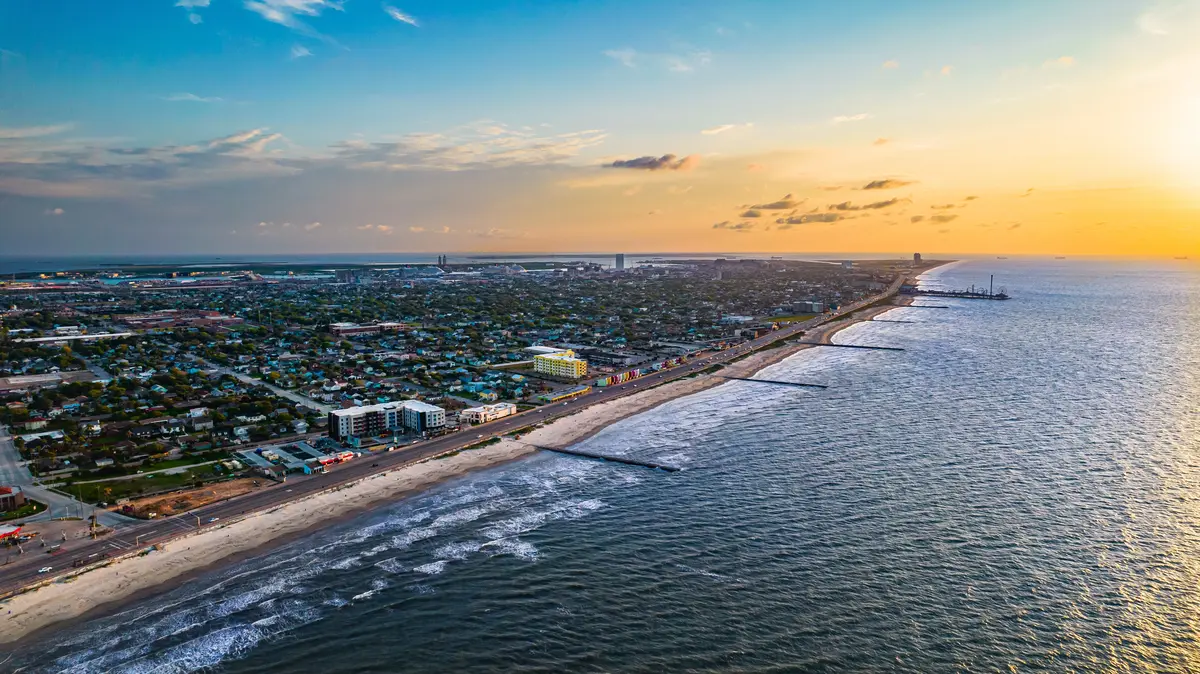
Most people who move to Galveston from the mainland expect a single, cohesive beach town. What they find is something more complicated: a barrier island city with 53,636 residents, split between Victorian historic districts where exterior renovation requires city approval, mid-island neighborhoods built for full-time families, and a long West End that stretches toward open water and country quiet. The tourist version of Galveston — Seawall Boulevard, the Strand, the pleasure pier — occupies a thin ribbon of the island. The real neighborhoods run deeper and wider than most buyers realize before they start shopping.
The economic engine here is anchored by UTMB Health, Texas A&M University at Galveston, the Galveston Wharves, and Galveston Independent School District, which together provide the island's most stable employment base. The school district holds a C rating, according to the Texas Education Agency — something buyers with kids should weigh carefully alongside housing choices, since private school enrollment is meaningful here and should factor into your true monthly cost. The commute reality is equally important: I-45 carries nearly all the traffic on and off the island, and the drive is about 55 minutes to Houston on a clear day — longer during peak hours or holiday weekends.
The typical home price of $320,772 (Zillow Home Value Index, July 2026) places Galveston below what you'd pay in League City or Friendswood but still above what most island incomes can comfortably carry — the median household income of $55,631 falls well short of what's needed to buy at that price point. For renters, the city-wide typical rent runs $1,366 per month (Zillow ZORI, July 2026). Day-to-day life here is shaped by 203 sunny days a year, salt air, and the ever-present reality of hurricane season — flood insurance costs and elevation certificates are part of every serious offer on this island, not an afterthought. For a full breakdown of costs, see the cost of living in Galveston page.
Whether you're considering a permanent move, a second home, or a long-term rental, the sections below break down Galveston's neighborhoods, what each one genuinely offers, who each suits best, and the mistakes buyers most commonly make on this island.
The Galveston Reality
The East–West Divide That Decides Everything
Galveston is a long, narrow island — roughly 30 miles from east to west and no more than three miles wide at any point. That geography forces a choice most buyers don't fully appreciate until after they've committed: do you want the historic urban core in the eastern half, or the quieter, more spread-out West End? These two halves of the island look like the same city on a map and function like entirely different places to live.
The eastern neighborhoods — East End Historic District, Midtown, Silk Stocking, Beachtown, Denver Court — are walking-distance from the Strand, the seawall entertainment corridor, and UTMB. They have sidewalks, corner stores, and a genuine neighborhood density. The West End, including Cedar Lawn, Sea Isle, and the broader West End itself, is coastal and quiet, but nearly every errand requires a drive, and the commute back toward I-45 adds miles that compound over time.
The Short-Term Rental Reality
Galveston's vacation economy creates a specific tension for buyers: in many neighborhoods, the house next door may turn over weekly with different guests, which affects noise, parking, and community feel in ways that don't show up on a listing sheet. Cedar Lawn's HOA actively restricts short-term rentals, making it one of the few areas where buyers can plan on neighbors rather than guests. Silk Stocking and Denver Court lean more residential by character. The West End and Beachtown, by contrast, attract significant vacation-home investment — a factor worth examining before you commit to either as a full-time address.
Flood Zone and Elevation: The Non-Negotiable Due Diligence
Every neighborhood on this island carries flood risk in some form. Elevation certificates, flood zone designation, and the history of a specific property's water intrusion are not optional research items here — they are the difference between an insurable, livable purchase and a costly mistake. Beachtown's Fortified construction standards address this explicitly. Historic districts present a different challenge: older pier-and-beam homes may sit higher than they look, but deferred maintenance on foundation systems is common. Get the elevation certificate before the inspection, not after.
Neighborhoods at a Glance
| Neighborhood | Best For | Vibe |
|---|---|---|
| East End Historic District | Walkable Luxury | Victorian streetscapes, active civic culture, landmark architecture within walking distance of downtown |
| Midtown | Families Commuter | Central island location, practical full-time living, mix of families and young professionals |
| West End | Nature Privacy | Expansive coastal living, fishing and birdwatching, proximity to Galveston Island State Park |
| Silk Stocking Historic District | Luxury Quiet | Compact historic district, Queen Anne architecture, residential feel within the urban core |
| Beachtown | Views Luxury | New-construction coastal village, Fortified storm-resistance standards, beachfront pedestrian community |
| Denver Court | First-Time Families | Mid-century architectural variety, walkable to the seawall, off-grid-street layout keeps through traffic out |
| Cedar Lawn | Quiet Privacy | Tree-lined conservation district, circular layout, HOA restricts short-term rentals |
| Sea Isle | Nature Families | Established West End subdivision with marina, bay access, and a full POA-managed amenity set |
Galveston typical home price: $320,772 (Zillow ZHVI, July 2026). Typical rent: $1,366/mo (Zillow ZORI, July 2026). Neighborhood tiers on this page are relative to these figures.

Best Neighborhood by Buyer Type
| Buyer Type | Best Neighborhood | Why |
|---|---|---|
| First-Time Buyer | Denver Court | Historic designation with mid-century variety, at the city median in price tier, close to the seawall without the premium of the most coveted districts. |
| Luxury Buyer | East End Historic District | Above the city median, landmark architecture, National Historic Landmark status, and the most established prestige address on the island. |
| Walkability Seeker | Midtown | Central location puts Galveston College, Lasker Park Community Pool, and Moody Gardens all within reach on foot or by bike. |
| Families with Kids | Cedar Lawn | HOA restrictions on short-term rentals mean actual neighbors rather than a rotating visitor base, and the quiet circular layout limits cut-through traffic. |
| Commuters | Midtown | Central island position shortens the drive to I-45 compared to West End addresses, trimming meaningful minutes off the about 55 minutes to Houston. |
| Large-Lot / Acreage Buyers | West End | The broader West End offers the most space on the island, with bay and beach access and an open, rural coastal character unavailable in the historic core. |
| Renters | Midtown | The most consistent supply of long-term rental housing on the island, without the vacation-rental competition that inflates short-term supply in tourist-heavy zones. |
Looking to buy in Galveston? Estimate your payment.
Enter your numbers to see an estimated monthly mortgage payment.
Estimate only. Excludes HOA fees and mortgage insurance. The interest rate above is a starting point, not a quoted rate — replace it with your own to see real numbers. Insurance is a flat placeholder, not a Galveston quote.
Most Popular Neighborhoods
East End Historic District
Galveston's oldest residential neighborhood spans more than 50 city blocks and was designated a National Historic Landmark in 1976 — the architectural legacy of a rapid rebuilding after the Great Fire of 1885, which produced the Victorian and Greek Revival streetscapes that make this district genuinely unlike anywhere else in Texas. Bishop's Palace sits here, recognized by the American Institute of Architects as one of the 100 most important buildings in America, alongside Ashton Villa and Moody Mansion. The East End Historic District Association organizes a Victorian Christmas Homes Tour and community events that reflect a civic culture most new subdivisions spend decades trying to manufacture. The honest trade-off: exterior renovations require review under Galveston's historic design standards, which slows and sometimes constrains modernization — plan for that process before you commit to any renovation scope. Homes here run above the city-wide typical price.
Best for: Buyers who want prestige architecture, walkable proximity to downtown, and a neighborhood with genuine civic depth — and who can navigate historic review for any exterior changes.
Midtown
Midtown sits in the central part of the island and works as a practical, full-time address in a way the tourist-facing corridors don't quite manage. Moody Gardens, the Lasker Park Community Pool, and Galveston College are all within the neighborhood's orbit, and the residential density here supports actual walkable errands rather than just scenic strolls. The mix of families and young professionals is the most balanced on the island. The trade-off is that Midtown's housing stock is varied and sometimes uneven — the same block can hold a well-renovated bungalow next to a rental property with deferred maintenance, so condition due diligence matters more here than in the tightly regulated historic districts.
Best for: Full-time residents, UTMB and Galveston College employees, and buyers who want a central island address without paying the premium of the named historic districts.
West End
The West End is where the island opens up — larger lots, bay access, beach access, and the kind of quiet that makes 53,636-person Galveston feel genuinely rural. Galveston Island State Park anchors the far end with four miles of trails, camping, paddling, and access to both the beach and bay sides of the island. The honest trade-off here is distance from everything: groceries, schools, entertainment, and I-45 all require a deliberate drive, and hurricane evacuation routes funnel through the same roads that carry daily traffic. This is not a neighborhood for buyers who want convenience — it is for buyers who are consciously trading it for space and coast.
Best for: Buyers prioritizing coastal space, fishing, birdwatching, and proximity to the state park over urban access or commute efficiency.
Silk Stocking Historic District
Silk Stocking covers roughly 14 blocks between Broadway and Seawall Boulevard, and its name comes from the prosperous late-19th-century families who built the Queen Anne, Colonial Revival, and Craftsman homes that still line its streets. Listed on the National Register of Historic Places in 1996, it is more compact and quieter than the East End — fewer foot-traffic events, a tighter residential feel, but the same historic preservation regulations that require city review for exterior alterations. Homes here run above the city median. The trade-off that surprises buyers: the district's proximity to Seawall Boulevard means tourist activity is closer than it looks on a map, and noise and weekend traffic are real considerations.
Best for: Buyers who want historic architecture and above-median prestige in a more compact, quieter setting than the East End — and who understand what historic overlay regulations require.
Beachtown
Beachtown is Galveston's most architecturally intentional neighborhood — more than 60 homes built to Fortified storm-resistance standards, with design cues drawn from Charleston, the Carolina Low Country, and New Orleans, organized into pedestrian-oriented coastal villages adjacent to the East End Lagoon Nature Preserve. The construction standards here are the most rigorous on the island, which matters for insurance and long-term resilience in a hurricane-prone market. The trade-off is scale and inventory: this is a small, specific community, and availability is limited by design — buyers looking here should expect a patient search and a price point that reflects both the location and the construction quality.
Best for: Buyers seeking new-construction beachfront living with serious storm-resistance credentials and a walkable, village-scale community character.
Denver Court
Denver Court was the first Galveston neighborhood to break from the Victorian era and the original street grid — its homes span the 1920s through the 1960s and range from modest bungalows of around 1,200 square feet to substantial homes exceeding 4,000. Listed on the National Register of Historic Places for this architectural diversity, it sits just blocks from the seawall with groceries, parks, and schools nearby. Prices run at the city-wide typical level, making it the most accessible of the nationally recognized historic districts. The trade-off: the same off-grid layout that keeps through traffic out also creates some navigation complexity for buyers unfamiliar with the area, and condition varies considerably across the district's more than 30 blocks.
Best for: First-time buyers and families who want National Register historic character at a more approachable price point, close to the seawall but away from the tourist corridor.
Cedar Lawn
Cedar Lawn is called the Garden District of Galveston for a reason — a designated conservation district with a circular, internally-facing layout and tree-lined streets that give it a contained, intentionally quiet character unlike anything else in the city. The HOA generally restricts short-term rentals, which is the detail that matters most to full-time buyers: this is one of the only neighborhoods on the island where you are reliably surrounded by residents rather than visitors. The trade-off is that the same limited-access design that creates privacy also means less street activity and fewer walkable destinations — Cedar Lawn is suburban in feel even though it sits mid-island.
Best for: Families with kids and buyers who specifically want a neighbor-stable, quiet residential pocket on an island where vacation-rental turnover is otherwise hard to avoid.
Sea Isle
Sea Isle is a substantial West End subdivision of approximately 1,640 homes, managed through a property owners' association that maintains a full-service marina and boat ramp, a community swimming pool and tennis court, a neighborhood park with a picnic pavilion, and a city fire substation. That POA infrastructure gives Sea Isle a more settled, amenity-complete feel than most of the broader West End. Homes here run above the city-wide typical price, reflecting both the bay access and the marina infrastructure. The trade-off is the same one shared by all West End addresses: daily errands mean a real drive, and the commute to I-45 for Houston-bound workers adds up quickly on a five-day-a-week basis.
Best for: Boating and fishing enthusiasts, second-home buyers, and buyers who want West End coastal living with an organized amenity set already in place.
Common Mistakes Buyers Make in Galveston
Treating the Island as Uniform
The most consistent mistake is buying a home on the far West End without fully internalizing what that distance means on a daily basis. FM-3005 carries all the West End traffic, and a routine grocery run or school pickup that looks quick on a map takes meaningful time when it is repeated twice a day. Buyers who compare a West End listing favorably against an East End price without accounting for fuel, time, and wear are doing incomplete math.
Skipping the Flood Zone Homework
Galveston sits on a barrier island along the Texas coast. Every neighborhood in this guide carries some flood designation, and the difference between a property in a moderate-risk zone and one in a high-risk zone can represent a significant annual insurance difference — not a rounding error. Buyers who treat the flood insurance line as a number to verify at closing rather than a number to research before making an offer routinely get surprised. Pull the elevation certificate and the FEMA flood zone designation before you get emotionally attached to any specific address.
Underestimating Historic Overlay Restrictions
The East End Historic District, Silk Stocking, and Denver Court all carry design review requirements for exterior alterations. Buyers who plan to update a Victorian porch, replace windows, or change roofing materials without factoring in the approval timeline and approved-material constraints find the process slower and more expensive than anticipated. The historic overlay protects the neighborhood character that made the property appealing — but it also constrains what you can do with it, and that constraint is real and ongoing.
Ignoring the Short-Term Rental Environment
In most Galveston neighborhoods outside Cedar Lawn, the house next door can legally operate as a vacation rental. For full-time buyers, that means weekends can feel noticeably different from weekdays in terms of noise, parking, and neighborhood energy — especially in blocks close to Seawall Boulevard or the beach. Buyers should ask specifically about the short-term rental density of the block they are considering, not just the neighborhood in general, before committing.
Best Areas to Rent in Galveston
| Area | Ideal For | Trade-off |
|---|---|---|
| Midtown | Commuters Families | Most stable supply of long-term rentals on the island; vacation-rental competition is lower here than in beach-adjacent zones |
| East End Historic District | Walkable Luxury | On-foot access to downtown, the Strand, and UTMB; rental supply is limited and tends to move quickly when it does appear |
| Denver Court | First-Time Renters Families | Historic neighborhood feel at a more accessible price tier; inventory is modest and turnover can be slow to appear |
| Cedar Lawn | Quiet Families | HOA restrictions on short-term rentals create a more stable residential atmosphere; fewer rental units available than in open neighborhoods |
| West End / Sea Isle | Nature Privacy | Coastal space and marina access; distance from I-45 and daily services makes this a deliberate lifestyle choice rather than a practical default |
The city-wide typical rent of $1,366 per month (Zillow ZORI, July 2026) reflects a market shaped significantly by vacation-rental economics — a large share of island housing stock is oriented toward short-term visitors, which compresses the supply of genuine long-term rentals and tends to push asking rents on annual leases above what the headline figure suggests. Renters planning a full-time move to Galveston should expect competition for the most livable long-term units and should prioritize mid-island areas where the vacation-rental overlay is thinnest.

Local Expert Takeaway: The single most useful thing a buyer can know before shopping in Galveston is which half of the island they are actually choosing. The historic eastern neighborhoods — East End, Silk Stocking, Denver Court, Beachtown — give you walkable density, landmark architecture, and proximity to UTMB and the Strand, but they come with design review requirements, vacation-rental neighbors in most blocks, and above-median prices in the most coveted districts. The West End and Sea Isle give you coast, quiet, and marina access, but daily life means a car for everything and a longer path back to I-45 for the about 55 minutes to Houston that defines the island's commuter reality. Cedar Lawn sits mid-island and resolves the vacation-rental problem better than almost anywhere else in the city — its HOA restrictions are the reason full-time families keep landing there even when other neighborhoods look comparable on paper.
Quick Takeaways & FAQs
✅ East End Historic District is a genuine National Historic Landmark — more than 50 city blocks of Victorian architecture, walkable to downtown, anchored by Bishop's Palace and one of the most active neighborhood associations in the city.
⚠️ The commute reality is unavoidable: I-45 is the only route on and off the island, and the drive is about 55 minutes to Houston on a clear day — West End addresses add meaningful miles to that baseline every single workday.
📍 Cedar Lawn's HOA actively restricts short-term rentals, making it one of the only neighborhoods in Galveston where you can reasonably expect to have stable neighbors rather than a rotating weekend visitor base.
Which Galveston neighborhood is best for full-time families with school-age kids?
What is the most walkable neighborhood in Galveston?
Are there neighborhoods in Galveston where short-term vacation rentals are restricted?
How does living on the West End compare to the East End for a full-time resident?
What should buyers know about flood insurance in Galveston before making an offer?
Moving to Texas?
Tell us what you need help with and we'll connect you with local resources.
