
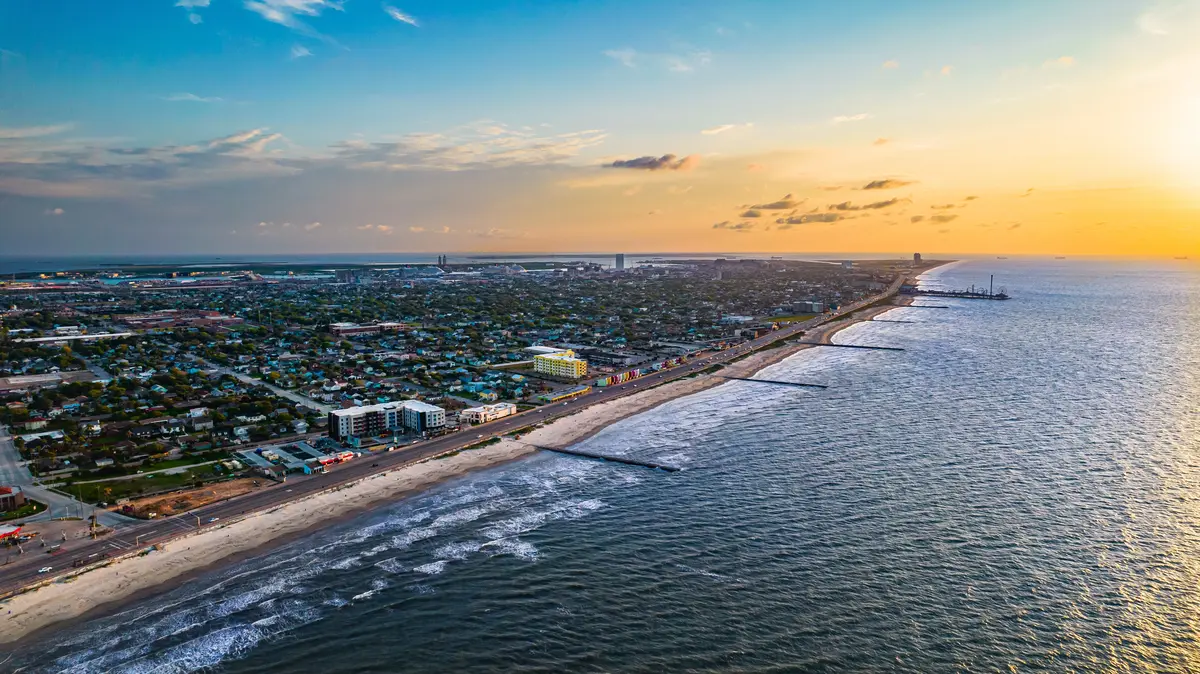
You've done the math, or at least started to. California's statewide typical home value of $773,735 is a number that shapes everything — what you can own, where you can afford to live, and how long the commute has to be to make it work. Galveston sits at a different price point entirely, on a barrier island at the southern edge of the Greater Houston metro, connected to the mainland by I-45. The Gulf of Mexico is the eastern and southern boundary. The island is about 27 miles long and no more than three miles wide at any point, which means geography is never an abstraction here — it is the thing that defines your neighborhood, your insurance bill, and your weekend.
The people who move here from California often work at UTMB Health, Texas A&M University at Galveston, or the Galveston Wharves port complex — or they work remotely and decided a Gulf-front city made more sense than another inland suburb. The Galveston Independent School District serves 6,671 students enrolled in 2025-26 and holds a C rating, according to the Texas Education Agency; families researching schools should read the full breakdown on the schools page before drawing conclusions. What draws California transplants specifically is a combination that is harder to find on the West Coast: coastal living, a historic downtown in The Strand Historic District, and a price gap wide enough to matter.
The typical home price in Galveston is $320,772 (Zillow Home Value Index, July 2026) — noticeably below California's statewide typical home value. The city's median household income is $55,631, which sits below what a buyer would need to carry the typical home here without strain, so affordability is relative and depends heavily on what equity you're bringing from California. Daily life runs on a car, with about 55 minutes to Houston for most professional services and major retail; a serious shopping trip often means a drive across the causeway. The full cost picture, including utilities and groceries, lives on the cost-of-living page.
Whether you're mid-decision or just starting to research, the sections below break down the California-to-Galveston comparison on home prices, taxes, insurance, and daily cost — along with what the first six months typically surprise people with and what the honest trade-offs are.
The Home Price Gap — and What It Actually Buys You
The headline comparison is straightforward. California's statewide typical home value of $773,735 (Zillow ZHVI) is more than double Galveston's typical home price of $320,772 as of July 2026. That gap translates to a meaningfully smaller mortgage, a larger down payment percentage from the same California equity, or both.
What that price buys in Galveston is worth understanding specifically. The island has distinct housing stock that does not look like a Texas suburb. Much of the older inventory is raised construction — piers and pilings rather than slab — which matters for flood ratings and insurance (more on that below). The East End Historic District and the Silk Stocking Historic District both run above the city median, with Victorian-era homes that attract buyers coming out of California's historic neighborhoods. Denver Court sits right at the city median. Sea Isle, toward the west end of the island, also trends above the city median, largely due to waterfront and canal-front lots.
Midtown and Cedar Lawn offer the most accessible entry points for buyers whose California equity is solid but not exceptional. The West End is the most varied stretch — everything from modest beach cottages to newer construction closer to Galveston Island State Park.
One thing Californians consistently underestimate: the gap between the sticker price and the true monthly cost of ownership on this island. The home price is lower. The insurance stack is not. Budget the purchase price carefully, then budget the insurance separately — they are not the same calculation here.
Best for: Buyers bringing California equity who want coastal character at a price point the California market stopped offering years ago. If you're comparing nearby options, Texas City runs noticeably lower than Galveston's median, while League City runs noticeably higher — useful context if the island's insurance costs push you to weigh alternatives.
Taxes: What Goes Away and What Goes Up
The tax picture is the most immediate financial change for any Californian moving to Texas, and it runs in two directions at once.
What Disappears
Texas has no state income tax. California's top state income tax rate of 13.3% applies only to the highest earners, but the brackets hit hard well before that ceiling — a household earning $100,000 in California owes thousands in state income tax that simply does not exist in Texas. For most professional-income households, the elimination of state income tax is the single largest annual savings from this move.
California's statewide base sales tax rate of 7.25% is also the floor, not the ceiling — local add-ons push most California cities higher. Galveston's combined sales tax rate is 8.25%, composed of the 6.25% Texas state rate and a 2% city levy; Galveston County adds nothing on top of that. Groceries are exempt from both state and local sales tax in Texas, which meaningfully offsets the rate difference for everyday spending.
What Rises
Property taxes are the trade the state makes, and it is a real one. California's effective property tax rate of 0.71% is held artificially low by Proposition 13 assessment caps — many long-term California homeowners pay taxes on valuations from years or decades ago, not on current market value. Texas has no equivalent cap. Galveston's effective property tax rate is 1.72%, assessed against current market value every year.
On paper that looks punishing. In practice, the math is more complicated. Texas homeowners who file a General Homestead Exemption remove $140,000 of assessed value before school taxes are calculated — a meaningful reduction on a $320,772 home. Homeowners 65 or older, or with a qualifying disability, receive an additional $60,000 exemption for a combined $200,000 school-tax shelter. These exemptions are not automatic; they require a filed application with the county appraisal district.
| Tax Category | California | Galveston / Texas |
|---|---|---|
| State income tax | California's top state income tax rate of 13.3% (California Franchise Tax Board) | None |
| Effective property tax rate | California's effective property tax rate of 0.71% (Tax Foundation) | 1.72% (current market value, annually reassessed) |
| Homestead exemption | Limited; Prop 13 caps assessment growth instead | $140,000 off assessed value for school taxes (filed application required) |
| Statewide base sales tax | California's statewide base sales tax rate of 7.25% (California Dept. of Tax and Fee Administration) | 6.25% state + 2% city = 8.25% combined; groceries exempt |
| Capital gains tax | Taxed as ordinary income at state rate | No state capital gains tax |
| Estate / inheritance tax | No state estate tax; federal rules apply | No state estate or inheritance tax |
The net result for most California transplants: income tax savings outrun the property tax increase, particularly in the early years of ownership before California's Prop 13 caps would have kicked in for a recent buyer anyway.
Texas property taxes are due January 31 each year. Homeowners may pay the first half by November 30 and defer the second half to June 30 without penalty — a split-payment option that helps with cash flow. See the full tax picture on the cost-of-living page.

The Insurance Stack — Galveston's Biggest Cost Surprise
Every California transplant who buys on the island learns this eventually. Most learn it at closing. The smart ones learn it before they make an offer.
In California, you carry one homeowners policy. In Galveston, you carry three.
Why Three Policies
Because Galveston sits in a Tier 1 coastal county — directly touching the Gulf of Mexico — standard homeowners insurance policies exclude both windstorm and flood damage. Those aren't minor carve-outs; they're the two most likely ways a Galveston home gets damaged. The result is a mandatory stack of coverage that California buyers are not used to budgeting for.
- Base homeowners policy — covers fire, theft, liability, and non-weather losses.
- Windstorm coverage — through the Texas Windstorm Insurance Association (TWIA), the state's insurer of last resort for coastal wind damage. The average TWIA residential windstorm premium was about $2,480 as of mid-2025. TWIA rates are uniform across all 14 first-tier coastal counties, so your home's construction details — elevation, roof type, opening protections — matter more to the final number than which block of the island you're on.
- Flood insurance — through the National Flood Insurance Program (NFIP) or a private insurer. Galveston participates in the NFIP, which makes subsidized coverage available to any city resident regardless of flood zone. Average flood premiums in Galveston County run $992–$1,199 per year under FEMA's Risk Rating 2.0 system, though coastal properties regularly exceed $3,000 annually. Older homes built on slabs rather than pilings typically face the steepest rates under the current rating methodology.
The Hurricane History That Shapes the Market
Hurricane Ike made landfall in 2008 and submerged more than half of Galveston Island in storm surge. It drove roughly 92,800 TWIA claims and more than $2.5 billion in TWIA losses — numbers that still shape how insurers, lenders, and appraisers think about this market. That history is not ancient. It is within the memory of every longtime homeowner on the island, and it is baked into current policy pricing.
The city's advice — and it is worth taking seriously — is that every resident should carry flood insurance regardless of their specific flood zone designation. Zones change. Storms don't care about zone boundaries.
What This Means for Your Budget
A buyer arriving from California with one homeowners policy in mind needs to rerun the numbers with three line items. On a typical Galveston home, the combined annual insurance cost across all three policies can easily run $5,000–$7,000 or more, depending on construction type, elevation, and coverage levels. That is a materially different monthly cost of ownership than the purchase price alone suggests. Build it into your offer analysis, not your post-closing budget.
Looking to buy in Galveston? Estimate your payment.
Enter your numbers to see an estimated monthly mortgage payment.
Estimate only. Excludes HOA fees and mortgage insurance. The interest rate above is a starting point, not a quoted rate — replace it with your own to see real numbers. Insurance is a flat placeholder, not a Galveston quote.
Daily Life: What Changes, What Stays the Same
Six months in, most California transplants report the same set of surprises. Some are pleasant. One is not.
The Weather Adjustment
Galveston gets 203 sunny days a year — not the idealized version of that figure, the real one. Gulf Coast summers are genuinely hot and humid from roughly June through September in a way that differs from California's dry heat. Coastal breezes make the Seawall Boulevard promenade and East Beach more bearable than inland Texas in those months, but the humidity is a genuine adjustment for anyone coming from a Mediterranean climate. Winters are mild and rarely severe. Hurricane season runs June through November, and the island takes it seriously: evacuation routes, storm shutters, and emergency plans are part of owning property here, not an occasional concern.
Getting Around
Galveston is not a walkable city in the way San Francisco or Santa Monica is. I-45 is the only route on and off the island for most residents, which creates a singular chokepoint. About 55 minutes to Houston is the standard commute reference, but that figure assumes normal traffic on the Gulf Freeway — pre-holiday and storm-evacuation windows are a different story. For daily life on the island itself, most errands require a car. FM-3005 carries traffic along the western reaches. SH-87 runs the eastern end.
Health insurance premiums generally run noticeably below what you were paying in California, though you will drive farther for specialist care — a trade-off that most transplants accept but that is worth factoring in before the move.
The Grocery and Retail Reality
On-island retail is genuinely limited. A serious shopping run — home goods, specialty groceries, large-format stores — almost always means crossing the causeway. Groceries are exempt from sales tax in Texas, which partially offsets the cost difference for everyday staples, but the selection within city limits skews toward convenience rather than variety. Remote workers and households used to large California grocery chains will feel this gap most acutely.
Where People Actually Gather
The Strand Historic District is the social center of the island for tourists and transplants alike — a stretch of 19th-century commercial buildings that houses the kind of independent retail and dining scene California buyers recognize from smaller coastal towns. Galveston's Own Farmers Market draws a consistent local crowd through the warm months. Galveston Island Historic Pleasure Pier and Moody Gardens are the two anchors for family activity, and Stewart Beach and East Beach are where the island actually lives on weekends. The East End Lagoon Nature Preserve is where residents go when they want water without the crowds.
The community is smaller than any California coastal city at comparable price points — 53,636 residents, which makes it the 73rd-largest incorporated city in Texas. You will know your neighbors. The Galveston Island State Park draws both residents and visitors, and on a slow Tuesday morning it reads more like a local park than a tourist site.
What Californians Get Right — and Get Wrong — About This Move
The case for moving from California to Galveston is easy to make in a spreadsheet. The case against it is shorter but worth understanding before you commit.
What the Numbers Get Right
The price gap is real. California's statewide typical home value of $773,735 (Zillow ZHVI) versus Galveston's $320,772 as of July 2026 is not a rounding error — it is the difference between a coastal home and an unachievable one for a wide range of buyers. The income tax elimination is real. The homestead exemption is real and meaningfully reduces the property tax sting for primary-residence buyers. The Greater Houston metro sits among the lowest cost-of-living large metros in the country, and Galveston participates in that regional affordability even while carrying a premium over the mainland.
What the Numbers Get Wrong
The three-policy insurance stack is the item most California buyers underestimate most severely. Running the monthly payment on a $320,772 home and comparing it to a California mortgage is not an apples-to-apples comparison until you've added windstorm and flood coverage. On the right home — elevated construction, newer roof, strong opening protections — the stack is manageable. On an older slab-built home in a high-risk flood zone, it is a meaningful monthly commitment that can close the gap with California ownership costs faster than buyers expect.
The school district question is the other common miscalculation. Galveston Independent School District holds a C rating, according to the Texas Education Agency, and on 2024-25 state assessments, 33% of students reached math proficiency and 44% reached reading proficiency. Families moving from high-rated California districts should read the schools page before anchoring to the price comparison alone.
The Honest Trade-off
What you give up is proximity. Houston's full range of professional services, specialists, major airports, and cultural institutions are about 55 minutes away — William P. Hobby Airport (HOU) is 41 miles from Galveston. That works well for remote workers and retirees. For households with complex professional lives that require flexibility and spontaneity, the island's geography is a real constraint, not a minor inconvenience.
What you gain is a coastal address that California stopped making affordable for most buyers a generation ago, a tax structure that materially favors earned income, and a community small enough to feel like a town. Whether that trade is right depends on what you were actually buying in California — and whether the island is the life you want, not just the price you can afford.
For a fuller picture of neighborhoods on the island, see the best neighborhoods page. For the complete buyer-process walkthrough, the first-time homebuyer page covers what to expect from offer to close in this market.

Local Expert Takeaway: The move from California to Galveston pencils out on paper faster than almost any other California-to-Texas corridor destination — but the three-policy insurance stack (base homeowners, TWIA windstorm, NFIP flood) is the one number that rewrites the math for buyers who don't factor it in before making an offer. File your General Homestead Exemption application the first year, take the time to understand your flood zone before you pick a property, and price the insurance before you price the mortgage. The income tax elimination and the price gap are real; the coastal insurance cost is equally real. Buyers who understand all three walk into this market with clear eyes. Those who discover the insurance stack at closing sometimes don't.
Quick Takeaways & FAQs
✅ Texas has no state income tax — for most professional-income households, this is the single largest annual savings from the California-to-Galveston move.
⚠️ Galveston requires three separate insurance policies (base homeowners, TWIA windstorm, NFIP flood) where California buyers are accustomed to one — a cost surprise that can significantly change the monthly ownership picture.
📍 The General Homestead Exemption removes $140,000 of assessed value before school taxes are calculated — but it requires a filed application and is not applied automatically.
How much cheaper is Galveston than California for buying a home?
Do I really save on taxes by moving from California to Texas?
Why do I need three insurance policies in Galveston when I only carried one in California?
What is Galveston's General Homestead Exemption and how do I apply?
How does the commute from Galveston to Houston work for California transplants used to freeway commutes?
Moving to Texas?
Tell us what you need help with and we'll connect you with local resources.
