
Most people researching Galveston find a crime rate that looks alarming at first glance, close the tab, and move on. That's a mistake — and this guide is specifically written for the people who stay in the tab. The raw numbers deserve context that most aggregate crime sites never provide, and Galveston has a structural quirk that makes per-resident crime ratios genuinely misleading compared to almost any inland Texas city. Understanding that quirk doesn't make the numbers disappear, but it changes how you read them and what you do with them.
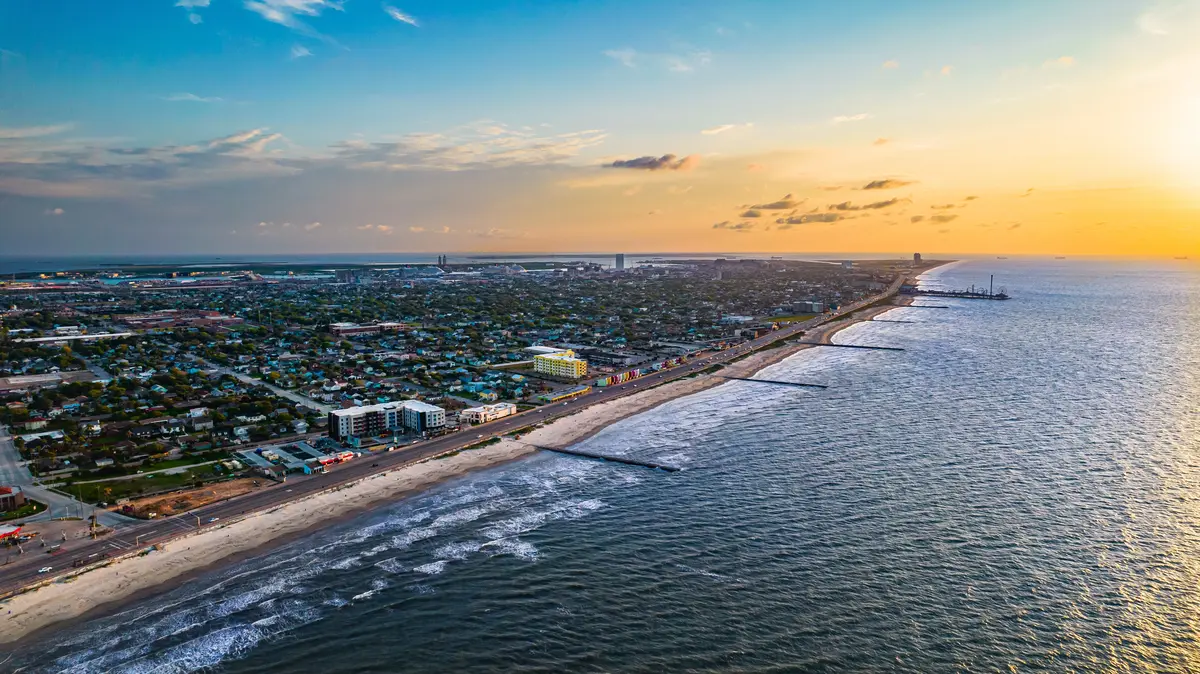
Galveston sits on a barrier island at the southern end of I-45, connected to the mainland by two causeways and surrounded on three sides by open water. A permanent population of roughly 50,000 shares that island with a tourism economy that draws tens of millions of visitor-days each year. On a busy Memorial Day weekend, the island's population can swell by 50,000 or more in a matter of hours. Crime statistics are calculated per resident — but the crowd those crimes happen around is far larger than the resident count suggests. That distinction matters enormously when you are weighing whether to live here, not visit.
The honest picture: Galveston carries both violent and property crime rates that run above the Texas state average and above national figures. That is true, and full-time residents know it. But the trend line has been moving in the right direction — city-level data shows declining crime across both categories over the last five years, and the Galveston Police Department reported a measurable drop in incident reports as recently as early 2024. The city has also made concrete investments in non-traditional public safety, including the COAST mental health co-response program launched in 2023. None of that erases the headline numbers, but it fills in a picture that aggregate crime maps never show.
This guide breaks down Galveston's crime rates against state and national benchmarks, explains the geographic safety variation across the island, covers what the city is doing to address public safety, and gives you the practical framing you need to evaluate specific neighborhoods. For neighborhood character and what each area is actually like to live in, see the Galveston neighborhoods guide.
Galveston's Crime Rates vs. State and National Benchmarks
Galveston carries a violent crime rate of 5.08 per 1,000 residents and a property crime rate of 23.33 per 1,000 residents. Both figures run above the Texas state averages — the state violent rate is 4 per 1,000 and the state property rate is 20.7 per 1,000 — and above national figures of 3.7 per 1,000 for violent crime and 18.4 per 1,000 for property crime.
The comparison table that follows this section lays those numbers side by side. What the table cannot show on its own is why Galveston's denominators are structurally different from those of an inland city of comparable size.
The Tourist Denominator Problem
Per-resident crime rates divide incidents by permanent population. In most cities that is a reasonable proxy. In Galveston, it understates the actual crowd present on peak weekends by tens of thousands of people. The millions of annual visitors the island draws are not in the denominator — they are in the numerator, as participants in and witnesses to incidents that inflate the city's recorded crime totals.
Areas near Seawall Boulevard, the historic pleasure pier, and the Strand Historic District concentrate both foot traffic and incident reports precisely because they concentrate people. Crime follows crowds. A tourist corridor that generates high raw incident counts is not the same safety environment as a residential street a mile inland — even when both fall inside Galveston's city limits and both feed the same per-resident statistic.
This is not a defense of the numbers. It is a calibration tool. Full-time residents living away from the heaviest tourist corridors experience a materially different day-to-day reality than the citywide rate suggests.
The Trend Is Downward
City-level data shows both violent and property crime declining over the last five years in Galveston. The Galveston Police Department's own incident reports confirmed the trend as recently as early 2024, when year-over-year comparisons showed a meaningful reduction in total incidents. Neither figure has reached the state average yet — but the direction matters when you are deciding whether conditions are improving or worsening for long-term residents.
Where Safety Varies Across the Island
Galveston is not a single safety environment. The island is roughly 27 miles long and 3 miles wide at its broadest point, and the difference between its safest and least safe areas is significant enough to change your day-to-day experience as a resident.
Violent Crime Geography
The chance of becoming a victim of violent crime ranges from roughly 1 in 127 in northern parts of the city to 1 in 239 in the southwest. Residents broadly consider the southwest the safest part of the island for violent crime. The northern areas — which include higher-density blocks closer to the port and some of the older, less gentrified residential corridors — carry meaningfully higher risk on this measure.
The West End and Sea Isle areas sit on the island's western stretches, where lower density and fewer tourist draws keep the overall incident environment calmer. The neighborhoods guide covers the character of each area in detail.
Property Crime Geography
Property crime shows a different geographic pattern. The chance of becoming a victim of property crime ranges from about 1 in 29 in northwest areas to 1 in 48 in the northeast. Counterintuitively, residents tend to consider the northeast the safer side for property crime — even though raw counts around that area's retail clusters can look alarming on a crime map.
The reason is the retail-concentration effect: the northeast holds more commercial establishments, which pull in more shoplifting, vehicle break-ins, and theft incidents that inflate raw counts. Those incidents cluster around commercial strips, not residential streets. A home on a quiet block in that quadrant is not experiencing the same risk as the parking lot of a busy shopping center half a mile away — yet both land in the same geographic heat map.
Neighborhoods Worth Understanding Before You Choose
The East End Historic District and the Silk Stocking Historic District both sit in the older eastern part of the island, where historic preservation has brought significant private investment and neighborhood stability. Midtown sits centrally and is more mixed in character. Beachtown is a planned development that has drawn younger buyers and tends to attract residents who are specifically seeking a quieter residential feel near the beach. Cedar Lawn and Denver Court are more established residential pockets.
No Galveston neighborhood is entirely insulated from the island's crime environment, but the gap between the most and least exposed areas is real enough to be a primary factor in your neighborhood research — not an afterthought.

What the City Is Doing About Public Safety
Galveston has made two concrete public safety investments worth knowing about: a co-response mental health program and transparent, publicly accessible crime reporting.
The COAST Program
In May 2023, Galveston launched COAST — Compassionate Open Access to Services and Treatment — a co-response model that pairs a licensed mental health clinician from the Gulf Coast Center, a Galveston Fire Department paramedic, and a specially trained police officer to respond to 911 mental health emergencies together. The goal is to divert crisis calls away from a purely enforcement response toward one that addresses the underlying condition.
Galveston's 911 call center added a fourth option alongside police, fire, and EMS: callers can now specifically request a mental health response. COAST teams also conduct proactive outreach when they are not answering emergency calls. The City formalized a renewed interlocal agreement with the Gulf Coast Center for continued COAST operations effective September 1, 2024.
This matters for residents because a meaningful share of law enforcement contacts in any city involve people in mental health crisis rather than criminal actors. A program that redirects those contacts can reduce both the burden on patrol officers and the kind of incidents that accumulate in a city's crime totals without making anyone safer.
Transparency and Community Engagement
The Galveston Police Department publishes monthly crime statistics in the City Manager's Report through the National Incident-Based Reporting System (NIBRS). That is a granular, incident-level reporting standard — more detailed than the old summary-based reporting most departments used — and the fact that it is publicly posted means residents can track trends themselves rather than waiting for annual FBI releases.
The department also runs a Citizens Police Academy and participates in National Night Out events. These are community-building programs rather than crime-reduction mechanisms on their own, but they reflect a department posture that is oriented toward resident engagement rather than being purely reactive.
Looking to buy in Galveston? Estimate your payment.
Enter your numbers to see an estimated monthly mortgage payment.
Estimate only. Excludes HOA fees and mortgage insurance. The interest rate above is a starting point, not a quoted rate — replace it with your own to see real numbers. Insurance is a flat placeholder, not a Galveston quote.
Practical Safety Guidance for Prospective Residents
If you are weighing whether a specific part of Galveston fits your household's risk tolerance, the most useful research is geographic and granular — not the citywide rate, which is too blunt an instrument for a 27-mile island with dramatically different environments at each end.
What Experienced Island Residents Know
Long-time Galveston residents tend to internalize a few things that surprise newcomers in their first year. Summer weekends bring a crowd that bears almost no resemblance to the island's off-season character. Memorial Day, July Fourth, and Labor Day weekends turn the Seawall corridor into a different environment entirely — higher energy, heavier alcohol consumption, more arrests, and more incidents that have nothing to do with the neighborhoods where full-time residents actually live. If you move to Galveston expecting the November version of the city year-round, the summer version will be jarring.
The other thing residents learn quickly: property crime prevention matters more on the island than in most comparable Texas cities. Vehicle break-ins, particularly in areas near beach access points and tourist parking, are a known issue. Residents in affected areas tend to leave nothing visible in a parked car — not a bag, not a charger, not a grocery receipt. It becomes automatic. That habit is not evidence that the neighborhood is dangerous; it is evidence that residents have calibrated to their actual environment.
How to Research a Specific Area Before Deciding
The city's NIBRS-based monthly crime reports are publicly available through the City Manager's Report and give you incident-level data you can filter by area. That is a more useful tool than a citywide rate. If you are narrowing a neighborhood search, look at where incidents cluster geographically within the quadrant you are considering — tourist corridors and commercial strips will look different from residential blocks even in the same general area.
Talk to residents in that specific neighborhood, not just people who live on the island generally. The experience of someone in the West End is genuinely different from the experience of someone in Midtown, and both will tell you things the data does not capture.
For a broader read on neighborhood character, affordability, and what each area is actually like day to day, the Galveston neighborhoods guide is the right starting point.
The Honest Bottom Line on Galveston Safety
Galveston's crime rates are above state and national averages on both violent and property crime, and that is true even after accounting for the tourist-inflation effect. Anyone who tells you otherwise is not giving you a straight read. The city is not the safest place to live in the Houston metro, and families making a neighborhood decision should take that seriously.
What is also true: the rates are declining, the geographic variation across the island is significant enough to meaningfully change your exposure depending on where you choose to live, and the resident experience in quieter, less tourist-facing neighborhoods is different from what the citywide number implies. The data does not resolve the tension between those two things — it lives in both of them simultaneously.
The people who move to Galveston and stay tend to be those who made the trade-off consciously: they wanted the island lifestyle, the Gulf access, the historic architecture, the tight-knit community that forms when a place is bounded by water on three sides — and they evaluated the safety picture with eyes open rather than explaining it away. The people who move here expecting a suburban safety profile and find they cannot recalibrate are the ones who leave within a few years.
If you are still weighing whether Galveston fits your situation, the cost of living guide covers what you will actually spend, and the living in Galveston overview covers who the city tends to suit and why.

Local Expert Takeaway: Galveston's headline crime rates are real and above average — but they are being read against a permanent population that accounts for only a fraction of the people actually on the island on any given summer weekend. Full-time residents in the southwest and West End neighborhoods experience meaningfully lower violent crime exposure than the citywide rate implies. Property crime, particularly vehicle break-ins near beach access points and tourist corridors, is the practical concern that shapes daily habits for most long-term island residents. The city's COAST co-response program and transparent NIBRS crime reporting both show a department that is being honest about the problem and investing in something beyond more patrol hours. Do your area-specific research using the city's monthly NIBRS reports — the citywide rate is too blunt a tool for a 27-mile island.
Quick Takeaways & FAQs
✅ Both violent and property crime rates have trended downward in Galveston over the last five years, based on city-level data tracked through the FBI reporting system.
⚠️ Galveston's per-resident crime rates overstate risk for full-time residents because millions of annual visitors are in the crime numerator but not the population denominator.
📍 The southwest part of the island carries roughly half the violent crime risk of the northern end — geographic research matters here more than the citywide rate.
Is Galveston safe to live in?
What parts of Galveston are safest?
How does Galveston's crime rate compare to the rest of Texas?
Does Galveston's crime spike in summer?
What is the COAST program in Galveston?
Moving to Texas?
Tell us what you need help with and we'll connect you with local resources.
