
You've probably heard Galveston described as an affordable coastal escape — and compared to any beach market on the East or West Coast, that framing holds. But Galveston isn't simply cheap, and anyone who moves here expecting low-cost island life without the trade-offs is in for a correction by month four. The city sits on a barrier island connected to the mainland via I-45, and that geography — beautiful, storm-exposed, and somewhat isolated — is the single biggest force shaping what things cost here. Insurance premiums in particular can be a real shock for buyers who budgeted only for the mortgage.
Galveston's 53,636 residents make up a city anchored by UTMB Health, Texas A&M University at Galveston, and the working port at Galveston Wharves. Those institutions create a stable employment base and a steady rental market — which matters when you're trying to read housing costs. The Galveston Independent School District serves the island's families, and a meaningful share of the workforce commutes roughly 55 minutes to Houston by car, treating the island as a residential base rather than an employment center.
Non-housing essentials in Galveston are relatively manageable. The catch is that the housing line item carries more weight here than in most Texas cities, partly because of what flood and windstorm insurance adds to the true monthly cost of ownership. The median household income of $55,631 sits meaningfully below what it takes to comfortably carry the typical home price, so the gap between what people earn and what ownership costs here is real and worth planning for.
Whether you're comparing Galveston against League City inland or weighing rent versus buying on the island, the sections below break down every major cost category — housing, utilities, groceries, transportation, and taxes — so you can build a realistic budget before you commit.
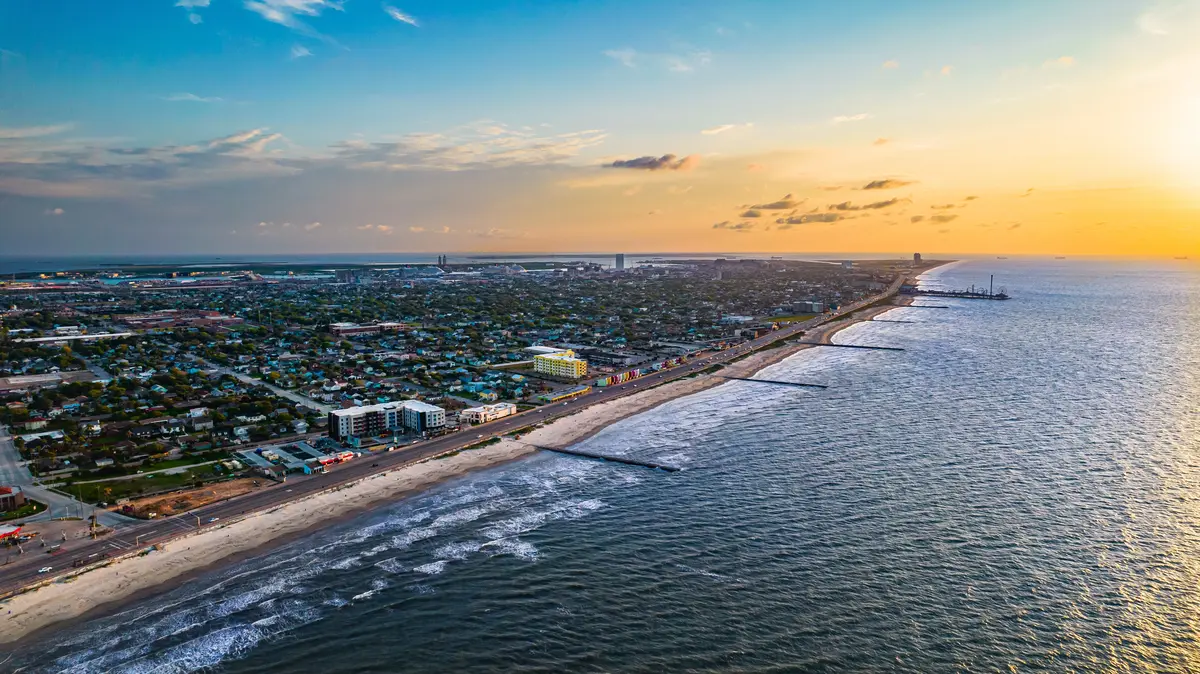
What It Really Costs to Live in Galveston
The headline number is more affordable than most coastal cities: the typical home price in Galveston is $320,772 (Zillow Home Value Index, July 2026) — a figure that would look like a bargain in virtually any coastal market outside Texas. But the sticker price on a Galveston home is not the full story. What drives total ownership costs above simple math is wind and flood insurance, which on a barrier island can add hundreds of dollars per month to a household budget that a spreadsheet built for an inland Texas suburb never accounted for.
Galveston runs below the U.S. average on overall costs and is roughly in line with the Texas average — a better position than many buyers assume when they hear "island" and expect premium pricing across the board. Compared to League City to the north, Galveston looks like a deal on housing. Compared to Texas City, it asks a real premium — most of it justified by proximity to the water and the island's character, not by higher local wages.
The honest posture: Galveston is below-average cost nationally, roughly average for Texas, and meaningfully shaped by coastal insurance exposure that doesn't show up in any standard comparison. Budget for that before you budget for anything else. For a full picture of the neighborhoods driving price variation, see the best neighborhoods guide.
Housing: Rent vs Buy in Galveston
The typical home on the island is priced at $320,772 (Zillow Home Value Index, July 2026), but entry-level inventory — older construction, smaller lots, homes that need updating — starts noticeably below that figure. The spread between entry-level and the city-wide typical is meaningful, and where those entry-level homes concentrate varies by part of the island; the best neighborhoods page breaks that geography down without attaching a price to any single area.
The effective property tax rate is approximately 1.72%, which is above the national average but entirely normal for Texas, where no state income tax means property taxes carry more of the government-funding load. Galveston ISD makes up the largest share of that bill. If you're buying a primary residence, the homestead exemption is worth filing promptly: Texas voters approved Proposition 13 in November 2025, raising the school-district homestead exemption to $140,000 — and homeowners 65 or older now qualify for a combined $200,000 exemption on school taxes. Primary-residence owners also benefit from a 10% annual cap on assessed-value increases, which matters in a coastal market where values can shift sharply after storm seasons.
The city-wide typical rent runs $1,366 per month (Zillow ZORI, July 2026), which is competitive for a coastal Texas market. Renting makes sense for people who are still learning the island's geography — which areas carry higher insurance exposure, which flood zones matter for long-term ownership — before locking into a purchase. Buying makes sense for those with a longer horizon and enough down payment to keep monthly ownership costs in check, since the mortgage principal on a typical Galveston home is only one piece of what you'll pay each month. The engine's mortgage calculator below this section can help you model the purchase side; just make sure your total monthly budget also accounts for insurance costs that any calculator here cannot include.
One thing worth understanding about the rental market: a significant share of Galveston's housing stock is used as short-term vacation rentals, which tightens long-term supply in desirable areas and can push rents higher than the city-wide typical in those pockets. If you're renting while you orient yourself, cast a wide net.

Everyday Costs Beyond Housing in Galveston
| Category | Typical Monthly Cost | Notes |
|---|---|---|
| Housing (typical rent) | $1,366/mo | City-wide typical rent. Buying? Use the calculator above for a mortgage estimate. |
| Utilities | $210–$310/mo | Electricity, gas, water, sewer, trash |
| Groceries | $500–$750/mo | Food at home, household of 2–3 |
| Transportation & Gas | $160–$280/mo | Fuel, and transit where it is a real option |
| Phone & Internet | $110–$180/mo | Mobile plan plus home broadband |
| Misc / Discretionary | $220–$420/mo | Dining out, entertainment, subscriptions |
Non-housing figures are estimates for a household of two to three, not a sourced index; housing is the city-wide typical rent (Zillow ZORI, July 2026). Refreshed with the rest of the city data.
Galveston's coastal climate is the dominant force behind non-housing utility costs. Summers are long, humid, and hot — air conditioning runs hard from May through October, and electricity is the largest utility line item on most household budgets. Galveston operates in a deregulated electricity market, meaning you choose your own retail electric provider for supply, while CenterPoint Energy handles transmission and distribution infrastructure. The practical tip locals share: shop and lock in a fixed-rate plan in spring or fall, when summer demand — and pricing — hasn't peaked yet. Combined monthly utilities (electricity, water, sewer, and trash) run roughly $220 for a typical household, which compares favorably against most Texas coastal markets.
Groceries track the broader Houston metro, since Galveston County is part of that survey area. Food prices are consistent with what you'd pay in the suburbs north of the city, though selection is more limited on the island itself — a serious shopping trip often means driving off the island, and that driving is a real transportation cost to factor in. Island Transit operates fixed-route bus service, a rubber-wheel trolley along Seawall Boulevard, and the Galveston Island Trolley heritage streetcar, providing genuine on-island mobility. A cross-bay bus route called The Splash, launched in December 2025 by Gulf Coast Transit District in partnership with Island Transit, connects the island to the Texas City mainland. For the Houston commute, though, most residents drive I-45 — roughly 55 minutes — and car ownership is effectively a given for daily island life.
Looking to buy in Galveston? Estimate your payment.
Enter your numbers to see an estimated monthly mortgage payment.
Estimate only. Excludes HOA fees and mortgage insurance. The interest rate above is a starting point, not a quoted rate — replace it with your own to see real numbers. Insurance is a flat placeholder, not a Galveston quote.
Galveston vs Nearby Cities: How the Costs Compare
| City | Typical Home Price | Typical Rent | Cost vs Galveston |
|---|---|---|---|
| Galveston (this city) | $320,772 | $1,366/mo | — |
| Texas City | $230,169 | $1,386/mo | 28% lower |
| League City | $378,258 | $1,811/mo | 18% higher |
| Friendswood | $464,253 | $2,324/mo | 45% higher |
Source — home prices: Zillow ZHVI, July 2026; rent: Zillow ZORI, July 2026. Nearby-city figures are the same series, refreshed together.
Galveston sits at a distinct price point from its neighbors, and understanding that positioning helps clarify what you're actually paying for when you choose the island over a mainland alternative.
League City to the north carries meaningfully higher home prices and rents than Galveston — you're paying for polished suburban infrastructure, newer construction, and lower insurance exposure. The beach is a commute away rather than walkable, and the lifestyle is fundamentally different. Families who prioritize school district performance and suburban amenities often land there; buyers who want coastal proximity tend to find the premium over Galveston hard to justify for what they get. For more on how those school systems stack up, the schools page has the details.
Texas City sits in the opposite direction on price — substantially below Galveston's typical home price, with a more industrial character and a mainland flood profile that differs from the island's. For buyers who want access to the bay region at an entry-level price point, Texas City makes sense. What you give up is Galveston's historic character, the Seawall, and the island identity that many buyers are actually moving here for.
Friendswood runs noticeably above Galveston on home prices and rents, with a reputation built on top-rated schools and a quiet suburban feel. It attracts households for whom school performance is the top priority and coastal access is secondary. La Marque lands below Galveston as one of the more affordable mainland entry points in the county, but with limited retail and amenities relative to the island.
Houston proper carries higher home prices and rents than Galveston in most submarkets, with the employment density to match. Many Galveston residents work in Houston and treat the island as a residential base — the 55-minute drive is the cost of that trade-off. For anyone already working remotely or employed on the island, that commute math disappears entirely, which is why remote workers are a significant and growing share of the buyer pool here.
This page shows a current price comparison table with figures drawn directly from the CSV under the "vs Nearby Cities" section of this page — that's where to find the sourced numbers side by side.
Taxes & the Bottom Line for Galveston
Texas levies no state income tax — full stop. Every dollar of wages, freelance income, retirement distributions, and investment gains is yours to keep at the state level, which is the single most meaningful tax advantage Galveston offers relative to California, Oregon, or any other income-tax state a buyer might be leaving. That absence of income tax is a significant real-dollar advantage that doesn't show up in any standard comparison index.
The state sales tax rate is 6.25%, and Galveston adds a local component that brings the combined rate to 8.25% — the Texas statutory maximum. That's consistent with most Texas cities and not a meaningful differentiator when comparing Galveston to League City, Texas City, or other nearby communities. What IS a differentiator is the property tax rate of approximately 1.72%, which is real money on a home at the city's typical price. The homestead exemption, the 10% annual cap on assessed-value increases, and the expanded senior exemption approved in Proposition 13 (November 2025) are the primary tools for managing that bill as a primary-residence owner. If you're an investor or vacation-home buyer who can't claim homestead status, you carry the full rate with no cap protection — a meaningful cost difference worth understanding before you close.
The honest bottom line: Galveston fits households that can sustain homeownership costs above what the city's median income alone would typically support, that value coastal living enough to pay a premium over inland Texas City, and that are prepared to budget seriously for wind and flood insurance as a real line item — not an afterthought. For remote workers earning above-median incomes, retirees with equity from higher-cost states, and dual-income households targeting a below-Houston-metro price point with walkable access to the water, the math here works. Buyers stretched thin at the typical home price, or those expecting insurance costs to be modest, tend to find Galveston a harder fit than they anticipated. For more on retiree-specific financial considerations, see the retiring in Galveston guide; for a full comparison with California's cost structure, the moving from California page runs those numbers side by side.
Tax Summary at a Glance
| Tax Type | Rate / Status | Notes |
|---|---|---|
| State Income Tax | None | Texas has no state income tax |
| State Sales Tax | 6.25% | Base Texas rate |
| Local Sales Tax | 2.00% | Combined rate capped at 8.25% |
| Effective Property Tax Rate | Approx. 1.72% | GISD is the largest share of bill |
| Homestead Exemption (school) | $140,000 off assessed value | Raised by Prop 13, November 2025 |
| Senior Homestead Exemption (school) | $200,000 combined off assessed value | Ages 65+, Prop 13, November 2025 |
| Annual Assessment Increase Cap | 10% per year (primary residence) | Applies after homestead exemption is filed |

Local Expert Takeaway: Galveston costs less than the national average on paper, but the island's real cost structure has a coastal surcharge that no standard index captures: wind and flood insurance. Buyers who lock in a fixed-rate electricity plan before summer, file for the homestead exemption at closing, and budget honestly for insurance come out ahead. Those who treat the typical home price as their monthly payment ceiling tend to feel squeezed within a year. The no-state-income-tax advantage is real and substantial — it's what makes Galveston genuinely viable for remote workers and retirees coming from higher-tax states, even after accounting for the 1.72% property tax rate.
Quick Takeaways & FAQs
✅ Texas has no state income tax, which meaningfully offsets Galveston's above-average property tax rate of approximately 1.72% — especially for higher earners relocating from states like California.
⚠️ Wind and flood insurance is the cost that surprises almost every buyer — it isn't reflected in the typical home price of $320,772 (July 2026) or in most budget estimates, but it can add hundreds of dollars to your actual monthly housing cost.
📍 The Galveston Island Trolley and Island Transit bus network provide genuine on-island mobility, but the roughly 55-minute commute to Houston via I-45 means most households need at least one car for daily life.
Is Galveston expensive compared to other Texas cities?
What is the property tax rate in Galveston?
How much does it cost to rent in Galveston?
What are utility costs like in Galveston?
Does the median household income in Galveston support buying a home here?
Moving to Texas?
Tell us what you need help with and we'll connect you with local resources.
