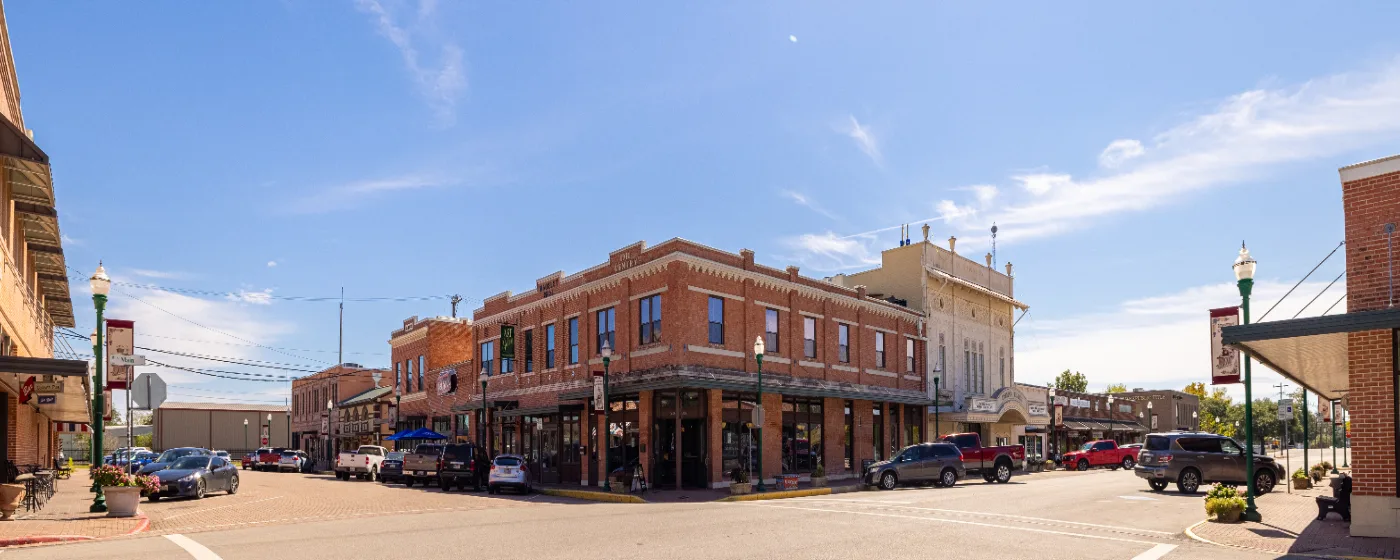
Conroe doesn't pitch itself as a retirement destination the way Florida cities do, and that's precisely why so many retirees from Houston are landing here. The city sits about 50 minutes to Houston along I-45, which means you keep proximity to a world-class medical center, international airports, and adult children's zip codes — without paying Houston-area prices for the privilege. At a typical home price of $315,986 (July 2026), Conroe is meaningfully more affordable than The Woodlands directly to its south, and the gap funds a lot of retirement.
What drives retirement decisions here is usually a combination of three things: the in-city hospital that punches well above its weight for a city of 119,564, a Texas tax environment that is genuinely favorable to retirees on fixed incomes, and the gravitational pull of Lake Conroe — a 21,000-acre reservoir that shapes the entire northern edge of the city and gives retirees a reason to stay active year-round. The master-planned communities that line the lake and the surrounding corridors were largely built for families, but their single-story floor plans and low-maintenance lots translate surprisingly well for people downsizing.
The honest caveats belong in the intro too. Conroe is a car-dependent city. Most errands require a drive, summer heat peaks around 95 degrees in July, and the city's walkability outside the small downtown core is minimal. Retirees who want to walk to coffee, a farmer's market, or a neighbor's porch without getting in a car will find the master-planned communities frustrating. The cost-of-living page breaks down the full budget picture, and the neighborhoods guide covers which areas feel most manageable on foot.
This guide covers the six questions that matter most for retirement: who Conroe genuinely fits, what healthcare looks like on the ground, what the retiree tax and budget picture adds up to, how active and social the community is, what downsizing options exist, and how Conroe stacks up against the retirement-relevant towns nearby.

Why Retirees Are Choosing Conroe
The retirees who land in Conroe and stay tend to share a few traits: they want a real house — not an apartment or a resort-style community — they want reliable medical access close by, and they don't mind driving for most things as long as the drive doesn't involve Houston traffic. For that profile, Conroe is a strong fit.
The financial case is real. At a typical home price of $315,986 (July 2026), Conroe sits noticeably below The Woodlands to its south — and that's before Texas's retiree-friendly tax structure does its work. Retirees arriving from high-income-tax states often describe the first full year of Texas residency as a meaningful shift in take-home income. The lake is not marketing copy either: Lake Conroe generates a social infrastructure — fishing clubs, boating, lakeside dining, an arts scene anchored by the Crighton Theatre and Owen Theatre — that genuinely sustains an active retirement.
Who should look elsewhere? Retirees who need to walk everywhere, who want urban density and transit, or who are sensitive to extreme summer heat will find Conroe harder than they expected. The city's 205 sunny days a year come with July afternoons near 95 degrees that push outdoor activity to early mornings and evenings from May through September. And retirees who depend on proximity to subspecialty academic medicine — major oncology programs, transplant centers — will eventually need to make the drive to the Texas Medical Center in Houston. For routine and even complex care, Conroe holds its own. For the most specialized procedures in the country, the city is a 50-minute drive from a place that does.
Healthcare & Medical Access in Conroe
The anchor of Conroe's healthcare picture is HCA Houston Healthcare Conroe, a 332-bed acute-care hospital inside city limits. It carries a Level II Trauma Center, an Accredited Chest Pain Center, and a Comprehensive Stroke Center certification from DNV Healthcare — a combination that matters enormously for retirees, who statistically have greater exposure to cardiac events and stroke than the general population. Having both time-sensitive certifications inside the city limits, rather than 30 minutes down the freeway, is not a small thing.
The depth of specialty care goes beyond the emergency credentials. The hospital offers heart and vascular surgery, neurological care, orthopedic surgery, and weight loss surgery, and functions as a regional tertiary referral center — meaning smaller regional hospitals send their more complex cases here rather than straight to Houston. That referral role signals something meaningful: this is a facility capable of handling cases that a typical community hospital would transfer out.
For the subspecialties that Conroe's campus doesn't cover — academic oncology, transplant programs, rare neurological conditions — the Texas Medical Center in Houston is the realistic destination. Montgomery County's broader healthcare network adds additional outpatient capacity: five regional hospitals and a wide array of specialist offices serve the county, so primary care, cardiology follow-ups, and orthopedic rehab are typically accessible without leaving the region. The honest read is that Conroe offers better in-city medical infrastructure than most Texas cities its size, with Houston as the backstop for anything beyond its reach.

The Retiree Budget in Conroe
Texas's tax posture toward retirees is about as favorable as any state in the country. There is no state income tax, which means Social Security benefits, pension income, 401(k) and IRA withdrawals, annuity payments, dividends, and capital gains are all free from Texas state taxation. Voters also approved a 2025 constitutional amendment prohibiting new estate, inheritance, and gift taxes — so wealth transfers to heirs carry no Texas-level tax exposure either.
Property taxes are the most significant cost variable for retirees considering Texas homeownership, and Conroe's effective rate is approximately 1.52%. That rate is the starting point; retirees 65 and older receive a substantial set of exemptions. Following voter approval of Proposition 11 in November 2025, qualifying homeowners now receive a combined $200,000 in school-district exemptions — the standard $140,000 homestead exemption plus an additional $60,000 over-65 exemption — effective for the 2026 tax year. Alongside those exemptions, the school-district portion of the tax bill is permanently frozen: once the over-65 exemption is approved, that school-tax amount can never rise above the level set in the first qualifying year, even as home values increase. For retirees on fixed incomes, that ceiling removes one of the biggest budget uncertainties in Texas homeownership.
Day-to-day costs on a fixed income run moderate. Groceries, utilities in the mild months, and local dining are in line with the broader Houston metro. Utilities climb in summer — air conditioning in a Texas July is not optional — and that seasonal spike is worth building into a retirement budget explicitly. For the full cost-of-living picture, including rent ranges for those not buying, see the Conroe cost-of-living guide.
Looking to buy in Conroe? Estimate your payment.
Enter your numbers to see an estimated monthly mortgage payment.
Estimate only. Excludes HOA fees and mortgage insurance. The interest rate above is a starting point, not a quoted rate — replace it with your own to see real numbers. Insurance is a flat placeholder, not a Conroe quote.
Walkability, Community & Staying Active in Conroe
The walkability picture in Conroe is honest and a little blunt: most of the city requires a car for most errands. The master-planned communities that line the I-45 corridor and spread toward Lake Conroe were designed around the automobile, and daily life in Harper's Preserve, Artavia, or Fosters Ridge reflects that. A retiree who wants to walk to coffee in the morning will find the suburban periphery frustrating.
The downtown core is the meaningful exception. The blocks around Conroe Founder's Plaza and Heritage Museum of Montgomery County function as a genuine small-town center — walkable, shaded in places, with independent coffee shops and a cultural anchor in the Crighton Theatre and Owen Theatre. Retirees who live close to downtown get a different daily experience than those in the master-planned communities five miles out. Most, however, end up in those communities — which means driving is simply part of the daily routine.
Community and Social Life
What Conroe does well is organized social infrastructure. Lake Conroe generates boating clubs, fishing groups, and a lake-oriented social calendar that is genuinely active. The Heritage Museum of Montgomery County draws volunteers and regular visitors. The Crighton Theatre runs a consistent performance season that brings a regional arts community together. Farmers Market at 1488 draws a weekly crowd and functions as one of the more reliable community gathering points in the county.
Retirees who engage with organized activity — clubs, volunteering, a standing weekend routine — tend to find the social fabric here substantial. Those who prefer to wander and stumble into community organically, the way you might in a walkable urban neighborhood, will have a harder time. The social life here is built; it does not happen by accident. Summers push outdoor activity to early morning or evening hours given the heat, but the lake and the Sam Houston National Forest to the north give active retirees real options across most of the year.
Right-Sizing: Downsizing in Conroe
Conroe's housing stock was built largely during the master-planned community boom of the 2000s and 2010s, which means the city has an unusually high proportion of single-story homes relative to older Texas cities. That's good news for retirees downsizing from a two-story family home: single-level living is a realistic expectation here, not a niche search. Patio homes — smaller lots, exterior maintenance handled by an HOA — appear throughout the master-planned communities and suit buyers who want to reduce upkeep without moving to an apartment.
Two age-restricted communities serve retirees specifically looking for purpose-built 55+ housing in Conroe: Villas at White Oak Ranch and Water Crest on Lake Conroe. Water Crest's name tells you the location — it sits on the lake's edge, and for retirees who want the lake experience baked into where they live rather than as a weekend destination, it is the more distinctive of the two options. Both offer the neighbor-age homogeneity that many retirees value, along with community amenities oriented toward active adults rather than families with young children.
For retirees who don't need an age-restricted community but want a smaller footprint, the broader single-family market in Conroe provides options. The neighborhoods guide covers the character and price tiers across the city's main communities. One practical note: the typical home here at $315,986 (July 2026) is below what many retirees arriving from higher-cost metros are used to spending, which means selling a California or northeast home frequently leaves equity to invest or to simply bank. That equity gap is one reason Conroe keeps appearing in retirement searches for Houston-area newcomers. Condo inventory in Conroe is limited compared with the single-family market — retirees with strong preferences for condo living may find the selection narrower than in The Woodlands or closer-in Houston suburbs.
Conroe vs Nearby Retirement Destinations
| City | Cost vs Conroe | Primary Hospital | Walkability | Senior Living Depth | Overall Retirement Fit |
|---|---|---|---|---|---|
| Conroe | Anchor | HCA Houston Healthcare Conroe (Level II Trauma, Comprehensive Stroke Center) | Car-dependent; downtown walkable | Two 55+ communities; broad single-story inventory | Strong: balanced cost, solid healthcare, lake lifestyle |
| The Woodlands | Noticeably higher | Houston Methodist The Woodlands Hospital | Better than Conroe; Village-center walkability | Extensive: multiple senior communities, active-adult clubs | Excellent but pricier; suits retirees prioritizing amenity depth |
| Montgomery | Noticeably higher | Relies on Conroe's HCA campus or Houston | Minimal; small-town rural feel | Very limited; mostly custom single-family | Best for retirees wanting rural quiet near the lake |
| Willis | Somewhat lower | Relies on Conroe's HCA campus | Minimal; car essential | Limited; smaller housing stock overall | Value option for buyers comfortable with longer drives to services |
| Magnolia | About the same | Relies on Conroe or Houston facilities | Minimal; growing suburb | Limited; newer single-family developments | Fits retirees wanting newer construction at similar cost, fewer amenities |
| Splendora | Somewhat lower | Relies on Conroe or regional facilities | Very limited; rural suburban | Minimal | Budget-focused option; trade-off is distance from services and healthcare |
The Woodlands is the most common alternative retirees weigh against Conroe, and the decision almost always comes down to budget versus amenity depth. The Woodlands delivers more walkable village centers, a more extensive senior social calendar, and a hospital campus of its own — but at a price that is noticeably higher than Conroe's typical home. For retirees who've sold a high-value home elsewhere and have the equity to absorb the premium, The Woodlands is the stronger overall retirement package. For retirees who need to watch the fixed-income math carefully, Conroe gives up relatively little on healthcare and lifestyle at a meaningfully lower price point.
Montgomery and Willis both lean on Conroe's HCA hospital for serious medical needs, which makes those towns viable only if you're comfortable driving to Conroe for anything beyond primary care. Willis offers a lower cost of entry but thinner services across the board. Montgomery costs more than Conroe for a rural lifestyle with fewer amenities — it suits retirees who specifically want the small-town lake-edge character and don't mind trading services for it. Magnolia and Splendora attract retirees primarily on price, but both require accepting real distance from the healthcare and social infrastructure that makes retirement in this region comfortable.

Local Expert Takeaway: Conroe works best for retirees who want a real house near a real lake, can handle the driving life without resentment, and want serious in-city medical infrastructure without paying The Woodlands prices. HCA Houston Healthcare Conroe's Level II Trauma and Comprehensive Stroke Center inside the city limits removes the biggest healthcare worry most retirees carry. Texas's over-65 property tax exemptions — now a combined $200,000 in school-district relief with a permanent freeze on that portion of the bill — make the ongoing ownership cost more predictable than the headline 1.52% rate suggests. The honest friction is the car dependency: plan for it, budget the gas, and find a neighborhood near downtown if walking matters to you.
Quick Takeaways & FAQs
✅ HCA Houston Healthcare Conroe operates a Level II Trauma Center and Comprehensive Stroke Center inside city limits — unusually strong in-city medical infrastructure for a Texas city of 119,564.
⚠️ Conroe is deeply car-dependent outside its small downtown core, and July heat averaging around 95°F limits outdoor activity to early mornings and evenings for roughly five months of the year.
📍 Texas homeowners 65 and older qualify for a combined $200,000 school-district exemption plus a permanent school-tax ceiling — two of the most retiree-favorable property tax benefits in the country, effective for the 2026 tax year following Proposition 11.
Does Texas tax Social Security or pension income for retirees?
What is the nearest hospital to Conroe, and how capable is it?
What property tax breaks do seniors get in Conroe?
Are there 55+ or active-adult communities in Conroe?
How does retiring in Conroe compare to retiring in The Woodlands?
Moving to Texas?
Tell us what you need help with and we'll connect you with local resources.
