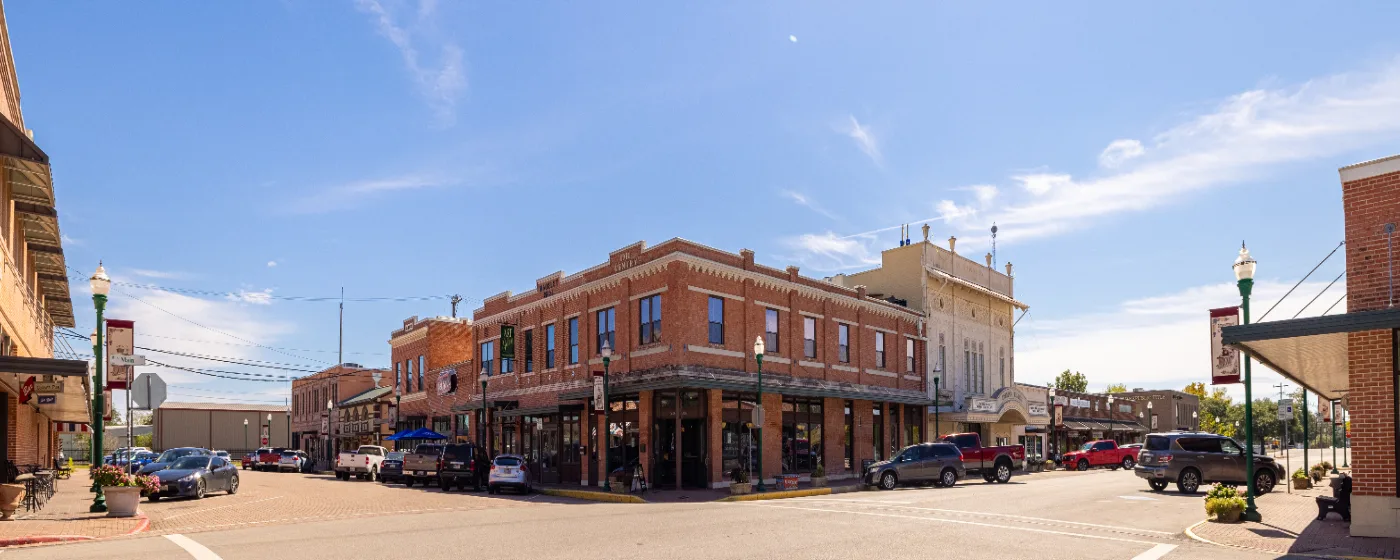
You've done the math. You know Texas has no state income tax, you've seen the Conroe home prices, and someone in your LinkedIn feed just posted a photo of their new backyard pool with the caption "couldn't have done this in California." The numbers are real. But the spreadsheet doesn't tell you that Conroe is not a sleepy small town anymore — it's a city of 119,564 people drawing more inbound moves than any other Houston-area suburb, with construction hoardings visible along Loop 336 and growth that is reshaping every corner of the city. Understanding what's driving it — and what it means for your daily life — is the actual work of this guide.
Conroe sits at the center of Montgomery County, about 40 miles north of downtown Houston along I-45. The Conroe Independent School District, one of the larger districts in Texas, holds a B rating, according to the Texas Education Agency — and for many California families, a large, rated public school district with recognizable structure is a genuine draw after years of navigating California's uneven district funding. Major employers anchor the local economy: the school district itself, the City of Conroe, Lone Star College–Montgomery, and ExxonMobil, whose petrochemicals campus is located in nearby Spring and employs a significant share of the north Houston commuter base. People move here for the schools, the lake, and the breathing room that comes with a lower price point than Houston's inner loop.
The cost of living in Conroe runs about 12% below the national average and noticeably below California's. Groceries run roughly 4% below the national average, gas is meaningfully cheaper, and the city-wide typical rent sits at $1,579 per month — a figure that reads as almost fictional if you're coming from the Bay Area or Los Angeles. Lake Conroe anchors the recreation calendar: fishing, boating, and shoreline trails are part of the reason families stay once they arrive. The trade-off is honest: Conroe is car-dependent, summer humidity is serious, and the rapid growth means some infrastructure — roads especially — is still catching up to the population.
Whether you're weighing a corporate relocation, chasing affordability after being priced out of your California city, or simply ready to stop paying California's top state income tax rate, the sections below break down the California-to-Conroe financial reality, what the housing market actually looks like, how the school district compares, what the lifestyle shift feels like, and what most Californians don't expect until month three.

The Tax Picture: What Texas Does (and Doesn't) Cost You
California's top state income tax rate of 13.3% is the sharpest single number in the California-to-Texas comparison — and even for earners well below the top bracket, California's progressive structure takes a real bite. Texas constitutionally prohibits a state income tax. That is not a policy that can be quietly reversed by a legislature; it requires a constitutional amendment. For a household earning $100,000, the annual state income tax savings runs approximately $5,208 compared to a California resident at the same income level.
California also imposes a State Disability Insurance payroll deduction on top of income tax. Texas has neither SDI nor state withholding, which means both employees and employers see lower deductions from the first paycheck in the new address.
The Property Tax Trade-Off
This is where Californians get surprised — and not always pleasantly. California's effective property tax rate of 0.71% is held low by Proposition 13, which caps assessments and limits annual increases. Conroe's effective property tax rate is 1.52%, more than double. The critical offset is the purchase price: Conroe's typical home value is $315,986 (Zillow Home Value Index, July 2026), while California's statewide typical home value of $773,735 is the figure you're comparing against. A 1.52% rate on $315,986 is a materially smaller dollar bill than a 0.71% rate on a California purchase price, in most scenarios. The cost of living page has the full breakdown with the actual numbers side by side.
Sales Tax and Everything Else
California's statewide base sales tax rate of 7.25% — the highest in the nation according to the Tax Foundation — combines with local additions to push California's combined average to roughly 8.99%. Texas's base rate is 6.25%; with local additions, the combined average in Conroe runs around 8.19%. The gap is real but modest at the individual-purchase level. The bigger savings show up in housing and income, not at the grocery checkout.
| Tax Category | California | Conroe / Texas |
|---|---|---|
| State income tax | Up to 13.3% (California Franchise Tax Board) | None — constitutionally prohibited |
| Effective property tax rate | 0.71% (Prop 13) | 1.52% (no cap on reassessment) |
| Statewide base sales tax | 7.25% base; ~8.99% combined with local | 6.25% base; ~8.19% combined with local |
| State Disability Insurance (SDI) | Yes — payroll deduction for employees | None |
| Estate / inheritance tax | None at state level | None |
| Overall cost of living vs. CA | Baseline | Approximately 39% less expensive (ERI) |
The overall picture is that Texas wins on income tax decisively, is roughly even on sales tax, and trades a lower property tax rate for a higher one — offset by dramatically lower purchase prices.
Housing: What California Money Buys in Conroe
Conroe's typical home value stands at $315,986 (Zillow Home Value Index, July 2026). California's statewide typical home value of $773,735 is the state-level benchmark — and the gap between those two figures is where most of the California-to-Conroe financial story lives. For many buyers arriving from California, the purchase price alone frees up capital they haven't had access to in years.
What that price buys is real square footage, newer construction, and suburban amenities that were out of reach in California at any reasonable budget. Master-planned communities like Grand Central Park, Harper's Preserve, and Artavia were built for this market: three- and four-bedroom homes with two-car garages, community pools, and trail systems, at price points that would represent entry-level condos in most California coastal metros.
Neighborhoods Worth Understanding
The neighborhoods page covers the full breakdown, but a few distinctions matter for California buyers specifically. Harper's Preserve, Graystone Hills, Jacobs Reserve, and Stewart's Forest all sit above the city median in price — these are the master-planned communities with the highest-finish new construction, resort-style amenities, and the kind of HOA infrastructure that California buyers from newer suburban markets will recognize immediately.
Fosters Ridge offers a more accessible entry point into the city's newer residential stock. Grand Central Park is the most commuter-oriented of the planned communities, designed around proximity to The Woodlands corridor and I-45. Artavia is one of the newer additions to the market and draws buyers who want walkable community design with lakeside features.
The Honest Catches
Two things catch California buyers off guard. First, the HOA fees in master-planned communities are real and recurring — budget for them before you fall in love with the amenity package. Second, flood insurance is a genuine line item in Montgomery County. Texas's property tax rate is already higher than California's, and adding flood coverage (required by most lenders in certain zones) changes the monthly math in ways that the headline purchase price doesn't signal.
The income-to-price gap is also worth naming honestly: the median household income in Conroe is $76,206, which runs below what's needed to qualify for the city's typical home at current rates. Many buyers arriving from California are coming with equity — sometimes substantial equity — and that equity is doing a lot of the work. If you're not carrying California sale proceeds, the affordability equation looks different.
Homeowners insurance is one cost that genuinely shifts in your favor. California's average homeowners insurance premiums rose 84% between the end of 2020 and March 2026 (Stanford Woods Institute), with seven of California's twelve largest insurers reducing or halting new underwriting. Texas has its own weather risk — hurricanes and tropical storms affect Montgomery County — but Conroe buyers are entering a market where standard coverage is still obtainable without routing through a state FAIR plan.

Schools, Safety, and the Daily Infrastructure
The Conroe Independent School District is one of the primary reasons families cite for choosing this city over other Houston suburbs. It is one of the larger districts in Texas — a scale that brings course breadth, UIL athletic programs, and the kind of institutional stability that smaller districts can't match. On 2024-25 state assessments, 58% of students reached math proficiency and 64% reached reading proficiency. The district holds a B rating, according to the Texas Education Agency, based on the 2025 A-F accountability rating for the 2024-25 school year.
For California families moving from districts where enrollment boundaries are redrawn frequently or where school quality varies block by block, CISD's consistency across its campuses is a real draw. The district runs active UIL athletics programs, and Friday night football is a genuine community event here — not a niche interest.
Safety in Context
Conroe carries a violent crime rate of 3 per 1,000 residents and a property crime rate of 18 per 1,000 residents. The state violent crime rate runs 4 per 1,000 and property crime 20.7 per 1,000. On both measures, Conroe runs below the Texas state average — context that matters when you're comparing a fast-growing city against your expectations.
Getting Around
This is where the California adjustment is steepest, but not in the way most people expect. Many California markets are also car-dependent — the trade-off isn't car vs. no car, it's which roads and how long. Conroe's main arteries are I-45, Loop 336, SH-105, SH-242, and SH-75. The commute reference point for Houston is about 50 minutes on I-45, which is honest about the distance — see the commute breakdown for peak-hour realities. What surprises California commuters after six months isn't the drive time — it's that gas costs genuinely less, the roads don't have tolls on every ramp, and a round trip to George Bush Intercontinental Airport, 33 miles away, is a manageable errand rather than a half-day commitment.
Routine care costs run a bit higher than the national average here, while health insurance premiums tend to run noticeably below what California residents were paying. The honest trade-off is the same one you get in most fast-growing mid-size cities: routine care is accessible, but advanced specialist care means a drive toward the Houston medical center.
Looking to buy in Conroe? Estimate your payment.
Enter your numbers to see an estimated monthly mortgage payment.
Estimate only. Excludes HOA fees and mortgage insurance. The interest rate above is a starting point, not a quoted rate — replace it with your own to see real numbers. Insurance is a flat placeholder, not a Conroe quote.
What the Lifestyle Shift Actually Feels Like
Conroe has drawn more inbound moves than any other Houston-area suburb in recent years, and the population pressure is visible. School pickup on Loop 336 generates real afternoon congestion. New subdivisions were breaking ground across the city well into 2025, adding neighborhoods to streets that had barely appeared on navigation apps. Anyone who settled here five years ago will tell you the city they knew then barely resembles today's version.
What Californians Don't Expect
The heat. Not the temperature — Californians from the inland valleys know triple digits. The humidity. Conroe sits in the East Texas piney woods, and summer afternoons from June through September are genuinely oppressive in a way that dry California heat is not. The city gets 205 sunny days a year, which is real but comes with the caveat that many of those summer days feel more like a sauna than a patio afternoon. Most residents adjust, but the adjustment takes one full summer.
The second surprise is social. Conroe has a well-established civic identity — the Crighton Theatre and the Owen Theatre anchor a performing arts scene that predates the growth surge; Conroe Founder's Plaza and the Heritage Museum of Montgomery County give the city a sense of history that newer Texas suburbs often lack. The culture is genuinely different from California's: more community-oriented around church, youth sports, and neighborhood events. That's a draw for some California families and a quiet friction point for others.
Weekends and Local Favorites
Lake Conroe is the social and recreational center of the city — boating, fishing, and waterfront time define the weekend calendar for most residents who settle here. The W.G. Jones State Forest and Sam Houston National Forest put real trail mileage within a short drive. Carriage Hills Park and Stewarts Creek Park serve the everyday outdoor calendar closer to the subdivisions. The Farmers Market at 1488 draws a consistent local crowd through the growing season.
The dining and coffee scene has matured alongside the population. Vernon's Kuntry Katfish is the kind of institution that has outlasted multiple growth cycles and remains genuinely beloved. The Catch: Conroe and Pacific Yard House round out a casual dining scene that's broader than the city's size might suggest. For coffee, Ruah Café, Hellcat Coffee Co. Ltd, Galindo's Coffee + Elixirs, Texas Grind Coffee Co., and Galavants Coffee represent an independent café scene that California transplants consistently mention as better than they expected. Benihana and Joe's Italian Restaurant fill out the sit-down options.
What Californians consistently say after six months: they miss on-foot access more than they expected. Conroe is car-dependent in the full sense — a walk to the coffee shop is not the default social act here. That's not a dealbreaker for most people who've already processed the compromise. But it's the thing that goes unstated in every conversation about Montgomery County growth.
The Move Itself: Timing, Equity, and What to Do First
Most California buyers arriving in Conroe are carrying equity. That equity — often six figures, sometimes substantially more — is doing the structural work that income alone can't do in this market. Understanding that dynamic changes how you approach the move: you're not just relocating, you're redeploying capital from one of the world's most expensive real estate markets into one that runs noticeably lower.
What to Know Before You Shop
The master-planned communities in Conroe sell new construction quickly. Builders in Grand Central Park and Artavia often have waitlists for specific floor plans and limited inventory at any given time. Harper's Preserve, Graystone Hills, Jacobs Reserve, and Stewart's Forest — all of which sit above the city median in price — similarly see brisk demand for higher-finish inventory. California buyers accustomed to bidding wars on resale homes sometimes find new construction more straightforward, but the builder contracts and upgrade pricing structures are different from anything a California purchase involves. The buying process page has the full walkthrough of what Texas-specific steps look like.
Why People Leave — and Why People Stay
The reasons people move out of Conroe after two or three years are predictable: Loop 336 congestion gets old, some buyers discover they want a denser urban environment than Conroe provides, and a subset of remote workers realize they've moved to a car-dependent suburb without a compelling reason to be in any particular one. The Houston Medical Center and the cultural density of Montrose or Midtown pull some families back toward the inner loop.
The reasons people stay are equally consistent: the schools, Lake Conroe, the price-to-space ratio that no California market can match, and — for the income earners who feel California's top state income tax rate most acutely — the permanent, structural relief of a zero-income-tax state. That last factor compounds every year.
Practical First Steps
Update your Texas driver's license within 90 days of establishing residency — Texas enforces this, and it is also the trigger for your homestead exemption application, which reduces your taxable property value and is worth filing immediately after closing. Texas does not have a state income tax return to file, which simplifies April considerably. If you own a vehicle, the Texas registration and inspection process runs on a combined annual schedule that California buyers find simpler than the separate smog-and-renewal cycle. The cost of living page covers the full picture of what the monthly budget looks like once you're settled.
Conroe's growth trajectory — among the most active inbound-migration destinations in the Houston metro, in a region that has consistently ranked among the fastest-growing in the country — means this is not a static market. The city you move into will be meaningfully different in five years. That can work in your favor as a buyer. It also means you should research current road projects and school boundary lines before committing to a specific subdivision, because both change more often than the master plan brochures suggest.

Local Expert Takeaway: California equity buys real square footage in Conroe — and the zero-income-tax environment means the savings compound every year, not just at closing. The honest adjustment is summer humidity, car dependence, and a growth rate that means the city is always slightly under construction. If you're coming from a California market where a typical home runs against a state median well above $700,000, the Conroe entry point at $315,986 (July 2026) represents a structural reset, not just a deal. Do your school boundary research before you pick a subdivision, file your homestead exemption the week after closing, and plan one full summer before you decide whether the heat is manageable.
Quick Takeaways & FAQs
✅ Texas has no state income tax — constitutionally prohibited — which means the savings begin with your first Texas paycheck and compound every year you stay.
⚠️ Conroe's effective property tax rate of 1.52% is more than double California's, and flood insurance is a real line item in Montgomery County — budget for both before you fall in love with a floor plan.
📍 Conroe is drawing more inbound moves than any other Houston-area suburb, which means master-planned communities move quickly — new construction waitlists are common, and school boundary lines shift as new campuses open.
Is Conroe, TX actually affordable compared to California?
What is the property tax rate in Conroe, and how does it compare to California?
How are the schools in Conroe compared to California?
How far is Conroe from Houston, and is the commute realistic?
What do Californians most commonly regret after moving to Conroe?
Moving to Texas?
Tell us what you need help with and we'll connect you with local resources.
