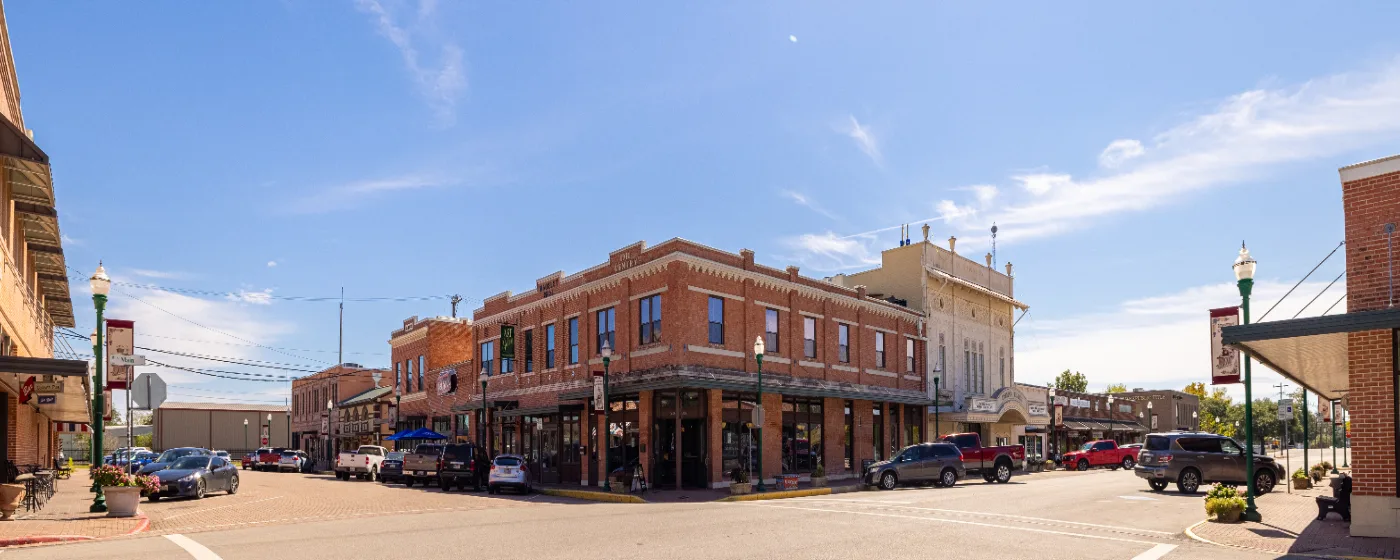
Most people asking whether Conroe is safe are really asking two different questions: how does the city stack up against state and national benchmarks, and which parts of town should they actually pay attention to? The answers to those two questions are very different. At the city-wide level, Conroe compares favorably — but the city covers approximately 77.5 square miles and holds a population of 119,564, and crime doesn't distribute itself evenly across that geography. Where you land in Conroe matters more than the headline number.
Conroe sits at the northern edge of the Houston metro, connected by I-45, and has grown rapidly over the past two decades as families priced out of The Woodlands and the inner suburbs looked for something more affordable with room to breathe. That growth brought master-planned communities with active HOA oversight and security-conscious design alongside older commercial corridors that see a very different kind of foot traffic. Both realities show up in the crime data, and understanding the difference is the single most useful thing you can do before choosing a neighborhood here.
The city's typical home price sits at $315,986 (July 2026) — see the full cost picture at the cost of living page — and the relative affordability compared to nearby markets has kept demand steady. That demand has also meant continued investment in public safety infrastructure. The Conroe Police Department is accredited by the Texas Police Chiefs Association Best Practices Accreditation Program, a credential that reflects organizational standards most departments in the state don't pursue. Whether that translates to a neighborhood you'd feel comfortable in depends on where you're looking, and this guide breaks it all down.
The sections below cover Conroe's overall crime rates in context, how safety varies across the city's geography, which neighborhoods consistently rank as the quietest, what the Conroe Police Department looks like in practice, and what to watch for when you're researching a specific area.

Conroe's Crime Rates in Context
Conroe carries a violent crime rate of 3 per 1,000 residents and a property crime rate of 18 per 1,000 residents. Both figures sit below their Texas and national counterparts — the state violent crime rate is 4 per 1,000, the national violent crime rate is 3.7 per 1,000, the state property crime rate is 20.7 per 1,000, and the national property crime rate is 18.4 per 1,000.
That context matters. A city of Conroe's size and growth rate — one that added tens of thousands of residents in the past decade and sits along a major interstate — being below both state and national benchmarks on violent crime is a meaningful data point, not a given.
The mix of crimes is also telling. Larceny-theft is by far the most common offense, and property crime outnumbers violent crime by a wide margin. That ratio matters when you're thinking about day-to-day risk: the concern in most of Conroe isn't physical safety in the traditional sense — it's leaving a laptop visible in a parked car near a busy retail strip.
When compared to cities of similar population size nationally, Conroe's overall crime rate runs noticeably lower than average. That peer comparison is often more useful than a raw number, because a city of 119,564 faces different pressures than a small town — more commercial traffic, more transit of strangers, more retail density — and Conroe still comes out favorably on that measure. The city recorded only one homicide in 2024, which is low for a city this size.
What the city-wide averages don't show you is the geographic variation within Conroe — and that variation is significant enough to drive the neighborhood decision.
Where Crime Concentrates — and Why
The northwest part of Conroe logs far more total incidents than any other part of the city, while the southwest logs the fewest. That difference — more than three to one between the busiest and quietest zones — is largely explained by what sits in the northwest: commercial corridors, retail centers, and the kind of high-traffic environments where property crime concentrates around shoppers and visitors rather than residents.
This is a point worth sitting with. Crime statistics are typically reported by where an incident occurs, not where the offender or victim lives. A theft in a parking lot near I-45 raises the count for that zone whether the person victimized lives in Conroe or drove in from Montgomery County. When you see elevated incident counts in commercial-heavy parts of town, a meaningful share of that reflects visitor and shopper traffic rather than the risk environment for someone living in a nearby neighborhood.
For violent crime specifically, the geography is equally stark. The chance of being a violent crime victim is materially higher in the northwest than in the southwest. Residents and independent safety analysts consistently identify the southwest as the city's safest residential corridor — a distinction that holds up across multiple data sources, not just one.
The practical implication for anyone choosing a neighborhood: a ZIP code or general area search isn't granular enough. The difference between a neighborhood on the commercial side of Loop 336 and one tucked into the southwest quarter can be substantial, and the city-wide average won't tell you which one you're looking at. Spend time with the neighborhood-level picture at the neighborhoods page before settling on an area.
One Pattern That Surprises Newcomers
People who move to Conroe from smaller markets are sometimes caught off guard in month three when they discover their car was rummaged overnight — not broken into, but gone through because a door was left unlocked. The consistent pattern across the city's safer neighborhoods isn't dramatic crime; it's opportunistic property theft targeting unlocked vehicles in driveways and parking areas. The fix is simple, but it's the thing nobody warns you about.

Neighborhood Safety: Where to Focus Your Research
Conroe's master-planned communities occupy a different safety category than the city's older, less planned sections. Grand Central Park, Graystone Hills, Harper's Preserve, Jacobs Reserve, Stewart's Forest, Fosters Ridge, and Artavia were all developed with modern HOA structures that include active covenant enforcement, controlled access in some cases, and community design features that reduce crime opportunity. That's not marketing language — it's a documented pattern in how planned residential environments differ from organic ones.
The Gated and HOA-Managed Communities
Harper's Preserve operates as a gated community, which eliminates most stranger-related violent crime in its residential sections. The incidents that do get logged in gated communities across Conroe are almost entirely unlocked-vehicle break-ins — a property crime category, and one that residents largely control through their own behavior.
Graystone Hills consistently surfaces in safety analyses for its low incident rates and quiet residential character. Set in rolling, wooded terrain, it draws families who want the suburban quiet without being distant from downtown Conroe. Multiple independent sources — not just real estate listings — flag it as among the city's lower-risk residential areas.
The Master-Planned Corridor
Grand Central Park carries a safety reputation that holds up across sources, with HOA protocols and modern infrastructure design that keep incident counts well below Texas state averages. Artavia, Jacobs Reserve, and Stewart's Forest occupy a similar tier — new construction, active community management, and the kind of neighborhood homogeneity that tends to keep crime rates low. These are not accident; they reflect deliberate development choices made in the past decade.
Fosters Ridge sits in the same general southwest-to-north corridor that benefits from lower commercial density and newer housing stock. For families researching the Conroe ISD school boundaries alongside safety, these neighborhoods tend to overlap well with the district's higher-performing campuses.
What Older Parts of Town Look Like
The areas closest to downtown Conroe and the older commercial stretches along SH-105 have more mixed profiles. They're not high-crime by any reasonable standard, but they lack the HOA structure and controlled access of the newer communities, and their proximity to retail corridors means they absorb more of the opportunistic property crime the city sees. For buyers who want walkable access to downtown amenities like Crighton Theatre or Conroe Founder's Plaza, that trade-off is real — more character, less insulation from the city's commercial traffic.
Best for: Families Quiet Residential — Graystone Hills, Harper's Preserve, Grand Central Park. Walkable Access — older downtown-adjacent neighborhoods with a more mixed safety picture.Looking to buy in Conroe? Estimate your payment.
Enter your numbers to see an estimated monthly mortgage payment.
Estimate only. Excludes HOA fees and mortgage insurance. The interest rate above is a starting point, not a quoted rate — replace it with your own to see real numbers. Insurance is a flat placeholder, not a Conroe quote.
The Conroe Police Department: What Residents Actually Experience
The Conroe Police Department serves roughly 77.5 square miles — a coverage area that includes both the dense commercial core and the sprawling residential edges of a fast-growing city. The department holds accreditation from the Texas Police Chiefs Association Best Practices Accreditation Program, which is a substantive organizational credential that relatively few Texas departments maintain. It signals a department that has submitted to external review of its policies, procedures, and training standards.
Response times vary by location, as they do in any city with significant geographic spread. Residents in the newer master-planned communities on the city's edges sometimes note that response times feel longer than those in the denser core — a practical reality of policing a city that has expanded faster than its central footprint. It's worth asking about when you're researching a specific neighborhood, not something to assume is uniform across Conroe.
Community Engagement That Goes Beyond a Hotline
The department runs a Citizens Police Academy — a structured program that includes classroom instruction, hands-on training, and a ride-along with a patrol officer. Programs like this tend to be leading indicators of a department that invests in community relationships rather than just enforcement numbers. Participation is open to residents, and the program consistently has a waiting list, which itself says something about community interest.
Property crime has trended downward over the five years from 2020 to 2024, even as the city's population and commercial density grew. Violent crime has moved the other direction — gradually upward — over the same period, which is a trend worth acknowledging honestly. The violent crime rate still sits below state and national benchmarks, but the direction is a reason to pay attention to neighborhood-level data rather than resting on the city-wide headline.
How to Research Safety Before Choosing a Neighborhood
The city-wide rates give you the baseline — below state and national averages on both violent and property crime — but the neighborhood decision deserves a more granular look. Here's how to approach it practically.
Use Geographic Crime Tools, Not Just City-Wide Stats
Tools like CrimeGrade and the Conroe Police Department's public crime mapping show incident density at a level far more useful than a single city-wide number. Search by the specific neighborhood or even the ZIP code you're considering, and pay attention to the type of crime, not just the count. A neighborhood with many larceny-theft incidents is a very different place from one with a cluster of aggravated assaults — even if a raw incident count makes them look comparable.
Understand What Elevated Numbers Near Commercial Corridors Mean
If a property you're considering sits near a retail center or a commercial stretch of I-45, Loop 336, or SH-242, the crime counts for that zone will reflect shopper and visitor traffic. That's not irrelevant — it means the area has higher foot traffic from strangers — but it doesn't translate directly into residential risk the way it would if those incidents were happening in quiet cul-de-sacs. Read the data type, not just the number.
Ask About HOA Safety Protocols Specifically
In Conroe's master-planned communities, HOA covenants often include provisions that directly affect security: lighting standards, rules about overnight parking, speed enforcement, and in some cases relationships with private patrol services. These vary significantly between communities and are worth asking about directly — they're part of the safety picture that no public crime database captures.
Visit at Different Times
This is obvious advice that most people don't follow. A neighborhood on a Tuesday afternoon and the same neighborhood on a Friday evening near a commercial corridor are two different environments. The southwest neighborhoods that consistently rank safest tend to be quiet at both times — that consistency is part of what makes them stand out. If you're considering an area near the commercial north or northwest, an evening visit gives you a more honest read.
For a broader picture of which neighborhoods fit which buyer profiles — beyond just safety — the neighborhoods guide covers the full range of community character across Conroe's major residential areas.

Local Expert Takeaway: Conroe's city-wide crime rates are genuinely below state and national benchmarks, and that's not spin — the numbers hold up across multiple independent sources. The real story is geographic: the southwest quarter of the city, anchored by master-planned communities like Grand Central Park, Graystone Hills, and Harper's Preserve, operates at a materially lower risk level than the commercial-heavy northwest. If you're choosing between areas in Conroe, the single most useful move is to pull neighborhood-level crime data for the specific ZIP codes you're considering rather than relying on the city-wide average — the gap between Conroe's quietest corners and its busiest corridors is wide enough to change the calculus entirely.
Quick Takeaways & FAQs
✅ Conroe carries a violent crime rate of 3 per 1,000 residents, which sits below both the Texas state average and the national average — a meaningful result for a fast-growing city of its size along a major interstate.
⚠️ Safety varies sharply by location — the northwest commercial corridor logs far more incidents than the quieter southwest, so the city-wide average can mislead buyers researching a specific area.
📍 The Conroe Police Department is accredited by the Texas Police Chiefs Association Best Practices Accreditation Program and runs a Citizens Police Academy open to residents — two markers of an organizationally serious department.
Is Conroe, TX a safe place to live?
Which neighborhoods in Conroe have the lowest crime rates?
How does Conroe's crime rate compare to Houston and The Woodlands?
Is property crime a bigger concern than violent crime in Conroe?
Is the commercial area near I-45 in Conroe less safe to live near?
Moving to Texas?
Tell us what you need help with and we'll connect you with local resources.
