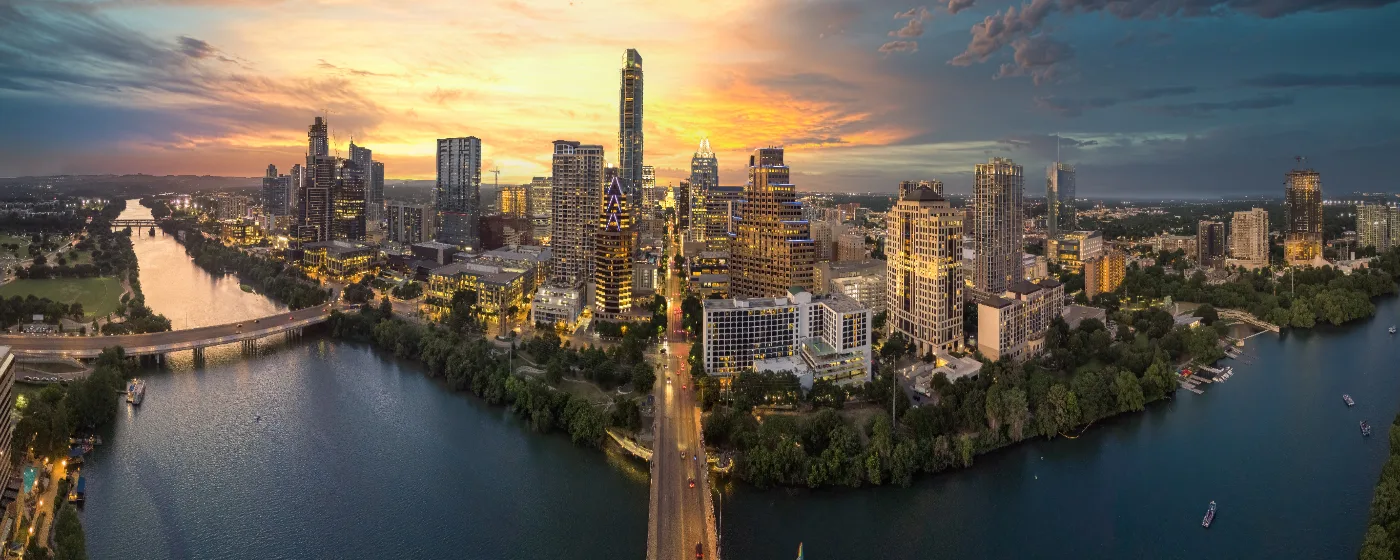
Most people moving to Austin ask the safety question in the wrong order. They search "is Austin safe" and get a city-wide number, then either relax or panic — without realizing that the city-wide figure is almost meaningless for a place that spans 328 square miles and 1,002,632 residents. Austin is not uniformly safe or uniformly dangerous. It is a city where your exposure to property crime in the western suburbs can be dramatically lower than in the central core, and where the type of crime — violent versus property — tells a very different story depending on which question you're actually asking.
The headline numbers place Austin in roughly the middle of the pack among large American cities — a reasonable result for a city of this size and growth rate. The more useful signal is the direction of travel: homicides fell to 50 by mid-November 2025, one of the sharpest single-year drops in recent Austin history, and violent crime has been declining since its 2021 peak. Property crime is the stickier problem.
Austin carries a violent crime rate of 4.7 per 1,000 residents and a property crime rate of 33 per 1,000 residents. Those figures sit modestly above both the Texas state average and the national average — which puts Austin in the same honest category as most large, fast-growing Sun Belt cities: safer than its size and density might suggest, but not the low-crime suburb some relocating buyers expect. The cost of crime per Austin resident runs approximately $404 per year, measurably below both the Texas and national averages, which suggests the aggregate burden is lower than the raw rates imply.
Whether you're considering a move or weighing one neighborhood against another, the sections below break down Austin's crime rates in context, map the safety picture across specific neighborhoods, explain what's driving property crime, and walk through what the city is actively doing about it.

Austin's Crime Rates in Context
Austin carries a violent crime rate of 4.7 per 1,000 residents and a property crime rate of 33 per 1,000 residents (Bureau of Justice Statistics, Crime Known to Law Enforcement, 2024). For context, the Texas state average sits at 4 per 1,000 for violent crime and 20.7 per 1,000 for property crime; the national figures are 3.7 per 1,000 for violent crime and 18.4 per 1,000 for property crime.
That comparison puts Austin's violent crime rate close to — though modestly above — both state and national benchmarks. Its property crime rate is the real gap: nearly double the national figure. Vehicle theft, catalytic converter theft, and residential burglary account for most of that spread, and they are not distributed evenly across the city.
What those aggregates don't capture is the trend. Violent crime in Austin has declined meaningfully since its 2021 peak, and homicides dropped sharply in 2025. A city of over a million people at the top of its growth curve posting a declining violent crime rate is a notable data point — not a reason to skip neighborhood-level research, but a reason to read the numbers without alarm.
Among major Texas cities, the comparison is favorable. Austin's violent crime rate runs noticeably below Dallas and substantially below Houston on the same reporting basis. That context matters if you're relocating from another large Texas metro and benchmarking relative risk.
How Safety Varies by Neighborhood
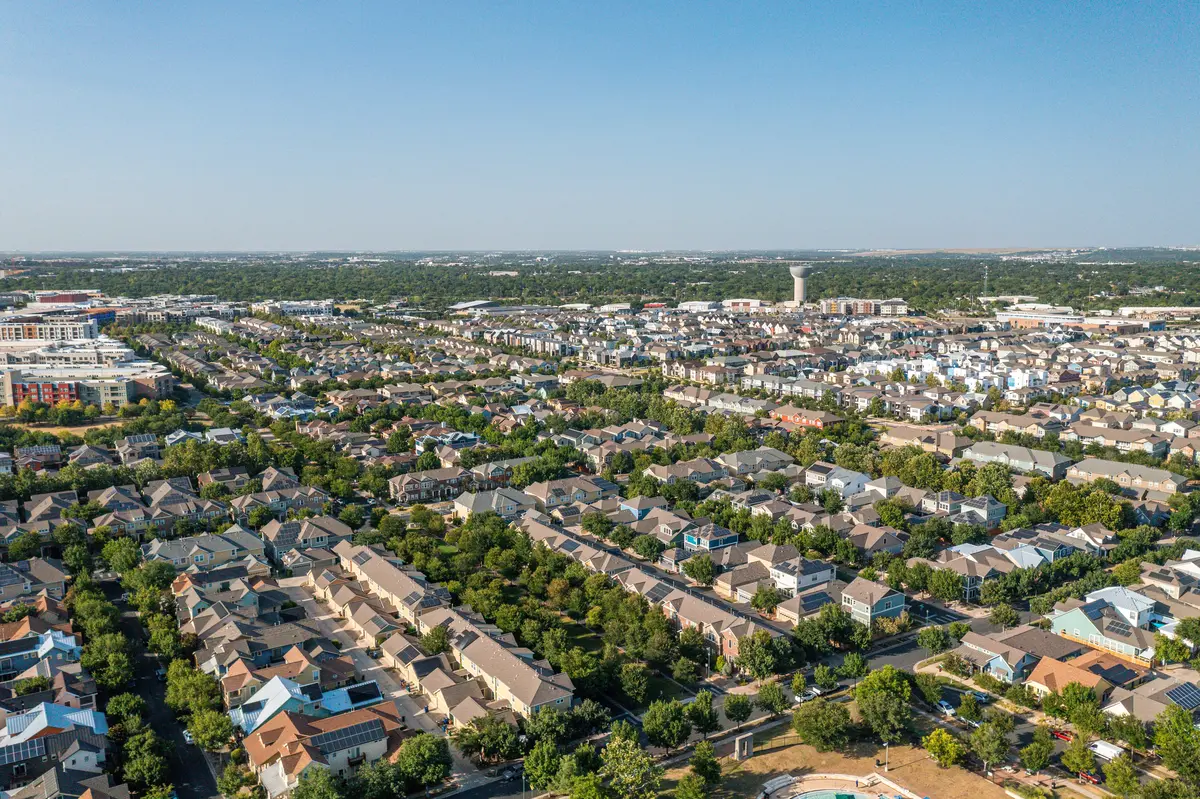
The single most important thing to understand about Austin's safety picture is its geography. The western and southwestern residential neighborhoods see significantly fewer incidents than the central corridors and the denser east-side commercial zones — location alone can make a meaningful difference in day-to-day exposure to property crime.
The safest areas in Austin cluster in two broad zones: the far west and southwest suburbs, and certain master-planned or association-governed communities elsewhere in the city. Among the established neighborhoods, Circle C Ranch, Tarrytown, Mueller, Allandale, and Hyde Park consistently rank near the top of neighborhood-level safety analyses. Each benefits from a different structural advantage.
Circle C Ranch and Avery Ranch / Steiner Ranch
These planned communities in the western and northwestern corridors sit in the lower-incident zone of the city. The residential southwest sees relatively few property crime incidents compared to Austin's commercial and transitional corridors. Managed common spaces and active homeowner associations create the kind of community infrastructure that correlates with lower property crime. If minimizing property crime exposure is your primary filter, the far western developments are where the data points.
Mueller
Mueller is the planned redevelopment of the old Robert Mueller Municipal Airport site, and it punches above its geographic weight on safety. Its managed common areas, walkable street grid, and active community infrastructure contribute to property crime rates that run below what the surrounding east Austin corridor would suggest. Mueller sits above the city median on home price — see the full neighborhood breakdown on the best neighborhoods page — but buyers choosing it partly for its safety profile tend to find that combination worth it.
Hyde Park and Allandale
Both neighborhoods run active associations that maintain street-level order and resident engagement. Hyde Park, just north of the University of Texas at Austin campus, benefits from its residential density and established community culture. Allandale, farther northwest, is a quieter single-family zone with low turnover and strong neighbor familiarity — the kind of block where people know each other's cars, which tends to deter opportunistic property crime.
East Austin and South Congress / South Lamar
These are Austin's most culturally active corridors and, by the same token, the ones where property crime is more present. East Austin sits above the city median in home prices, which reflects its desirability — but the higher foot traffic, denser commercial activity, and proximity to the central corridors place it in a higher property-crime tier. This is the trade-off buyers in these neighborhoods make consciously, not a reason to avoid them, but a reason to factor it into your decision.
Best for: Families prioritizing the lowest crime risk: Circle C Ranch Tarrytown. Buyers who want urban amenities with better-than-average safety: Mueller Hyde Park.
Property Crime: The Stickier Problem
Austin's violent crime decline is real and encouraging. Its property crime rate is the number that should give a relocating buyer pause — not because it signals danger, but because it shapes the practical experience of living here in ways that violent crime statistics don't.
Vehicle theft is the most reported category. Catalytic converter theft became particularly concentrated in Austin's central and near-east corridors, where older housing stock and street parking are common. Residential burglary tends to cluster in transitional zones — blocks that sit at the edge of commercial corridors or near high-traffic arterials. These patterns mean that your garage, your parking setup, and your block's commercial adjacency matter more in Austin than in a lower-property-crime city.
The cost framing is worth noting: the estimated annual crime cost per Austin resident runs approximately $404, which is measurably below both the Texas state average and the national average. That suggests the financial and physical impact of property crime, while higher in raw rate, is spread across enough incidents that the per-person burden remains manageable relative to comparable large cities.
What that doesn't mean is that the risk is distributed evenly. Before you decide on a neighborhood, check CrimeGrade.org or the Austin Police Department's public crime mapping tool for the specific blocks you're considering — not the zip code, and not the neighborhood label. A single street's distance from a commercial corridor can make a measurable difference in property crime exposure.
The practical steps most Austin residents take: garage parking where available, steering column locks on older vehicles, and motion-sensor lighting for street-facing properties. These are habits that residents in the central and east-side corridors develop quickly, usually within the first six months.
Looking to buy in Austin? Estimate your payment.
Enter your numbers to see an estimated monthly mortgage payment.
Estimate only. Excludes HOA fees and mortgage insurance. The interest rate above is a starting point, not a quoted rate — replace it with your own to see real numbers. Insurance is a flat placeholder, not a Austin quote.
What Austin Is Doing About It
Austin's response to its crime picture has moved on several fronts since 2022, and the institutional investment is worth understanding if you're evaluating the city's trajectory rather than just its current snapshot.
In October 2024, Austin City Council established the Downtown Area Command, stationing EMS medics and vehicles downtown on weekends and during special events — a direct response to safety incidents near Lady Bird Lake. The structure puts medical response closer to the highest-density entertainment zones rather than routing everything through the standard dispatch system.
The Austin Police Department's Community Police Academy has graduated 2,891 community members across 107 classes as of May 2026. That number reflects a sustained effort to build civilian familiarity with law enforcement operations — not a headline program, but a consistent one that a city serious about community safety tends to maintain over time.
In August 2025, UT Austin's police department and APD formalized a cross-training partnership under a signed Memorandum of Understanding, creating a shared West Campus Patrol District designed to improve response times near the University of Texas at Austin campus. That area — dense with student housing, late-night foot traffic, and proximity to commercial corridors — had historically been a coordination gap between two agencies with overlapping jurisdiction.
Austin's Vision Zero program is driving pedestrian infrastructure upgrades, including improved lighting and crosswalk safety in historically underlit areas. The program targets the intersections where traffic fatalities and pedestrian incidents concentrate, which is a different safety dimension from crime but equally relevant to daily life. Expansions were expected through 2026.
None of these programs erases the property crime gap. But for a buyer weighing Austin's trajectory, the institutional posture is forward-moving rather than reactive — and the homicide trend line is the clearest evidence that something is working on the violent crime side.
What to Research Before You Choose a Neighborhood
City-wide statistics are the starting point, not the answer. Austin's aggregate crime rate tells you Austin is roughly mid-pack among large American cities — useful framing, but not enough to choose a block. The geography of safety in a 328-square-mile city requires neighborhood-level and block-level research, and Austin makes that reasonably accessible.
Use Block-Level Tools, Not Zip Codes
The Austin Police Department publishes a public crime mapping tool that lets you search by address and date range. CrimeGrade.org provides aggregated neighborhood grades. Neither is a perfect predictor, but both are far more useful than city-wide averages when you're evaluating a specific street. Zip codes span too much variation to be meaningful in Austin — a single zip code in the 78702 or 78741 range can include both low-crime residential blocks and high-traffic commercial corridors with meaningfully different property crime patterns.
Ask About Parking and Street Exposure
Austin's vehicle theft concentration makes this a practical question, not a paranoid one. A home with a closed garage in Circle C Ranch or Mueller sits in a different risk category from a street-parked vehicle in a dense East Austin corridor. If you drive an older truck or an SUV with an accessible catalytic converter, that matters more here than in many cities your friends might have moved from.
Factor In the Neighborhood Association
Hyde Park and Allandale have active neighborhood associations that coordinate on safety, lighting, and maintenance. Mueller's managed common spaces serve a similar function. These structures don't eliminate property crime, but they correlate with lower rates — and they signal the kind of community investment that tends to sustain neighborhood character over time. It's worth asking, before settling on an area, whether an active association exists and how engaged it is.
The Six-Month Reality
People who move to Austin from lower-crime cities — particularly from smaller Texas metros or the suburbs of comparable metros — often say the same thing around month six: property crime is more present than they expected, even in neighborhoods that felt clearly residential. A catalytic converter gone from a driveway. A package stolen from a porch. These incidents are not universal, but they are common enough that long-time Austin residents treat basic deterrence as routine rather than precautionary. Going in with that calibration tends to produce a more accurate picture of what daily life here actually involves.
For a full picture of Austin's neighborhoods — character, housing stock, and who each area suits — see the best neighborhoods in Austin page.

Local Expert Takeaway: Austin is not an unsafe city, but it is not a low-crime one either. The violent crime trend is genuinely improving — homicides dropped sharply in 2025 and the rate has declined since its 2021 peak. A property crime rate of 33 per 1,000 residents is the honest concern: vehicle theft and burglary run well above state and national averages, and they concentrate in specific corridors rather than spreading evenly across the city. Buyers who do block-level research before choosing a neighborhood — rather than relying on city-wide averages — consistently land in areas where those risks are manageable. Circle C Ranch, Tarrytown, Mueller, Allandale, and Hyde Park are the neighborhoods where the data and the resident experience most consistently align on safety.
Quick Takeaways & FAQs
✅ Homicides in Austin fell to 50 by mid-November 2025, one of the sharpest single-year drops in the city's recent history — the violent crime trend is moving in the right direction.
⚠️ Austin carries a property crime rate of 33 per 1,000 residents, running substantially above both the Texas state average and the national figure, with vehicle theft and catalytic converter theft concentrated in central and east-side corridors.
📍 The western and southwestern neighborhoods see significantly fewer property crime incidents than Austin's central core — geography matters more here than the city-wide number.
What is Austin's crime rate compared to the national average?
Which Austin neighborhoods are considered the safest?
Is Austin's crime rate getting better or worse?
How does Austin's safety compare to other major Texas cities?
What should I actually check before deciding on a neighborhood in Austin?
Moving to Texas?
Tell us what you need help with and we'll connect you with local resources.
