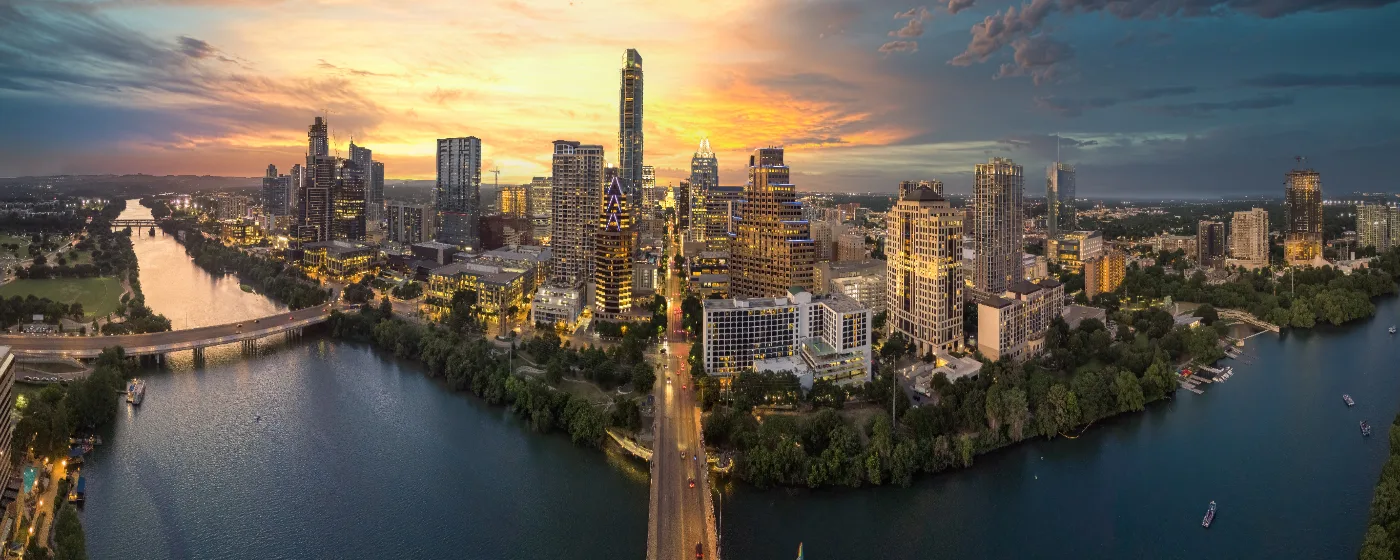
You've done the spreadsheet. Austin checks the boxes — no state income tax, home prices well below what you paid or were eyeing in California, a genuine tech job market, and a city that actually has a downtown worth walking around. But spreadsheets don't warn you about the property tax bill, the August heat that doesn't break until October, or the fact that I-35 through downtown is among the most reliably punishing stretches of urban freeway in the southern United States. Austin is a real trade, not a free upgrade — and understanding exactly what you're trading is the whole point of this guide.
Austin is now a city of 1,002,632 people, the 5th-largest incorporated city in Texas, anchored by the State of Texas government, The University of Texas at Austin, and a technology sector that has pulled Apple, Tesla, and a deep bench of enterprise software and AI infrastructure companies into the metro. Californians are arriving in meaningful numbers — they represent roughly 14% of all new Texas residents in recent high-migration years — and a large share of them land in Austin specifically because the job market speaks their language. Tesla's Gigafactory Texas is operating on the eastern edge of the city; Apple's North Austin campus employs approximately 15,000 people. If you work in tech, the professional infrastructure is here.
On cost of living, the practical difference shows up in your monthly statements rather than in any single index figure. Groceries and utilities in Austin run noticeably below what most Californians pay in the Bay Area or Los Angeles. Austin's typical home price stood at $504,148 as of July 2026 — noticeably below California's statewide typical home value of $773,735. What surprises people is where Texas claws some of that back: a property tax rate of 1.54% effective rate, assessed at full market value every year with no Proposition 13 to shield you, means your annual tax bill will be larger than anything you experienced on a California home of equivalent price. The income tax savings are real and often substantial; the property tax reality deserves equal attention before you close.
Whether you're seriously considering the move or still in the research phase, the sections below break down Austin's tax and cost picture against California's, what the job market looks like for California transplants, what day-to-day life actually feels like here, and the honest trade-offs that don't make it into the marketing pitch.
The Tax Shift: What You Gain and What Catches You Off Guard
The income tax swap is the single biggest financial change you will feel after moving. California's top state income tax rate of 13.3% applies only to the highest earners, but the brackets below it are steep too — and Texas constitutionally prohibits a state income tax at any level. A single filer earning $100,000 saves approximately $5,208 per year just from that change. At $150,000 in income, the savings run closer to $9,500 annually. For a dual-income household in the tech sector, this compounds quickly.
Property tax is where the picture reverses. California's effective property tax rate of 0.71% is held artificially low by Proposition 13, which caps assessed values at the original purchase price and limits annual increases to 2%. Texas has no equivalent protection. Austin's effective property tax rate of 1.54% applies to full assessed market value, reassessed regularly. On the same $504,148 typical home price, the annual property tax burden in Austin is roughly twice what the California rate would produce on an equivalent home — and unlike California, there is no Prop 13 floor locking your rate in place as values rise.
The homestead exemption partially offsets this. If you occupy your Austin home as a primary residence, you can file a homestead exemption that removes $140,000 from the school district's taxable value — worth approximately $1,000 to $1,200 in annual savings, by recent estimates. File it as soon as you close; it does not apply automatically.
Sales Tax: Closer Than You Think
Austin's combined sales tax rate is 8.25% — 6.25% Texas state base, plus 1% city, plus 1% transit district. California's statewide base sales tax rate of 7.25% looks lower on paper, but many California localities stack local additions on top of that base, pushing combined rates above 9% or 10%. Depending on where in California you're moving from, Austin's 8.25% may actually feel familiar or even slightly lighter.
| Tax Type | California | Austin, TX | The Practical Read |
|---|---|---|---|
| State income tax | Up to 13.3% (top rate) | None (constitutionally prohibited) | Major annual savings for most earners |
| Effective property tax rate | 0.71% (Prop 13-suppressed) | 1.54% | Austin's rate is roughly double; no Prop 13 protection |
| Property reassessment | Capped at purchase price + 2%/yr (Prop 13) | Full market value, reassessed regularly | Austin bills grow with the market |
| Homestead exemption | $7,000 exemption (limited benefit) | $140,000 off school district taxable value | File immediately after closing |
| Sales tax (combined) | 7.25% base (+ local additions) | 8.25% | Comparable; many CA localities run higher |
| State capital gains tax | Taxed as ordinary income at full CA rate | None at state level | Meaningful for anyone selling appreciated CA assets |
The honest net is this: most California transplants come out meaningfully ahead on taxes overall. The income tax savings dominate at higher incomes. What closes the gap is property tax — specifically the combination of a higher rate, full market-value assessment, and no long-term cap. Plan for your Austin property tax bill to grow as the city's home values grow, because there is nothing in Texas law to stop it.
Home Prices: The Real Comparison
Austin's typical home price stood at $504,148 as of July 2026. Set beside California's statewide typical home value of $773,735, that is a meaningful difference — enough to shift what you can buy, where you can buy it, and how much you need to put down. For many Californians who have built equity in a market that ran hard over the past decade, the math of bringing California proceeds to Austin is genuinely compelling.
What that number buys varies considerably across the city. Neighborhoods like Hyde Park, Mueller, and East Austin sit above the city-wide typical price — these are established, walkable areas close to the university and the lake, and they carry premiums that reflect demand from transplants and longtime locals alike. If you're looking for more house at or below the city median, the outer neighborhoods and suburbs are where buyers have more room. Round Rock and Pflugerville both price noticeably lower than Austin proper; Cedar Park comes in somewhat lower as well. For a full neighborhood breakdown, the best neighborhoods guide covers each area's character and trade-offs in detail.
What the Affordability Picture Actually Looks Like
One thing worth knowing before you anchor on the median: Austin's median household income of $93,658 sits below the income level actually needed to buy the typical home here — by roughly $53,000. That gap exists because Austin's price run-up over several years outpaced local wage growth. Californians arriving with equity or high tech salaries are insulated from that squeeze; buyers relying primarily on local income face a tighter market than the headline price suggests.
Austin-Bergstrom International Airport (AUS) sits 10 miles from Downtown Austin — close enough that flight paths are a real consideration in certain east and southeast neighborhoods. That is one of those facts that does not appear in the listing description but that residents figure out quickly.
For the full cost-of-living breakdown — utilities, groceries, transportation, and how the overall picture compares — the cost of living page goes deeper on each category.
The Job Market for California Transplants
Austin's job market is the reason this migration flow exists at all. The metro employed over 1.4 million workers across technology, healthcare, education, and government as of late 2025. For Californians in tech specifically — the single largest professional group making this move — the local landscape has matured well beyond a startup scene. Apple's North Austin campus employs approximately 15,000 people. Tesla's Gigafactory Texas anchors the eastern corridor. The city added roughly 8,300 net new technology jobs recently, concentrated in AI infrastructure, semiconductor-adjacent software, and enterprise SaaS.
The employers that have shaped Austin for decades are still central: The University of Texas at Austin, the City of Austin, and the State of Texas government together represent a large, stable public-sector base. Austin Independent School District is one of the city's largest single employers. This mix — tech, government, education, and healthcare — is what gives the city its economic durability and what draws people from markets that are more narrowly concentrated.
What California Résumés Look Like Here
California tech experience translates directly in Austin's market, and companies actively recruit from Bay Area and LA talent pools. The culture difference is real but navigable: Austin's tech scene is less venture-saturated than San Francisco's and more oriented toward enterprise software, manufacturing tech, and energy-adjacent innovation. Remote-friendly employers have also made Austin a landing pad for people who kept their California salary and needed a Texas address — that arrangement changes the financial calculus considerably, since the income tax savings land immediately without any salary adjustment.
The commute reality is covered on the living in Austin page, but the short version is that I-35 is the city's primary north-south spine and its most consistent source of driver frustration. Where you live relative to where you work matters more in Austin than it does in many Texas cities, because the geography is not forgiving during peak hours.
Looking to buy in Austin? Estimate your payment.
Enter your numbers to see an estimated monthly mortgage payment.
Estimate only. Excludes HOA fees and mortgage insurance. The interest rate above is a starting point, not a quoted rate — replace it with your own to see real numbers. Insurance is a flat placeholder, not a Austin quote.
Daily Life: What Actually Changes When You Land
Six months in, almost every California transplant says the same thing: the heat is harder than they expected, and the social ease is better than they expected. Austin's summers are genuinely punishing — sustained temperatures above 100°F for stretches of July and August, with humidity that is lower than Houston's but higher than anything a Bay Area or San Diego resident has experienced. The city gets 228 sunny days a year, which sounds like a selling point until August, when the sun feels less like a feature and more like a sustained grievance.
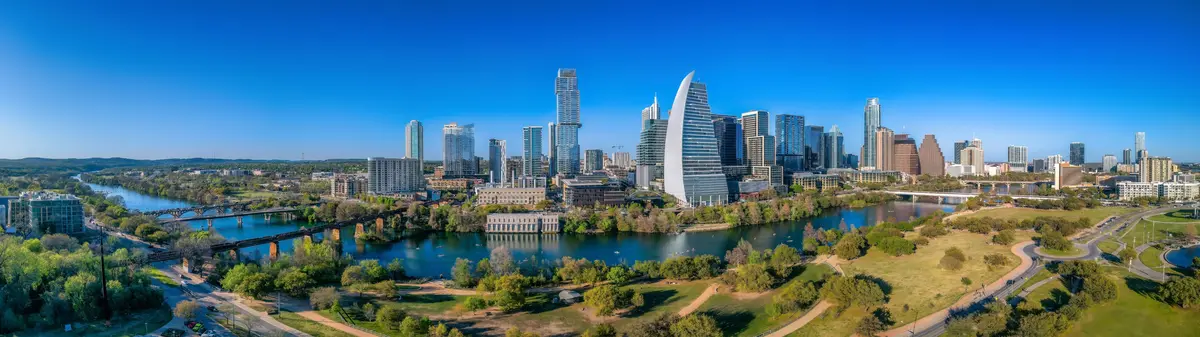
The flip side is that outdoor life from October through May is exceptional. Lady Bird Lake Trail runs through the center of the city and draws runners, cyclists, and kayakers on weekday mornings when the weather cooperates. Zilker Metropolitan Park anchors the south side of the lake, home to Barton Springs Pool — a spring-fed swimming hole that stays around 68°F year-round and functions as Austin's most democratic social institution. Mount Bonnell offers the best elevated view of the Colorado River corridor. Lake Travis, to the northwest, is where the city goes for boat days when the summer heat becomes inescapable.
The Grocery and Retail Shift
Austin has a wider range of grocery and retail options than most Texas cities its size, but it is not the density you had in a major California metro. A serious shopping run for specialty or imported goods sometimes means a drive or an online order. The farmers market scene is genuine — the Texas Farmers' Market at Mueller and the SFC Farmers' Market Downtown both draw real local producers — but neither replaces a well-stocked specialty grocery as a weekly anchor.
Culture and Weekend Life
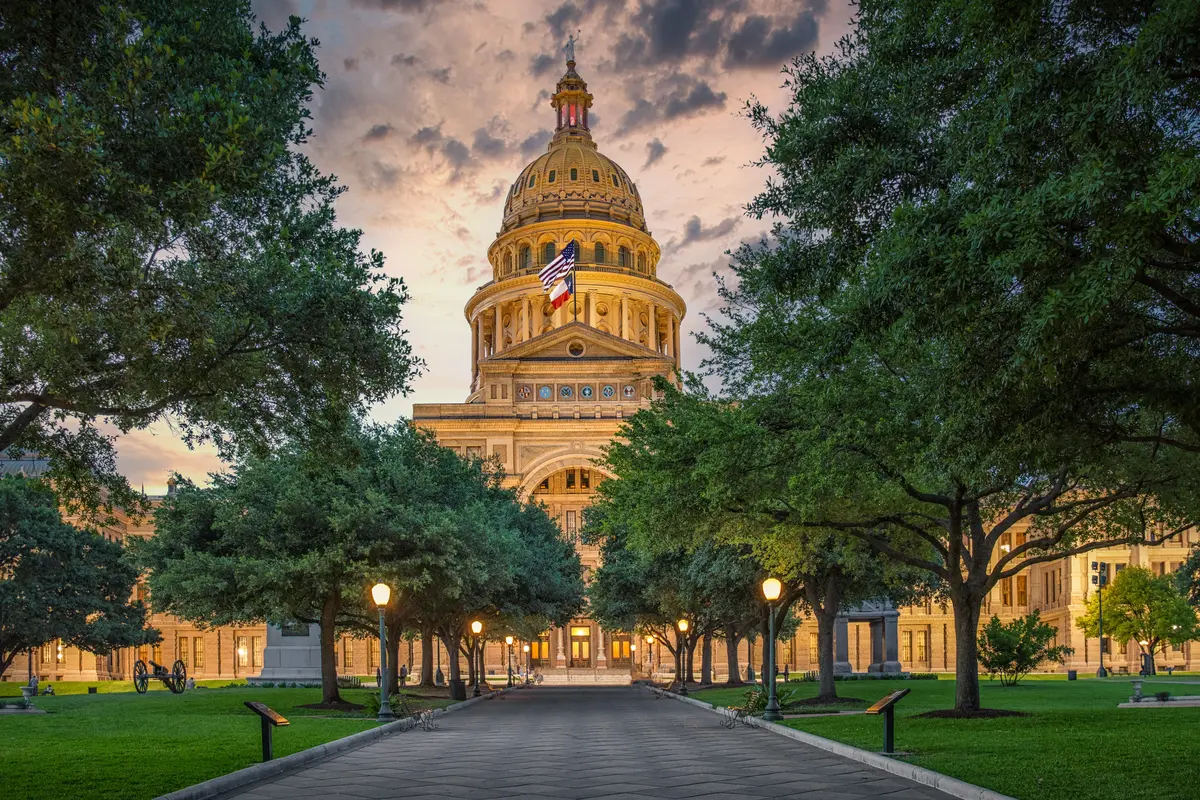
South Congress Avenue is the city's most photogenic commercial corridor — independent restaurants and the kind of foot traffic that makes an afternoon walk feel intentional. The Texas State Capitol grounds anchor the northern end of the Congress corridor and double as the city's most recognizable landmark. The Congress Avenue Bridge bat colony, a colony of Mexican free-tailed bats that emerges at dusk from spring through fall, is one of those local phenomena that sounds like a tourism cliché and turns out to be genuinely worth seeing. Austin's live music density is real and city-wide, not confined to the Sixth Street blocks that tend to appear in magazine coverage.
For parks, trails, and outdoor options in more detail, the parks and recreation page covers the full picture.
Weekends and Local Favorites
Austin's dining and coffee scene has caught up to its reputation faster than most transplants expect. The independent coffee culture is strong: Mozart's Coffee Roasters, with its patio overlooking Lake Austin, is one of those places that earns its reputation rather than trading on it. Epoch Coffee has anchored the Hyde Park end of the city for years and runs late for the night-owl crowd. Houndstooth Coffee and Spokesman Coffee both draw the specialty-coffee crowd, and Barrett's Coffee is worth knowing if you find yourself in the north part of the city.
On the restaurant side, Corner Restaurant is a reliable anchor for the kind of thoughtful American cooking that works for a weeknight or a longer dinner. Caroline and its rooftop sibling Upstairs at Caroline have become go-to options for the downtown-adjacent crowd. Aba Austin brings a Mediterranean-leaning menu that translates well for Californians used to that style of eating. Zanzibar holds its own on the cocktail-and-small-plates end of the spectrum.
The Texas Farmers' Market at Mueller draws a consistent crowd and is one of the better ways to get a read on the city's east-side energy on a weekend morning. The SFC Farmers' Market Downtown is smaller and more central — useful if you're in the Capitol corridor.
What People Miss From California (And What They Don't)
The things California transplants genuinely miss: ocean proximity, the produce variety of a state that grows most of its own food, and the coastal evening coolness that makes summer in San Francisco or San Diego habitable without air conditioning. What they tend not to miss: the cost of housing, the state income tax, and the specific anxiety of watching home prices accelerate faster than their savings. Austin is not a perfect substitute for California living — it is a different place with its own character and its own frustrations. The Californians who stay are generally the ones who came for the professional opportunity and found the city itself worth the adjustment.
The schools question is one worth addressing directly: Austin Independent School District holds a C rating, according to the Texas Education Agency, based on the 2025 A-F accountability rating for the 2024-25 school year, with 69,074 students enrolled in 2025-26. For families with school-age children, the district's performance is a real factor — and the schools page breaks it down neighborhood by neighborhood, including which areas feed into the district's stronger campuses.
Local Expert Takeaway: The income tax savings are real — California's top state income tax rate of 13.3% versus zero in Texas is not a rounding error, and for a tech household earning well above six figures, the annual difference compounds into something meaningful. What catches Californians off guard is the property tax: Austin's 1.54% effective rate on full assessed value, reassessed at market, means your tax bill grows with the city. File the homestead exemption the week you close. Beyond the finances, the adjustment is mostly cultural — Austin is warmer in every sense than people expect, the outdoor life from October through May is genuinely excellent, and the live music and food scene has outgrown its own marketing. The people who move here and stay tend to be the ones who came for the math and found the city itself was the reason they didn't leave.
Quick Takeaways & FAQs
✅ Texas has no state income tax — constitutionally prohibited — which translates to thousands of dollars in annual savings for most California earners, especially in the tech sector.
⚠️ Austin's effective property tax rate of 1.54% applies to full market value with no Proposition 13 protection, meaning your bill grows as home values grow — a real offset to the income tax savings.
📍 File the Texas homestead exemption immediately after closing; it removes $140,000 from your school district's taxable value and saves Austin homeowners approximately $1,000 to $1,200 annually.
Is Austin actually cheaper than California for housing?
How much do I actually save on income taxes by moving from California to Texas?
Why is Austin's property tax so high if Texas has no income tax?
What is the sales tax rate in Austin compared to California?
What do California tech workers need to know about Austin's job market?
Moving to Texas?
Tell us what you need help with and we'll connect you with local resources.
