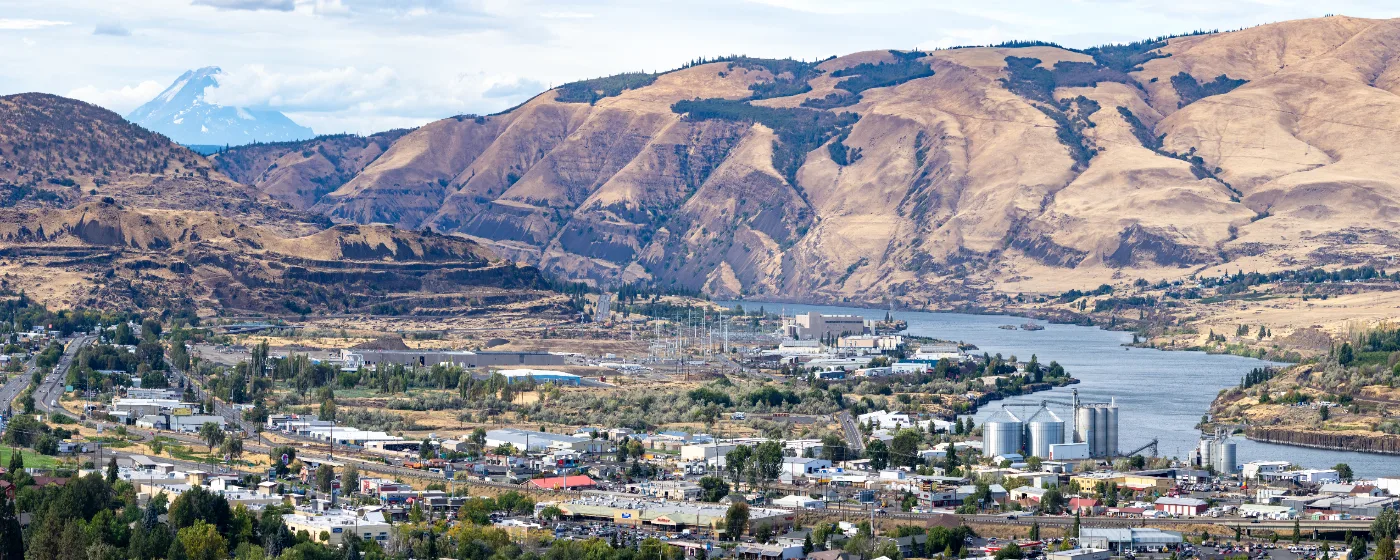
If you're choosing between staying in California and moving to The Dalles, the decision usually comes down to one number: what you can actually afford to own. California's statewide typical home value of $773,735 puts homeownership out of reach for a large portion of working households. The Dalles sits on the Oregon side of the Columbia River Gorge — a city of 15,917 people wedged between basalt cliffs, cherry orchards, and one of the most spectacular river corridors in the country — where the Zillow Home Value Index places the typical home at $396,291 as of July 2026. That gap is the engine behind a steady flow of California movers, and Oregon consistently draws a disproportionate share of people leaving California relative to its population size.
The Dalles is not a bedroom suburb. It is the county seat of Wasco County, with its own economic fabric built around a regional healthcare system, North Wasco County School District 21 serving 2,847 students enrolled in 2025-26, Wasco County and City of The Dalles municipal government, and — most unexpectedly for a city this size — Google, whose Columbia River data campus has drawn $1.8 billion in investment since 2006. The tech presence explains why you encounter remote workers and engineers alongside fourth-generation cherry farmers at the same downtown coffee counter. I-84 connects the city to Portland in about 85 minutes, which matters both for commuters and for anyone who misses a big airport: Portland International Airport (PDX) sits roughly 80 miles west.
Day-to-day life here is shaped by the Gorge in ways that Californians from coastal cities tend to underestimate. The Columbia River Gorge National Scenic Area is not a weekend destination you drive to — it is your backyard. The Dalles Riverfront Trail runs approximately eight to ten miles along the Columbia, paved and ADA-accessible. Windsurfing, kiteboarding, rock climbing, kayaking, and salmon fishing are not aspirational activities here; they happen on weekday evenings. The climate runs drier and sunnier on the east side of the Gorge than the Pacific Northwest stereotype suggests, with 177 sunny days a year. The honest trade-off is wind: the same natural tunnel that makes this a world-class windsurfing destination means some spring days feel relentless.
Whether you are being relocated by an employer, priced out of a California metro, or simply done with the density, the sections below break down The Dalles's home price comparison, tax picture, lifestyle shift, neighborhoods, and what Californians actually say after six months here.

Home Prices: What Your California Equity Actually Buys Here
California's statewide typical home value of $773,735 represents roughly double the typical home price in The Dalles. The Zillow Home Value Index placed The Dalles at $396,291 as of July 2026 — a figure that, in practical terms, means a Californian arriving with equity from a sold home is often able to buy here with a substantial down payment or no mortgage at all.
The Dalles has a range of residential neighborhoods, from the historic downtown core and older areas like Erickson Addition to newer construction in Whispering Pines Estates and Columbia View Heights, where panoramic Gorge sightlines command more buyer interest. The neighborhoods page covers the character and geography of each area in detail.
Hood River, a short drive west along the Gorge, prices noticeably higher than The Dalles. Mosier, the small community between them, also runs noticeably higher. Dufur, a farming town to the south on US-197, prices at about the same level. If your California frame of reference is that small towns are always cheaper, Mosier and Hood River will reset that assumption quickly.
The Equity Conversation
Californians selling in a market where the typical home sits at California's statewide typical home value of $773,735 and buying in The Dalles at the July 2026 figure frequently find themselves with equity that eliminates — or dramatically reduces — their mortgage. That changes the monthly cash-flow math in ways that a simple price comparison doesn't capture.
What that equity does NOT buy is the walkable density, the restaurant variety, or the proximity to major airports that California metros deliver. A serious shopping trip means driving out of town. The honest version of this move is a trade: financial breathing room in exchange for a smaller-city life. Most people who make it intentionally find the trade worthwhile. The ones who struggle are the ones who didn't fully price in the second half of that sentence.
The median household income in The Dalles is $62,614 — below what is needed to comfortably carry the typical home at current rates. That figure matters for buyers arriving without California equity behind them, particularly first-time buyers who haven't yet built that cushion. The first-time homebuyer page covers loan programs and down payment options in more detail.
The Tax Picture: Where You Win, Where You Don't
The tax case for moving to Oregon from California is real but more complicated than the headline makes it sound. The wins are genuine. The traps are real. Understanding both before you move matters more than almost any other piece of financial planning for this transition.
Sales Tax: Oregon's Clearest Advantage
Oregon has no state or local sales tax — zero, on everything. California's statewide base sales tax rate of 7.25% is the highest state rate in the country, and local additions push the combined average to nearly nine percent. If you spend meaningfully on taxable goods, this difference adds up faster than most people expect. It shows up every time you buy a car, furnish a house, or stock a kitchen.
Property Tax: A Modest Surprise
Many Californians assume they are escaping property taxes when they leave. The reality is more nuanced. California's effective property tax rate of 0.71% is held low by Proposition 13's cap on annual assessed-value growth — longtime homeowners in California often pay taxes on a value assessed decades ago. Oregon has a similar protection in Measure 50, which limits how fast assessed values can rise, but buyers purchasing today are assessed at current market value. The Dalles carries an effective property tax rate of 0.80%, modestly above California's statewide rate. The difference is not dramatic, but it is not zero either.
Income Tax: The Counter-Intuitive Part
California's top state income tax rate of 13.3% is the highest in the nation, but it applies only to earners above $1 million. For the income range that most California-to-The Dalles movers represent, Oregon's income tax tends to be the heavier burden. Oregon's top rate of 9.9% kicks in for single filers at a much lower threshold than California's highest brackets, meaning middle-income households frequently pay more in Oregon income tax than they did in California. The income-tax savings favor high earners significantly; many middle-income households pay about the same or more here. Oregon's complete elimination of sales tax is the meaningful offset for everyday earners.
| Tax Type | The Dalles / Oregon | California | Who Benefits |
|---|---|---|---|
| Sales Tax | 0% | California's statewide base: 7.25%+ | Oregon movers |
| Effective Property Tax Rate | 0.80% (The Dalles) | 0.71% (statewide effective) | California (slight) |
| Top State Income Tax Rate | 9.9% (above $125K single) | 13.3% (above $1M) | Depends on income |
| Social Security Tax | Not taxed at state level | Not taxed at state level | Wash for both |
| Other Retirement Income | Taxed (pensions, IRA/401k) | Taxed | Similar exposure |
The bottom line: the sales tax elimination is real money, the income tax is a genuine gotcha for middle earners, and the property tax difference is modest. Relocating for tax reasons alone requires more math than the simple Oregon-vs-California headline invites.
For the full cost-of-living picture — utilities, groceries, transportation — see the cost of living page.

Lifestyle Shift: What Changes After the Move
The most common thing Californians say six months after moving to The Dalles is some version of: I didn't expect to feel this settled this fast. A city of 15,917 people has a social gravitational pull that larger metros rarely do. You see the same faces at Klindt's Booksellers — Oregon's oldest bookstore, operating since 1870 — and at the annual Cherry Festival each June, when the whole city turns out for a parade celebrating the orchards that have defined the mid-Columbia landscape for generations.
The Outdoor Reality
The Columbia River Gorge National Scenic Area is not an amenity you visit on weekends. It is the geographic context of everyday life. The Dalles Riverfront Trail gives you eight to ten miles of paved, ADA-accessible path along the Columbia. Windsurfing and kiteboarding conditions here are internationally recognized — the Gorge functions as a natural wind tunnel that draws competitive athletes from around the world, and the water is minutes from town. Rock climbing, whitewater kayaking, river fishing for salmon, steelhead, and sturgeon, and winter access to Mount Hood's slopes are all within reach without a long drive.
If you're coming from a California coastal city where outdoor access means driving an hour to a crowded trailhead, the density of options here — and the lack of crowds on most of them — takes adjustment. You stop treating a trail as a destination and start treating it as a Tuesday.
What You Give Up
Small-city trade-offs are real and worth naming. The restaurant scene is genuine but limited — there are good independent spots, but you will not find the culinary variety of a California metro. A serious shopping run means leaving town. Specialist care requires a longer drive than most Californians are used to; routine care is accessible locally. The honest framing on healthcare is that you give up proximity to advanced treatment.
The wind also takes getting used to. Spring in the Gorge is dramatic in ways that don't read on a weather app — sustained gusts that make outdoor plans contingent in a way that most California climates don't require. The 177 sunny days a year are real, but wind is the other defining weather fact that the region's marketing rarely leads with.
The Google Effect
The presence of Google's data campus — $1.8 billion invested since 2006, with a fifth facility approved in early 2024 — has quietly changed the social texture of The Dalles. Remote workers and tech employees exist here in numbers that a city this size wouldn't otherwise see, which means the coffee shops and coworking conversations reflect a different mix than a comparably sized Oregon agricultural town would. For California transplants, particularly those working remotely for Bay Area or Seattle companies, that cultural overlap makes the adjustment meaningfully easier.
Looking to buy in The Dalles? Estimate your payment.
Enter your numbers to see an estimated monthly mortgage payment.
Estimate only. Excludes HOA fees and mortgage insurance. The interest rate above is a starting point, not a quoted rate — replace it with your own to see real numbers. Insurance is a flat placeholder, not a The Dalles quote.
Neighborhoods: Where Californians Tend to Land
The Dalles is small enough that no neighborhood puts you far from the river or the Gorge, but the city's topography creates real distinctions. Basalt ridgelines divide the lower city — closer to I-84 and the Columbia — from the upper residential areas, and those two zones feel meaningfully different in character and daily commute.
Downtown The Dalles / Trevitt's Addition
The historic core runs along the Columbia River Gorge Discovery Center and the commercial strip anchored by The Dalles Commercial Historic District. The architecture here is legitimately old — brick-front commercial blocks from the 1870s and 1880s — which reads as exotic to buyers coming from California's newer suburban fabric. On-foot access to the Riverfront Trail, Klindt's Booksellers, and the dining and coffee options along the main corridor makes this the most walkable part of the city. Older housing stock means more maintenance attention, but also the most character of anything in The Dalles.
Best for: Walkable First-Time Buyers
Cherry Heights
Sitting above the downtown core on the ridge, Cherry Heights offers the elevated sightlines that Gorge views require — and they are genuinely dramatic, with the Columbia and Washington's hills visible from front yards. The neighborhood is established residential rather than new construction, and the streets feel quieter than the commercial zone below.
Best for: Views Families
Chenoweth
One of the more established residential areas in the city, Chenoweth draws families with school-age children who want suburban spacing without the new-construction premium. The neighborhood has a settled feel — mature trees, modest yards, less turnover — that Californians accustomed to HOA-dense tract development often find refreshing.
Best for: Families Quiet
Whispering Pines Estates & Columbia View Heights
These upper-elevation neighborhoods deliver the Gorge panoramas that define The Dalles's most in-demand addresses. Newer construction and larger lots push prices above the city-wide typical, but buyers arriving with California equity frequently find the comparison still favorable. The compromise is distance — errands require a drive to the lower city, and the ridgeline roads require more attention in winter.
Best for: Views Move-Up Buyers Privacy
Dry Hollow, Pomona Meadows & Erickson Addition
These neighborhoods cover a range of The Dalles's mid-city residential fabric — from Erickson Addition, which offers some of the city's more accessible entry points into ownership, to Pomona Meadows, which has a newer, more suburban character. Dry Hollow sits in the canyon geography that gives the city much of its visual drama, with the hollow itself creating a quieter micro-climate. Buyers on tighter budgets who want to own rather than rent often start here.
Best for: Value First-Time Buyers Nature
A deeper look at each neighborhood, including geographic divides and what local agents know about micro-market differences, is on the neighborhoods page.
Weekends, Local Favorites, and What Daily Life Actually Looks Like
The transition from a California metro to a city of 15,917 is a lifestyle renegotiation, not just a real estate transaction. The Dalles has a specific texture that is worth understanding before you arrive, because it rewards people who engage with it and frustrates people who are waiting for it to become something bigger.
Where People Actually Gather
Sorosis Park is the city's high-ground anchor — the 2024-2025 renovation added a new playground and ADA-accessible pavilion, backed by more than $1 million in community investment, and on a clear day the views across the Gorge explain why the park has been central to the city's social life for generations. The Columbia Gorge Discovery Center and Museum grounds along the river draw a steady mix of locals and visitors, and the Riverfront Trail connects the two ends of the city's public life.
The coffee scene is genuine and independent. Holstein's Coffee Co, Grinders Coffee, T & T Coffee and Bagels, The Riv Cafe, and The Coffee Shop give the city a density of local options that surprises people who expect a small Oregon town to run on gas station drip. These are real gathering places — the kind where you start recognizing faces within a few weeks of moving in.
For dining, Cousins' Restaurant & Saloon and Cousins' Country Inn anchor the more established end of the scene, with Rivertap Restaurant and Pub carrying the casual, after-trail crowd. Spooky's Pizza and Casa El Mirador round out the weeknight rotation. None of these will remind you of a Bay Area restaurant row, but all of them are genuinely good and reliably packed with people you'll come to know.
The Wine and Cherry Culture
The mid-Columbia region's cherry orchards are not background scenery — they are a civic identity. The Cherry Festival each June draws the whole city together in the way that agricultural festivals do when they are genuinely connected to local economy and history rather than invented for tourism. The regional wine scene has developed in parallel, ranging from cool-climate pinot noir grown in the western Gorge hills to tempranillo and syrah in the drier, sunnier terrain near The Dalles. Sunshine Mill Winery, housed in a converted flour mill, is one of the more striking repurposing projects in the Gorge.
What People Move Out For
Honesty matters here: the people who leave The Dalles most often do so for two reasons. The first is career opportunity — a city this size has a limited local job market, and the commute to Portland is about 85 minutes each way, which is a real daily commitment. The second is social life for single adults or younger transplants who find the social scale challenging once the novelty of the landscape wears off. The city is genuinely family-oriented, and the outdoor culture fills weekends, but the nightlife and dating pool of a larger metro it is not.
The people who stay — and many Californians do stay — are the ones who came for the specific combination of affordability, the Gorge, and the human-scale community. Those three things, taken together, are not replicated anywhere cheaper.

Local Expert Takeaway: The Dalles is one of the most honest value propositions in the Pacific Northwest for a Californian with equity to deploy. The typical home at $396,291 (July 2026) sits noticeably below California's statewide typical home value of $773,735, the Gorge access is the real thing, and the community is genuinely cohesive in a way that larger cities are not. The tax picture is more complicated than the Oregon-vs-California headline suggests — income tax will likely go up for middle earners, sales tax goes away entirely, and property tax barely moves — so run the actual math for your income before assuming you come out ahead on every line. The move rewards people who want to own their lives rather than rent a lifestyle. It frustrates people who want the lifestyle to come pre-installed.
Quick Takeaways & FAQs
✅ The typical home in The Dalles (July 2026) sits noticeably below California's statewide typical home value — arriving with California equity here often means buying with a large down payment or no mortgage.
⚠️ Oregon eliminates sales tax entirely, but many middle-income earners pay more Oregon income tax than they paid in California on the same household income — run the full numbers before assuming a net tax win.
📍 The Columbia River Gorge National Scenic Area is not a weekend drive from The Dalles — it is the city's immediate backyard, with the Riverfront Trail, windsurfing access, and Mount Hood skiing all within reach of a weekday evening.
Is The Dalles actually affordable compared to California?
How does Oregon's income tax compare to California's for someone earning $80,000-$100,000?
What is the commute like from The Dalles to Portland?
What do Californians most commonly regret after moving to The Dalles?
Is The Dalles a good place to buy if I'm working remotely for a California company?
Moving to Oregon?
Tell us what you need help with and we'll connect you with local resources.
