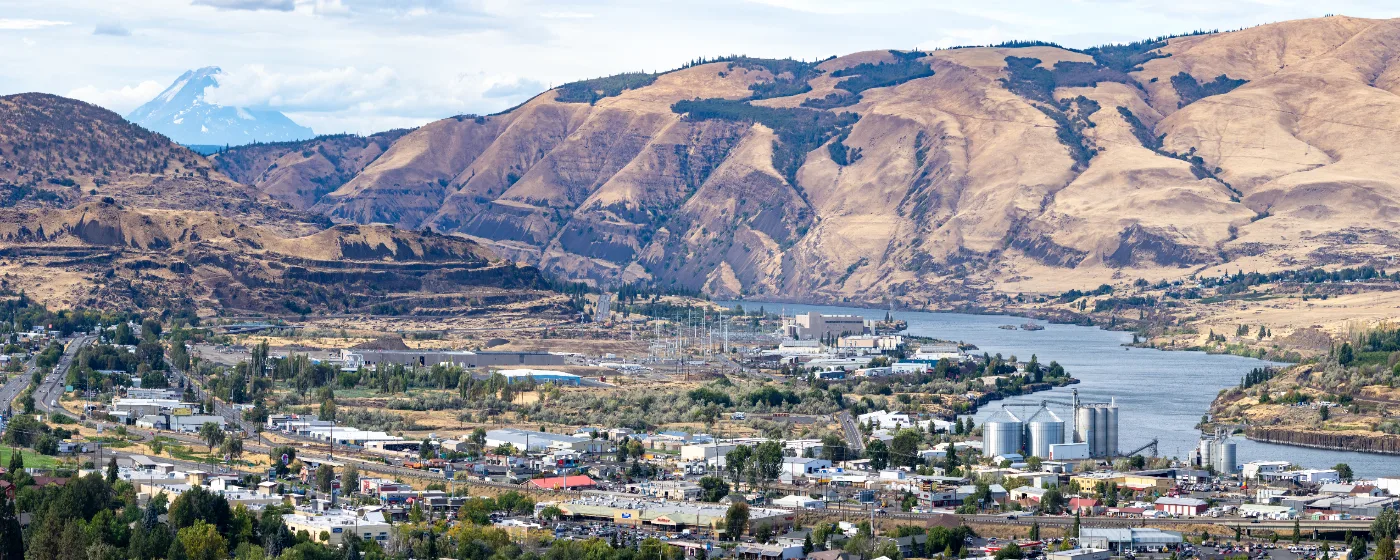
Maybe you've been priced out of Hood River and someone pointed east along I-84. Maybe Portland felt like too much city and this Columbia Gorge town, with its big-sky views and surprising affordability, landed on your shortlist. The honest version of The Dalles' cost story is this: you are trading the premium of the Gorge's most fashionable address for a price point that actually pencils out — but you are not escaping Oregon's tax structure, and the income gap here is real enough to matter.
The Dalles is a working river city of 15,917 people anchored by Mid-Columbia Medical Center, the North Wasco County School District, Wasco County and City government, and a Google data center that represents a newer economic layer. Those employers give the city stability, but they do not generate the wage density of a metro. The median household income of $62,614 falls noticeably short of what it takes to carry the typical home here comfortably — something worth factoring into your planning before you run the numbers on a mortgage.
Groceries and everyday goods run modestly below the Oregon norm, and the city sits noticeably below Portland on most cost measures. Oregon's zero-sales-tax policy means no additional friction at the grocery store or hardware counter. The catch that catches people off guard fastest is the electricity bill — Pacific Power serves the city, and its Oregon residential rates have risen sharply in recent years, with another rate case pending. Factor that trajectory into your utility budget from day one.
Whether you are comparing The Dalles against Hood River, considering a move from Portland, or relocating from out of state, the sections below break down housing costs, everyday expenses, transportation, nearby-city comparisons, and the tax picture so you can run an honest budget before you make an offer.

What It Really Costs to Live in The Dalles
The Dalles sits in an interesting position: it is more expensive than the national median on housing, but it is one of the more affordable entry points into the Columbia River Gorge. The typical home price of $396,291 (Zillow Home Value Index, July 2026) is the anchor of that story. Hood River, the Gorge's better-known neighbor to the west, runs noticeably higher — and Mosier, the small community between them, does too. Dufur, to the south, comes in at about the same level as The Dalles, but with far fewer services and a much smaller job base.
What drives costs here is a specific combination: the scenic premium of Gorge living, the relative scarcity of housing stock in a city constrained by canyon topography, and an electricity provider whose rates have risen sharply. Food costs run modestly below the national average — one genuine bright spot. Transportation costs run above it, which reflects the reality that most residents own at least one car and that a serious shopping trip, a medical specialist, or a flight out of Portland means a significant drive along I-84.
The clearest comparison for Portland-area buyers: The Dalles is considerably less expensive overall than Portland, with median home cost accounting for the largest share of that gap. For a full picture of how nearby cities stack up, the comparison table below gives you the current figures side by side.
Housing: Rent vs Buy in The Dalles
The Buying Side
The typical home price of $396,291 (July 2026) represents the city-wide median. Entry-level homes — older construction, smaller lots, and fewer updates — can be found at a meaningful discount to that figure, though they tend to cluster in specific parts of the city rather than being evenly distributed. For neighborhood-by-neighborhood context, the best neighborhoods guide covers the character and housing stock of each area.
The effective property tax rate in The Dalles is approximately 0.80% — noticeably below the national median effective rate of roughly 1.02%. That is a genuine budget advantage, and it means the annual tax drag on a typical home here is lower than what buyers carry in most comparable markets. Oregon does not have a statewide sales tax, which means there is no additional tax friction on the purchase of materials, appliances, or furnishings after closing.
The affordability gap is real, though. The median household income of $62,614 falls short — by a meaningful margin — of what a buyer typically needs to carry the median-priced home here without stretching. For buyers in that income range, the first-time homebuyer programs and down payment assistance options available in Oregon can make a measurable difference; the first-time homebuyer page covers those programs in detail.
The Renting Side
The typical two-bedroom rent range in The Dalles runs $1,500–$1,820. The city-wide typical rent sits at $1,625 per month (Zillow, July 2026). That is considerably lower than you would pay in Hood River or in Portland's metro, which makes renting a reasonable short-term strategy while you learn the market — especially if you are arriving from outside Oregon and want time to understand the neighborhood differences before committing.
Renting makes the most sense if you are not planning to stay at least three to five years, or if you are waiting to see how rates shift before locking in. Buying makes more sense if you have a solid down payment and an income that can absorb the monthly payment at current rates — because the property tax advantage here is real, and time-in-market matters in a supply-constrained Gorge city.

Everyday Costs Beyond Housing in The Dalles
| Category | Typical Monthly Cost | Notes |
|---|---|---|
| Housing (typical rent) | $1,625/mo | City-wide typical rent. Buying? Use the calculator above for a mortgage estimate. |
| Utilities | $200–$290/mo | Electricity, gas, water, sewer, trash |
| Groceries | $520–$720/mo | Food at home, household of 2–3 |
| Transportation & Gas | $280–$420/mo | Fuel, and transit where it is a real option |
| Phone & Internet | $115–$185/mo | Mobile plan plus home broadband |
| Misc / Discretionary | $220–$430/mo | Dining out, entertainment, subscriptions |
Non-housing figures are estimates for a household of two to three, not a sourced index; housing is the city-wide typical rent (Zillow ZORI, July 2026). Refreshed with the rest of the city data.
The non-housing cost that catches people off guard most quickly in The Dalles is the electricity bill. Pacific Power serves the city, and its Oregon residential rates have risen sharply in recent years — with a new rate case filed in May 2026 proposing further increases effective April 2027. The Dalles sits in high-desert terrain east of the Cascades, which means air conditioning load in summer and heating load in winter are both real. Budget conservatively on utilities and revisit that number annually.
Groceries are a relative bright spot — food costs in The Dalles run modestly below the national average, which takes some of the sting out of the utility picture. Transportation costs run above the national norm, and for good reason: most households depend on a personal vehicle. The Link, The Dalles' local transit system operated by the Mid-Columbia Economic Development District, runs Blue and Red route buses on weekdays. Columbia Area Transit connects The Dalles to Hood River and onward toward Portland for riders willing to use transit for the commute along I-84. The Gorge Transit Pass provides unlimited rides across multiple regional transit agencies for $40 per year for adults — genuinely affordable, though the network covers local errands and commutes rather than the full range of daily driving most residents do. Oregon's no-sales-tax rule applies at every store and market in The Dalles, which saves real money on clothing, household goods, and anything you would pay tax on in a neighboring state.
Looking to buy in The Dalles? Estimate your payment.
Enter your numbers to see an estimated monthly mortgage payment.
Estimate only. Excludes HOA fees and mortgage insurance. The interest rate above is a starting point, not a quoted rate — replace it with your own to see real numbers. Insurance is a flat placeholder, not a The Dalles quote.
The Dalles vs Nearby Cities: Cost Comparison
| City | Typical Home Price | Typical Rent | Cost vs The Dalles |
|---|---|---|---|
| The Dalles (this city) | $396,291 | $1,625/mo | — |
| Hood River | $721,304 | $2,825/mo | 82% higher |
| Dufur | $400,000 | $1,300/mo | About the same |
| Mosier | $550,000 | $1,700/mo | 39% higher |
Source — home prices: Zillow ZHVI, July 2026; rent: Zillow ZORI, July 2026. Nearby-city figures are the same series, refreshed together.
The table below shows how The Dalles compares against Hood River, Dufur, Mosier, and other nearby cities on home price, rent, and overall cost — updated yearly from live data so the figures stay current.
Taxes & the Bottom Line for The Dalles
Oregon's Income Tax: The Big Number
Oregon's state income tax is progressive, with four brackets ranging from 4.75% to 9.9% for tax year 2025. The top marginal rate is among the highest in the nation. If you are moving from Washington, Nevada, or another no-income-tax state, this is the most significant cost adjustment you will make — more impactful in practice than anything in the housing stack. That said, Oregon does not levy a statewide sales tax, which means every dollar you spend at the grocery store, hardware counter, or furniture shop stays whole. For households that spend heavily on goods, the sales-tax savings partially offset the income-tax burden.
Property Tax: A Genuine Advantage
The effective property tax rate of approximately 0.80% is a real selling point. It sits well below the national median effective rate and gives buyers a lower annual carrying cost than they would face in most comparable markets. Oregon also allows qualifying residents age 62 or older to defer property taxes until the home is sold, and disabled veterans may exempt a portion of their home's assessed value. Exemption claims in Wasco County must be filed with the county assessor. For the full retiree tax picture, including Oregon's treatment of Social Security income, the retiring in The Dalles page covers it in detail.
Who The Dalles Works For — and Who Finds It a Stretch
The Dalles works well for buyers arriving with equity from a more expensive market — Portland, Hood River, or the Bay Area — who can convert that equity into a down payment large enough to make the monthly math work at the income levels common here. It also works for dual-income households earning above the city median, for remote workers carrying a metro salary into a Gorge cost structure, and for buyers who genuinely want the outdoors, the Columbia River, and the high-desert sky as a daily backdrop.
The Dalles is a stretch for single-income buyers at or near the median household income of $62,614. The gap between that income and what the typical home price demands is real, and it does not close easily without either a substantial down payment or meaningful income growth. The first-time homebuyer guide outlines the Oregon programs designed to bridge exactly that gap — they are worth reading before you rule out buying.
At the neighborhood level, the trade-offs between price, character, and commute access shift considerably depending on where in The Dalles you land. The best neighborhoods guide breaks that down in full.

Local Expert Takeaway: The Dalles is priced below Hood River and Mosier but not below the reach of most buyers' expectations. The effective property tax rate of approximately 0.80% and Oregon's no-sales-tax rule are real advantages — but electricity costs through Pacific Power run high in this high-desert climate, and Oregon's income tax bites hard above the median. The buyers who land here most comfortably are those bringing equity from a pricier market, remote workers earning outside the local wage structure, and dual-income households who can carry the typical home price without overextending. If your household income sits near the city median, run the numbers carefully — and look at what Oregon's first-time buyer programs can do for your down payment before you decide renting is the only option.
Quick Takeaways & FAQs
✅ The typical home price of $396,291 (July 2026) is noticeably lower than Hood River and Mosier, making The Dalles one of the more accessible entry points into Columbia River Gorge living.
⚠️ Oregon's progressive income tax — topping out at 9.9% — is a significant adjustment for anyone relocating from a no-income-tax state, and it matters more to your bottom line than almost any other cost line here.
📍 Pacific Power serves The Dalles and its Oregon residential rates have risen sharply in recent years, with another rate case pending — budget utilities conservatively and revisit that number each year.
What is the typical home price in The Dalles, Oregon?
What is the average rent in The Dalles?
Does Oregon have a sales tax that affects the cost of living in The Dalles?
What is the property tax rate in The Dalles?
Is The Dalles cheaper to live in than Portland?
Moving to Oregon?
Tell us what you need help with and we'll connect you with local resources.
