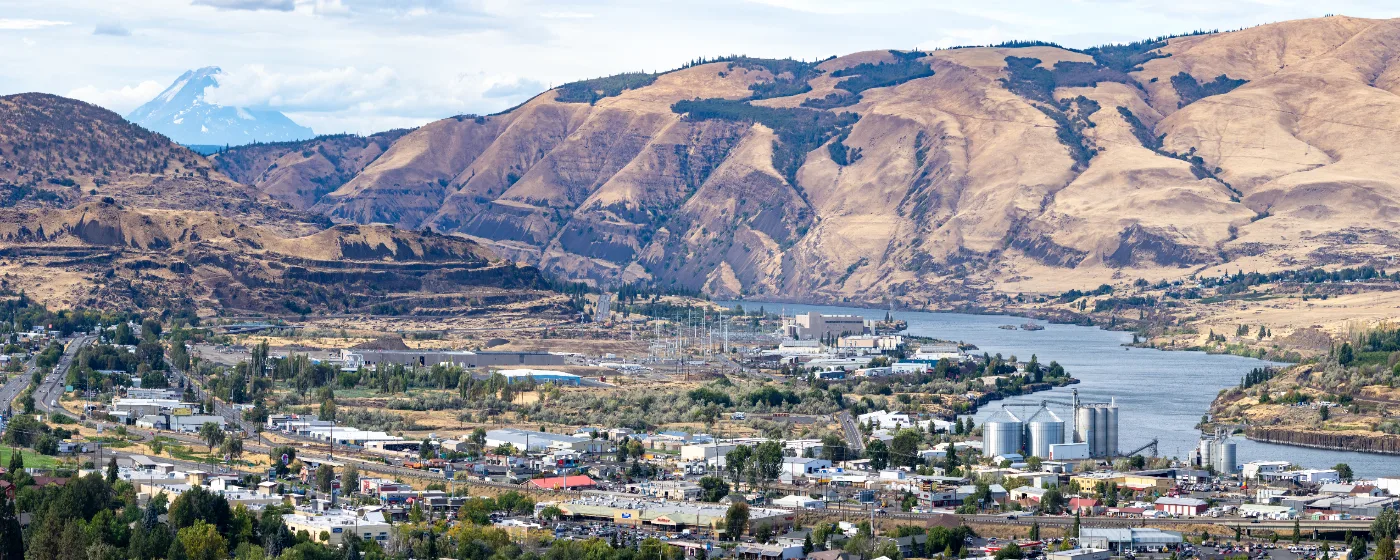
About one in five residents of The Dalles is already 65 or older — a share above the national average — and that number is not an accident. The city sits at the eastern edge of the Columbia River Gorge, where the landscape opens up into high desert sun and wide-open skies after the dense forest of the western Gorge. You get 177 sunny days a year, a hospital inside city limits, a paved ten-mile riverside trail, and a downtown that still has a functioning bookstore, a diner, and a wine bar, all within a few blocks of each other. For retirees who want a real town without a resort-town price tag, the case is easy to make.
The honest counterpoint is that The Dalles is small — a population of 15,917, the 38th-largest incorporated city in Oregon. Specialty medical care beyond what the local hospital covers means a drive west on I-84, and that drive is roughly 80 miles to Portland International Airport and the full range of urban medical and cultural amenities. The city has no 55+ planned community and no light rail. If your retirement picture depends on walkable errands, a dense restaurant scene, or proximity to a major research hospital, this is probably not the right fit.
For everyone else — the retirees who want a mortgage paid off with something to spare, Columbia River views, outdoor access, and a community where neighbors recognize each other at the hardware store — The Dalles keeps delivering. The typical home price sits at $396,291 (July 2026), well below comparable Gorge towns, and Oregon's tax treatment of Social Security income removes one of the biggest anxieties retirees carry into a fixed-income life. The cost of living on a day-to-day basis is manageable in a way that Hood River, just 20 miles west, no longer is for most retirees.
The sections below cover healthcare access in detail, the retiree tax picture, what daily life and walkability actually look like, downsizing options, and how The Dalles stacks up against the other towns retirees typically consider in this part of Oregon and southern Washington.

Why Retirees Are Choosing The Dalles
The retirees who land in The Dalles and stay tend to have a specific profile: they want outdoor access without paying the outdoor-recreation premium, they want a hospital they can actually reach in a weather event, and they want a downtown that still has some life in it without being overrun by weekend tourists. The Dalles delivers all three, and at a typical home price of $396,291 (Zillow Home Value Index, July 2026) — see the full cost-of-living breakdown — it does so at a price that lets many buyers arrive without a mortgage, or with a small one they can retire comfortably.
The Columbia River is not scenery you drive past — it is the backdrop of daily life here. The Riverfront Trail runs east to west through the heart of the city. Sorosis Park sits on the ridge above downtown with views of Mount Adams and the river below. The Columbia Gorge Discovery Center is a cultural anchor that draws residents year-round, not just tourists in summer. These are the things that keep retirees here once they arrive.
The honest answer about who should look elsewhere: retirees who need frequent specialist visits without long drives, those who want a walkable urban core with dense transit, and anyone whose retirement picture includes amenities like live theater, a major university medical center, or a significant arts district. The Dalles is a small Oregon river city. It punches above its weight on livability and natural setting, but it does not pretend to be something it is not. For the right buyer, that candor is part of the appeal.
Healthcare & Medical Access in The Dalles
Adventist Health Columbia Gorge is the city's hospital — a 49-bed acute-care facility inside city limits that has served the region since 1901. For a city of 15,917, having a full-service hospital with a 24-hour emergency room within a few minutes' drive is a genuine advantage, and one retirees rank highly when comparing small-city options in the Pacific Northwest.
The depth of services is broader than a rural 49-bed footprint might suggest. Emergency care, cardiology, oncology, orthopedics, neurology, diabetes management, imaging, sleep care, urology, and inpatient rehabilitation are all available without leaving The Dalles. The hospital holds the Joint Commission's Gold Seal of Approval and earned the 2024 Performance Leadership Award for top-quartile outcomes among rural hospitals — a meaningful external benchmark for a facility this size.
The realistic constraint is what sits above that baseline. Complex cardiac interventions, advanced oncology protocols, transplant services, and major neurosurgical procedures are not available locally — that level of care requires the drive west, toward the Portland metro, which is about 85 minutes under normal conditions. Retirees managing serious chronic conditions who need frequent access to subspecialists should factor that drive into the decision honestly. I-84 is reliable in summer and shoulder seasons; winter closures in the Gorge are rare but real, and they matter most when someone is ill.
For primary care, routine specialist visits, and most of what retirees need on a day-to-day basis, the local system is genuinely capable. Primary care, physical therapy, lab work, and imaging are all available without leaving Wasco County — a broad specialist bench for a city this size, and one that retirees from truly rural areas will recognize as something worth protecting.

The Retiree Budget in The Dalles
Oregon's tax treatment of Social Security income is straightforward and favorable: the state fully exempts Social Security retirement benefits from state income tax, regardless of how much you receive or what else is on your return. That exemption alone removes a layer of anxiety for retirees whose primary income is a Social Security check.
The rest of the Oregon tax picture is less uniformly friendly. Income drawn from a 401(k), IRA, or pension is taxed at Oregon's regular graduated state income tax rates, which run higher than many Western states. Retirees drawing heavily from tax-deferred accounts should model their Oregon tax bill before making the move — a financial planner familiar with Oregon income tax is worth the conversation.
Two other structural benefits help retirees on fixed incomes. Oregon has no sales tax, so everyday spending on groceries, clothing, and household goods is not subject to the 6–9% haircut that retirees coming from California or Washington absorb. Second, Oregon homeowners age 62 or older may qualify to defer payment of property taxes until they sell their home, provided household income does not exceed $60,000 (the 2025 threshold). For retirees with a paid-off or near-paid-off home, that program can meaningfully reduce monthly cash-flow pressure.
The effective property tax rate in The Dalles runs approximately 0.80% — one of the lower rates in the Pacific Northwest, and a meaningful advantage over comparable markets. On the cost-of-living page, the interactive calculator lets you model how that rate affects a specific purchase price. Daily costs — groceries, utilities, dining — track closer to a mid-sized Oregon city than to the inflated service-economy prices you find in Hood River or the Portland inner eastside.
What surprises retirees after six months: the lack of a sales tax sounds abstract until the first time you buy appliances or furniture and watch the total stay exactly where the price tag said it would. Retirees coming from California or Nevada consistently name it as one of the first things they notice.
Looking to buy in The Dalles? Estimate your payment.
Enter your numbers to see an estimated monthly mortgage payment.
Estimate only. Excludes HOA fees and mortgage insurance. The interest rate above is a starting point, not a quoted rate — replace it with your own to see real numbers. Insurance is a flat placeholder, not a The Dalles quote.
Walkability, Community & Staying Active in The Dalles
The Walkability Reality
The Dalles is not a city where you park the car and walk everywhere. The terrain is hilly enough that getting from downtown to Cherry Heights or Sorosis Park on foot requires real effort, and most grocery and errand runs involve driving. That said, the downtown core — anchored by The Dalles Commercial Historic District — is genuinely walkable once you are in it. Klindt's Booksellers, the riverfront, and a handful of independent coffee shops and casual restaurants are all reachable on foot from a downtown residence.
The Dalles Riverfront Trail is the single greatest walkability asset for retirees. The trail is paved 8 to 12 feet wide and largely ADA-accessible, running ten miles along the southern bank of the Columbia from the Columbia Gorge Discovery Center grounds to The Dalles Dam. It is flat, it is safe, and it is used by retirees every morning in every season. For anyone who wants a meaningful daily walk without hills or traffic, it is the answer.
Senior Services and Community Life
The Mid-Columbia Senior Center is the organizational hub for older adults in the city, offering fitness classes and volunteer coordination. Volunteering is taken seriously here — the Columbia Gorge Discovery Center, the Fort Dalles Museum, and several civic organizations rely on retiree volunteers in visible, meaningful roles, not peripheral ones.
Approximately 19.8% of The Dalles residents are 65 or older, which means retirees are not an afterthought in the social fabric — they are a significant share of the community. That concentration makes it easier to find peers, build routines, and land in an existing social circle faster than in a younger, faster-growing city.
For outdoor recreation, the Gorge access is real and varied: hiking, fishing, kayaking, windsurfing, and cycling all within a short drive. Sorosis Park's rose garden and the Vogt Fountain give the park a contemplative side that older residents use alongside the disc golf and tennis courts. Old St. Peter's Landmark hosts cultural events year-round, and Sunshine Mill Winery brings a wine-country feel to an otherwise working-river town.
Right-Sizing: Downsizing in The Dalles
No 55+ communities were found in The Dalles. That is the honest starting point for any retiree researching the city's age-restricted or active-adult housing market: it does not exist here in the planned-community form common in larger metros or in sunbelt retirement hubs.
What does exist is a range of conventional single-family inventory that skews older and includes many single-level ranch-style homes, particularly in Pomona Meadows and parts of Dry Hollow. Buyers willing to shop carefully can find single-level homes with minimal stairs, manageable yards, and covered parking — the practical checklist most downsizers are working from. The inventory is not deep enough that you can be selective on every criterion simultaneously, but it is not the zero-inventory situation you find in Hood River.
For retirees who want institutional support as needs change, Flagstone Senior Living offers independent living, assisted living, and secure memory care under one roof, overlooking the Columbia River Gorge. It is not a 55+ community in the active-adult sense — it is a full continuum-of-care senior living facility — but it is the option that allows residents to age in place within a single community as circumstances shift. That flexibility matters enormously for couples where one partner's care needs are likely to change faster than the other's.
The condo and patio-home market in The Dalles is thin. Buyers looking for a lock-and-leave property with exterior maintenance handled by an HOA will find limited options, and patience is required. Most of the practical downsizing here happens within the single-family market — trading a larger older home for a smaller, newer one, often in a flatter part of the city closer to the riverfront. For neighborhood detail, the neighborhoods page breaks down which areas offer the flattest terrain and the most accessible housing stock.
The Dalles vs Nearby Retirement Destinations
| City | Cost vs The Dalles | Primary Hospital | Walkability | Senior Living Depth | Overall Retirement Fit |
|---|---|---|---|---|---|
| The Dalles, OR | Anchor | Adventist Health Columbia Gorge (in-city, full acute care) | Moderate — flat riverfront trail, hilly elsewhere | Flagstone Senior Living (full continuum); Mid-Columbia Senior Center | Strong for outdoor-oriented, value-minded retirees |
| Hood River, OR | Noticeably higher | Providence Hood River Memorial (in-city, smaller acute care) | Compact downtown, hilly terrain | Limited age-restricted options; some assisted living | High lifestyle appeal; premium price limits fixed-income fit |
| Mosier, OR | Noticeably higher | No in-city hospital; reliant on Hood River or The Dalles | Very limited — small village, minimal services | Very limited | Best for retirees seeking extreme quiet and rural privacy |
| Dufur, OR | About the same | No in-city hospital; reliant on The Dalles | Minimal — rural small town | Very limited | Rural lifestyle appeal; limited services require The Dalles as anchor |
| Dallesport, WA | Comparable overall | No in-city hospital; crosses to Oregon for care | Minimal — rural community across the Columbia | Very limited | Works best for retirees with Washington state ties or preferences |
| Portland metro corridor | Noticeably cheaper than Portland metro | Full Portland metro hospital network about 85 minutes away | Limited locally; metro access via I-84 | Far broader metro options within driving range | Best of both when the drive is manageable |
Hood River wins on lifestyle aesthetics — the wineries, the Columbia River kiteboarding scene, the compact walkable downtown — but it consistently prices retirees on fixed incomes out of ownership, and the gap versus The Dalles is significant. Mosier and Dufur offer genuine rural quiet and comparable or similar pricing, but neither has an in-city hospital, which is a serious practical consideration for older adults who need reliable emergency access.
Dallesport sits directly across the Columbia in Washington, which introduces a state income tax consideration that does not exist on the Oregon side — Washington taxes capital gains but not general income, a trade-off worth modeling depending on your income sources.
For retirees who genuinely need subspecialty care on a recurring basis, The Dalles functions best as a home base paired with the Portland metro's hospital network, reached in about 85 minutes under normal driving conditions. That arrangement works well for most retirees whose specialist visits are quarterly or less frequent. For anyone who needs to be near a major medical center weekly, the math tilts toward closer-in Portland suburbs instead.

Local Expert Takeaway: The Dalles is a working river town with real retiree infrastructure — an in-city hospital, a senior center, a flat ADA-accessible riverfront trail, and a downtown that has maintained its identity without becoming a tourist set piece. The 19.8% senior share of the population means retirees land in an established community rather than pioneering one. Oregon's Social Security exemption and the approximately 0.80% effective property tax rate make the fixed-income math work in a way it simply does not in Hood River or the Portland inner eastside. The trade-off is honest: no 55+ community, thin condo inventory, and an 85-minute drive to Portland for advanced medical care. Retirees who move here knowing those facts tend to stay. Those who discover them later sometimes don't.
Quick Takeaways & FAQs
✅ Adventist Health Columbia Gorge has operated inside The Dalles city limits since 1901 and covers emergency, cardiac, orthopedic, oncology, and rehabilitation care — an unusually complete local hospital for a city of 15,917.
⚠️ Oregon taxes 401(k) and IRA withdrawals at full state income tax rates, which catches some retirees off guard — Social Security income is fully exempt, but tax-deferred accounts are not.
📍 The Dalles Riverfront Trail is ten miles long, paved 8 to 12 feet wide, and largely ADA-accessible — it runs flat along the Columbia River and is the daily walking route for a significant share of the city's retiree population.
Does Oregon tax Social Security income for retirees in The Dalles?
What hospital serves retirees in The Dalles?
Are there 55+ or active-adult communities in The Dalles?
Can retirees get around The Dalles without a car?
How does the property tax rate in The Dalles compare, and is there a senior deferral program?
Moving to Oregon?
Tell us what you need help with and we'll connect you with local resources.
