
What Is Living in Hood River, Oregon Like?
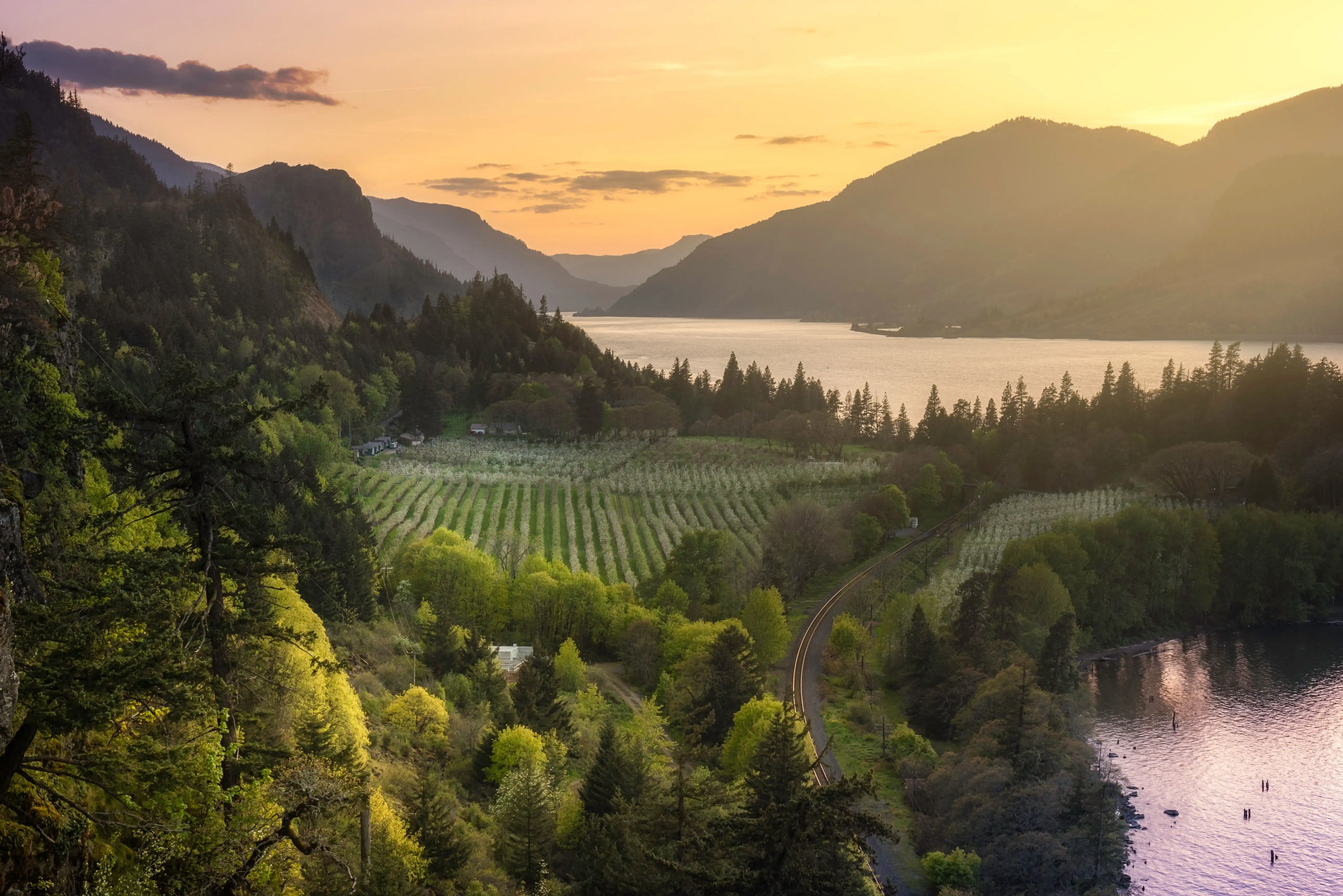
Maybe you drove through Hood River on I-84 and thought, wait, people actually live here? Or you've been priced out of Portland's close-in neighborhoods and someone mentioned the Gorge. Either way, the thing that surprises most people is how fully formed this place is — a city of 8,361 that operates with the cultural density of somewhere much larger. Hood River sits on the Columbia River at the foot of Mt. Hood, with Washington State directly across the bridge and the wind-scoured Gorge framing every view. I-84 is the artery that connects it to the metro, and the same geography that makes it jaw-dropping to visit is the same geography that shapes everything about living here: what you do on weekends, who your neighbors are, why you will likely need a car, and why you probably won't mind.
The economy here is a genuinely unusual mix. Hood River County School District and a major regional health system are the two anchor institutional employers — between them they cover a substantial share of local jobs in education and healthcare. Insitu, a Boeing subsidiary that designs and operates unmanned aircraft systems, represents the high-tech thread in the local economy and was founded right here in the Columbia Gorge. Agriculture runs underneath all of it: more than 14,500 acres of pears, apples, and cherries fill the Hood River Valley, and the Hood River County Fruit Loop — a scenic circuit with farm stands, wineries, cideries, and u-pick orchards — is both a tourist draw and a genuine part of local identity. The Hood River County School District holds a B+ rating, according to Niche, and with 3,744 students enrolled in 2025-26, it's large enough to offer real programming depth for a city this size. Who moves here? A distinct blend of outdoor athletes, remote workers who prioritized lifestyle over location, agricultural families going back generations, and aerospace professionals who found they didn't want to live in a suburb.
Cost of living is the honest conversation you need to have before falling too hard for the scenery. The typical home price sits at $721,304 (July 2026), which puts Hood River well above most smaller Oregon cities and not that far below Portland's close-in suburbs — for a city of under 9,000 people, that's a significant premium, and it's driven almost entirely by demand from people who want exactly what Hood River offers. Rent runs similarly high. What you get in return is access to Post Canyon's mountain biking trails, the Columbia River Gorge, ski and snowboard terrain on Mt. Hood, and a downtown compact enough to walk end to end in fifteen minutes. The full cost-of-living breakdown covers the numbers in depth. Oregon also has no sales tax, and the effective property tax rate here — 0.56% — is notably low by Pacific Northwest standards.
Whether you're seriously considering a move or just starting to research the area, the sections below break down Hood River's neighborhoods, housing market, daily commute realities, local employers, and what weekends here actually look like — so you can decide whether this city fits your life, not just your Instagram feed.
Hood River at a Glance
Looking to buy in Hood River? Estimate your payment.
Enter your numbers to see an estimated monthly mortgage payment.
Estimate only. Excludes HOA fees and mortgage insurance. The interest rate above is a starting point, not a quoted rate — replace it with your own to see real numbers. Insurance is a flat placeholder, not a Hood River quote.
Why Are People Moving to Hood River?
The short answer is lifestyle arbitrage — people who have decided the outdoor access here is worth whatever it costs to live next to it. The longer answer involves a specific kind of person: one who has run the numbers on remote work, looked at what Portland or Seattle would cost for a comparable quality of life, and concluded that Hood River makes sense if you can make the income work.
The Outdoor Pull Is Real, Not a Marketing Slogan
Hood River has carried the nickname "Windsurfing Capital of the World" for decades, and the Columbia River earns it — wind speeds top 20 knots on roughly 190 days a year, making the Event Site one of the premier kiteboarding, winging, and foiling venues on the continent. That's not the only draw. Post Canyon is a genuine destination for mountain bikers, Mt. Hood offers summer glacier skiing and snowboarding a short drive up OR-35, and the Columbia River Gorge has whitewater kayaking that draws paddlers from across the region. People move here specifically because this is where they want to be on a Saturday morning.
The Job Base Is Small but Specific
If you're not working remotely, your realistic local options center on the school district, county and city government, the healthcare sector anchored by a major regional medical facility, and Insitu — the Boeing subsidiary that designs and operates unmanned aircraft systems and is one of the few private-sector employers in the area offering technical, engineering-level work. Many residents commute out for work, and many more have structured their careers around being able to live here rather than the other way around.
The agricultural economy is genuinely significant — Hood River Valley pear and apple orchards represent a major production hub for Oregon — though it's worth knowing that growers have faced difficult economics in recent seasons. That context matters for understanding the broader community character, which runs deeper than the tourism-facing version of the city.
Who This City Is Not For
If you need a Costco run every other weekend or want a wide restaurant rotation without driving, Hood River will test your patience. A serious shopping trip means leaving town. The city's population of 8,361 means the amenity base reflects that scale. People who move here from larger metros and haven't fully reckoned with the smallness — the limited dining variety, the fact that everyone eventually knows everyone — are among the most common early departures.
What Daily Life Feels Like in Hood River
Living here doesn't feel like living in a tourist town, even though tourists show up every weekend from spring through fall. The locals have a way of routing around the crowds — parking in spots visitors don't find, timing errands to avoid the Friday afternoon I-84 backup from Portland — and the off-season reveals a quieter, more genuinely local version of the city.
The Downtown Core
Downtown Hood River is compact and genuinely walkable once you're in it. Oak Street runs the commercial spine, and you can cover most of it on foot in a single pass — independent coffee shops, the occasional gallery, a handful of restaurants, gear shops for every outdoor discipline. Hood River is, famously, the only city in Oregon where drinking on public sidewalks and in parks is unrestricted, which gives the waterfront and downtown a different atmosphere than most small Oregon cities.
The Heights as a Neighborhood Anchor
The Heights sits above downtown and functions as the residential and service center for a lot of everyday life. Small businesses cluster along 12th and 13th Streets, and Jackson Park anchors the neighborhood as an outdoor gathering point. This is where a lot of families with school-age children settle — close to the school district's facilities, with a neighborhood character that feels distinctly Hood River without being in the tourist-traffic corridor.
Seasonal Rhythms That Catch Newcomers Off Guard
Spring brings the Fruit Loop's Blossom Fest, when the orchards between Hood River and Parkdale bloom and the roads fill with visitors. Fall harvest season does the same. If you're moving here without experiencing a summer weekend on the waterfront, that's the thing most worth doing first — the Event Site fills with kiters and the Hood River Bridge backs up and the town feels suddenly twice its size. By November, it's a different place entirely, and longtime residents tend to love that version best.
The weather is sunnier than the rest of western Oregon — 144 sunny days a year — but the Gorge wind is relentless, and not everyone finds that charming after a few months. It's worth a winter visit before committing.
Schools in Practice
The Hood River County School District holds a B+ rating, according to Niche, and serves a genuinely diverse student population — both economically and culturally — that reflects the agricultural and outdoor-recreation mix of the broader county. On 2024-25 state assessments, 34.4% of students reached math proficiency and 45.8% reached reading proficiency, figures consistent with statewide challenges in post-pandemic recovery. See the full schools page for detail on individual campuses and boundary specifics.
The Hood River Housing Market Right Now
The typical home price in Hood River is $721,304 (July 2026), which is the number that stops most people cold when they first look seriously at moving here. For a city of under 9,000, that price point reflects sustained demand from buyers who are specifically choosing this place — not just people who couldn't afford somewhere else, but people who decided this is where they want to be and are paying for the privilege.
Entry-level inventory is genuinely limited. Well-priced homes at the lower end of the market move quickly, and sellers in desirable parts of the city rarely need to wait long. Some parts of the city sit noticeably above that city-wide figure; see the neighborhoods page for a full breakdown of where the geographic and price divides actually fall.
The Rent Picture
The typical 2BR rent runs $2,600–$3,160, and the city-wide typical rent across unit sizes is $2,825 per month (Zillow ZORI, July 2026). That's high for a city this size anywhere in Oregon, and it reflects the same demand dynamic as the purchase market. Rentals turn over infrequently, and competition for available units can be real.
Property Tax and Oregon's Tax Structure
One meaningful offset: the effective property tax rate here is 0.56%, which is low compared to most comparable markets in the Pacific Northwest. Oregon also has no sales tax. Those two factors together don't close the gap on purchase price, but they do change the ongoing cost math in ways worth factoring in — the cost-of-living page works through the full picture.
What the Market Rewards
Buyers who come prepared — who have done the neighborhood research, understand which areas hold value for their specific priorities, and aren't anchored to prices from three years ago — tend to find Hood River more navigable than it first appears. The inventory is small, but so is the city, and patient buyers do find their footing here.
Hood River Neighborhoods
Hood River has several distinct areas — each with its own character and appeal. Here’s a breakdown to help you narrow down where to focus your home search.
🏡 The Heights
Sitting above downtown on the ridge, The Heights mixes historic Hood River homes with newer construction along 12th and 13th Streets, with small businesses and services that let residents handle most errands without descending the hill. Jackson Park anchors the neighborhood as a community outdoor space, and the area draws families with school-age children who want a residential feel close to the school district's facilities.
🏠 Downtown Hood River
The commercial and social heart of the city, where Oak Street's walkable corridor puts independent coffee shops, gear outfitters, and restaurants within a short walk of each other. It suits buyers who want to be at the center of Hood River's distinct small-city energy and are close enough to the waterfront to feel the river in daily life.
🌳 Westside
A quieter residential stretch west of the commercial core, Westside tends to attract buyers looking for a neighborhood feel with slightly more distance from tourist traffic. The housing stock ranges from older craftsman-era homes to mid-century builds.
🏘 Eastside / Country Club
The Eastside corridor runs toward the eastern edge of the city and includes the area around the Hood River Golf Course, giving it a more spacious, semi-rural feel compared to the denser core neighborhoods. It suits buyers who want room and a quieter residential pace while staying within the city limits.
🏔 Willow Ponds
Willow Ponds is a newer residential development with more recently built homes and a neighborhood layout that appeals to families and buyers seeking move-in-ready construction rather than the older housing stock found elsewhere in Hood River.
🌆 The Waterfront
Living on the waterfront means the Columbia River, the Event Site, and Hood River Waterfront Park are immediately accessible — a real draw for wind-sports enthusiasts and anyone who wants the river as a daily backdrop. It's the most visitor-facing part of the city, with the energy and foot traffic that comes with that position.
Pros & Cons of Living in Hood River
The Pros
- World-class windsurfing, kiteboarding, and Columbia River Gorge recreation right in town
- Strong, well-regarded school district with above-average graduation rates
- Scenic orchard valley setting with Mt. Hood and Mt. Adams views
- Vibrant craft beer and food scene for a small town
The Cons
- Home prices are high relative to income, driven by tourism demand and limited land
- Heavy seasonal tourist traffic and crowds in summer months
- Property crime runs above state and national averages, concentrated in commercial/tourist areas
Getting Around & Commuting in Hood River
I-84 is the spine that connects Hood River to the rest of the region, and understanding how it works is the first thing any commuter needs to know. The freeway runs along the Columbia River corridor, and Hood River's exits drop you directly into the city. In either direction, the Gorge itself shapes the drive — there are stretches where weather, wind, and seasonal congestion compress what looks like a short drive on a map.
The Portland Commute
The drive to Portland from Hood River takes about 60 minutes under normal conditions. That's a real commute, not a casual one, and anyone doing it daily needs to account for the fact that I-84 through the Gorge carries freight, weekend recreation traffic, and occasional weather closures that have no good workaround. Most people who make it work do so on a hybrid schedule — two or three days in the office rather than five. The Columbia Gorge Express runs year-round between Hood River and Portland, offers bike storage on some runs, and is a legitimate alternative for days you don't want to drive.
Local Transit Options
Columbia Area Transit (CAT) provides local bus service throughout Hood River seven days a week. The Link regional bus connects Hood River to The Dalles, and Greyhound intercity service is also available. OR-35 is the route up toward Parkdale and the mountain, and US-30 — the Historic Columbia River Highway — connects to other Gorge communities to the west. OR-281 runs south into the valley toward Dee and Parkdale.
Within the City
Downtown Hood River is small enough that a car is optional once you're parked. The Heights and the waterfront are separated by a significant hill — the grade between them is steep enough to make a casual walk less casual — so most residents drive between neighborhoods for anything beyond a short trip. The Indian Creek Trail offers a useful connector for cyclists and walkers within parts of the city, and the waterfront parks are within reach on foot from downtown.
The Airport Equation
Portland International Airport (PDX) is approximately 57 miles away — the Columbia Gorge Express covers the route, or it's about the same drive time as the Portland commute. For a city this size, that's a reasonable airport connection, and one more argument for the occasional bus trip rather than driving and parking.
Who Manages the Commute Well
Remote workers, hybrid schedules, and people whose jobs are in the Gorge corridor itself — the school district, county government, local healthcare, Insitu — tend to find Hood River's commute situation workable. People who need to be in Portland five days a week find it exhausting after about six months. That's the honest version.
Schools in Hood River
Families relocating to Hood River have public, private, and higher-education options nearby. Here’s a quick overview.
🎓 School District
Hood River County School District serves K–12 students across Hood River and the surrounding area. Rated B+ (source: Niche.com).
🏆 Graduation Rate
The 4-year high-school graduation rate here is approximately 89.6%.
📚 Higher Education
Oregon’s public universities — the University of Oregon, Oregon State University, and Portland State University — offer four-year degrees statewide, with a network of 17 community colleges providing two-year and workforce programs.
🌐 Online Learning
Oregon State University Ecampus and Portland State University Online offer fully accredited online degrees for remote learners across the state.
Safety in Hood River
A quick look at how Hood River compares on the numbers that matter most when weighing a neighborhood or a move.
🛡 Violent Crime
Approximately 0.83 per 1,000 residents.
🔒 Property Crime
Approximately 3.92 per 1,000 residents.
Compared to the most recent national figures from the Bureau of Justice Statistics (2024), Hood River’s violent crime is below the national average (about 3.7 per 1,000), and property crime is below the national average (about 18.4 per 1,000).
Against Oregon as a whole, Hood River’s violent crime is roughly a quarter of the state average, and property crime is a small fraction of the state average (Bureau of Justice Statistics, Crime Known to Law Enforcement, 2024 (tables 2 and 3)).
Crime rates can vary a lot within a single city, so the citywide numbers above are only a starting point. Some neighborhoods in Hood River run well below these averages, while others run higher — the kind of block-by-block detail that matters most when you’re actually choosing where to live. The full guide below breaks it down neighborhood by neighborhood.
Working in Hood River
Hood River’s largest employers span several industries — here are some of the anchors of the local job market.
🎓 Hood River County School District
Education
🏥 Providence Hood River Memorial Hospital
Healthcare
🏛 Hood River County
Municipal government
🏛 City of Hood River
Municipal government
💼 Insitu
Aerospace
Parks & Recreation in Hood River
Some of the outdoor spaces that shape everyday life in Hood River.
🌱 Hood River Waterfront Park
🌱 Hood River County Fruit Loop
🌱 Columbia River Gorge
Hood River residents don’t have to go far for green space — spots like Hood River Waterfront Park and Hood River County Fruit Loop are part of everyday life here, whether that’s a morning walk, a weekend hike, or just somewhere to unwind outside. The full guide below covers more of what Hood River has to offer for parks and outdoor recreation.
Retiring in Hood River
Hood River draws retirees for its balance of amenities, outdoor access, and cost. Here’s what to weigh.
🌤 Climate
Hood River averages 144 sunny days a year — more than most of western Oregon — with warm, dry summers and mild, wet winters. The Gorge wind is a constant presence from spring through fall, which many retirees find invigorating and others find exhausting. Snow is rare in the city itself, though Mt. Hood is visible and accessible for those who want a winter season.
🍴 Lifestyle
The Fruit Loop's farm stands, local breweries, the Hood River Farmers Market, and a compact downtown with independent coffee shops and restaurants give daily life a strong sense of place. The cultural calendar follows the agricultural seasons — Blossom Fest in spring, harvest in fall — and the outdoor recreation access is exceptional for retirees who want to stay active well into later years.
🏚 55+ Communities
Hood River's 55+ options include Mid Columbia Mobile Estates and Moores Mobile Manor — both smaller, community-oriented settings rather than large amenity-heavy developments. Retirees looking for an independent lifestyle with outdoor access and a genuine small-city character tend to find the broader housing stock more appealing than age-restricted communities specifically. See the retiring in Hood River page for more detail.
✈ Getting Around
A car is practical for most daily errands, though downtown is walkable on its own terms. Columbia Area Transit provides local bus service, and the Columbia Gorge Express connects to Portland for medical appointments or airport trips. Portland International Airport (PDX) is approximately 57 miles away — about 60 minutes by car under normal Gorge conditions.
🏛 Oregon Taxes for Retirees — What to Know
- Social Security is not taxed — Oregon does not tax Social Security or Railroad Retirement benefits. Any amount included in your federal adjusted gross income is subtracted back out on the Oregon return.
- But other retirement income IS taxed — This is the trade-off that surprises people moving from Washington or Texas. Pension distributions and 401(k)/IRA withdrawals are taxed as ordinary income at Oregon’s regular rates — there is no blanket retirement-income exclusion.
- Graduated income tax — Oregon has four brackets — 4.75%, 6.75%, 8.75% and 9.9%. The 4.75% rate covers the first $10,000 of taxable income for a single filer ($20,000 filing jointly); the 8.75% rate starts at $125,000 ($250,000 jointly); and the top 9.9% rate applies above $250,000 ($500,000 jointly).
- No sales tax — Oregon levies no general sales tax.
- Property taxes, with senior deferral — Oregon’s Senior and Disabled Property Tax Deferral lets qualifying homeowners have the state pay their county property taxes, with a lien recorded against the home. The 2026 household income limit is $70,000, and deferred balances accrue 6% simple interest — it defers the bill rather than forgiving it.
- Estate tax — the one to plan for — Oregon has its own estate tax with a $1 million filing threshold — far below the federal exemption, and NOT indexed for inflation, so it reaches more estates every year in real terms. Retirement accounts and a long-held home count toward the taxable estate, so estates that feel modest can cross the line without the owner expecting it.
- No inheritance tax — Oregon has no separate inheritance tax and no gift tax.
Tax laws change frequently and individual situations vary. This is general information, not tax advice — always consult a qualified Oregon tax professional or CPA for personalized retirement tax planning.
Weekends & Local Favorites in Hood River
Hood River's weekend culture is organized around being outside first and eating and drinking second, usually in that order. The sequence that locals have worked out: get on the water or the trail early, be back by early afternoon, then settle into the food and drink scene while the tourists are still fighting for parking.
On the Water and on the Trails
Hood River Waterfront Park and The Hook are the gathering points for the wind-sports community — the Event Site at The Hook is where kiters and windsurfers launch when conditions are right, and watching the river on a 25-knot afternoon is worth doing even if you never get on a board. Post Canyon mountain biking trails draw riders from well outside the region, ranging from beginner-accessible to expert-level descents. The Indian Creek Trail runs through parts of the city for runners and cyclists who want something closer to home.
The Fruit Loop
The Hood River County Fruit Loop is a scenic drive through the valley with farm stands, wineries, cideries, breweries, lavender fields, and u-pick orchards framed by views of Mt. Hood and Mt. Adams. The April Blossom Fest, when acres of orchards bloom simultaneously, and the fall harvest season are the two moments when the loop is at its most spectacular. Locals do it mid-week to avoid the weekend crowds.
Where to Eat and Drink
The verified local anchors worth knowing: pFriem Family Brewers - Hood River is consistently one of the most acclaimed craft breweries in Oregon, with a taproom that draws visitors from across the state. Ferment Brewing Company offers its own take on the Gorge brewing scene. For wood-fired pizza, Solstice Wood Fire Pizza & Bar has a devoted local following. Riverside rounds out the sit-down dining options that residents return to regularly.
For coffee, the morning options are genuinely good for a city this size. Doppio Coffee, Dog River Coffee, Ground Espresso Bar & Cafe, Pine Street Bakery, and River Daze Café each have their regulars, and KickStand Coffee & Kitchen adds a casual breakfast and lunch dimension.
The Farmers Market
The Hood River Farmers Market runs through the warm months and is genuinely embedded in local life — this is one of the more agriculturally rich valleys in the Pacific Northwest, and the market reflects that. It's the weekly version of what the Fruit Loop does seasonally: direct access to the people who actually grow the food.
The Mt. Hood Railroad
The Mt. Hood Railroad runs excursion trips through the Hood River Valley with views of the orchards and the mountain — a detail that sounds like a tourist thing until you've done it once and understood why locals put out-of-town visitors on it every time.
Local favorites in Hood River
Restaurants
- Solstice Wood Fire Pizza & Bar
- Riverside
- pFriem Family Brewers - Hood River
- Ferment Brewing Company
- KickStand Coffee & Kitchen
Outdoors
- Hood River Waterfront Park
- Indian Creek Trail
- Post Canyon mountain biking trails
- The Hook
Coffee
- Doppio Coffee
- Pine Street Bakery
- River Daze Café
- Ground Espresso Bar & Cafe
- Dog River Coffee
Farmers Markets
- Hood River Farmers Market
Top Things Locals Say About Hood River
The best intel about a city comes from the people who actually live there. Here’s what Hood River residents say when newcomers ask the questions everyone’s thinking.
“I knew the commute to Portland was an hour, but I didn't really feel what that meant until the first time I-84 closed for ice and I was stuck on US-30 in the dark for two and a half hours. What I didn't expect was how quickly I stopped caring — because the next morning I was on the river at 7am and there were forty kiters already out.”
— Recent Hood River home buyer
“What's the most surprising thing about living in Hood River?”
How different the city feels once you're actually living in it versus visiting on a weekend. The Heights neighborhood is genuinely quiet and residential — you're navigating school drop-off and grocery runs like any small town — and then you drive down the hill and the waterfront is full of kiters and tourists. Both versions are real. Most newcomers only know the second one before they move.
“What do locals love most about Hood River?”
The access is just immediate. Post Canyon is a ten-minute drive. The river is five minutes from downtown. Mt. Hood is close enough on OR-35 that you can ski in the morning and be back for dinner. Longtime residents talk about how the Gorge itself — the scale of it, the wind, the views of Mt. Hood and Mt. Adams across the valley — never really gets old. The Hood River Farmers Market and the Fruit Loop seasons give the year a rhythm that's distinct to this valley.
“What should newcomers to Hood River know?”
The hill between downtown and The Heights is real — it's not a casual walk, and anyone who assumes they'll walk everywhere without accounting for that grade is going to be surprised. The Gorge wind is relentless from spring through fall, which is exactly what the windsurfing community came for and something that catches everyone else off guard the first summer. And plan a mid-week Fruit Loop trip if you want to actually stop and talk to growers — the weekend crowds on that route are a different experience entirely.
“How much do you need a car in Hood River?”
Most day-to-day errands — particularly anything beyond the immediate downtown core — mean a drive. The Heights and downtown are connected by a steep hill that most people don't walk regularly. The waterfront and parts of downtown are genuinely on-foot accessible if you live nearby, and the Indian Creek Trail gives cyclists and walkers a useful corridor. Columbia Area Transit covers the city and connects to Portland via the Columbia Gorge Express, which is a real option for commuting days. But for the school run, grocery shopping, or getting out to Post Canyon or the Fruit Loop, a car is how most residents get around.
Cities Near Hood River
Other communities near Hood River worth a look — each with its own character and price point.
| City | Distance | Best For | Vibe | Median Rent | Median Buy |
|---|---|---|---|---|---|
| White Salmon, WA | 7 mi | Outdoor-focused buyers, lower entry prices | Small-town, river views, Washington side | $1,500 | $450,000 |
| Odell | 5 mi | Agricultural community, more space | Rural, orchard country, quiet | $1,600 | $500,000 |
| Cascade Locks | 17 mi | Value seekers, outdoor access | Small, trail-adjacent, working-town feel | $1,400 | $380,000 |
More Helpful Guides for Hood River
Going deeper on Hood River? Our blog series covers everything from first-time buying to retiring here — explore the guides below.
Local Expert Takeaway: Hood River asks you to make a real trade: you accept a small city with limited retail, a demanding Portland commute, and home prices that make Portland's close-in suburbs look competitive — and in return you get the Columbia River at your doorstep, Post Canyon five minutes away, pFriem on a Friday afternoon, and a community that has genuinely decided living well matters more than living conveniently. Most people who leave cite the commute or the cost. Most people who stay say they can't imagine living anywhere else.
Quick Takeaways & FAQs
✅ Hood River is the undisputed windsurfing and kiteboarding capital of the U.S., with over 190 high-wind days a year on the Columbia River — a genuine draw that shapes who moves here and why.
⚠️ The typical home price of $721,304 (July 2026) is high for a city of 8,361, and the limited inventory means well-priced homes don't sit — buyers who aren't prepared to move decisively often lose out.
📍 The Columbia Gorge Express runs year-round between Hood River and Portland with bike storage on some trips, giving commuters a real alternative to driving I-84 every day.
What is the typical home price in Hood River, Oregon?
How far is Hood River from Portland, and is the commute manageable?
What are the schools like in Hood River?
Is Hood River safe to live in?
What is there to do in Hood River on weekends?
Helpful Links for Moving to Hood River
Moving to Oregon?
Tell us what you need help with and we'll connect you with local resources.
