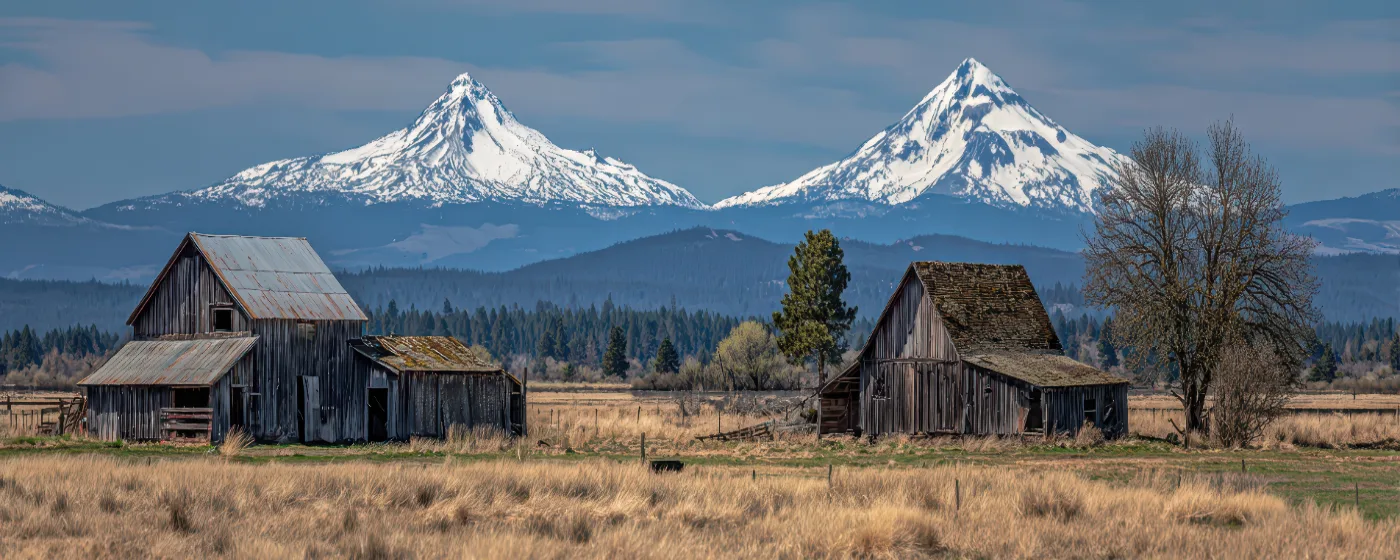
Most people moving to Sisters ask about crime first. The data answers that question quickly and confidently. What takes longer to explain — and what nobody moving from California or the Pacific Northwest's wetter side fully anticipates — is that the more consequential safety conversation in Sisters isn't about crime at all. It's about fire. A city of 3,022 people surrounded by ponderosa pines and Deschutes National Forest land sits in a landscape that burns, and understanding that reality is as important as reading any crime statistic before you decide on a neighborhood here.
On the conventional crime side, Sisters posts numbers that are genuinely difficult to argue with. With a violent crime rate of 0.34 per 1,000 residents and a property crime rate of 3.72 per 1,000 residents — drawn from Bureau of Justice Statistics, Crime Known to Law Enforcement, 2024 (tables 2 and 3) — the city sits far below both state and national benchmarks. Law enforcement here is handled by the Deschutes County Sheriff's Office rather than a city police department, which is typical for a small incorporated city of this size. That structure works: residents have consistently rated law enforcement services positively in the city's own surveys.
The wildfire picture is more complicated. The Flat Fire of August 2025 burned approximately 23,346 acres northeast of Sisters, placed nearly 4,000 homes under evacuation orders, and destroyed 4 homes and 6 buildings. That event wasn't an anomaly — it was a reminder of what Central Oregon's fire seasons can look like. Some neighborhoods here have responded with serious, organized preparedness efforts. Others haven't. That distinction matters when you're choosing where to live.
Whether you're weighing Sisters against Bend or researching Central Oregon for the first time, the sections below break down the crime statistics in context, explain what within-city patterns look like, cover wildfire risk by neighborhood, and tell you what residents actually think about safety here.
Sisters Crime Rate in Context
The numbers place Sisters among Oregon's safest communities by a wide margin. A violent crime rate of 0.34 per 1,000 residents is roughly one-tenth the Oregon state rate of 3.3 per 1,000 and well below the national rate of 3.7 per 1,000. A property crime rate of 3.72 per 1,000 residents similarly undercuts both the state figure of 24.5 per 1,000 and the national figure of 18.4 per 1,000 — Bureau of Justice Statistics, Crime Known to Law Enforcement, 2024 (tables 2 and 3).
That gap isn't marginal. On violent crime especially, Sisters sits at a level that most Oregon cities of any size don't approach — the difference between Sisters and the state average is large enough that it holds even when accounting for the year-to-year variability that affects small-city rates.
One metric that gives some texture to what those rates mean in daily life: the estimated tangible cost of crime per resident in Sisters runs approximately $336 per year, according to CrimeGrade.org 2025 projections — notably below both the national average and Oregon's state average on the same measure. That figure is worth treating as one data point rather than a precise target, but it corroborates the overall picture that Sisters is not a city where crime carries a significant practical burden on most residents. Sites like CrimeGrade.org and NeighborhoodScout are useful for looking up specific addresses if you want additional context beyond the official rates.
The engine renders a comparison table of these figures immediately below — the clearest way to see how Sisters stacks up against state and national benchmarks at a glance.
Where Crime Actually Concentrates in Sisters
The citywide rate tells one story. The within-city pattern tells a more useful one for anyone deciding where to live.
In a small city like Sisters, crime is not evenly distributed. The central and downtown core — the commercial corridor with its Western-themed storefronts, galleries, and active foot traffic — generates the most incidents, simply because it's the busiest part of town. The residential neighborhoods further out, particularly on the southwestern side of the city, see comparatively little. That's not a surprising pattern, but it's worth naming clearly: the southwest residential areas are among the quietest in town by any crime measure, while the downtown commercial area accounts for a disproportionate share of a very small total.
Understanding that concentration correctly matters. Sisters' downtown isn't dangerous by any conventional standard — the incidents it generates tend to be minor property matters rather than anything that would affect a resident's sense of personal safety walking around town. The commercial corridor is busy because people want to be there, and that foot traffic is what drives both the appeal and the modest crime concentration.
For families choosing between neighborhoods like Tollgate, Pine Meadow Village, or Village at Cold Springs, the practical takeaway is that the residential neighborhoods sit in the quieter end of that distribution. The more meaningful neighborhood-level distinction in Sisters isn't crime — it's wildfire exposure, covered in the next section.
The City of Sisters took its own measure of resident safety perceptions in summer 2024, distributing a public safety survey to roughly 1,642 city newsletter subscribers. Results were presented to City Council in November 2024. That residents were engaged enough to respond in meaningful numbers — and that the city sought the input in the first place — reflects a community that takes safety governance seriously rather than treating it as an afterthought.
What locals know: The downtown area generates most of the headline incidents, but the incidents themselves tend to be minor property matters rather than anything that would affect a resident's sense of personal safety walking around town.
Wildfire Risk: The Safety Conversation Sisters Actually Has
Ask a Sisters resident what they worry about and very few say crime. Most say fire.
The Flat Fire of August 2025 made the stakes concrete: approximately 23,346 acres burned northeast of Sisters, nearly 4,000 homes came under evacuation orders, and 4 homes and 6 buildings were destroyed. The fire didn't reach most of the city, but the evacuation orders touched the lives of thousands of households — including people whose homes were ultimately fine but who spent days not knowing. That experience is the context in which every neighborhood-level wildfire conversation in Sisters now happens.
Sisters sits in what fire managers call the Wildland-Urban Interface — the zone where developed land meets forest and rangeland. The ponderosa pine stands that make neighborhoods like Tollgate and Sisters Woodlands (The Woodlands) feel like a retreat are the same fuel load that makes those areas higher-exposure in a fire year. Oregon land use law no longer permits new forest and sagebrush subdivisions, which means existing wooded neighborhoods are both unique in character and fixed in their relationship to the surrounding landscape.
Tollgate: The Most Prepared Neighborhood in Oregon
Tollgate has responded to that reality more seriously than almost any residential community in the state. The neighborhood's homeowners association maintains its own community fire station and runs a cross-connection water safety program. A Tollgate home became the first in Oregon to receive certification from the Insurance Institute for Business & Home Safety as a wildfire-prepared home — a rigorous standard focused on ember resistance and structural fire resilience.
The community's Firewise committee is active and organized. This level of preparedness doesn't eliminate wildfire risk — nothing does — but it does mean that Tollgate buyers are purchasing into a community that takes the risk seriously and has invested accordingly.
Prescribed Burns and Mitigation Efforts
The Deschutes National Forest has conducted prescribed burns in the vicinity of Sisters — including areas along Cold Springs Road — as part of active risk reduction work. These burns reduce fuel loads that would otherwise make a fire spread faster and burn hotter. They're a genuine mitigation tool, not just a bureaucratic exercise, and their presence near Sisters reflects the Forest Service's recognition that this landscape needs active management.
What to Check Before You Choose a Neighborhood
Before settling on a neighborhood, look up each address on Oregon's wildfire hazard map, which assigns risk levels based on fire behavior modeling. Check whether the neighborhood or its HOA participates in a Firewise program. Ask specifically about the home's construction — ember-resistant vents, fire-resistant roofing, and defensible space all meaningfully affect insurance eligibility and actual fire survival odds.
Emergency alerts for the Sisters area are issued through deschutesalerts.org, managed by the Deschutes County Sheriff's Office. Signing up before you move — not after — is one of the first practical steps new residents take.
Looking to buy in Sisters? Estimate your payment.
Enter your numbers to see an estimated monthly mortgage payment.
Estimate only. Excludes HOA fees and mortgage insurance. The interest rate above is a starting point, not a quoted rate — replace it with your own to see real numbers. Insurance is a flat placeholder, not a Sisters quote.
What Newcomers Don't Expect
People moving to Sisters from cities focus on crime statistics. After six months, most say the crime data was never the point — and two things caught them off guard instead.
The first is the psychological reality of fire season. Smoke from regional fires settles into the Sisters valley more summers than not, turning the air hazy and the light amber for days or weeks at a stretch. It's not always from a fire threatening Sisters directly — Central Oregon sits in a region where nearby ignitions regularly affect air quality regardless of where the actual fire is burning. New residents often underestimate how much this affects daily outdoor life, particularly for households that moved here specifically for hiking the Peterson Ridge Trail System or spending time in the Three Sisters Wilderness.
The second is how small 3,022 people actually feels when something goes wrong. When the Flat Fire evacuation orders went out, residents got the alert, made the call about whether to leave, and dealt with the uncertainty largely through neighborhood networks — texts with neighbors, HOA communications, social media groups. The formal alert system through deschutesalerts.org worked, but the informal community infrastructure was what people leaned on most. That's common in small towns, and it's a feature rather than a bug — but it means your relationship with your immediate neighbors matters more here than it would in a larger city.
People who move out of Sisters tend to cite one of two reasons: the isolation gets to them faster than expected, or the wildfire anxiety becomes a chronic stressor rather than a manageable background concern. Neither is a flaw in the city — they're honest trade-offs for a life in a small mountain community at the edge of the national forest. For the right household, those trade-offs are more than worth it. For the wrong one, the crime statistics being excellent doesn't change the calculus.
Sisters Safety: The Honest Summary
On conventional crime, Sisters is one of Oregon's safest communities. A violent crime rate of 0.34 per 1,000 residents and a property crime rate of 3.72 per 1,000 residents both sit far below state and national rates — that gap isn't marginal, it's substantial. Families with kids, retirees, remote workers, and anyone who values a low-crime environment will find the data genuinely reassuring rather than just statistically average.
The honest complexity is wildfire. Sisters is not a city where you can treat fire as an abstract future risk and move on. It's a city where you research the specific neighborhood, check the hazard map for the specific parcel, ask about the home's construction, sign up for deschutesalerts.org, and make a clear-eyed decision about whether you can live comfortably in a landscape that carries that kind of seasonal risk.
The neighborhoods vary meaningfully in their fire exposure and their preparedness culture. Tollgate's organized approach — community fire station, Firewise committee, the state's first certified wildfire-prepared home — represents one end of that spectrum. The more open, newer subdivisions like Grand Peaks and Saddlestone sit in a different risk profile. For full neighborhood-by-neighborhood context on character, location, and how each area relates to both the downtown core and the surrounding forest, see the Sisters neighborhoods guide.
The cost-of-living picture — including what a typical home runs and how Sisters prices compare to Bend and Redmond — is on the Sisters cost of living page. On safety alone, the short answer is: Sisters is genuinely safe by any conventional crime measure, and your next question after reading that should be about fire, not about anything else.
Local Expert Takeaway: Sisters has exceptionally low crime by any Oregon benchmark, and most longtime residents will tell you they don't think about crime much at all. What they do think about — especially after a summer like 2025 — is fire. The smart move before choosing a specific neighborhood is to pull the Oregon wildfire hazard map for the addresses you're considering, find out whether the HOA or community has a Firewise program, and register for Deschutes County alerts at deschutesalerts.org before you even move in. The crime data is on your side here. The wildfire landscape requires more active attention.
Quick Takeaways & FAQs
✅ Sisters posts a violent crime rate of 0.34 per 1,000 residents — roughly one-tenth the Oregon state average — making it one of the safest communities in the state by conventional crime measures.
⚠️ Wildfire is the real safety variable in Sisters: the Flat Fire of August 2025 placed nearly 4,000 homes under evacuation orders, and residents in wooded neighborhoods like Tollgate live with this risk as a recurring seasonal reality.
📍 Emergency alerts for the Sisters area are issued through deschutesalerts.org by the Deschutes County Sheriff's Office — signing up before you move is one of the first practical steps every new resident takes.
What is the crime rate in Sisters, Oregon?
Is Sisters, Oregon a safe place to live?
What are the wildfire risks in Sisters, Oregon?
Which neighborhoods in Sisters have the lowest crime?
Who handles law enforcement in Sisters, Oregon?
Moving to Oregon?
Tell us what you need help with and we'll connect you with local resources.
