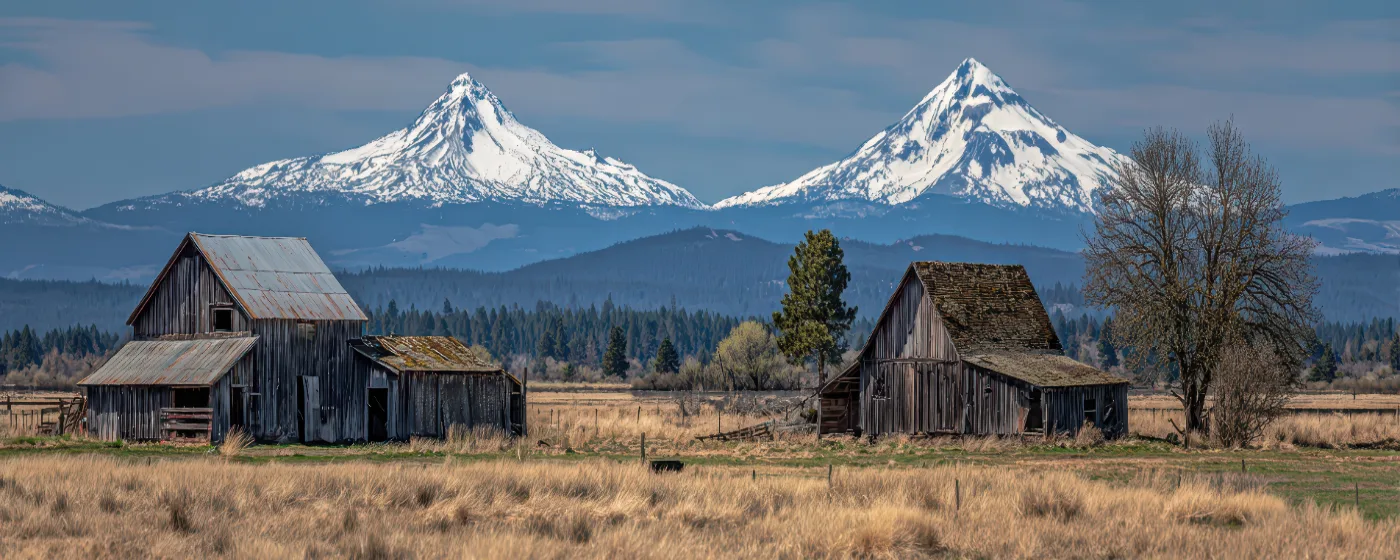
Most people who move to Sisters in retirement arrive because of what they can see from nearly every street corner: the three volcanic peaks of the Cascade Range rising above a Western-style main street in a town of 3,022. That view is not incidental — it is the organizing principle of daily life here. The recreational access is real, the community is tight-knit, and the pace is genuinely unhurried. The catch, and it is a real one, is that Sisters sits at the higher end of Central Oregon's already-elevated price range, and the services that support aging in place are thin for a town this size. Understanding both sides of that equation is what this guide is for.
Sisters is a small city at approximately 3,182 feet of elevation, situated where US-20 and OR-126 converge on the eastern slope of the Cascades. The drive to Bend is about 25 minutes — close enough to draw on that city's hospitals, specialists, big-box retail, and airport, yet far enough that Sisters keeps its own character. The local economy runs on the Sisters School District, city and county government, Black Butte Ranch hospitality, and Sisters Coffee Company, but for retirees the practical anchor is Bend, not the local job market. Many residents commute out; most retirees stay close to home and drive in when they need to.
The cost of living in Sisters runs noticeably above the Oregon average, and the full cost-of-living breakdown reflects that across groceries, services, and housing. The upside is that the outdoor lifestyle — the Peterson Ridge Trail System, the Three Sisters Wilderness, Suttle Lake, the Metolius River — is effectively at your door, and 162 sunny days a year means you can actually use it. Winters bring real snow at this elevation, but summers are dry and warm without coastal humidity. For active retirees who want four-season recreation without the density of a larger city, Sisters is a genuine fit.
Whether you are weighing a move here or still comparing options, the sections below cover who Sisters really suits in retirement, what healthcare access looks like from a practical standpoint, what the retiree budget requires, how walkable and socially connected the community is, what the downsizing inventory actually offers, and how Sisters stacks up against the retirement destinations closest to it.

Why Retirees Are Choosing Sisters
Sisters draws a specific kind of retiree: someone who spent a career somewhere denser and louder and wants the opposite. The town's population of 3,022 means everyone eventually knows their neighbors, the community calendar is participatory rather than spectator-oriented, and the mountain backdrop is not a weekend trip — it is Tuesday morning. The Sisters Rodeo, the Sisters Outdoor Quilt Show (one of the largest outdoor quilt shows in the world), and the Sisters Folk Festival give the year a rhythm that feels genuinely local rather than imported.
The honest question for any retiree considering Sisters is whether the entry price makes sense for what you get. The typical home price in Sisters stood at $790,765 as of July 2026 (Zillow Home Value Index) — a figure that reflects demand from exactly the demographic being described here. That price point requires either significant equity brought from a previous home sale, a strong retirement portfolio, or both. The median household income here sits well below what it takes to carry the typical home at current prices, which means Sisters is not a value play — it is a lifestyle choice that needs to be financed accordingly.
Who should look elsewhere: retirees on a fixed Social Security income without substantial assets will find Sisters financially stressful. Those who need frequent specialist care or prefer walking to medical appointments should factor in the 20-mile drive to the nearest hospital carefully. And anyone who wants an urban amenity set — transit, walkable grocery options, a dense restaurant scene — will spend most of their time in Bend rather than Sisters, which raises the question of whether to simply live there instead. Sisters rewards retirees who are mobile, reasonably healthy, outdoors-oriented, and financially prepared for a premium small-town market.
Healthcare & Medical Access in Sisters
Sisters has no hospital within city limits. St. Charles Redmond — a non-profit community hospital and Level III trauma center — is the nearest facility at about 20 miles. It is part of the St. Charles Health System, the largest provider of medical care in Central Oregon, and it handles emergency care, surgical services, and rehabilitation. For a routine ER visit or a scheduled outpatient procedure, St. Charles Redmond is a solid community hospital. For anything requiring Level II trauma capability or more complex specialty services, the St. Charles campus in Bend carries that designation and the depth of specialists to match.
St. Charles Health System operates four hospitals across Central and Eastern Oregon — in Bend, Redmond, Prineville, and Madras — with more than 220 employed medical providers covering a service area that stretches across roughly 32,000 square miles. That regional scale matters for Sisters residents: most specialist appointments flow through Bend, not Redmond, so the realistic medical commute for cardiology, oncology, or orthopedic consultations is about 25 minutes to Bend rather than 20 miles to Redmond.
Local primary care in Sisters is limited, and the town does not have the density of clinics you would find in a city several times its size. Retirees who manage chronic conditions or see multiple specialists should plan on regular drives to Bend as a standard part of life — not an emergency measure. That is a manageable reality for many active retirees, but it is worth building into your honest assessment of the lifestyle. If you or your partner would eventually need care that requires proximity to a hospital on short notice, Sisters' location deserves careful thought before you commit.
What to Know About Air Transport
For serious trauma or advanced cardiac or neurological care, the St. Charles Bend campus is the regional hub. Redmond Municipal Airport (RDM) is approximately 22 miles from Sisters and provides commercial air access if medical evacuation or specialist travel out of state becomes relevant. The proximity to both a regional Level II trauma center and a commercial airport is meaningfully better than many comparably sized rural towns in Oregon.

The Retiree Budget in Sisters
Oregon's Tax Picture for Retirees
Oregon's most retiree-friendly tax feature is straightforward: the state fully exempts Social Security and Railroad Retirement benefits from state income tax. If Social Security is your primary income source, you will not owe state income tax on it.
The less favorable side: pension income, traditional IRA distributions, and 401(k) withdrawals are taxed at Oregon's regular graduated rates, which run from 4.75% up to 9.9%. Those are among the higher state income tax rates in the country, and retirees drawing down tax-deferred accounts will feel them. Oregon's Retirement Income Credit — which offered a 9% credit on eligible pension income for lower-income seniors 62 and older — expired after tax year 2025 and was not extended by the legislature. Retirees who were counting on that credit should factor its absence into their planning.
Oregon also levies an estate tax on estates of $1 million or more, with an exemption that is not indexed for inflation. In a market where the typical home alone is approaching that threshold, retirees whose primary asset is real estate should consult an estate planning attorney about how Oregon's estate tax interacts with their situation.
Property Tax
The effective property tax rate in Sisters is approximately 0.62% — well below the national average and one of the practical arguments in favor of owning here versus in many other states. That rate does not make the purchase price smaller, but it does reduce the annual carrying cost of a home once you own it. See the cost-of-living page for a full breakdown of what daily expenses look like in Sisters.
Fixed-Income Reality
Groceries, dining, and services in Sisters carry a small-town premium: there is limited retail competition, and anything that requires a specialty purchase means a drive to Bend or an online order. A realistic retiree budget in Sisters requires accounting for regular fuel costs, given that most errands beyond the immediate downtown core need a car. The town is not unaffordable to live in once you own a home outright — the low property tax rate helps — but it is not a budget-retirement destination by any measure.
Looking to buy in Sisters? Estimate your payment.
Enter your numbers to see an estimated monthly mortgage payment.
Estimate only. Excludes HOA fees and mortgage insurance. The interest rate above is a starting point, not a quoted rate — replace it with your own to see real numbers. Insurance is a flat placeholder, not a Sisters quote.
Walkability, Community & Staying Active in Sisters
The Walkability Reality
Downtown Sisters is genuinely walkable by small-town standards. The Western-themed commercial district covers a compact stretch where you can walk from one end to the other, browse galleries, and pick up lunch without moving your car. That is a real quality-of-life asset for retirees who want an on-foot morning routine.
Beyond downtown, the picture changes. Grocery shopping, the pharmacy, hardware, and most practical errands require a car. The terrain is relatively flat within the commercial core, which matters for retirees managing mobility; Sisters does not have the hilliness that makes some Oregon small towns physically demanding on foot. But the honest assessment is that you will drive far more than you walk if Sisters is your full-time residence.
The Active-Adult Scene
The Peterson Ridge Trail System's more than 20 miles of multi-use trails — including designated horse trails with Cascade Range views — serve as an informal gathering space for active retirees who run, hike, or ride. The Three Sisters Wilderness, Suttle Lake, and the Metolius River are all within roughly a 20-minute drive for fly-fishing, kayaking, and hiking. The Sisters Community Garden offers a volunteer opportunity that puts retirees in regular contact with neighbors across age groups — a practical social anchor that retirement coverage of the town consistently calls out.
The Lodge Retirement Community — formerly Sisters Senior Living, now operating as an independent senior living community since April 2025 — provides an activities calendar and a community structure for residents who want built-in programming. It sits close enough to the downtown core to make the coffee shops and restaurants part of a regular routine rather than an occasional outing. The town's three signature annual events — the Sisters Rodeo, the Outdoor Quilt Show, and the Sisters Folk Festival — draw the whole community and give retirees recurring anchors on the calendar that feel participatory rather than passive.
Social Infrastructure
For a population of 3,022, Sisters punches above its weight on community engagement. The farmers market, the gallery scene along the main street, and the event calendar create genuine gathering points across the year. The trade-off is that the formal senior infrastructure — organized senior programming, transportation assistance, meal delivery — is thin compared to what a city of 30,000 or more would offer. Retirees who arrive in good health and with their own mobility will barely notice; those who anticipate needing more organized support in the near term should factor that gap in.
Right-Sizing: Downsizing in Sisters
Sisters' housing stock skews toward single-family homes on moderate lots, and single-level construction is available but not dominant. The town is small enough that the total inventory of any specific housing type — patio homes, true lock-and-leave condos, attached townhomes — is limited at any given time. Retirees who want to downsize from a large home into a smaller, lower-maintenance property will find options, but they will need patience: Sisters is not a market where you can expect to find a specific product type on demand.
The 55+ Option
The Pines at Sisters is the designated 55+ community within city limits and the primary option for buyers specifically seeking an age-restricted environment. For retirees who want a structured community with neighbors in a similar life stage, The Pines at Sisters is the only named 55+ community the market offers here.
Independent Senior Living
The Lodge Retirement Community — which transitioned from licensed assisted living to independent senior living in April 2025 — operates on about five acres with mountain views and a lodge-inspired design. It offers an activities calendar and short-term trial stays, which makes it a practical option for retirees who want to test the Sisters lifestyle before committing to a home purchase, or who prefer a community structure over standalone homeownership. It is a separate entry from The Pines at Sisters and serves a different function: rental-based independent living rather than owned 55+ housing.
Inventory Honesty
Single-level homes do exist across neighborhoods like Tollgate, Village at Cold Springs, Pine Meadow Village, and ClearPine, but buyers should not expect the kind of single-level condo inventory that a purpose-built retirement market would offer. The town's overall typical home price of $790,765 (July 2026) applies city-wide; the neighborhoods page covers how the individual communities within Sisters differ in character and housing type. The practical advice for downsizers: get clear on your must-haves — single story, attached, maintenance-free exterior — before you start looking, and build in time to find the right fit in a small inventory.
Sisters vs Nearby Retirement Destinations
| City | Cost vs Sisters | Primary Hospital | Walkability | Senior Living Depth | Overall Retirement Fit |
|---|---|---|---|---|---|
| Sisters | — | St. Charles Redmond (~20 mi); St. Charles Bend (~25 mi) | Compact downtown walkable; errands need a car | The Pines at Sisters (55+); The Lodge (independent senior living) | Strong for active, financially secure retirees |
| Bend | Somewhat lower | St. Charles Bend (Level II trauma, on-site) | Multiple walkable districts; more retail on foot | Substantially broader — multiple 55+, memory care, assisted living | Best for retirees prioritizing healthcare proximity and amenity depth |
| Redmond | Noticeably lower | St. Charles Redmond (Level III, on-site) | Improving downtown core; car still needed for most errands | Growing senior living inventory | Best budget-conscious option in Central Oregon with hospital access |
| Black Butte Ranch | Noticeably lower | St. Charles Redmond (~30+ mi); Bend farther | Resort community; golf-cart and trail oriented | Resort residential; limited dedicated senior facilities | Fits retirees wanting a resort lifestyle over a town community |
| Nearby rural communities | Comparable or higher for limited inventory | St. Charles Redmond (farther than Sisters) | Minimal — deeply rural | Essentially none | Fits retirees seeking near-total rural solitude; not practical for most |
| Terrebonne | Noticeably lower | St. Charles Redmond (~15 mi); Bend accessible | Very limited; rural community | Very limited dedicated senior options | Value option for independent retirees comfortable with rural trade-offs |
Bend wins on nearly every dimension for retirees who need to be near healthcare or want urban walkability — the cost is somewhat lower than Sisters, the hospital is on-site rather than a drive away, and the senior living inventory is far deeper. Redmond is the value case in Central Oregon: noticeably lower costs, its own hospital, and improving infrastructure for an aging population. Sisters' edge over both is a specific one — smaller scale, a stronger sense of community, and a more immediate connection to the outdoors — but that edge comes with a real premium and thinner local services. Black Butte Ranch suits a particular resort-lifestyle buyer but lacks the town infrastructure most retirees eventually need. Deeply rural communities west of Sisters offer solitude but essentially no senior support infrastructure; neither competes with Sisters on community depth or amenity access. The honest summary: if your retirement picture is health, active recreation, and a genuine small-town community and your finances support it, Sisters is a legitimate choice. If cost pressure or healthcare proximity is the deciding factor, Bend or Redmond will serve you better.

Local Expert Takeaway: Sisters is a high-conviction retirement choice for a specific profile: outdoors-oriented, financially secure, and genuinely drawn to small-town community over urban convenience. The Peterson Ridge trails out the back door, the Sisters Folk Festival each September, and a tight social fabric are all real. But so is the 20-mile drive to the nearest hospital, the thin specialist access, and the $790,765 typical home price. Retirees who arrive with those realities fully priced in consistently love it here; those who expected something between Sisters and Bend in scale and services consistently don't.
Quick Takeaways & FAQs
✅ Oregon fully exempts Social Security income from state tax, and Sisters' effective property tax rate of approximately 0.62% keeps annual carrying costs low once you own.
⚠️ The nearest hospital — St. Charles Redmond — is about 20 miles away, and most specialist care routes through Bend: retirees with frequent medical needs should factor regular driving into their daily reality.
📍 The Pines at Sisters is the only 55+ community within city limits, and single-level home inventory is real but limited — downsizers should budget extra search time in this small market.
Is Sisters, Oregon a good place to retire?
How far is Sisters from the nearest hospital?
Does Oregon tax retirement income?
Are there 55+ communities in Sisters, Oregon?
How does retiring in Sisters compare to retiring in Bend?
Moving to Oregon?
Tell us what you need help with and we'll connect you with local resources.
