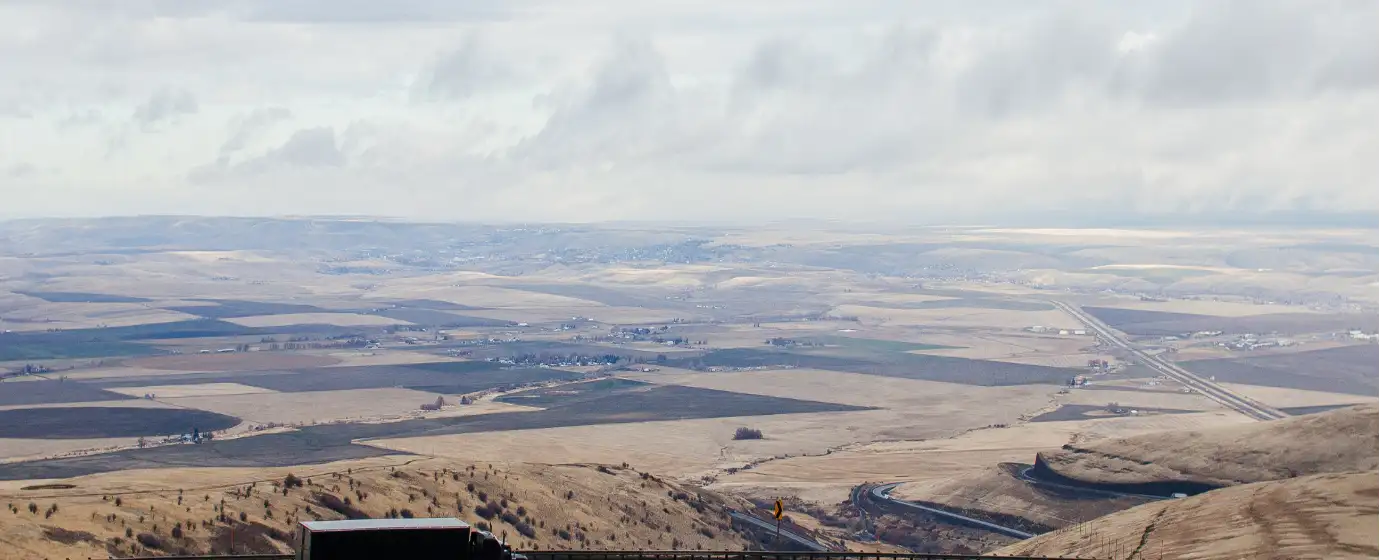
If you've been watching California prices climb while your paycheck stays flat, Pendleton has probably shown up in your research. The city sits at the intersection of I-84 and US-395 in the high desert of eastern Oregon, about 200 miles east of Portland and a straight shot north toward Walla Walla, WA. It's a working cattle-and-wheat town of 16,950 people, not a lifestyle suburb, and that distinction matters. The Round-Up Grounds, Pendleton Woolen Mills, and a Main Street that still has a hardware store all tell you something about what daily life here actually looks like — which is specific and unhurried in ways that coastal California simply isn't.
The economic backbone is a mix of tribal government, county services, education, and agriculture. The Confederated Tribes of the Umatilla Indian Reservation (CTUIR) — which operates Wildhorse Resort & Casino among other enterprises — is the city's largest employer and a meaningful stabilizer for the local economy. Umatilla County, Pendleton School District, and Blue Mountain Community College round out the major institutional employers. Many residents work remotely or commute to Hermiston, Walla Walla, or the broader Tri-Cities area. The Pendleton School District, with 2,845 students enrolled in 2025-26, holds a B- rating, according to Niche — a competent district for a small city, not a marquee one.
The cost picture is the main reason Californians end up here. Pendleton's overall cost of living sits roughly 11–12% below the Oregon state average and noticeably below the national average — and Oregon already costs substantially less than California on nearly every index. The typical home price of $304,381 (Zillow Home Value Index, July 2026) is a figure that stops California buyers cold, in the best way. For a fuller breakdown of ongoing costs — utilities, groceries, transportation — the cost-of-living page has the detail. Health insurance premiums run noticeably below what most Californians were paying, though you will drive farther for specialist care than you would in a coastal metro.
Whether you're fleeing Bay Area prices, craving space, or simply done with California's tax structure, the sections below break down Pendleton's home price reality, the tax comparison, what daily life feels like here, the climate trade-offs, and honest answers to the questions California buyers ask most.
The Home Price Reality: What Your California Budget Buys Here
California's statewide typical home value of $773,735 (Zillow Home Value Index) is more than two and a half times Pendleton's typical home price of $304,381 (July 2026). That gap is not a rounding error — it is the difference between stretching to afford a starter condo and buying a three-bedroom house on a corner lot with a garage and room for a dog.
Pendleton's neighborhoods vary in feel and age of housing stock, but the city-wide figure is the honest starting point. Entry-level options — older ranch homes, some needing cosmetic work — can come in well below that figure. Sunridge Estates and Grecian Heights tend to draw buyers who want newer construction and wider streets. North Hill has older homes with established lots. The neighborhoods page has the full character breakdown by area.
One thing California buyers should understand about property taxes here: Oregon's system caps annual assessed-value increases at 3% per year, similar in spirit to California's Proposition 13. Unlike California, though, Oregon does not reset the assessed value to market value when a property sells — the 3% cap simply continues on the prior year's assessed value. That means a new buyer in Pendleton does not face the dramatic tax-bill jump that a California buyer moving from a long-held property might fear. Pendleton's effective property tax rate is 1.10% — higher than California's effective property tax rate of 0.71% (Tax Foundation), but applied to a purchase price that is a fraction of what you'd pay in California, so the actual annual bill is substantially lower in dollar terms.
Affordability does have a real limit here. The median household income in Pendleton is $66,563 — below the income needed to comfortably carry the typical home at current rates. That gap is worth understanding: the market is affordable by California standards but not universally attainable for local wage earners. Remote workers bringing California or Portland salaries into a Pendleton market tend to find themselves in a genuinely strong position. For detail on the buying process itself, see the first-time homebuyer page.
The Tax Comparison: Oregon vs. California, Honestly
The headline that most California buyers lead with is the income tax. California's top state income tax rate of 13.3% (California Franchise Tax Board) applies only to the highest earners, but California's brackets reach into six-figure income levels aggressively. Oregon's top rate is 9.9% — lower in headline terms. The more honest read: Oregon's brackets hit middle-to-upper earners sooner, so for most households earning between roughly $150,000 and $725,000, the effective income tax burden is not dramatically different between the two states. Do not move to Pendleton expecting to bank the full rate difference on your paycheck.
Where Oregon genuinely wins is sales tax — or rather, the complete absence of one. Oregon has no general retail sales tax. California's statewide base sales tax rate of 7.25% (California Department of Tax and Fee Administration), plus local additions averaging roughly 1.74%, means most California residents are accustomed to paying close to 9% on top of every listed price. In Oregon, the listed price is the final price. On everyday groceries, clothing, and household goods, that adds up fast. On a vehicle purchase, the difference is immediate and large.
| Tax Category | California | Oregon / Pendleton | What It Means for You |
|---|---|---|---|
| State income tax (top rate) | 13.3% top rate | 9.9% top rate | Headline win for OR; effective difference smaller for most earners |
| Sales tax | 7.25% base + local avg. ~1.74% | No sales tax | Real, daily savings on every purchase |
| Property tax (effective rate) | 0.71% (Tax Foundation) | 1.10% | Higher rate in OR; far lower dollar bill on Pendleton prices |
| Property tax cap | Prop 13: resets to market on sale | 3% annual cap; does NOT reset on sale | No tax-bill shock when you buy |
| Social Security tax | Exempt at state level | Exempt at state level | Even for retirees |
| Overall tax burden | Among the highest in the U.S. | High income tax, no sales tax | Trade-offs, not a clean sweep for OR |
The honest summary: moving to Pendleton is not a tax escape in the way some California-to-Oregon marketing implies. It is a genuine trade — no sales tax and lower top income tax rates in exchange for a state income tax that still reaches into middle-income brackets more aggressively than California's lower brackets do. The real financial gain is in the home price, not the tax code.
Daily Life and Cost of Living: What Actually Changes
Six months after moving here, most Californians say some version of the same thing: they didn't expect to feel the absence of traffic this strongly. I-84 runs through the northern edge of the city and US-395 connects north toward Walla Walla and south through the Blue Mountains — but neither one produces the kind of congestion that defines a California commute. The city is a genuine 10-minute town in a way that most people only read about.
Groceries, utilities, and services all run noticeably below what you were paying in California. The cost-of-living gap is not a statistical abstraction — it shows up at the checkout counter (where, again, Oregon adds nothing), on the utility bill, and in what a local dentist or plumber charges. The two-bedroom rent range of $1,250–$1,530 captures most of the rental market; for Californians comparing that against coastal rents, the difference is stark. Full detail on ongoing costs is on the cost-of-living page.
What you give up is density of options. Pendleton has a handful of independent coffee shops, a solid local dining scene anchored by a few well-regarded spots, and a small but genuine downtown. There is no equivalent of a large regional mall; a serious shopping run means driving out of town or ordering online. That adjustment is real and worth being honest about before the move.
Pendleton's parks and outdoor access are a genuine draw — the Umatilla River Parkway runs through the city, and the high desert terrain opens up quickly in every direction for hiking, hunting, and fishing. The parks and recreation page has the full picture. The Eastern Oregon Regional Airport (PDT) is about 4 miles from downtown and offers commercial service; for most destinations, plan on a connection through Portland (PDX) or Seattle (SEA). Californians used to flying direct from a major hub should factor that into the lifestyle calculation.
Looking to buy in Pendleton? Estimate your payment.
Enter your numbers to see an estimated monthly mortgage payment.
Estimate only. Excludes HOA fees and mortgage insurance. The interest rate above is a starting point, not a quoted rate — replace it with your own to see real numbers. Insurance is a flat placeholder, not a Pendleton quote.
Climate: The Trade-Off Nobody Warns You About
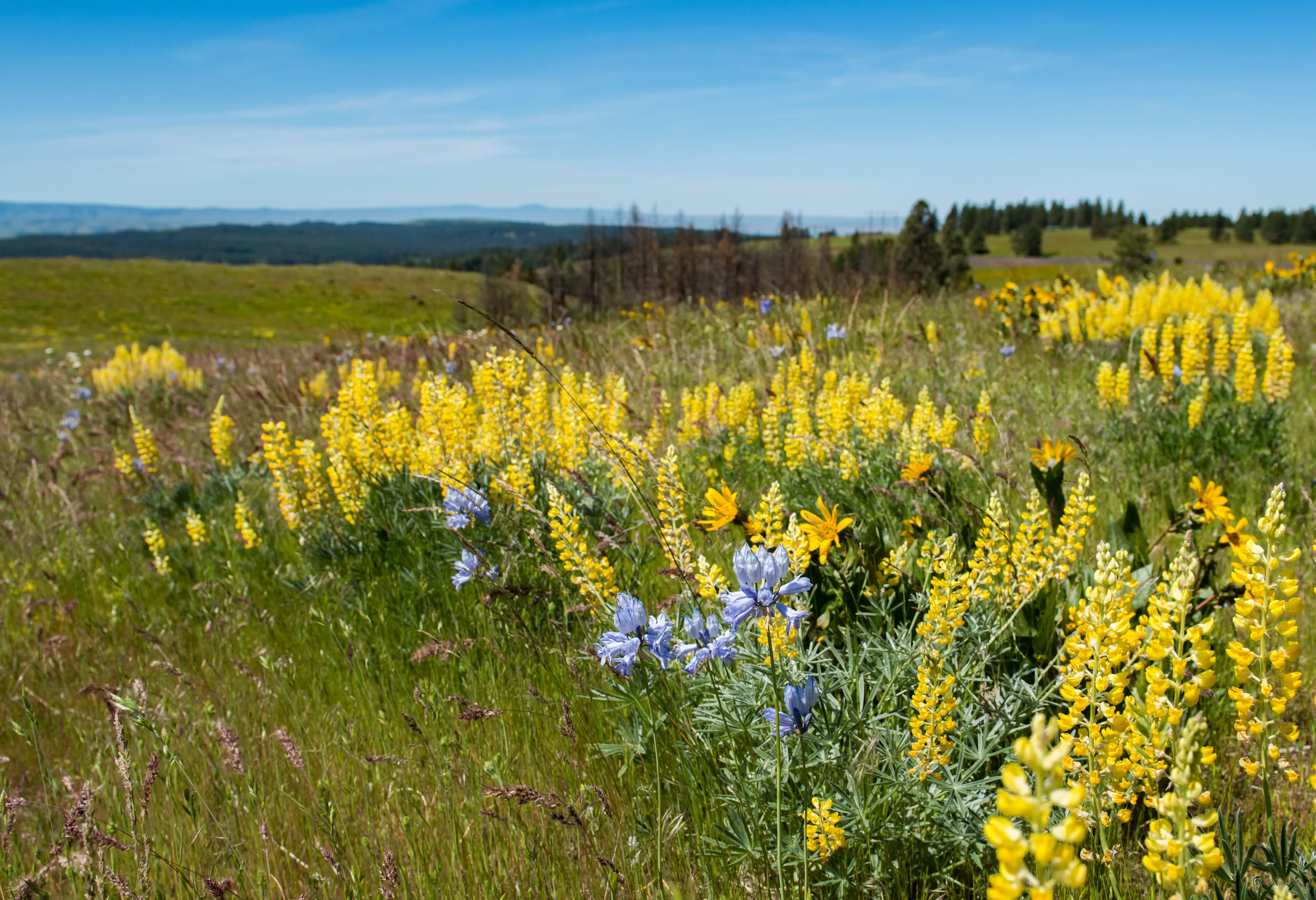
Eastern Oregon's climate is not western Oregon's climate, and it is not California's climate either. Pendleton sits in a semi-arid continental zone: summers run hot and dry, with July highs averaging around 84°F, and winters bring genuine cold with periodic snow. Annual precipitation is roughly 13 inches — less than most of California's rainy-season cities and a fraction of what Portland sees.
Pendleton does average 195 sunny days a year, which places it well above the statewide Oregon average. That number surprises people who assume Oregon means rain. What it does not mean is California sunshine — the light here is high-desert light, the summers are dryer and hotter than coastal California, and the winters are colder than anything a Bay Area or San Diego transplant has experienced as a daily reality.
The first winter catches most newcomers off guard. Snow on the ground is not a novelty — it happens, and I-84 through the Blue Mountains to the west can close or require chains. Californians who have driven only in rain should plan a real adjustment period. The flip side is that summers here are genuinely spectacular: dry heat, low humidity, and long evenings that make the outdoor life feel effortless in a way that sticky coastal summers never do.
The deeper lifestyle shift is the pace and the scale. A city of 16,950 means everyone knows their neighbors, Friday night football at the high school fills the stands, and the Pendleton Round-Up each September is not a tourist event — it is something residents build their fall calendar around. If you are moving from a California metro where anonymity was a feature, the social texture here takes some deliberate getting used to. Many people find it the best part of the move. Some find it the hardest.
Weekends and Local Favorites: Where Pendleton Actually Gathers
The Pendleton Round-Up Grounds anchor the city's identity in a way that almost no single venue does in a California metro. The Round-Up itself runs every September and draws visitors from across the country, but the grounds matter to locals year-round — rodeo culture here is not a costume, it is context. The Pendleton Underground Tours, departing from the downtown area, give an unexpected and genuinely absorbing window into the city's layered history. Pendleton Woolen Mills, one of the country's oldest working woolen mills, is worth a visit not as a tourist stop but as a reminder that Pendleton has been making things for a very long time.
Hamley & Co., the historic saddlery and Western goods store, anchors one end of the downtown block and has been a local landmark for generations. The Hamley Steakhouse & Saloon and Hamley Cafe operate alongside it, making the Hamley complex something of a local gathering point. Wildhorse Resort & Casino, operated by the Confederated Tribes of the Umatilla Indian Reservation, is the city's largest single entertainment venue — it draws regional visitors but is also where many Pendleton residents go for a dinner out or a weekend event.
The independent dining and coffee scene is smaller than what most Californians are used to, but genuinely local. Roosters Country Kitchen draws the early-morning crowd. OMG! Burgers & Brew covers the casual end of the spectrum. The Saddle Restaurant And Lounge has the neighborhood bar feel that California's chain-heavy suburbs rarely replicate. For coffee, Sister's Cafe, Sorbenots Coffee, Buckin Bean Coffee Roasters, Pendleton Ground-up, and Hamley Cafe all have regulars rather than just customers — the kind of place where your order is remembered.
The Umatilla River Parkway gives the city a genuine outdoor corridor through town, and Emigrant Springs State Heritage Area lies nearby for those who want forested terrain after a week in the high desert. The safety picture for the city — a full breakdown is on the safety page — shows a property crime rate of 19.48 per 1,000 residents, which sits below the Oregon statewide rate of 24.5 per 1,000, though above the national figure. A violent crime rate of 3.58 per 1,000 residents tracks close to both state and national averages. For a city of this size in eastern Oregon, the numbers tell a reasonable story — not a perfect one, but a real one.
Local Expert Takeaway: Pendleton is not a soft landing for Californians who want everything they had at a lower price. It is a specific place — a working high-desert city with deep rodeo roots, a genuine downtown, and a home price that makes coastal California buyers feel like they are dreaming. The tax picture is more nuanced than the marketing suggests: no sales tax is real money every day, but Oregon's income tax brackets will reach you. What is not nuanced is the quiet, the space, and the fact that a $304,381 home here often means a yard, a garage, and neighbors who wave. For Californians who have made peace with the trade-offs — smaller airport, farther to a specialist, a cold winter — Pendleton delivers exactly what it promises.
Quick Takeaways & FAQs
✅ Pendleton's typical home price of $304,381 (July 2026) is a fraction of California's statewide typical home value, and Oregon's no-sales-tax rule adds daily savings on top of that.
⚠️ Oregon's income tax brackets hit middle-to-upper earners sooner than California's lower brackets do, so the headline rate difference understates the real effective burden for many transplants.
📍 Pendleton averages 195 sunny days a year — high-desert sun, not coastal California sun — and winters bring genuine cold and periodic snow that catches most California newcomers off guard in year one.
Is Pendleton, Oregon actually affordable compared to California?
Do I pay less in taxes if I move from California to Pendleton?
What is the climate like in Pendleton compared to California?
How does Pendleton's school district compare to what I'm used to in California?
What surprises California transplants most after moving to Pendleton?
Moving to Oregon?
Tell us what you need help with and we'll connect you with local resources.
