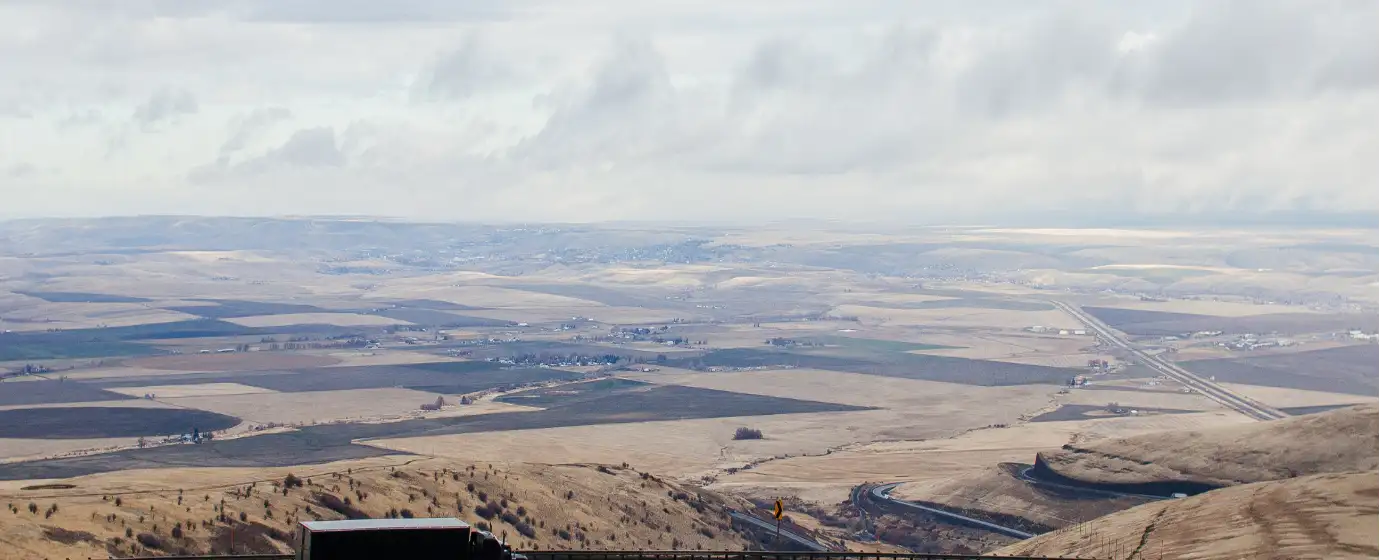
Maybe you've been looking at homes in Pendleton and someone in a Facebook group warned you about crime. Maybe the per-1,000 rate you found online looked alarming without any context. The honest answer is that Pendleton — a high-desert city of 16,950 on the eastern edge of Oregon — is a place where the headline numbers deserve more than a headline reading. The city carries a real property crime burden, concentrated almost entirely in its commercial core, and those numbers shape how you should think about which neighborhood to choose. They do not make Pendleton a city to avoid.
Pendleton's economy runs on the Confederated Tribes of the Umatilla Indian Reservation, Umatilla County government, Pendleton School District, Blue Mountain Community College, and a regional healthcare presence. The Round-Up draws tens of thousands of visitors every September, and Pendleton Woolen Mills has kept the city's name on the national map for over a century. That tourism and commercial activity matters for the safety conversation, because it concentrates foot traffic — and opportunistic theft — in areas where few residents actually live. Residents on community platforms consistently describe the lived experience as one of theft and vandalism concerns rather than fear of violence.
Cost of living is one of the clearest reasons people relocate here from the Portland metro or the Willamette Valley. The cost of living page covers that in full. What matters for this guide is that Pendleton's safety picture is deeply neighborhood-dependent: the northwest quadrant of the city — North Hill, Grecian Heights, and the hillside residential streets — feels and statistically performs like a very different city from the downtown commercial strip along the river.
The sections below break down Pendleton's violent and property crime rates against state and national benchmarks, explain the neighborhood-level variation that the city-wide numbers obscure, detail what the Pendleton Police Department actually looks like for a city this size, and give you a practical framework for evaluating any specific area before you decide where to settle.

How Pendleton's Crime Rates Compare to Oregon and the Nation
Pendleton registers a violent crime rate of 3.58 per 1,000 residents and a property crime rate of 19.48 per 1,000 residents (Bureau of Justice Statistics, Crime Known to Law Enforcement, 2024, tables 2 and 3). Those numbers land in a specific context that changes how you read them.
On violent crime, Pendleton sits slightly above the Oregon state average of 3.3 per 1,000 but meaningfully below the national average of 3.7 per 1,000. That is not a city in crisis — it is a mid-range result for a small regional hub that serves a much larger surrounding county.
Property crime is the more complicated figure. At a property crime rate of 19.48 per 1,000 residents, Pendleton runs above the national average of 18.4 per 1,000 but well below the Oregon state average of 24.5 per 1,000. Oregon as a whole has a persistent property crime problem that reflects statewide policy choices; Pendleton's number, read against that backdrop, is actually closer to average than it first appears.
Why the City-Wide Rate Overstates Residential Risk
Crime statistics are measured against resident population, not against the people who actually pass through a place. Pendleton's Downtown / City Center core has a dense concentration of retail, hospitality, and tourist-facing businesses. The Round-Up Grounds alone draws enormous crowds for an extended stretch each fall. When incidents in those commercial zones get divided by a resident population of 16,950, the per-1,000 figure climbs — even if no residential neighborhood is generating the activity.
The same inflation applies to the corridor near Eastern Oregon Regional Airport and to high-traffic parks. A family choosing a home in North Hill or Green Meadows is not choosing to absorb the statistical risk of the downtown commercial strip. Understanding that distinction is the most important thing a prospective resident can take from the raw numbers.
One positive directional signal: City-Data's composite crime index for Pendleton fell roughly 20% in the most recent reporting year. That figure reflects a composite index rather than a raw FBI rate, and it should be read as a trend signal rather than a precise measurement — but a meaningful decline in a single reporting period is worth noting regardless of methodology.
The Neighborhood Safety Gradient: Northwest vs. Downtown
The single most useful thing to know about crime in Pendleton is that it is not evenly distributed. The difference between the city's safest residential areas and its highest-activity commercial zones is not marginal — it is structural.
The Northwest Quadrant: North Hill and Grecian Heights
North Hill and Grecian Heights, which occupy the elevated northwest portions of the city, record the fewest total crime incidents of any part of Pendleton. Residents in these neighborhoods describe the streets as quiet and the pace as unhurried — the kind of environment where a car parked overnight rarely draws a second thought. The elevated terrain, established ownership patterns, and distance from the commercial corridor all contribute to that character.
These are the neighborhoods that local residents point to when they describe Pendleton as a safe place to live. Families with school-age children consistently choose them for that reason. If you want to look up a specific address before committing, a tool like CrimeGrade.org provides sub-city mapping that city-level averages cannot. The neighborhoods guide covers the character and housing stock of each in detail.
The Downtown / City Center Core
The downtown commercial zone tells a different statistical story. The concentration of retail, hospitality, and alcohol-adjacent businesses in the central core generates the majority of Pendleton's reported incidents — primarily retail theft, vandalism, and disturbance calls rather than resident-on-resident violence.
Very few people actually live in Pendleton's commercial core. The incidents recorded there get divided by a small resident base while capturing activity that affects a much larger transient population — which is exactly why the city-wide rate overstates the risk that a typical homeowner experiences. The downtown zone is active and worth understanding, but it is not representative of what residential Pendleton feels like day to day.
The Middle Ground: Green Meadows, McKay Creek, South Hill
The residential neighborhoods that sit between the northwest hillsides and the downtown core — Green Meadows, McKay Creek, South Hill, Creek Side Estates, and Sunridge Estates — occupy a middle range on the safety gradient. None of them generate the concentrated commercial activity of the downtown strip. Their crime profiles sit closer to the quiet northwest residential areas than to the city-center figures, though specific block-level variation exists within each.
Niche describes Pendleton broadly as having a sparse suburban feel where most residents own their homes and many families live — a demographic profile that historically correlates with community stability and lower residential crime. That character holds most clearly in these mid-city neighborhoods, where owner-occupied single-family homes predominate.

What Type of Crime Is Actually Happening
Pendleton's crime picture is primarily a property crime story, not a violent crime story. That distinction matters practically for how you think about living here.
Property Crime: Opportunistic and Location-Dependent
Theft and vehicle break-ins are the incidents residents most commonly report on community platforms. These are crimes of opportunity concentrated around commercial zones, parking areas near the Round-Up Grounds, and high-traffic retail corridors. The northwest residential neighborhoods see dramatically fewer of these incidents than the commercial core — the gap between the two parts of the city is large enough that they effectively represent different risk environments.
The practical implication: locking your car matters more here than in some comparably sized cities, particularly during the Round-Up in September when visitor volumes are highest and commercial activity spikes. This is not a revelation unique to Pendleton — it is the reality of any small city that hosts a major regional event — but newcomers who don't plan for it sometimes find September catches them off guard.
Violent Crime: Below the National Average
Pendleton carries a violent crime rate of 3.58 per 1,000 residents, which lands below the national benchmark of 3.7 per 1,000. Pendleton is not an outlier in any alarming direction. Residents on community platforms consistently describe their lived experience as one where violent incidents are not a regular feature of daily life. The events that do appear in local reporting tend to cluster in and around the downtown entertainment district rather than in residential neighborhoods.
The Tourism Amplification Effect
One friction moment that surprises newcomers every September: the Round-Up transforms the city's character for an extended stretch. Hundreds of thousands of visitors cycle through a city of under 17,000 residents. Reported incidents in the commercial zones climb during that window. If you're evaluating crime data that captures a September spike, it is worth knowing that the spike is real but also seasonal and geographically bounded. It does not represent what a quiet Tuesday in Green Meadows looks like the other eleven months of the year.
Looking to buy in Pendleton? Estimate your payment.
Enter your numbers to see an estimated monthly mortgage payment.
Estimate only. Excludes HOA fees and mortgage insurance. The interest rate above is a starting point, not a quoted rate — replace it with your own to see real numbers. Insurance is a flat placeholder, not a Pendleton quote.
Pendleton Police Department: What the City Has to Work With
For a city of 16,950, Pendleton's police department is unusually well-structured. The department operates a 24/7 patrol division and fields a school resource officer, canine unit, SWAT team, Drug Recognition Evaluation program, and code enforcement — a service roster that is more typical of cities two or three times this size.
Accreditation and Training Standards
The Pendleton Police Department has held accreditation from the Oregon Accreditation Alliance since April 2009. That credential requires ongoing policy and practice review against an external standard — it is not a one-time award. Officers are required to complete a minimum of 60 hours of annual training, and the department participates in ODOT and NHTSA grant programs that fund overtime enforcement and specialized equipment. The department also maintains a certified Crash/Crime Scene Reconstructionist, a resource that small-city departments often lack entirely.
Accreditation matters for residents in a practical way: it means the department's use-of-force policies, evidence handling, and operational practices are subject to outside review rather than only internal oversight. For a city that occasionally sees heightened tensions during large events, that external accountability is worth knowing about.
Community Visibility
The Umatilla River Parkway — a nearly three-mile paved trail along the south bank of the Umatilla River — functions as a well-traveled public corridor through both residential and commercial sections of the city. Active trails like this one generate the kind of natural neighborhood surveillance that correlates with lower crime: more eyes on the street, more routine pedestrian activity, less opportunity for incidents to go unnoticed. It is one of the less obvious assets in Pendleton's safety picture. More on the parks and recreation page.
The department's school resource officer is embedded in the district, which has 2,845 students enrolled in 2025-26. That presence keeps the SRO model functioning as both a safety resource and a community relationship — something that matters for families evaluating which city to put down roots in.
How to Evaluate Safety Before Choosing a Neighborhood
City-level statistics are the starting point, not the answer. In Pendleton, the difference between the safest residential quadrant and the most active commercial zone is large enough that choosing the wrong framework for your research produces a genuinely misleading picture.
Start with the Northwest-to-Downtown Gradient
The directional rule in Pendleton is consistent: the further northwest and uphill you go from the commercial core, the lower the crime activity. North Hill and Grecian Heights sit at one end of that spectrum. Downtown and the immediate surrounding blocks sit at the other. The mid-city residential neighborhoods — Green Meadows, McKay Creek, South Hill, Creek Side Estates — occupy the middle, and their profiles are closer to the quiet end than the active end.
Before you decide on a neighborhood, run the specific streets or blocks you're considering through a tool like CrimeGrade.org, which provides sub-city mapping rather than city-level averages. The city-wide rate tells you roughly where Pendleton sits against benchmarks. The block-level view tells you what you're actually choosing.
Account for the Commercial Core Distortion
If you're looking at a property near the downtown commercial strip, near the Round-Up Grounds, or adjacent to high-traffic retail, price the crime rate of that area accordingly. Those zones attract opportunistic property crime that has almost nothing to do with the residential character of Pendleton's quieter streets. A home in that area is not necessarily a poor choice — downtown access has real value — but the crime data should be read with the commercial-distortion effect in mind rather than at face value.
Talk to People Who Live There
One thing that doesn't show up in any crime index: Pendleton is a small city where people know each other. The social fabric of a 16,950-person community means that neighbors notice unfamiliar activity, community platforms like Nextdoor are actively used, and the kind of anonymous urban alienation that enables persistent crime is harder to sustain. Residents consistently describe the city as a place where they feel known. That is not a statistic, but it is a real feature of daily life that shapes the experience of safety in ways the numbers don't fully capture.
For a deeper look at which specific neighborhoods fit different lifestyle priorities — not just safety, but commute, housing type, and community character — the neighborhoods guide goes deeper on each.

Local Expert Takeaway: Pendleton's crime story is really two stories: a commercial core that generates most of the reported incidents, and a set of residential neighborhoods — especially the northwest hillside areas of North Hill and Grecian Heights — where the experience of daily life is genuinely quiet. The city carries a violent crime rate of 3.58 per 1,000 residents, which falls below the national average, and a property crime rate of 19.48 per 1,000 residents, which runs above the national figure but well below Oregon's statewide average. The Pendleton Police Department is accredited, well-resourced for a city this size, and has held Oregon Accreditation Alliance certification since 2009. If you're evaluating neighborhoods, the northwest quadrant is where the data and resident sentiment align most clearly. If you're drawn to the walkability and energy near the Umatilla River Parkway and downtown, go in with eyes open about property crime risk — and lock your car.
Quick Takeaways & FAQs
✅ Pendleton carries a violent crime rate of 3.58 per 1,000 residents, placing it below the national average and making it less dangerous on that measure than most people assume.
⚠️ Property crime is the real concern, and it is concentrated in the downtown commercial core — residents in northwest neighborhoods like North Hill and Grecian Heights see dramatically lower risk than the city-wide rate suggests.
📍 The Pendleton Police Department has held Oregon Accreditation Alliance certification since 2009 and operates specialized units — including a canine unit, SWAT team, and school resource officer — that are unusual for a city of under 17,000.
Is Pendleton, Oregon a safe place to live?
Which neighborhoods in Pendleton have the lowest crime?
Why does Pendleton's property crime rate look high?
How does crime in Pendleton compare to the rest of Oregon?
Does the Pendleton Round-Up affect crime in the city?
Moving to Oregon?
Tell us what you need help with and we'll connect you with local resources.
