What Is Living in Ontario, Oregon Like?
Most people arrive in Ontario from the west and expect to land in a typical Oregon city. What they get instead is a high-desert agricultural hub sitting at Oregon's far eastern edge, operating on Mountain Time — not on the same clock as Portland or Eugene — and functioning as the Oregon anchor of the broader Treasure Valley region that stretches east into Idaho. Ontario is the first city you enter when crossing from Idaho on I-84, and that geographic reality shapes everything about daily life here: the employers, the commute patterns, the culture, and the retail footprint all lean east toward Boise just as much as they look inward to the city itself. At 11,957 residents, Ontario is small in population but outsized in its regional role.
The economy here is built on land and the industries that work it. Sugar beets, onions, potatoes, and dairy anchor Malheur County's agricultural base, and food-processing operations — including Amalgamated Sugar's Snake River Sugar Company — provide steady manufacturing employment. Malheur County (the county seat is Ontario), Ontario School District 8C, a major regional health system, and Treasure Valley Community College round out the largest local employers. The school district 2,056 students enrolled in 2025-26 and holds a C+ rating, according to Niche. The community is notably diverse — a sizable share of residents trace roots to Hispanic, Japanese, Basque, and Indigenous heritage — a history that the Four Rivers Cultural Center documents and celebrates in ways few small cities can match.
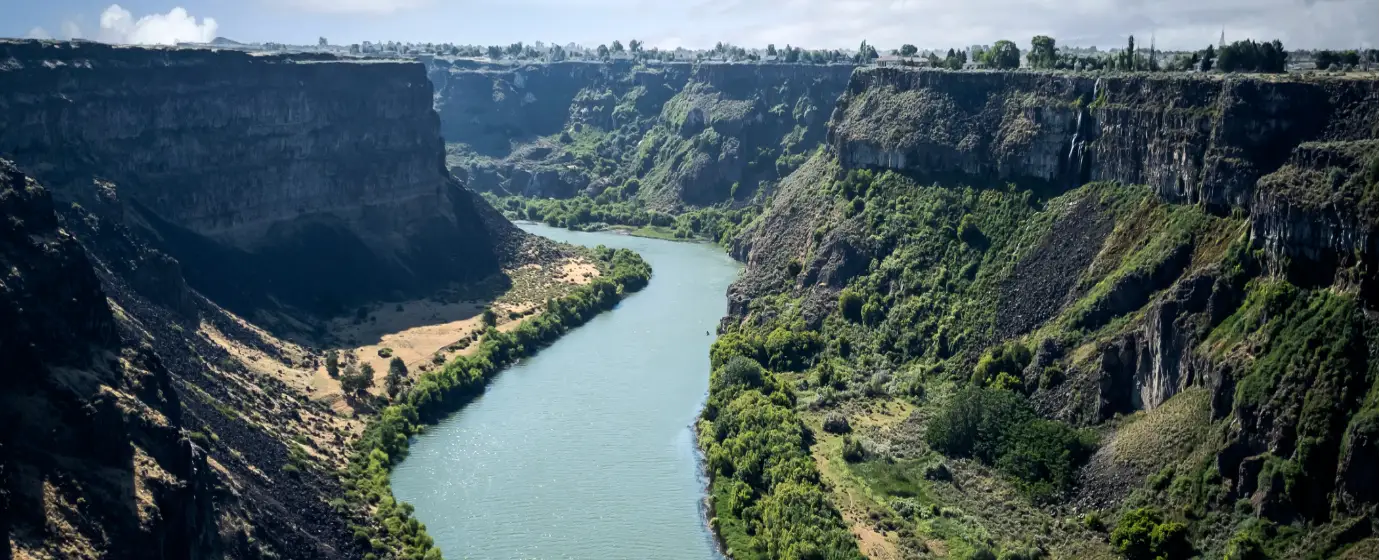
The cost of living is the clearest reason people choose Ontario over the Boise metro. The typical home price sat at $312,219 as of July 2026, a figure that is dramatically below what buyers encounter across the state line. Renters find similar relief. The trade-off is income: the median household income of $47,540 reflects the wage structure of agriculture and public-sector employment, and Boise remains the practical hub for many services and shopping. Outdoors, the Snake River waterfront, the Owyhee Mountains, and the high-desert landscape give Ontario a recreational draw that genuinely surprises newcomers used to smaller western towns with fewer wild places on the doorstep. The climate runs to extremes — July highs near 95°F and January lows averaging 24°F — with 207 sunny days a year and only about 9.5 inches of annual precipitation.
Whether you are considering a move or just researching the area, the sections below break down Ontario's neighborhoods, housing market, employers, commute realities, local culture, and what daily life here is actually like.
Ontario at a Glance
Looking to buy in Ontario? Estimate your payment.
Enter your numbers to see an estimated monthly mortgage payment.
Estimate only. Excludes HOA fees and mortgage insurance. The interest rate above is a starting point, not a quoted rate — replace it with your own to see real numbers. Insurance is a flat placeholder, not a Ontario quote.
Why Are People Moving to Ontario?
The case for Ontario is easy to make. Home prices well below the Oregon median, a regional job base anchored in agriculture and public services, and a location that keeps Boise's airport and job market reachable without Boise's prices — that combination is driving a consistent inflow of buyers priced out of the broader Treasure Valley.
The Regional Reality
Ontario is less an isolated small town than the Oregon edge of a multi-city regional economy. Fruitland and Payette sit just across the Snake River in Idaho, and Nampa is roughly an hour east. Residents routinely cross the state line for work, services, and entertainment without thinking twice about it. That cross-border fluidity is a genuine quality-of-life advantage that people from western Oregon rarely anticipate.
Who Is Buying Here
| Buyer Profile | What Draws Them | Best Fit |
|---|---|---|
| First-time buyers priced out of the Boise metro | Home prices well below Treasure Valley averages | First-Time |
| Agricultural and food-industry workers | Local employment in Malheur County's farm economy | Value |
| Remote workers seeking affordability | Mountain Time, reliable internet, low cost base | Commuter |
| Retirees on fixed income | Low property tax rate, affordable housing, sunny climate | Quiet |
| Families with school-age children in public sector | Stable government and healthcare employment | Families |
| Nature and outdoor enthusiasts | Snake River, Owyhee Mountains, high-desert recreation | Nature |
The honest caveat: wages here lag behind both the Portland metro and Boise, so the affordability math works best when income comes from remote work or from one of Ontario's larger institutional employers.
The Employment Backbone
Malheur County and the City of Ontario are the two pillars of local government employment. Ontario School District 8C and Treasure Valley Community College anchor education hiring. A major regional health system serves a vast tri-state rural area that stretches into Idaho and Nevada, making healthcare one of the more stable employment sectors in the city. Agriculture and food processing — from the onion and sugar beet fields to the processing facilities in the county — provide the private-sector base that much of eastern Oregon runs on.
Many residents work remotely or commute into the broader Treasure Valley. That is an honest picture of Ontario's economy, not a deficiency: the city's location on Mountain Time and its distance from western Oregon's congestion are features for a remote worker who wants space, sun, and affordable square footage. For a full look at the buying process and financing programs available here, see the first-time homebuyer guide.
What Daily Life Feels Like in Ontario
Six months in, nearly everyone who moved from western Oregon says the same thing: they didn't expect to feel this far from the Willamette Valley — not in distance, but in pace, landscape, and rhythm. Ontario is genuinely high desert. The sky is enormous, the horizon is flat, and the nearest major urban center is about 55 minutes to Boise, ID. That gap shapes how you plan your week.
The Time Zone Surprise
Ontario runs on Mountain Time, not the same zone as the rest of Oregon. If your employer, family, or clients are on the coast, you start the workday an hour earlier by the clock and finish an hour earlier too. Longtime residents consider it a feature — the workday ends while the summer sun is still well up, and evenings are long. Newcomers from Portland or Eugene find the adjustment takes a full season.
The Cultural Texture
Ontario has a richer cultural life than its size suggests. The Four Rivers Cultural Center is an 85,000-square-foot arts and culture complex that houses a 13,000-square-foot museum covering the stories of Indigenous peoples, Basque settlers, Japanese Americans, Hispanic communities, and EuroAmerican pioneers. During World War II, Ontario recruited approximately 1,000 Japanese Americans at a time when most communities were turning them away — until 1990, the city had the largest percentage of Japanese Americans of any community in Oregon. That history shows up in the food, the festivals, and the Hikaru Mizu Japanese Garden, the second-largest Japanese garden in Oregon, on the Four Rivers grounds.
The broader community is diverse in ways that give the local food scene and annual events more dimension than most towns this size. Oregon Trail Days and the Malheur County Fair anchor the summer calendar. The Ontario Saturday Market brings local produce and vendors through the warm months.
What You Give Up
Major retail requires a drive. A serious shopping trip means heading out of town — either into the Idaho side of the valley or making the longer journey to Boise proper. The downtown core along Oregon Street has independent shops and restaurants, but the footprint is modest. Anyone accustomed to the density of Portland or Eugene will notice the difference immediately and adapt to it within a year, or decide it isn't for them. For a full look at parks, trails, and outdoor amenities, see the parks and recreation page.
The Ontario Housing Market Right Now
Ontario's housing market is one of the most straightforward affordability stories in Oregon. The typical home price was $312,219 as of July 2026 — a figure that puts homeownership within reach for buyers who would be locked out of nearly every other Oregon market. The effective property tax rate runs at approximately 0.85%, which keeps the ongoing cost of ownership comparably low.
The entry point into ownership here is genuinely accessible. Older ranch-style homes on the west side of the city represent the lower end of the market, while newer construction in areas like Waterford Estates and West Ridge Estates sits above the city-wide figure. Some areas cost meaningfully more than others, and the neighborhood breakdown covers that in detail.
What the Rental Market Looks Like
Renters find Ontario among the most affordable markets in the state. Average apartment rents run well below the national norm, which makes Ontario a viable landing spot while buyers save for a down payment or wait for the right home to come available. For the full cost picture — rents, taxes, utilities, and groceries — see the cost of living page.
Market Character
Well-priced homes here do not sit for long. The combination of low prices and regional in-migration from the Boise metro has kept Ontario's market more active than the population size alone would suggest. Buyers new to the market are often surprised that move-ready homes in desirable parts of the city attract prompt attention — the price point is low enough that financing hurdles are smaller, which keeps the pool of ready buyers wide.
Ontario Neighborhoods
Ontario has several distinct areas — each with its own character and appeal. Here’s a breakdown to help you narrow down where to focus your home search.
🏡 Downtown Ontario
The commercial and civic core of the city, where Oregon Street carries the local dining and retail scene and the historic Ontario Depot grounds the neighborhood's identity. A good fit for buyers who want to walk to coffee or a restaurant and stay close to city services.
🏠 Fairgrounds Area
Centered on the Malheur County Fairgrounds and the surrounding residential streets, this area has a working-community feel with established homes and easy access to the county's agricultural events calendar.
🌳 Northwest Ontario
A quieter residential pocket on the city's northwest edge with more space between homes and a mix of older and mid-century housing stock; suits buyers who want to be in Ontario proper with a little more breathing room.
🏘 Southwest Ontario
The southwest quadrant blends residential neighborhoods with proximity to I-84 access, making it a practical base for residents who commute east toward the Treasure Valley on a regular basis.
🏔 Waterford Estates
One of Ontario's newer residential developments, Waterford Estates attracts buyers looking for more recent construction and a suburban feel within city limits — well suited to families with school-age children.
🌆 West Ridge Estates
Sitting above the valley floor on the city's western edge, West Ridge Estates offers newer homes with views of the high-desert landscape; a natural fit for buyers prioritizing newer construction and a quieter setting.
Pros & Cons of Living in Ontario
The Pros
- Home prices well below the Oregon state average
- No Idaho sales tax nearby drives a lively retail/restaurant scene
- Agriculture and logistics base along I-84 provide steady blue-collar jobs
- About an hour from Boise's larger job market and airport
The Cons
- Property and violent crime rates run above state and national averages
- Hot, arid summers and cold winters typical of the high desert
- Limited big-city amenities and cultural offerings compared to western Oregon
Getting Around & Commuting in Ontario
Ontario is a driving city, full stop. Most errands mean a drive, and the city's residential fabric is laid out around that assumption. The upside is that commutes are short by almost any national measure — the average one-way trip runs approximately 16.4 minutes, shorter than 96% of U.S. towns. When you need to go farther, the infrastructure is there.
The Highway Network
I-84 is the spine of the regional commute, running east-west through the city and connecting Ontario directly to the broader Treasure Valley. US-30 and its business spur provide the surface-street alternative through town, and OR-201 carries traffic south toward Nyssa and the agricultural areas of the county. The highway network here is genuinely functional for a city this size — there is no notorious chokepoint, no single interchange that backs up every morning.
Boise as the Practical Hub
The commute that matters most to many Ontario residents is the one that runs east: about 55 minutes to Boise, ID. That drive puts the Boise metro's jobs, hospitals, shopping, and Boise Airport (BOI) within reach on a same-day basis. BOI is a well-connected regional airport, and for Ontario residents it is the functional air travel gateway — not a regional afterthought.
What Locals Have Figured Out
Residents who work in Ontario itself tend to cluster their errands into a single outing rather than making multiple short trips across the week. The run to the Idaho side of the valley for big-box shopping has become a routine for many households — it is faster than the drive to Boise and covers most of what a typical week requires. The short average commute within the city means that even residents on the outer edges of town reach the commercial core quickly.
Trips that cannot be made by car require planning ahead. That reality is worth weighing honestly if you do not drive or if you have household members who need alternatives to driving for their daily routine.
Schools in Ontario
Families relocating to Ontario have public, private, and higher-education options nearby. Here’s a quick overview.
🎓 School District
Ontario School District 8C serves K–12 students across Ontario and the surrounding area. Rated C+ (source: Niche.com).
🏆 Graduation Rate
The 4-year high-school graduation rate here is approximately 88.3%.
📚 Higher Education
Oregon’s public universities — the University of Oregon, Oregon State University, and Portland State University — offer four-year degrees statewide, with a network of 17 community colleges providing two-year and workforce programs.
🌐 Online Learning
Oregon State University Ecampus and Portland State University Online offer fully accredited online degrees for remote learners across the state.
Safety in Ontario
A quick look at how Ontario compares on the numbers that matter most when weighing a neighborhood or a move.
🛡 Violent Crime
Approximately 7.4 per 1,000 residents.
🔒 Property Crime
Approximately 40 per 1,000 residents.
Compared to the most recent national figures from the Bureau of Justice Statistics (2024), Ontario’s violent crime is above the national average (about 3.7 per 1,000), and property crime is above the national average (about 18.4 per 1,000).
Against Oregon as a whole, Ontario’s violent crime is about double the state average, and property crime is about one and a half times the state average (Bureau of Justice Statistics, Crime Known to Law Enforcement, 2024 (tables 2 and 3)).
Crime rates can vary a lot within a single city, so the citywide numbers above are only a starting point. Some neighborhoods in Ontario run well below these averages, while others run higher — the kind of block-by-block detail that matters most when you’re actually choosing where to live. The full guide below breaks it down neighborhood by neighborhood.
Working in Ontario
Ontario’s largest employers span several industries — here are some of the anchors of the local job market.
🏛 Malheur County
Municipal government
🎓 Ontario School District
Education
🏥 Saint Alphonsus Medical Center - Ontario
Healthcare
🎓 Treasure Valley Community College
Education
🏛 City of Ontario
Municipal government
Parks & Recreation in Ontario
Some of the outdoor spaces that shape everyday life in Ontario.
🌱 Lions Park
🌱 Snake River waterfront
Ontario residents don’t have to go far for green space — spots like Lions Park and Snake River waterfront are part of everyday life here, whether that’s a morning walk, a weekend hike, or just somewhere to unwind outside. The full guide below covers more of what Ontario has to offer for parks and outdoor recreation.

Retiring in Ontario
Ontario draws retirees for its balance of amenities, outdoor access, and cost. Here’s what to weigh.
🌤 Climate
Ontario's high desert climate means 207 sunny days a year with very little rain — only about 9.5 inches annually. Summers are hot, with July highs near 95°F, and winters are cold and clear, with January lows averaging around 24°F. Many retirees find the dry, sunny winters preferable to the gray, wet seasons that define western Oregon.
🍴 Lifestyle
The Four Rivers Cultural Center anchors Ontario's cultural life with rotating gallery exhibits, the Hikaru Mizu Japanese Garden, and a summer concert series. The Ontario Saturday Market, annual festivals, and a modest but genuine local dining scene give retirees a weekly rhythm without the noise and congestion of a larger city. The Snake River waterfront and surrounding high desert landscape are ideal for birding, fishing, and casual outdoor time.
🏚 55+ Communities
Treasure Valley Mobile Village is Ontario's established active-adult housing option for retirees looking for a community setting. Retirees who want a larger amenity-heavy development will need to look at the broader Treasure Valley. That said, the low cost of homeownership and the 0.85% effective property tax rate make independent ownership here very manageable on a fixed income.
✈ Getting Around
A car is necessary for day-to-day life in Ontario. Most errands and appointments require driving, and the nearest major airport — Boise Airport (BOI) — is about 55 miles east. The short average commute within the city and the flat, grid-style street layout make driving straightforward, and the lack of traffic congestion is a genuine quality-of-life advantage for retirees who are done with urban rush hours.
🏛 Oregon Taxes for Retirees — What to Know
- Social Security is not taxed — Oregon does not tax Social Security or Railroad Retirement benefits. Any amount included in your federal adjusted gross income is subtracted back out on the Oregon return.
- But other retirement income IS taxed — This is the trade-off that surprises people moving from Washington or Texas. Pension distributions and 401(k)/IRA withdrawals are taxed as ordinary income at Oregon’s regular rates — there is no blanket retirement-income exclusion.
- Graduated income tax — Oregon has four brackets — 4.75%, 6.75%, 8.75% and 9.9%. The 4.75% rate covers the first $10,000 of taxable income for a single filer ($20,000 filing jointly); the 8.75% rate starts at $125,000 ($250,000 jointly); and the top 9.9% rate applies above $250,000 ($500,000 jointly).
- No sales tax — Oregon levies no general sales tax.
- Property taxes, with senior deferral — Oregon’s Senior and Disabled Property Tax Deferral lets qualifying homeowners have the state pay their county property taxes, with a lien recorded against the home. The 2026 household income limit is $70,000, and deferred balances accrue 6% simple interest — it defers the bill rather than forgiving it.
- Estate tax — the one to plan for — Oregon has its own estate tax with a $1 million filing threshold — far below the federal exemption, and NOT indexed for inflation, so it reaches more estates every year in real terms. Retirement accounts and a long-held home count toward the taxable estate, so estates that feel modest can cross the line without the owner expecting it.
- No inheritance tax — Oregon has no separate inheritance tax and no gift tax.
Tax laws change frequently and individual situations vary. This is general information, not tax advice — always consult a qualified Oregon tax professional or CPA for personalized retirement tax planning.
Weekends & Local Favorites in Ontario
Ontario's weekends run on a quieter frequency than a larger city, but the bones of a full life are here — and the outdoor access that begins right at the city's edge is the piece most newcomers underestimate.
Food and Coffee Worth Knowing
The local dining scene punches above its weight for a city of 11,957. WINGERS Restaurant & Alehouse draws a reliable crowd for casual meals. Mackey's Public House covers the gastropub end of the spectrum. Country Kitchen Restaurant is the kind of unpretentious local diner that anchors morning routines across the county. Brewsky's Broiler handles the grill-and-tavern slot, and Cowboys Bar & Grill rounds out the options for a casual evening out. On the coffee side, Dutch Bros Coffee — the Oregon-born chain that started just down the road in Grants Pass — has a presence here, alongside local options like Sorbenots Coffee and BP on 4th Espresso & Bistro for something more neighborhood-scale.
Culture and Markets
The Four Rivers Cultural Center is genuinely worth an afternoon. The Hikaru Mizu Japanese Garden alone draws visitors from across the region, and the Harano Gallery's rotating exhibits give the center a living-program feel rather than a static museum. The center's summer concert series, Live After Five in the Garden, draws a real crowd for a city this size — it is one of those events where parking fills well before showtime. The Ontario Saturday Market runs through the warm months for local produce and vendors.
The Outdoors, Close In
Lions Park anchors the city's green space and is the local default for families on a warm afternoon. The Snake River waterfront gives the city an actual edge to walk along, and the Owyhee Mountains to the south open up hiking, fishing, and horseback riding for residents willing to drive twenty or thirty minutes. Birding along the Snake River corridor is a serious draw — the high-desert river environment attracts species that bring dedicated observers from well outside the region. Oregon Trail Days and the Malheur County Fair give the summer calendar anchors that feel specific to this corner of Oregon rather than imported from somewhere else.
Local favorites in Ontario
Restaurants
- WINGERS Restaurant & Alehouse
- Mackey's Public House
- Country Kitchen Restaurant
- Brewsky's Broiler
- Cowboys Bar & Grill
Outdoors
- Lions Park
- Four Rivers Cultural Center grounds
Coffee
- Dutch Bros Coffee
- Sorbenots Coffee
- BP on 4th Espresso & Bistro
Farmers Markets
- Ontario Saturday Market
Top Things Locals Say About Ontario
The best intel about a city comes from the people who actually live there. Here’s what Ontario residents say when newcomers ask the questions everyone’s thinking.
“I knew it was small and I knew it was desert, but I didn't expect to actually love the Mountain Time thing — the evenings here are long and still, and by the time western Oregon people are finishing lunch I've already gotten half my day done. What caught me off guard was how often I ended up in Boise. That drive becomes just part of your week.”
— Recent Ontario home buyer
“What's the most surprising thing about living in Ontario?”
The Mountain Time zone is the one nobody warns you about. You set your clocks when you cross the Snake River and your whole day shifts. Once you're used to it, the long summer evenings feel like a gift — but that first month of early morning calls with coast-side colleagues catches a lot of people off guard.
“What do locals love most about Ontario?”
The affordability is real, not theoretical. You can actually buy a house here on a teacher's or county worker's salary, which is not something you can say about much of Oregon anymore. And the Four Rivers Cultural Center is something this city is genuinely proud of — the Japanese Garden and the summer concert series draw people who wouldn't otherwise have a reason to stop in Eastern Oregon.
“What should newcomers to Ontario know?”
Budget your Boise trips intentionally. It's easy to make that drive once a week without thinking about it, and it adds up. Within Ontario, the Ontario Saturday Market and the local dining scene are worth working into your routine early — the city feels a lot smaller if you don't find your regular spots. Also: the heat in July is real. 95-degree afternoons are not unusual, and the Snake River becomes your best friend.
“How much do you need a car in Ontario?”
A car is essential for daily life in Ontario. Most errands mean a drive, and the Idaho side of the Treasure Valley — where a lot of residents do their big-box shopping — is only reachable by car. The downtown core along Oregon Street is manageable on foot once you're in it, but getting there from most residential neighborhoods requires wheels. The average commute within the city is short, which softens the car-dependency in practice.
Cities Near Ontario
Other communities near Ontario worth a look — each with its own character and price point.
| City | Distance | Best For | Vibe | Median Rent | Median Buy |
|---|---|---|---|---|---|
| Payette, ID | 4 mi | Families seeking Idaho amenities | Small-town, agricultural, Idaho side | $1,100 | $260,000 |
| Fruitland, ID | 4 mi | Quiet living near the river | Residential, calm, cross-border convenience | $1,300 | $310,000 |
| Nyssa, OR | 20 mi | Ultra-affordable, rural lifestyle | Small, quiet, deep agricultural roots | $900 | $210,000 |
More Helpful Guides for Ontario
Going deeper on Ontario? Our blog series covers everything from first-time buying to retiring here — explore the guides below.
Local Expert Takeaway: Ontario is genuinely affordable by Oregon standards, and that is not a polite way of saying it is second-rate — it is a legitimate entry point into homeownership with a real regional economy, a surprising cultural depth at the Four Rivers Cultural Center, and outdoor access that most towns this size cannot match. The catch is that Boise does the heavy lifting for major services and shopping, Mountain Time will rewire your schedule, and the wage base here reflects an agricultural economy rather than a tech corridor. Know those three things going in and Ontario is a strong value; ignore them and the adjustment will be harder than expected.
Quick Takeaways & FAQs
✅ Ontario's typical home price of $312,219 (July 2026) makes it one of Oregon's most accessible ownership markets, with an effective property tax rate of approximately 0.85%.
⚠️ A property crime rate of 40 per 1,000 residents runs notably above the Oregon state average of 24.5 per 1,000 — worth factoring into neighborhood research before you buy.
📍 Ontario operates on Mountain Time, not the same zone as the rest of Oregon — the only city in the state on MT, which reshapes daily schedules for anyone working with clients or employers on the coast.
Is Ontario, Oregon a good place to live?
How far is Ontario, Oregon from Boise?
What time zone is Ontario, Oregon in?
What are home prices like in Ontario, Oregon?
What is the school district like in Ontario, Oregon?
Helpful Links for Moving to Ontario
Moving to Oregon?
Tell us what you need help with and we'll connect you with local resources.
