What Is Living in Boise, Idaho Like?
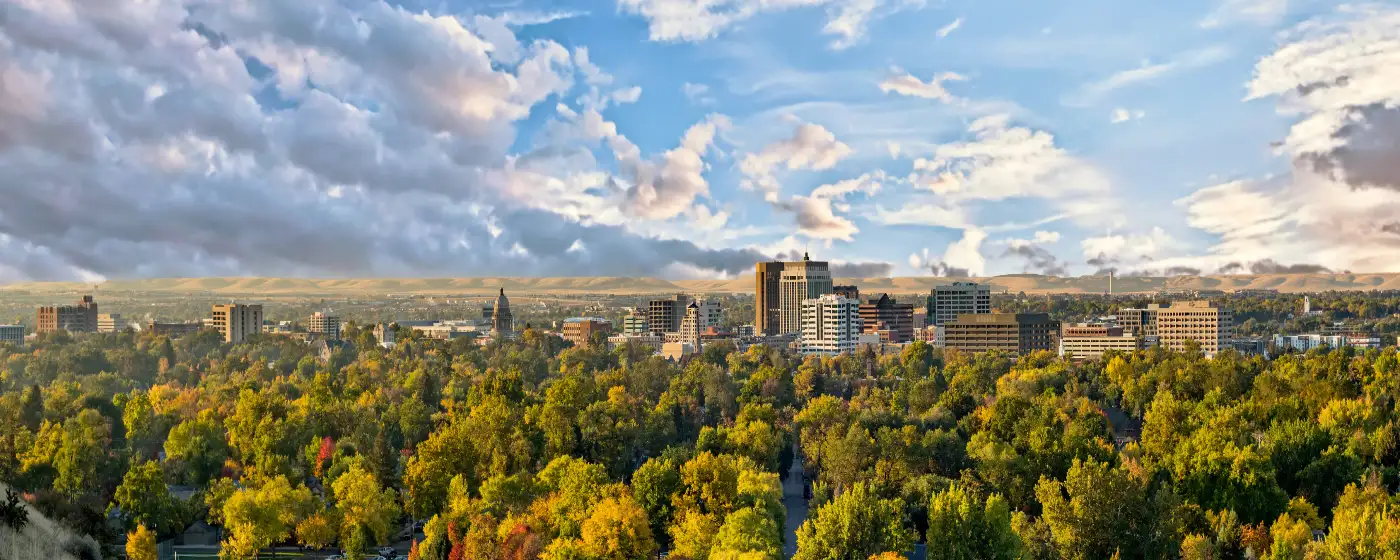
Maybe your company is relocating you here. Maybe you've been priced out of Seattle or the Bay Area and a coworker mentioned Boise. Maybe you drove through on I-84 and thought, wait, this is bigger than I expected. Boise sits at the edge of the high desert in the Treasure Valley, flanked by the Boise River to the south and the foothills to the north — and that geography is not decorative. It shapes where people live, where they exercise on Tuesday morning, and how they feel about the city six months after moving in. The central tension here is real: Boise is growing fast enough that it's no longer the small city people moved to in 2015, but it hasn't yet become the congested metro people were fleeing.
The economic backbone runs deeper than one industry. Micron Technology has anchored semiconductor manufacturing here for decades. HP Inc. maintains a significant technology and printing operation. Albertsons Companies — headquartered here — keeps a major corporate and distribution presence in the valley. Boise State University brings roughly 26,000 students to a campus that borders downtown, generating research jobs, cultural events, and a consistent pipeline of young professionals who decide to stay. A major regional health system rounds out the top-employer list, employing thousands across the metro. The Boise School District holds an A- rating, according to Niche, which is one reason parents with school-age children keep showing up in the same neighborhoods year after year.
Housing here sits noticeably below what you'd pay in coastal markets, though prices climbed sharply during the pandemic years and haven't fully retreated. The Zillow Home Value Index for Boise stood at $508,045 in May 2026 — a far cry from Portland or Denver, but no longer the bargain it was. Day-to-day life is defined less by what you're buying and more by what you can get to: the 29-mile Boise River Greenbelt connects parks and wildlife habitat through the center of the city, the Foothills trail network puts 190-plus miles of singletrack within reach of most zip codes, and Bogus Basin ski area sits 16 miles north of downtown. For a full breakdown of taxes, rent, and utility costs, see the cost of living in Boise page.
Whether you're seriously considering a move or just doing early research, the sections below break down why people are choosing Boise right now, what daily life actually looks like, how the housing market is behaving, how the commute math works, and where locals spend their weekends.
Boise at a Glance
Looking to buy in Boise? Estimate your payment.
Enter your numbers to see an estimated monthly mortgage payment.
Estimate only. Excludes HOA fees and mortgage insurance. The interest rate above is a starting point, not a quoted rate — replace it with your own to see real numbers. Insurance is a flat placeholder, not a Boise quote.
Why Are People Moving to Boise?
The case for Boise is easier to make than it used to be — and slightly harder to execute. The city has shifted from a quiet Idaho capital into a genuine mid-size tech and services hub, and the people arriving reflect that shift.
The Jobs Picture
Micron Technology is the name that comes up first in any conversation about Boise's economy, and for good reason: the company has operated semiconductor manufacturing here for decades and remains one of the largest private employers in the state. HP Inc. maintains a substantial technology presence as well, drawing engineers and product managers who want Pacific Northwest proximity without Pacific Northwest prices.
Albertsons Companies, headquartered downtown on South Cole Road, employs a large corporate workforce in finance, logistics, marketing, and technology — categories that don't always come to mind when people think grocery retail, but that make Boise's white-collar job market broader than a single-industry town. Boise State University adds research and administrative positions on top of the student-driven economy around the campus corridor.
What's changed in the last few years is the remote-work layer. A meaningful share of recent arrivals work for companies based in California, Texas, or the Pacific Northwest but live in Boise full-time. That's reshaped demand in every price tier and made the question "where do you work?" a more complicated one than it was a decade ago.
Who's Actually Moving Here
| Buyer/Renter Type | What Draws Them | Best Fit |
|---|---|---|
| Tech professionals (remote) | Lower housing costs vs. Seattle/SF, outdoor access, direct flights | Tech Value |
| Families with school-age children | Rated school district, lower crime, proximity to parks and foothills | Families School |
| California transplants | No state income tax penalty vs. CA, more space per dollar, slower pace | Value First-Time |
| Retirees & pre-retirees | Four seasons, medical infrastructure, lower cost vs. coastal retirement markets | Quiet Views |
| Outdoor-focused singles & couples | Greenbelt, Foothills trails, Bogus Basin 16 miles away, river access | Nature Walkable |
| First-time buyers priced out of other markets | Entry-level inventory still exists; median below most Western metros | First-Time Commuter |
What surprises people around month six is how much the foothills define social life — not just recreation. Weekend mornings on the Foothills trail network function the way coffee shops do in denser cities: it's where you run into your neighbors.
The Honest Downside
Growth has made Boise less affordable and more congested than the city people researched two or three years ago. If you're arriving with a 2021-era price expectation, you'll need to recalibrate. And if your job requires daily in-office time in a valley city other than Boise, the commute math changes — the Treasure Valley sprawl is real, and State Street and I-84 both show it at rush hour.
What Daily Life Feels Like in Boise
Boise runs on a rhythm that's hard to convey on a spreadsheet. Summers are long and dry — triple-digit days happen, but the low humidity makes them tolerable in a way that surprises people from the South or Midwest. Winters bring cold snaps and occasional valley fog, but rarely the months of gray drizzle that characterize the Pacific Northwest two hours west.
The Geographic Reality
The Boise River and the Greenbelt divide the city experientially more than any administrative boundary. North of the river, the North End and Hyde Park feel like a different city from the commercial corridors along Overland Road or the newer subdivisions pushing southeast. Understanding that divide before you pick a neighborhood saves a lot of buyer's remorse — the neighborhoods guide goes deeper on each area.
Downtown Boise is genuinely walkable by Mountain West standards. The Basque Block on Grove Street — a stretch rooted in Boise's historically significant Basque community — sits within a few blocks of the Idaho State Capitol and Julia Davis Park. The Morrison Center for the Performing Arts anchors a cultural calendar that runs well beyond what you'd expect from a city of 238,000. The Boise Art Museum faces Julia Davis Park directly, making the museum-to-park-to-river loop a realistic Tuesday afternoon.
What Locals Know
The Warehouse Food Hall on S. 8th Street has become a reliable gathering point in the BoDo district — multiple independently owned vendors under one roof, which means you're not choosing between cuisines so much as collecting them. It's the kind of place longtime residents bring visiting family to make the point about how much the downtown has changed.
2026 added meaningful new anchors to the social calendar: El Gaucho, a high-end steakhouse from Seattle's Fire & Vine Hospitality, opened in historic downtown Boise, and AC Boise professional soccer launched with a 7,225-plus-seat stadium and corresponding Greenbelt improvements nearby. Neither of those existed when most of the relocation guides you've already read were written.
Seasonal Quirks Worth Knowing
Smoke season is real. Late July and August can bring wildfire smoke from fires across Idaho, Oregon, and Montana that settles in the valley for days at a stretch — air quality apps become a daily habit for anyone with respiratory sensitivities. It's one of the things people don't mention in the "move to Boise" conversation but nearly every longtime resident brings up unprompted.
The flip side: spring here is genuinely spectacular. The foothills green up in April and May before curing to their summer gold, and the Greenbelt fills with people who look like they forgot winter happened at all.
The Boise Housing Market Right Now
The Boise market has cooled from its pandemic-era frenzy but hasn't gone soft. The Zillow Home Value Index stood at $508,045 in May 2026, up approximately 0.9% year-over-year — a pace that signals stability rather than the double-digit swings that defined 2020–2022. For the full picture on what that median means for your budget, including rent comparisons and tax rates, see the cost of living in Boise page.
The Redfin median sale price for the three months ending June 2026 came in at $535,000 — slightly above the Zillow index, reflecting the mix of what's actually transacting versus the broader valuation estimate. Homes spent an average of 11 days on market during that period, down from 13 days the prior year, and sales volume rose to 1,024 closings in June 2026 versus 824 in June 2025. That's not a dormant market.
What the Pace Means for Buyers
Eleven days on market sounds fast — and in some price bands and neighborhoods, it is. Well-priced homes in the North End or close-in areas of the East End frequently see multiple offers within the first weekend. Some areas and price points move more slowly, giving buyers more room. The imbalance isn't uniform across the city.
Inventory has improved compared to the tightest years, but it hasn't reached the levels where buyers can afford to be casual about timing. If you find something that fits your criteria in the $450,000–$550,000 range, waiting a week to decide is a meaningful risk. For guidance on how to navigate that pace as a buyer, the first-time homebuyer page covers the process in detail.
The Broader Trajectory
Idaho's population is projected to grow at 1.5% annually through 2034, per the Idaho Department of Labor — and the Boise metro area already counts approximately 864,000 residents across the Treasure Valley. That demand floor is structural, not cyclical, which is why most local analysts don't anticipate significant price declines even as appreciation moderates.
Some parts of the city price noticeably higher than the city-wide median; others offer entry points well below it. The neighborhoods guide breaks down the character and general price positioning of each area without making you guess which is which.
Boise Neighborhoods
Boise has several distinct areas — each with its own character and appeal. Here’s a breakdown to help you narrow down where to focus your home search.
🏡 North End
Boise's most sought-after historic neighborhood, the North End sits at the base of the Foothills with Craftsman bungalows lining tree-shaded streets that dead-end into trailheads. It's the address of choice for buyers who want walkable streets, immediate trail access, and a neighborhood that actually has a coffee shop and a bookstore within walking distance.
🏠 Hyde Park
Hyde Park's main street — 13th Street — functions as a neighborhood commercial village, with independent shops and dining clustered in a stretch walkable from the surrounding residential blocks. It sits just north of the North End proper and shares its bungalow character, attracting buyers who want an established, close-knit feel with a defined local gathering point.
🌳 East End
The East End wraps around the eastern edge of Julia Davis Park and the Old Idaho Penitentiary grounds, with mature trees, quieter streets, and a mix of older ranch-style and historic homes. It appeals to buyers who want proximity to the cultural corridor — the Boise Art Museum, Boise State, the river — without the North End price premium.
🏘 Bench
The Bench sits on a plateau above the river south of downtown, offering one of Boise's most affordable entry points in an established, diverse neighborhood with a strong local identity. It's a practical choice for buyers who want in-city living at lower price points and don't need to be steps from the foothills.
🏔 Southeast Boise
Southeast Boise stretches along the river corridor east of downtown, with a mix of mid-century neighborhoods and newer infill development. It suits buyers who want outdoor access via the Greenbelt and a quieter residential feel while staying within easy reach of downtown.
🌆 Harris Ranch
Harris Ranch is a planned community built along the Boise River east of the city core, with newer homes, a network of walking paths, and river access that appeals strongly to families with kids. It offers a neighborhood-within-the-city feel that's harder to find in Boise's more established areas.
Pros & Cons of Living in Boise
The Pros
- 206 sunny days and mild four-season climate
- Direct foothills trail access from neighborhoods
- Strong tech and healthcare job market
- Low property tax rate (0.76%) compared to national average
The Cons
- Home prices up 80-100% since 2019
- Summer wildfire smoke can affect air quality
- Winter inversions trap cold air and create gray skies
Getting Around & Commuting in Boise
Boise is a car city. That's the honest baseline. The average commute within city limits runs approximately 20–25 minutes by car, which puts it among the more manageable mid-size metros in the country — but that figure assumes you're driving, not waiting for a bus.
The Highway Architecture
Three routes carry most of the load. I-84 is the east-west spine connecting Nampa and Caldwell to the west with the broader interstate system to the east. I-184 — locally called The Connector — funnels traffic directly from I-84 into downtown, which is convenient when it flows and brutal when it doesn't. State Street (Highway 44) is the surface alternative between downtown Boise and Eagle, and it functions as the city's most reliable congestion thermometer: when State Street is moving, traffic is fine; when it's not, neither is anything else.
Eagle Road is the north-south connector between south Boise, Meridian, and the Eagle corridor, and it earns consistent frustration at the Chinden Boulevard intersection during afternoon hours. If you're buying in anything south of Chinden and commuting north, build in an extra 10 minutes and don't fight it.
The Transit Reality
Valley Regional Transit operates 19 fixed bus routes with roughly 700 stops across the Treasure Valley, connecting Boise to Meridian, Nampa, and Caldwell. Three routes reach Boise Airport Monday through Saturday. For a central Boise commute to a downtown employer, transit is a realistic option — especially from the North End or areas near State Street. For cross-valley commutes, it's a longer conversation.
The Community Planning Association of Southwest Idaho (COMPASS) is studying a high-capacity transit corridor — including commuter rail and bus rapid transit — between downtown Boise and Caldwell under its "Let's Ride Treasure Valley" initiative. The urgency is real: COMPASS projects cross-valley commute times could increase by 50% by 2050 without intervention. Whether that study produces infrastructure in the next decade is a different question, and buyers commuting from Nampa or Caldwell shouldn't plan their lives around it yet.
Living Car-Free: An Honest Assessment
If you live in the North End, Downtown, Hyde Park, or the East End, and your employer is downtown or on the Boise State corridor, a car-optional lifestyle is genuinely feasible — especially if the Greenbelt serves as your commute route by bike. Most of Boise's commercial and service infrastructure assumes a car, however, and anything involving a big-box errand, a medical appointment in a suburban complex, or a commute to Meridian will require one.
Boise Airport
Boise Airport (BOI) serves the valley with direct flights to Seattle, Portland, San Francisco, Los Angeles, Denver, Phoenix, Dallas, and Las Vegas, among others. For a non-hub city, the direct route network is strong enough that most West Coast trips require no connection. Cross-country routes east of Denver often still involve one stop — something frequent travelers from out of state notice and adjust to.
| Route / Corridor | Typical Commute (off-peak) | Pain Point |
|---|---|---|
| North End → Downtown | 8–12 min | Parking, not traffic |
| Southeast Boise → Downtown | 12–18 min | Federal Way / Americana merge |
| Meridian → Downtown Boise via I-84/Connector | 20–30 min | Connector backup, 5–6 PM |
| Eagle → Downtown Boise via State Street | 25–35 min | State Street signal timing |
| Nampa → Downtown Boise via I-84 | 30–45 min | I-84 merge near the Cole Road interchange |
| Kuna → Downtown Boise via I-84 / Can-Ada Rd | 30–40 min | Limited alternate routes |
The Cole Road interchange on I-84 is the single choke point locals warn every newcomer about. Eastbound backups there during afternoon rush don't read as severe on traffic apps until you're already in them.
Schools in Boise
Families relocating to Boise have public, private, and higher-education options nearby. Here’s a quick overview.
🎓 School District
Boise School District serves K–12 students across Boise and the surrounding area. Rated A- (source: Niche.com).
🏆 Graduation Rate
The 4-year high-school graduation rate here is approximately 82.3%.
📚 Higher Education
Idaho’s public universities — Boise State, the University of Idaho, and Idaho State — offer four-year degrees statewide, with community colleges (CWI, CSI, NIC) providing two-year and workforce programs.
🌐 Online Learning
Boise State Online and University of Idaho Online offer fully accredited online degrees for remote learners across the state.
Safety in Boise
A quick look at how Boise compares on the numbers that matter most when weighing a neighborhood or a move.
🛡 Violent Crime
Approximately 3 per 1,000 residents.
🔒 Property Crime
Approximately 11 per 1,000 residents.
Compared to the FBI’s most recent national data (2024), Boise’s violent crime is below the national average (about 3.6 per 1,000), and property crime is below the national average (about 17.6 per 1,000).
Against Idaho as a whole, Boise’s violent crime is somewhat above the state average, and property crime is about one and a half times the state average (Bureau of Justice Statistics, Crime Known to Law Enforcement, 2024 (tables 2 and 3)).
Crime rates can vary a lot within a single city, so the citywide numbers above are only a starting point. Some neighborhoods in Boise run well below these averages, while others run higher — the kind of block-by-block detail that matters most when you’re actually choosing where to live. The full guide below breaks it down neighborhood by neighborhood.
Working in Boise
Boise’s largest employers span several industries — here are some of the anchors of the local job market.
💻 Micron Technology
Semiconductor manufacturing
🏥 St. Luke's Health System
Healthcare
💻 HP Inc.
Technology/printing
🛒 Albertsons Companies
Retail/grocery
🎓 Boise State University
Education
Parks & Recreation in Boise
Some of the outdoor spaces that shape everyday life in Boise.
🌱 Julia Davis Park
🌱 Camel's Back Park
Boise residents don’t have to go far for green space — spots like Julia Davis Park and Camel's Back Park are part of everyday life here, whether that’s a morning walk, a weekend hike, or just somewhere to unwind outside. The full guide below covers more of what Boise has to offer for parks and outdoor recreation.
Retiring in Boise
Boise draws retirees for its balance of amenities, outdoor access, and cost. Here’s what to weigh.
🌤 Climate
Boise gets roughly 206 sunny days per year — more than Miami — with dry summers that can reach the triple digits but rarely feel brutal thanks to low humidity. Winters bring cold snaps, occasional snow, and valley fog in January and February, but the gray-sky stretches are shorter than anything you'd find west of the Cascades. Fall and spring are the seasons that convert people.
🍴 Lifestyle
The Boise Art Museum, Morrison Center for the Performing Arts, and Old Idaho Penitentiary give the cultural calendar real substance for a city this size. The Basque Block's restaurants and annual festivals, the Boise River float in summer, and Bogus Basin's four-season access define a lifestyle that's active without being demanding. The downtown restaurant scene has added meaningful depth in 2026 with new anchors joining an already solid independent dining scene.
🏚 55+ Communities
The Treasure Valley has seen significant development of active-adult and independent-living communities over the last decade, with options concentrated in Boise proper as well as in neighboring Meridian and Eagle. Proximity to a major regional health system and access to Boise Airport's direct-flight network to family on the coasts are consistently cited as practical draws for retirees choosing this market over others in the Mountain West. For a fuller look at retirement-specific considerations, see the retiring in Boise page.
✈ Getting Around
Most daily driving within Boise is straightforward — the average in-city trip runs under 25 minutes and parking outside the downtown core is rarely an issue. The Boise Airport (BOI) offers direct flights to Seattle, Portland, San Francisco, Denver, and Phoenix, making it practical to maintain connections to family elsewhere without a connecting flight. For those who prefer not to drive, the Greenbelt's 29 miles of paved pathway connect the major parks, and Valley Regional Transit covers the broader valley by bus.
🏛 Idaho Taxes for Retirees — What to Know
- Social Security is not taxed — Idaho does not tax Social Security benefits at the state level, regardless of income.
- Flat state income tax — Idaho has a flat income tax (5.3% for 2026). Other retirement income — pension distributions and 401(k)/IRA withdrawals — is taxed as ordinary income at that rate.
- Narrow retirement deduction — Idaho’s Retirement Benefits Deduction is limited: it reaches only certain government pensions (federal CSRS, Idaho firefighter/police, and military retirement) for those 65+ (or 62+ if disabled), and is reduced by Social Security received.
- Sales tax is the tradeoff — The state sales tax is 6.0%, and Boise adds no local sales tax on general retail, so the combined rate is 6.0% (Idaho State Tax Commission, 2026). Groceries are taxed, but a grocery tax credit offsets part of it; prescription drugs are exempt. A small number of resort cities add a local option tax, usually on lodging, alcohol, and prepared food rather than general retail.
- Low property taxes, with senior relief — Idaho property taxes are relatively low. Homeowners 65+ who own and occupy their home may qualify for the “circuit breaker” Property Tax Reduction based on income.
- No estate or inheritance tax — Idaho has no estate, inheritance, or gift tax.
- Capital gains — Capital gains are taxed as ordinary income, though Idaho allows a deduction of up to 60% of the net gain on qualifying Idaho property.
Tax laws change frequently and individual situations vary. This is general information, not tax advice — always consult a qualified Idaho tax professional or CPA for personalized retirement tax planning.
Weekends & Local Favorites in Boise
Boise's weekend identity runs on outdoor access more than on restaurant rows or bar districts — though those exist too, and they're better than the city's size would suggest.
The Outdoors Are the Point
The Boise Foothills trail network puts over 190 miles of hiking and mountain biking within reach of most city neighborhoods. From the upper North End, you can be on singletrack within a 10-minute walk. Camel's Back Park at the base of the foothills serves as the main gathering point for the weekend trail crowd — dogs, strollers, and riders all converge there on Saturday mornings in a way that functions as the city's informal town square.
The 29-mile Boise River Greenbelt connects the system from east to west, linking Julia Davis Park, the Ann Morrison Park lawn, and the river access area near Barber Park where people put in for the inner tube float. The float — down the Boise River, roughly 6 miles — is a Boise summer institution that people do at least twice before they've lived here a year.
Bogus Basin is 16 miles north of downtown — close enough to feel like a neighborhood amenity and far enough to require a real winter tire conversation. With 2,600 acres across 90 ski trails plus 20-plus miles of summer mountain biking, it's a four-season asset that most residents use in multiple forms. Night skiing on weeknights is a local habit that people who moved from resort towns didn't expect to find 25 minutes from downtown.
Downtown and the Cultural Core
The Basque Block on Grove Street is the neighborhood most locals point to when explaining what makes Boise different from a generic Western city. The community's roots go back over a century, and the cultural presence — in food, in the Basque Museum, in annual festivals — is substantive rather than decorative.
Julia Davis Park anchors a cultural corridor that includes the Boise Art Museum, the Idaho Historical Museum, and the Morrison Center for the Performing Arts. The Morrison's programming — Broadway touring productions, symphony, dance — runs at a level that surprises people expecting a small-city calendar. The Old Idaho Penitentiary on the East End adds a genuinely unusual historical dimension to weekend exploring; it operated as a working prison until 1973 and the grounds are still striking.
The Warehouse Food Hall on S. 8th Street in the BoDo district has become the most reliable answer to "where do we eat tonight?" for groups with mixed preferences — independently owned vendors under one roof, with a mix of cuisines that changes as the tenant lineup evolves. El Gaucho's arrival in historic downtown Boise in 2026 added a high-end anchor the city didn't previously have at that tier.
The Sports Calendar
Boise State football is not a hobby here — it's an organizing principle for fall weekends. Blue Field Saturdays at Albertsons Stadium pull the entire city into a shared orbit from September through November, and the team's consistent Mountain West competitiveness means the stakes feel real year after year. The Idaho High School Activities Association (IHSAA) events layer on top of that for families with kids in the district. And 2026 brought professional soccer to the mix: AC Boise launched with a new 7,225-plus-seat stadium, adding a spring-through-fall sports option that hadn't existed before.
Top Things Locals Say About Boise
The best intel about a city comes from the people who actually live there. Here’s what Boise residents say when newcomers ask the questions everyone’s thinking.
“I kept expecting it to feel like a smaller version of Portland, but it doesn't — it has its own thing. What got me was that within three months I was doing the Greenbelt on a Tuesday after work like it was nothing, and I'd never done anything like that where I lived before.”
— Recent Boise home buyer
“What's the most surprising thing about living in Boise?”
How fast the foothills become part of your routine. People assume the trails are a weekend thing, but you find yourself doing a quick loop on the Foothills trail network on a Wednesday evening because it's 10 minutes from the North End and you've got an hour to spare. The other surprise is smoke season — late July and August can bring days where you don't want to be outside at all because of wildfire smoke drifting in from across the region. Nobody in the relocation conversation mentions that part.
“What do locals love most about Boise?”
The combination of things that usually don't coexist — a real airport with direct flights to the coast, a university town energy, the Greenbelt running right through the middle of everything, and a downtown that's actually gotten better over the last few years rather than hollowing out. Boise State football Saturdays have a communal energy that's hard to explain if you haven't been to Albertsons Stadium for a home game. And the Basque Block is the kind of neighborhood anchor most cities would spend decades trying to manufacture.
“What should newcomers to Boise know?”
Buy or rent somewhere you can actually get to the Greenbelt or Foothills without a special trip — otherwise those amenities stay theoretical. State Street is your commute barometer; if it's slow heading west toward Garden City in the morning, everything is slow. The Boise Airport is much more useful than people expect — direct flights to Seattle, Portland, and the Bay Area run regularly, which matters a lot if you're maintaining ties to a coast. And give yourself one full seasonal cycle before you judge the city; summer and fall here are genuinely different from February.
“Can you live in Boise without a car?”
Technically yes, practically it depends entirely on where you live and work. If you're in the North End, Hyde Park, or close-in East End and your employer is downtown or on the Boise State corridor, biking the Greenbelt or walking is genuinely realistic. Valley Regional Transit has 19 routes covering the Treasure Valley, and three of them serve the airport. But anything that involves suburban errands, medical appointments in outlying clinic complexes, or a commute to Meridian or Nampa will require a car. Boise is not building the kind of transit infrastructure that changes that equation in the near term.
Cities Near Boise
Other communities near Boise worth a look — each with its own character and price point.
| City | Distance | Best For | Vibe | Median Rent | Median Buy |
|---|---|---|---|---|---|
| Meridian | 15 mi | Families seeking new construction & top schools | Fast-growing, suburban, amenity-rich | $1,750 | $540,000 |
| Eagle | 15 mi | Buyers wanting space, quiet & upscale feel | Affluent, low-density, semi-rural edges | $1,900 | $650,000 |
| Nampa | 22 mi | Budget-conscious buyers & renters | Working-class, diverse, industrial roots | $1,430 | $435,000 |
More Helpful Guides for Boise
Going deeper on Boise? Our blog series covers everything from first-time buying to retiring here — explore the guides below.
Local Expert Takeaway: Boise rewards people who do their geographic homework before buying. The difference between a home two blocks west of the foothills trailhead in the North End and one off Overland Road near Orchard is not just price — it's an entirely different relationship with the city. Get your commute route nailed down first, then work backward to the neighborhoods that make the daily math work. The Greenbelt and Foothills are legitimate quality-of-life assets, not just marketing language — but only if you buy somewhere close enough to actually use them on a weeknight.
Quick Takeaways & FAQs
✅ Bogus Basin ski area sits just 16 miles from downtown Boise — closer than most resort towns are to any city of comparable size.
⚠️ The housing market has stabilized from its pandemic peak, but homes in desirable areas still move in roughly 11 days on average — slow enough to breathe, fast enough to require a decision.
📍 The Cole Road interchange on I-84 is the commute choke point that doesn't show up on relocation brochures but shapes daily life for anyone living south of the river.
Is Boise, Idaho a good place to live?
What is the average home price in Boise, Idaho?
How bad is traffic in Boise?
What are the best neighborhoods in Boise for families?
What is Boise like compared to other Idaho cities?
Helpful Links for Moving to Boise
Moving to Idaho?
Tell us what you need help with and we'll connect you with local resources.
