
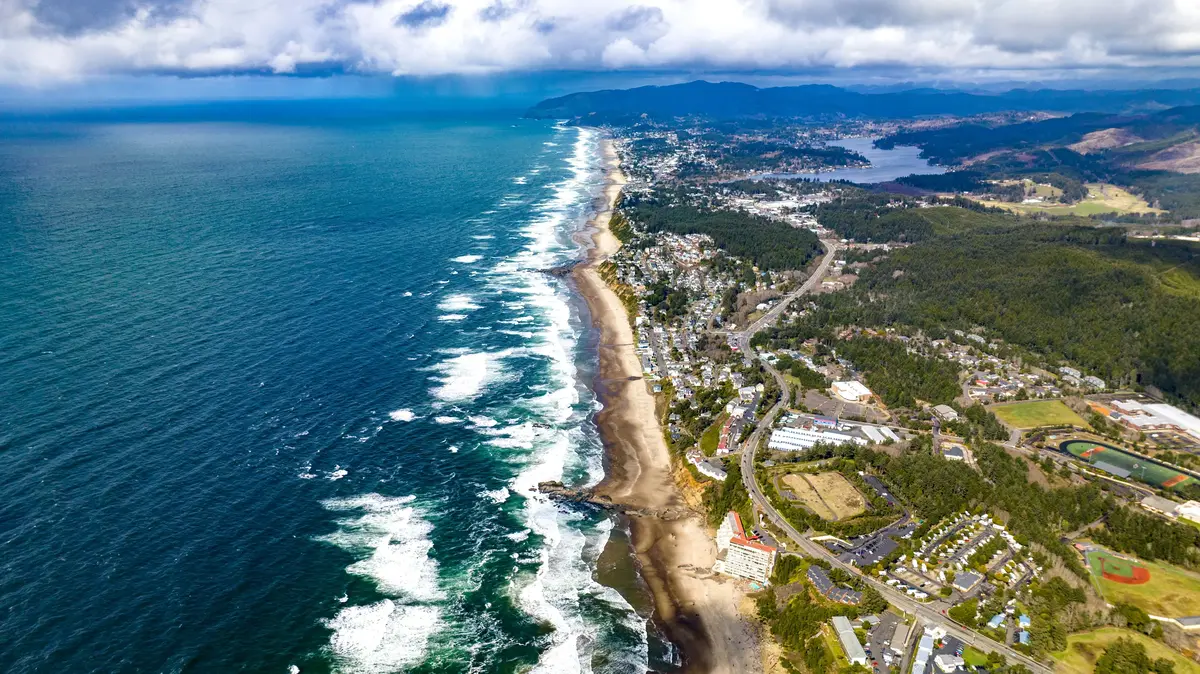
You've probably driven through Lincoln City on a summer afternoon, caught the smell of salt air somewhere around Siletz Bay, and filed it away as a place to come back to. A lot of retirees do exactly that — and then they actually move here. The city sits at the midpoint of the Oregon Coast along US-101, a narrow strip of town roughly seven miles long pressed between the Coast Range and the Pacific. At a population of 10,034, it is small enough that you'll recognize faces at the grocery store within a month, but large enough to have a real hospital, a handful of genuine restaurants, and a cultural center that punches well above its size.
The case for retiring here is genuinely compelling for a specific kind of person: someone who wants the ocean as a daily backdrop, doesn't need a metropolitan job market, and is willing to trade big-city convenience for an unusually slow pace. The city draws retirees from California and the Willamette Valley who have been priced out of coastal towns further south, and it draws people who simply decided — often after a vacation — that they'd rather watch the surf from their living room than commute to an office. The typical home price of $503,488 (July 2026) is real money for a coastal market, but it is well below what equivalent ocean proximity costs in California or even parts of the Washington coast.
Oregon's tax posture helps too. The state exempts Social Security from income tax, levies no sales tax — so groceries, prescriptions, and everyday purchases cost exactly what the sticker says — and offers a property-tax deferral program for homeowners 62 and older that can meaningfully reduce out-of-pocket costs on a fixed income. The effective property tax rate is approximately 0.80%, which is low by most coastal standards. What you give up is specialist medical depth, big-box retail within city limits, and consistent sunshine: Lincoln City averages 157 sunny days a year, and the gray winters are long, wet, and genuinely overcast.
Whether you're seriously planning a move or still weighing the Oregon Coast against other options, the sections below cover healthcare access, the retiree budget, walkability, downsizing realities, and how Lincoln City stacks up against the retirement destinations nearest to it.
Why Retirees Are Choosing Lincoln City
The retirees who thrive here tend to share one trait: they came for the coast and they mean it. Seven miles of uninterrupted beach, Siletz Bay at the southern edge of the city, and the Cascade Head Scenic Research Area just to the north are not amenities you drive to on weekends — they are the texture of daily life. If that sounds like the retirement you've been picturing, Lincoln City delivers it consistently and affordably by Oregon Coast standards.
The city also fits retirees who are done with traffic, commuter culture, and the logistics of a large metro. With a population of 10,034, the pace is genuinely unhurried. The Historic Taft District and the Lincoln City Cultural Center give the town an arts-and-culture presence that surprises newcomers. Enough independent restaurants, coffee shops, and galleries line the US-101 corridor to fill a week of evenings without repeating yourself.
Who should look elsewhere? Retirees who need frequent access to subspecialty medical care — cardiac surgery, cancer treatment, neurology — will find the distance to a major academic medical center a real constraint, not a minor inconvenience. Anyone who wants to walk to most errands will struggle with a city built along a seven-mile highway spine. And if 157 sunny days a year sounds thin to you, be honest with yourself before you sign anything: the winters here are gray in a way that catches people off guard, even those who thought they were ready for it. For the right person, Lincoln City is an exceptional retirement setting. For the wrong one, the romance fades by February.
Healthcare & Medical Access in Lincoln City
For a coastal city of this size, the local hospital situation is better than most people expect. Samaritan North Lincoln Hospital is inside city limits — the facility that opened in February 2020 overlooks Devils Lake near the northern end of the city — and it is the only hospital you should treat as your primary care anchor. It is an accredited critical access hospital and a Level IV trauma center, and it has served this community since 1968.
What the hospital actually offers on-site matters a great deal for retirees doing their homework. Diagnostic imaging is genuinely comprehensive: MRI, 160-slice CT, PET scan, 3-D mammography, and DEXA bone-density testing are all available without a long drive. The infusion center handles both oncology and non-oncology needs. A wound and ostomy clinic, home health services, and hospice round out the continuum of care that aging patients specifically rely on.
Specialty coverage is broader than you'd expect for a facility this size. Cardiologists and cardiac-device management clinicians come to the hospital, as do specialists in nephrology, orthopedics, podiatry, and urology. Mental health and psychiatry services are available. Physical rehabilitation — occupational, physical, and speech therapy — is on-campus. For routine and moderately complex care, most retirees here will not need to leave town.
The honest limitation is at the top of the acuity scale. Complex cardiac procedures, neurosurgery, and major cancer surgery require a transfer to a higher-level facility. The drive toward Portland is about 90 minutes under normal conditions, and a higher-level trauma center is that same distance away. Retirees with a known cardiac or oncology history should think carefully about what that distance means in a genuine emergency, and should discuss it with their physicians before making a final decision.

The Retiree Budget in Lincoln City
Oregon's tax treatment of retirement income is a mixed picture that deserves a clear read. The good news: Social Security benefits are fully exempt from Oregon state income tax, regardless of your income level. Oregon also has no state sales tax, which means every trip to Safeway, every prescription, and every hardware-store run costs exactly what the shelf price says. That is a meaningful daily savings for anyone on a fixed income.
The catch is retirement-account income. Distributions from IRAs, 401(k)s, and most pension income are taxed at Oregon's regular graduated state income-tax rates, which run higher than the national average at the upper brackets. The Oregon Retirement Income Credit that had softened this burden for some retirees expired after tax year 2025; readers planning around it should verify the current landscape with a tax professional rather than relying on any general guidance.
Property taxes at an effective rate of approximately 0.80% are low for a coastal market. Oregon also offers a deferral program for homeowners aged 62 or older with household income at or below $60,000 (the 2025 threshold — verify the current year's limit with the Oregon Department of Revenue). Under this program, the state pays your property taxes and records a lien at 6% simple interest, repaid when you sell or pass the home. For retirees whose income is modest but whose home equity is substantial, this can meaningfully reduce monthly cash requirements. The typical home price here is $503,488 (July 2026) — see the full cost-of-living breakdown for how that translates across the full budget picture.
Day-to-day costs in Lincoln City run roughly in line with mid-size Oregon cities rather than the inflated coastal resort premium you might expect. Groceries are available at Safeway and, for a broader selection, require a drive. Eating out ranges from casual seafood spots to sit-down dinners, with enough variety that a couple can dine out several nights a week without exhausting the options. The bigger fixed-income pressure in Lincoln City is not taxes or groceries — it is the cost of the housing itself relative to local incomes, and the fact that a serious shopping trip or a specialist medical appointment means burning gas and time on US-101.
Looking to buy in Lincoln City? Estimate your payment.
Enter your numbers to see an estimated monthly mortgage payment.
Estimate only. Excludes HOA fees and mortgage insurance. The interest rate above is a starting point, not a quoted rate — replace it with your own to see real numbers. Insurance is a flat placeholder, not a Lincoln City quote.
Walkability, Community & Staying Active in Lincoln City
The honest walkability picture: Lincoln City is a car-dependent city for most daily errands. It is long and linear, strung along US-101, and the distance between the northern neighborhoods near Roads End and the southern end near Siletz Bay is a real span. Most grocery runs, medical appointments, and retail trips require a car. This is not a criticism — it is geography — but retirees who are counting on living car-free will find Lincoln City a difficult fit.
Within that reality, there are genuine walkable pockets. The Historic Taft District, anchored by Siletz Bay, offers a walkable cluster of galleries, restaurants, and shops compact enough to spend an afternoon on foot. The Lincoln City Cultural Center, which hosts rotating exhibitions and community events year-round, functions as a genuine civic anchor rather than a seasonal attraction. These are the places where Lincoln City's small-town social life actually concentrates.
The beach itself is the most democratic amenity in the city. Starting in 2024, the city installed mobi-mat beach-access pathways at four points along the shoreline, and free beach wheelchairs are available through the city's parks and recreation department. This makes the seven miles of coastline genuinely usable for retirees with mobility challenges — a detail that separates Lincoln City from many coastal towns where the beach is scenic but practically inaccessible if you're not steady on soft sand.
For staying active, the options are legitimate. Cascade Head offers hiking for those who can handle an elevation gain. The Siletz Bay National Wildlife Refuge borders the city's southern edge and is flat enough for a slow morning walk. Drift Creek Falls — a suspension-bridge hike to a 75-foot waterfall through old-growth forest — sits roughly ten miles east of town and is one of those places that locals treat as their own even though it draws visitors from across the coast. The city's arts community, the Cultural Center's programming, and the concentrated dining and gallery scene in the Taft District give socially active retirees enough to fill the week without needing to drive to Newport or Salem for stimulation.
Right-Sizing: Downsizing in Lincoln City
No 55+ communities were found in Lincoln City. This is the single biggest structural gap for retirees who are specifically looking for an age-restricted ownership community — the lock-and-leave condo with a homeowners association that handles the lawn, or the patio-home neighborhood where most of your neighbors are also retired. That product simply does not exist here in a formal sense.
What the market does offer is single-family homes, many of them smaller and older, along with a limited condo and townhome inventory concentrated near the beachfront and in the Siletz Bay area. For retirees downsizing from a larger home, the math can work: a well-priced single-level home in Lincoln City often costs less than an equivalent property in the beach markets of Southern Oregon or Northern California. The inventory of genuinely single-level homes — no stairs to the main bedroom, no split-level layout — is not deep, and patience is required. Homes that check that box and sit in a quieter neighborhood tend to move when they come available.
The care continuum does exist in the city even without age-restricted ownership communities. Assisted living and memory care are available locally — Lakeview Senior Living offers assisted living, memory care, 24-hour staffing, and respite stays within the city. For retirees who are planning a decade or more ahead and want to understand the full aging-in-place picture, the presence of that local care option alongside Samaritan North Lincoln Hospital's home health and hospice services means the city is not a gap in the continuum — it simply lacks the ownership-community layer that some buyers are specifically seeking. If that layer is non-negotiable, Newport, about 25 miles south, has a meaningfully broader senior-living inventory than Lincoln City does.
Lincoln City vs Nearby Retirement Destinations
| City | Cost vs Lincoln City | Primary Hospital | Walkability | Senior Living Depth | Overall Retirement Fit |
|---|---|---|---|---|---|
| Lincoln City | Anchor | Samaritan North Lincoln Hospital (in-city, Level IV) | Car-dependent; walkable pockets in Taft District and beachfront | Assisted living and memory care; no 55+ ownership communities | Strong for ocean-focused, car-comfortable retirees; healthcare better than size suggests |
| Newport | Noticeably lower | Samaritan Pacific Communities Hospital (in-city) | More compact; genuine downtown walkability near the bayfront | Broader senior-living inventory; more assisted-living options | Best all-around value on this stretch of coast; more services, lower entry price |
| Depoe Bay | About the same | No in-city hospital; depends on Lincoln City or Newport facilities | Very walkable village core; tiny footprint cuts both ways | Minimal; very few senior-specific services in-city | Excellent for retirees who want extreme quiet and a village feel; not practical for those with medical needs |
| Otis | About the same | No in-city hospital; depends on Lincoln City facilities nearby | Rural; essentially no walkable errands | Minimal; small unincorporated community | Suits retirees seeking forested, rural privacy; not a standalone retirement base |
| Gleneden Beach | About the same | No in-city hospital; relies on Lincoln City | Low; residential coastal community without a commercial core | Very limited; largely residential | Works as a quieter alternative to Lincoln City with access to its services; little independent infrastructure |
| Lincoln City area broadly (Neotsu / Delake) | About the same or slightly lower | Shares Samaritan North Lincoln Hospital access | Car-dependent; similar to main Lincoln City | Same as Lincoln City proper | Viable for buyers who want Lincoln City's amenities at a slightly more relaxed pace within a short drive |
Newport is the honest answer for retirees who want the Oregon Coast and a more complete service picture. Its home prices run noticeably lower than Lincoln City's, its bayfront is more walkable, Samaritan Pacific Communities Hospital is an in-city option, and its senior-living inventory is meaningfully broader — if the 55+ ownership-community gap in Lincoln City is a dealbreaker, Newport is the place to look first.
Depoe Bay suits a specific and smaller set: retirees who want a genuinely quiet, postcard-sized village and who are comfortable driving to Lincoln City or Newport for medical care, groceries, and most services. Its walkable core is real, but the city is small enough that daily life there requires a car for anything substantive. Otis and Gleneden Beach are better understood as lifestyle settings than as self-contained retirement bases — beautiful if forested quiet and rural pace is what you're after, but not places where you can age in place without total car dependence and a clear plan for how medical needs get handled. Lincoln City sits in the practical middle: better healthcare than any nearby village, more character and community than a pure resort town, and a price point that still makes sense for retirees coming from higher-cost markets.

Local Expert Takeaway: Lincoln City's retirement case rests on three things that actually hold up: an in-city hospital that is better-equipped than its size implies, an effective property tax rate of approximately 0.80% that keeps housing costs lower than most coastal markets, and a genuine daily relationship with the Pacific that no amount of amenity-list language fully captures. The catch is equally specific: the city is built along a highway, not a downtown grid, so a car is required for life here, the specialist medical distance to Portland is real, and the 55+ ownership-community inventory is simply absent. Retirees who do best here are the ones who showed up for the ocean and found everything else acceptable — not the ones who hoped the coast would come with big-city infrastructure attached.
Quick Takeaways & FAQs
✅ Samaritan North Lincoln Hospital, inside city limits, offers on-site MRI, PET scan, cardiac care, and specialist clinics — more than most coastal towns this size can claim.
⚠️ Oregon exempts Social Security from state income tax and charges no sales tax, but IRA and pension income is taxed at full state rates, and no 55+ ownership communities exist in Lincoln City.
📍 The city installed mobi-mat beach-access pathways at four points starting in 2024, with free beach wheelchairs available through city parks and recreation — the seven-mile shoreline is genuinely accessible for retirees with mobility challenges.
Is Lincoln City a good place to retire on Social Security alone?
How good is the hospital in Lincoln City for retirees?
Are there any 55+ communities in Lincoln City?
Can you get around Lincoln City without a car as a retiree?
How does Lincoln City compare to Newport for retirement?
Moving to Oregon?
Tell us what you need help with and we'll connect you with local resources.
