
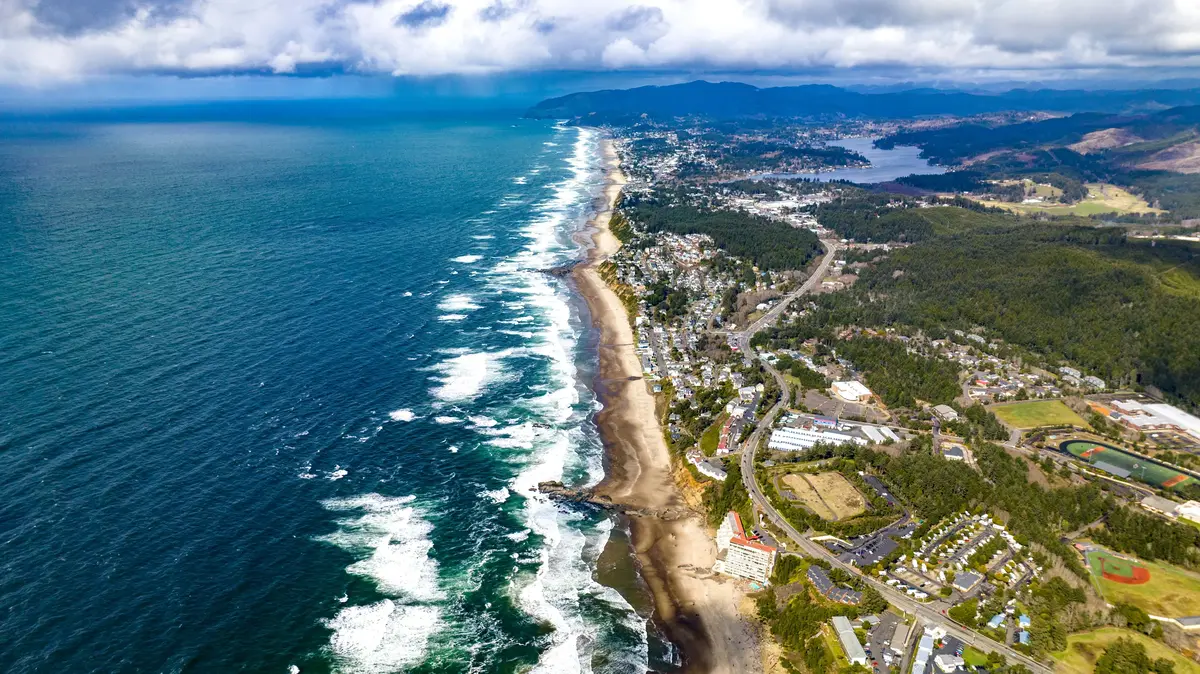
Maybe you've been watching California housing prices eat deeper into your financial future and someone mentioned the Oregon Coast. Maybe a remote job finally made it possible to move somewhere you actually want to live. Either way, Lincoln City keeps coming up for a reason. It sits on the Pacific, 7.5 miles of uninterrupted beach from Roads End in the north to Siletz Bay in the south, connected by US-101 as the single spine running through town. This is not a suburb — it's a small coastal city of 10,034 people where the ocean is never more than a short walk away and the crowd thins dramatically once tourist season ends.
The economic backbone here is honest and worth understanding before you arrive. Chinook Winds Casino Resort, operated by the Confederated Tribes of Siletz Indians, is one of the largest employers on the Oregon Coast. The Lincoln County School District and a regional healthcare presence round out the more stable employment tier, while hospitality and retail jobs are plentiful but seasonal. California was the single largest source state for Oregon's inbound migration in the United Van Lines 2025 National Movers Study, accounting for 22 percent of arrivals — people landing here tend to be remote workers, retirees, or buyers who've been priced out of the California coast and want the same geography at a different price point.
Lincoln City's cost of living runs above the national average, and housing is the primary driver. Vacation-home demand and short-term rental pressure shrink the supply available to full-time residents. But even accounting for that, the gap between what California costs and what Lincoln City costs is real and wide — utilities, groceries, and transportation in Lincoln City run meaningfully below what most California metros produce, and the housing differential is substantial. The trade-off is smaller shops, fewer restaurants, and a commute to Portland International Airport (PDX) that runs about 95 miles. You will give up urban density in exchange for fog, surf, and a meaningfully lower housing payment.
Whether you're already researching neighborhoods or still deciding if this is the right move, the sections below break down what Californians actually encounter here: the home price comparison, the tax picture, the climate adjustment, the daily lifestyle reality, and the honest downsides worth knowing before you sign anything.
The Home Price Comparison: What Your California Equity Buys Here
The headline number is the one that usually closes the argument for California buyers. The typical home price in Lincoln City stands at $503,488 (Zillow Home Value Index, July 2026). Compare that against California's statewide typical home value of $773,735, and the gap is substantial — you are looking at a price noticeably below what even a median California market produces.
For buyers who've been in a California home for more than five years, the equity story is often even more compelling. Sellers coming from the Bay Area or Southern California frequently arrive with enough proceeds to pay cash or put down a significant portion — which matters in a market where inventory is constrained by vacation-home demand and short-term rental conversion.
Entry-level options do exist, particularly in Taft and Cutler City where older housing stock and smaller lots bring prices below the city-wide figure. Roads End sits at the northern tip of the city with direct beach access and dramatic headland scenery. Lincoln Palisades offers a mix of older cottages and newer construction with ocean proximity. For a full read on how each area feels and who it suits, see the neighborhoods guide.
The Affordability Catch
The sticker price is lower than California's, but Lincoln City is not cheap on local terms. The median household income of $56,635 falls well short of what it takes to buy at the city's typical price — the gap is roughly $72,000 in annual income. That matters most if you're arriving without California equity and need to qualify on current earnings alone.
Vacation-home buyers and remote workers with California-level salaries have reset expectations in this market. Full-time residents employed locally are often priced into rentals — the typical 2BR rent ranges from $1,820 to $2,220 per month — or into older, smaller homes farther from the beach corridor.
The Comparison Table
| Metric | Lincoln City, OR | California (statewide) |
|---|---|---|
| Typical home value | $503,488 (July 2026) | $773,735 (statewide typical) |
| Effective property tax rate | 0.80% | ~0.71% (statewide effective) |
| State income tax (top rate) | 9.9% | 13.3% |
| State sales tax | None | 7.25% base (local additions often push combined rate higher) |
| Median household income | $56,635 | Noticeably higher statewide |
| Monthly utilities (avg) | ~$142 | Higher in most major metros |
The property tax line surprises most Californians. Lincoln City's effective rate of 0.80% runs slightly above California's effective property tax rate of 0.71% — Proposition 13 has held California assessments down for long-term homeowners in a way Oregon's Measures 5 and 50 do not fully replicate. If you're buying at $503,488 versus what you sold in California, the annual tax bill is lower in absolute terms even at the marginally higher rate, but the rate itself is not the windfall people expect.
The Oregon Tax Picture: Where You Win, Where You Don't
The sales tax story is simple and genuinely valuable. Oregon has no state or local sales tax. California's statewide base sales tax rate of 7.25% — with local additions pushing the combined average close to 9% in many counties — means that a household spending $40,000 a year on taxable goods saves roughly $3,600 annually just by crossing the border. That figure compounds across groceries, clothing, furniture, and the gear-heavy outdoor lifestyle Lincoln City invites.
The income tax picture is more complicated, and getting it wrong costs real money.
What Californians Misread About Oregon Income Tax
California's top state income tax rate of 13.3% applies only to the highest earners — that rate is reserved for seven-figure incomes. Oregon's top rate of 9.9% sounds like a clear win, but Oregon's brackets compress much faster. At $100,000 of income, Oregon's effective bill runs noticeably higher than California's equivalent. The savings from escaping California's top bracket only materializes for the very highest earners; most people making six figures will pay more in Oregon income tax than they did in California, not less.
Oregon does offer one offset most people don't know about: the state allows taxpayers to subtract a portion of federal income taxes paid from Oregon taxable income, which reduces the Oregon-taxable base. That subtraction phases out for higher earners and disappears entirely for joint filers above $290,000 in federal adjusted gross income, but for middle-income households it provides meaningful relief.
The Net Tax Reality for Most Movers
The honest summary: most California transplants to Lincoln City come out modestly ahead on taxes overall — the sales tax elimination is real and daily, the property tax difference is small, and the income tax may actually run slightly higher depending on earnings. This is not a dramatic tax cut. It is a structural shift that favors consumption-heavy households and penalizes high earners less than California does at the very top, while asking more from middle-income earners in the middle brackets.
For a detailed breakdown of Oregon's income, property, and sales tax rules, the cost-of-living page covers the full picture alongside utilities and day-to-day expenses.

Climate: The Real Adjustment for California Transplants
No section of this guide matters more for long-term happiness than this one. Lincoln City averages 157 sunny days a year. If you are coming from the Central Valley or Southern California — where 280 or more sunny days is a baseline expectation — that figure is the most important one on this page. The Oregon Coast is genuinely beautiful, and the mild temperatures are real, but the grey is also real and it lasts longer than most newcomers anticipate.
What the Numbers Mean on the Ground
July and August average highs around 67°F — comfortable in a fleece, rarely requiring air conditioning, and free from the heat waves that have made California's interior summers increasingly punishing. That summer mildness is a genuine selling point for buyers fleeing Sacramento or the Inland Empire.
The adjustment comes in the other nine months. Fog rolls in from Siletz Bay before most mornings are done. Rain runs from October through May with only occasional breaks. Winters are mild — temperatures rarely drop below freezing — but the persistent overcast wears on people who weren't expecting it. The most common thing California transplants say after their first full winter is that nobody warned them about the grey. This guide is warning you now.
What You Get in Exchange
The beach in peak summer is noticeably less crowded than anything along the California coast. Cascade Head rises just north of town — a federally protected headland with trails that look out over the ocean on clear days. Nelscott Reef draws surfers chasing serious swells from November through March. Devils Lake sits in the center of the city, a freshwater counterpoint to the salt air a few blocks west.
If your California life was structured around outdoor time, Lincoln City replaces it — just with different gear and a higher tolerance for drizzle. If you relied on the California sun for mood regulation, budget for full-spectrum lighting and plan a trip south in February. That's not a small thing, and buyers who skip the honest accounting on this tend to last about two winters before they start reconsidering.
Looking to buy in Lincoln City? Estimate your payment.
Enter your numbers to see an estimated monthly mortgage payment.
Estimate only. Excludes HOA fees and mortgage insurance. The interest rate above is a starting point, not a quoted rate — replace it with your own to see real numbers. Insurance is a flat placeholder, not a Lincoln City quote.
Daily Life: What Changes, What Doesn't, and What Surprises People
Lincoln City is long and narrow — US-101 is the only spine, and nearly everything runs along or just off it. That geography shapes daily life more than any other single factor. Errands that take twenty minutes in a California suburb because of grid streets can take the same twenty minutes here because everything is strung along one road and traffic backs up whenever a weekend wave of visitors hits town.
What Californians Find Immediately Different
The dining and coffee scene is smaller but real. A handful of independent cafés and brewpubs anchor the main corridor, and the seafood quality — given direct access to the Pacific — is genuinely excellent. A serious shopping trip or a specialty retail run means driving out of town; you will be ordering online for anything the local shops don't carry. Lincoln City Premium Outlets handles a portion of the retail gap, but it is not a replacement for the range a California metro offers.
Weekend and tourist traffic on US-101 is the friction point most full-time residents cite first. Summer weekends bring a surge of day-trippers and vacationers from the Willamette Valley, and the single road means there's no alternate route when it slows. Californians used to freeway gridlock can handle it, but it's worth understanding that this is a daily-life variable, not a rare event.
Where Families Actually Gather
The parks and recreation anchors are mostly outdoors and largely tied to the beach, Devils Lake, and the recreational areas along Siletz Bay. The Lincoln County School District serves 4,660 students enrolled in 2025-26 and holds a C+ rating, according to Niche — worth reading carefully for families with school-age children before committing. The schools page breaks down what that means at the individual school level.
Routine healthcare is accessible locally; anything more complex typically means heading toward Salem or Portland. Health coverage costs generally run below California levels, though the trade-off is fewer specialists and a longer drive for advanced care — see the retiring page for a fuller picture of healthcare access.
The Commute Reality
Lincoln City is not a commuter suburb. The drive to Salem takes about 90 minutes, and Portland is farther still. Most people who move here and keep a California-style career do so remotely. The city has been investing in infrastructure and EV charging stations as part of its economic development push, but the fundamental geography is coastal and isolated, and that doesn't change.
For a full picture of employers, remote-work dynamics, and what the local job market actually looks like, see the living in Lincoln City hub.
Weekends and Local Favorites
The best test for whether Lincoln City fits your California lifestyle is a long weekend in the off-season, not a July visit. Summer is genuinely lovely — 67°F, uncrowded beach, long evenings — but it is not representative. Come in November or February, walk the beach at Roads End State Recreation Site when the surf is up and the parking lot is nearly empty, and see whether that version of the place still appeals to you. If it does, you're probably going to be fine here.
On the Water and in the Hills
Cascade Head Trail is a legitimate draw — federally protected headland, ocean views on clear days, and accessible enough that it doesn't require technical gear. Nelscott Reef breaks hard in winter and draws a dedicated surfing community. Siletz Bay at low tide is its own world, with shorebirds and quiet that feels genuinely remote despite sitting inside the city limits. Devils Lake is where families and paddlers show up on warm days, a freshwater anchor in the middle of a very salt-focused town.
The Dining and Coffee Scene
Mo's Seafood & Chowder is the Oregon Coast institution that needs no introduction — the Lincoln City location is the place to start. Kyllo's Seafood & Grill sits above the beach and delivers on both counts. McMenamins Lighthouse Brewpub brings the McMenamins formula — Oregon craft beer, casual food, reliably consistent — and Pelican Brewing's Siletz Bay location adds another strong brewing option. The Wild Flower Grill rounds out the sit-down dining end with a different register than the seafood-heavy competition.
On the coffee side, Salt and Pacific Grind Cafe draw the regulars who want something beyond a drive-through. The Lighthouse Coffee Co. and Nyla's Cup of Jo are worth knowing for their local character. The Human Bean handles the drive-through lane for the mornings when you're moving fast.
The Connie Hansen Garden and Quieter Draws
The Connie Hansen Garden near the northern end of the city is the kind of place that doesn't get mentioned in California relocation articles and should. It's a botanical garden built by a single woman over decades, maintained by volunteers, and representative of what Lincoln City does quietly well — small-scale, genuinely local, and completely unlike anything a tourist brochure would highlight. Chinook Winds Casino Resort provides entertainment that draws from across the region, and Lincoln City Premium Outlets handles the retail gap for a significant portion of the shopping that would otherwise require leaving the coast.
The honest summary: the lifestyle here rewards people who want less of certain things — traffic, crowds, noise, heat, expense — and more of others, specifically the ocean, the quiet, and the slower pace that comes with a city of 10,034 on the edge of the Pacific.

Local Expert Takeaway: California equity travels well to Lincoln City — the typical home price of $503,488 (July 2026) is well below California's statewide typical home value, and Oregon's zero sales tax is a genuine daily saving. But go in clear-eyed: the income tax won't drop the way most people expect, the property tax rate is marginally higher than California's, and 157 sunny days a year is a real number that catches transplants off guard by February. The buyers who thrive here are the ones who visited in November, walked Roads End State Recreation Site in the rain, sat down at a local seafood spot, and still wanted to come back.
Quick Takeaways & FAQs
✅ Oregon has no state or local sales tax, saving a typical household thousands of dollars annually compared to California's base rate of 7.25% plus local additions.
⚠️ Lincoln City averages only 157 sunny days a year — a genuine lifestyle shift for transplants from Southern California or the Central Valley who underestimate how long the grey season runs.
📍 US-101 is the only through-road in Lincoln City, and summer tourist traffic regularly slows it to a crawl — full-time residents build their schedules around it.
How does Lincoln City's home price compare to what I'd pay in California?
Will I pay less in taxes after moving from California to Lincoln City?
Is Lincoln City a good place for remote workers moving from California?
What should I know about the schools before moving to Lincoln City with kids?
How should I think about the weather adjustment coming from California?
Moving to Oregon?
Tell us what you need help with and we'll connect you with local resources.
