
The first thing most people notice when they pull up a crime map for Lincoln City is a property crime rate that looks elevated. The second thing — if they dig past the headline number — is that this coastal city of 10,034 permanent residents regularly hosts two to three times that many people on any given summer weekend. Hotel guests, day-trippers rolling down US-101, casino visitors, and seasonal workers all move through here constantly, and every incident that happens in the Lincoln City Premium Outlets parking lot or near the Chinook Winds Casino Resort gets counted against a resident base of 10,034 rather than the actual crowd present. That denominator problem does not erase the crime numbers, but it changes how you should read them.
Lincoln City carries a violent crime rate of 5.1 per 1,000 residents and a property crime rate of 20 per 1,000 residents. Set against Oregon's state violent crime rate of 3.3 per 1,000 and the national violent crime rate of 3.7 per 1,000, the local violent figure sits above both benchmarks — that is worth acknowledging plainly. On the property side, Lincoln City reports a property crime rate of 20 per 1,000 residents, which actually tracks below Oregon's state property crime rate of 24.5 per 1,000, though it runs above the national property crime rate of 18.4 per 1,000. The engine renders a comparison table immediately after this section for quick reference.
Where you live within Lincoln City matters considerably. Roads End, at the quieter northern edge, records the lowest raw crime counts in the city. The central retail corridor — the stretch near the outlets and the casino — draws the densest visitor traffic and, predictably, the most incidents. Understanding that geographic spread is the most practically useful thing a prospective resident can do. The neighborhoods guide covers the character of each area; this page focuses on what the safety picture looks like across them and what natural hazards add a separate layer of consideration for anyone buying on the Oregon coast.
Whether you are weighing a year-round move or a second-home purchase, the sections below break down Lincoln City's crime context, neighborhood safety variation, policing, vehicle crime, and the natural hazard planning every coastal household should understand before settling in.
Reading the Numbers: Why Lincoln City's Rates Need Context
| Measure | Lincoln City | Oregon | National | vs. national |
|---|---|---|---|---|
| Violent crime (per 1,000) | 5.1 | 3.3 | 3.7 | 38% higher |
| Property crime (per 1,000) | 20 | 24.5 | 18.4 | 9% higher |
State and national figures — Bureau of Justice Statistics, Crime Known to Law Enforcement, 2024 (tables 2 and 3). City figures — NeighborhoodScout (FBI crime data). City rates come from a different reporting series than the state and national benchmarks, so read the comparison as a direction, not a precise multiple.
A violent crime rate of 5.1 per 1,000 residents sounds alarming in isolation. But Lincoln City operates as a regional tourism hub on the Oregon coast, and the population it serves on a busy summer day is far larger than the 10,034 residents those rates are calculated against.
When crimes occur near the casino floor, in outlet parking lots, or at beachfront access points along US-101, they are logged against the resident count — not against the actual number of people present. Crime analysts who study coastal resort communities consistently note that this mechanism inflates per-resident rates in ways that do not reflect the day-to-day experience of people who live here year-round.
That context does not mean you should ignore the numbers. Lincoln City's violent crime rate does exceed both the Oregon state average of 3.3 per 1,000 and the national average of 3.7 per 1,000. That gap is real and should factor into your thinking. What it means in practice is that the risk is not evenly distributed across the city — it concentrates in the high-traffic commercial zones, not in the residential neighborhoods where most year-round families actually live.
Lincoln City reports a property crime rate of 20 per 1,000 residents, which falls below Oregon's state rate of 24.5 per 1,000. That is a meaningful distinction: the property crime picture, which is the category most directly relevant to residents' day-to-day experience, compares reasonably well against the rest of the state. The comparison table rendered below this section gives the full side-by-side view.
What the Numbers Cannot Tell You
Crime rates are a city-wide average, and Lincoln City's seven-mile stretch of US-101 contains wildly different environments — from quiet residential blocks in Roads End to the concentrated commercial activity around the casino and outlets. Treating the city-wide figure as a single neighborhood's profile will consistently mislead you.
The useful question is not "is Lincoln City safe?" but "which part of Lincoln City, and for what kind of household?" The answer to that varies enough that it is worth working through neighborhood by neighborhood before deciding where to focus your search.
Neighborhood Safety Snapshot: From Roads End to Taft
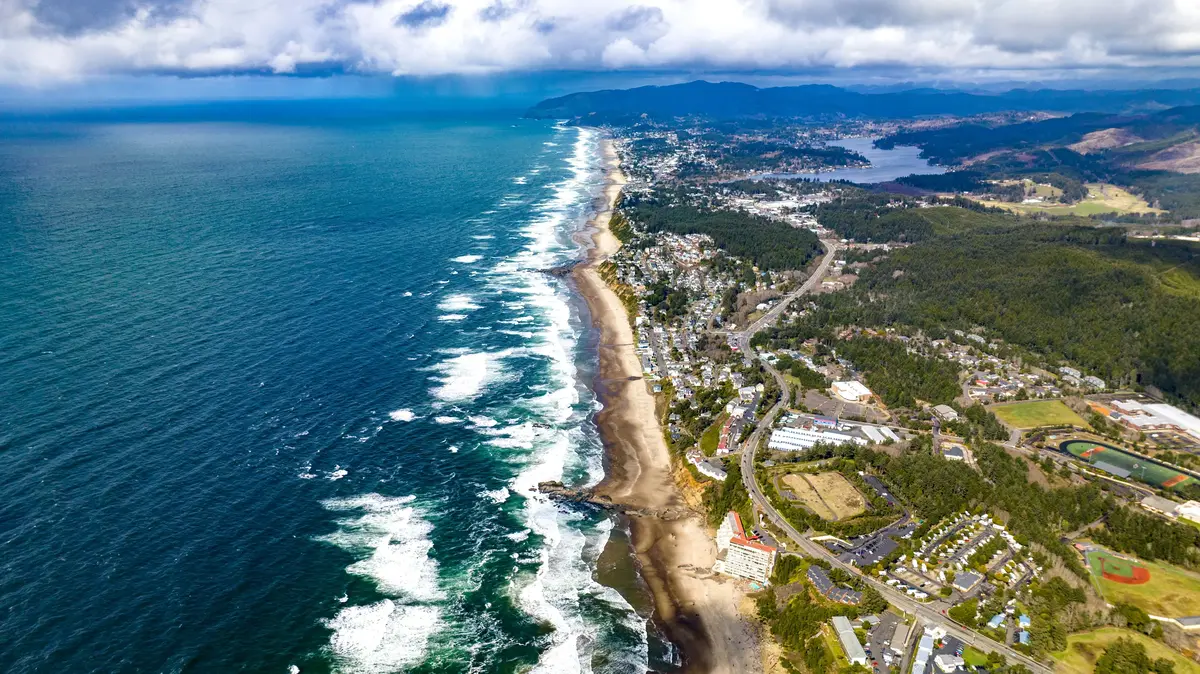
Lincoln City's geography is essentially linear — a narrow coastal strip running north to south along US-101, with neighborhoods stacked along that corridor. Safety conditions follow a recognizable pattern: quieter and more residential at the northern end, more active and commercially dense toward the center and south.
Roads End
Roads End, where US-101 quiets and lots front directly onto beach access, logs the lowest raw crime counts in the city. Violent crimes in available estimates are effectively zero for this neighborhood. The mix of vacation rentals and year-round residents means there are consistent eyes on the street throughout tourist season, which has its own informal deterrent effect. Families and retirees who prioritize quiet and low foot traffic consistently land here. See the neighborhoods guide for the full character breakdown.
Oceanlake and Nelscott
These mid-city neighborhoods sit in the residential core and represent a middle ground in the safety picture. Neither is adjacent to the casino complex or the outlet center, which keeps ambient foot traffic at a manageable level. Long-term residents are well-established here, and the neighborhood character skews toward year-round households rather than transient tourism.
The Central Corridor: Delake and Cutler City
The stretch anchored by the Lincoln City Premium Outlets and Chinook Winds Casino Resort carries the heaviest visitor traffic in the city — and, predictably, the highest incident concentration. This is where the tourism-denominator effect is most pronounced: crimes that happen here get counted against 10,034 residents when the actual crowd is several times that. Residents who live adjacent to these commercial zones are not living inside them; the neighborhoods themselves are more stable than the raw rates suggest. But the visual and logistical exposure to high-traffic activity is real, and worth factoring in if a quieter setting matters to you.
Historic Taft District
Taft sits at the southern end of the city where Siletz Bay meets the Pacific. Its walkable commercial strip and small-town character draw long-term residents who want some on-foot access without the frenetic pace of the central corridor. Its more central position means the crime considerations are different from the quieter northern neighborhoods — not dramatically elevated, but buyers who want the lowest-possible exposure to commercial-zone activity tend to look north rather than south.
Lincoln Palisades and Resort at Bayview
These areas sit at quieter ends of the city's residential spectrum and are generally associated with a lower ambient activity level. Neither anchors the heavy commercial zones, which keeps their day-to-day feel closer to Roads End than to the central corridor.
The honest summary: if a quiet, residential environment with minimal tourist-traffic exposure is your priority, the northern neighborhoods deliver it most consistently. If walkability and proximity to amenities matter more, the central and southern neighborhoods offer that trade-off with a somewhat busier environment attached.

Property Crime in Practice: Vehicle Break-Ins and What Locals Know
Vehicle break-ins are the safety concern Lincoln City residents mention most often. It is not an abstract statistic — it is the thing that comes up in local conversations, on community boards, and in any honest conversation with a long-timer. Locals and visitors alike are consistently advised to lock cars and keep valuables completely out of sight, not just out of reach.
The pattern makes sense in context. A city that draws significant day-tripper and tourist traffic — people who park along US-101 to access the beach, leave bags in the car, and walk away — presents an opportunity that is more visible here than in a purely residential inland town. Trailhead and beach-access parking areas are the most commonly cited locations.
What This Means for Residents
Year-round residents who have internalized the habit — nothing visible in the car, doors locked, always — report that vehicle break-ins become background noise rather than a genuine ongoing threat. It is a behavioral adjustment rather than a fundamental safety concern, but it is one you will make on day one and keep making.
Lincoln City reports a property crime rate of 20 per 1,000 residents, which sits below Oregon's state rate of 24.5 per 1,000, meaning Lincoln City is not an outlier in its coastal peer group on this measure. The vehicle break-in concentration in tourist-facing areas, rather than in residential neighborhoods, tracks with that picture.
A Practical Note on Timing
Summer concentrates visitor traffic and, with it, the incidents that happen in parking lots and along the beachfront. Winter in Lincoln City is a different city entirely — quieter, slower, with a fraction of the transient population. Residents who arrive outside peak season sometimes report a jarring adjustment when their first summer hits and the character of the city shifts around them. It is worth experiencing both before committing to a neighborhood near the commercial core.
Looking to buy in Lincoln City? Estimate your payment.
Enter your numbers to see an estimated monthly mortgage payment.
Estimate only. Excludes HOA fees and mortgage insurance. The interest rate above is a starting point, not a quoted rate — replace it with your own to see real numbers. Insurance is a flat placeholder, not a Lincoln City quote.
Policing and Community Safety Infrastructure
The Lincoln City Police Department organizes its work around four divisions, with the Patrol division deploying directed, crime-analysis-driven patrols and community-oriented policing strategies across the city. The department's stated mission centers on protecting persons and property through close community partnership — language that reflects an approach more common in mid-sized cities than in a town of 10,034.
The LCPD's Community Service Officer program extends department reach in a practical way: CSOs handle minor investigations, parking enforcement, evidence collection, and crime prevention at community and school events without requiring sworn officers for every call. For a department serving a city that swells to several times its resident count in peak season, that kind of tiered coverage matters.
An Honest Look at Staffing
The department has faced staffing pressures that are worth knowing about. In August 2025, the LCPD paused its annual Citizens Police Academy to prioritize patrol coverage, citing the need to manage overtime costs responsibly. That decision reflects a real constraint, not a crisis — departments in coastal resort towns routinely face the challenge of staffing for peak-season demand on a year-round budget. It is a genuine consideration, though not one unique to Lincoln City among Oregon's coastal communities.
For residents, the practical implication is that response times and community-engagement programs can be affected by staffing levels during high-demand periods. That is worth weighing alongside the crime rate figures, not as an alarm, but as an honest piece of the picture.
Community Orientation
Lincoln City's relatively small permanent population means the LCPD operates in a genuinely community-scale environment for most of the year. Officers tend to be recognizable figures in the community in ways that are harder to sustain in larger cities. That character of policing — present, relationship-based, oriented toward problem-solving — is one of the things longtime residents cite when they describe why they stay despite the headline numbers.
Natural Hazards: The Safety Dimension Every Oregon Coast Buyer Must Understand
Crime rates are one dimension of safety. On the Oregon coast, natural hazards are the other — and for Lincoln City, they deserve their own clear-eyed section rather than a footnote.
Two Tsunami Scenarios
Lincoln City faces two distinct tsunami scenarios identified by the Oregon Department of Geology and Mineral Industries (DOGAMI). Distant tsunamis — generated by earthquakes in Japan, Alaska, or elsewhere far from the coast — provide hours of warning, enough time for orderly evacuation. The second scenario is the one that requires more preparation: a local Cascadia Subduction Zone earthquake could generate a tsunami that reaches Lincoln City within 15 to 20 minutes of the triggering event. There is no hours-long warning window in that case.
Oregon emergency officials put the Cascadia Subduction Zone's probability of a major earthquake of magnitude 7.1 or greater at about 37% over the next 50 years. That figure is not meant to be alarming — it is the basis for a planning posture, not a prediction. Every Lincoln City household should know its evacuation route before it needs it.
What the City Has Done
Blue-and-white tsunami evacuation route signs are posted throughout Lincoln County, directing residents toward high ground. The city publishes tsunami evacuation maps, and DOGAMI makes neighborhood-specific inundation maps available for download. Residents and prospective buyers can generate custom maps using the NANOOS web viewer, which lets you enter a specific address and see whether it falls within a projected inundation zone for various earthquake scenarios.
Checking that map before deciding on a neighborhood is not optional for an informed buyer on this stretch of coast. Some parts of Lincoln City — including lower-elevation areas near Siletz Bay and the beachfront — sit within inundation zones for a Cascadia event. Others, on higher ground or further inland, do not. This is exactly the kind of research to do at the neighborhood-selection stage, not after.
Living With the Risk
Long-term Lincoln City residents are generally matter-of-fact about the tsunami risk in the way that Oregonians are matter-of-fact about wildfire and people in the Midwest are about tornadoes. The risk is real, it is documented, and the preparation tools exist. What separates informed residents from unprepared ones is whether they have done the ten minutes of map-checking and evacuation-route planning that the city and DOGAMI have made genuinely easy. For a deeper look at how this factors into neighborhood selection, the neighborhoods guide covers the geographic character of each area.

Local Expert Takeaway: Lincoln City's crime numbers are real, but they are not the whole story. A violent crime rate of 5.1 per 1,000 residents sits above Oregon's state average — that is worth acknowledging — but the same figure gets calculated against a resident base of 10,034 in a city that regularly hosts two to three times that many people. Lincoln City reports a property crime rate of 20 per 1,000 residents, which actually tracks below the state average of 24.5 per 1,000. Where you live within the city matters enormously: Roads End records effectively zero violent crimes in available estimates, while the commercial corridor near the casino and outlets concentrates the activity that drives the city-wide averages up. Vehicle break-ins are the day-to-day concern for residents — a behavioral adjustment (lock everything, leave nothing visible) that most locals make automatically. The Cascadia tsunami risk is the safety dimension that gets less attention in crime-focused conversations and deserves more: check the DOGAMI inundation map for any address you are seriously considering before making a neighborhood decision.
Quick Takeaways & FAQs
✅ Lincoln City reports a property crime rate of 20 per 1,000 residents, which is actually below Oregon's state average of 24.5 per 1,000 — a figure that surprises most people who read the headline numbers first.
⚠️ A violent crime rate of 5.1 per 1,000 residents exceeds both state and national averages, and while the tourism-denominator effect explains part of that gap, it does not explain all of it — it is a genuine consideration for buyers prioritizing the quietest possible environment.
📍 Before settling on a neighborhood, check the DOGAMI tsunami inundation map for your specific address — some parts of Lincoln City sit in projected Cascadia Subduction Zone inundation zones, and others on higher ground do not.
Is Lincoln City, Oregon a safe place to live?
Which neighborhoods in Lincoln City have the lowest crime?
What is the most common crime concern for Lincoln City residents?
Does Lincoln City have a tsunami risk?
How does Lincoln City's crime rate compare to other Oregon coast towns?
Moving to Oregon?
Tell us what you need help with and we'll connect you with local resources.
