
You've done the math on California. Maybe you've been watching coastal property prices climb past what felt reasonable, or maybe you've been working remotely for two years and realized there's no reason to pay California prices for a lifestyle you don't use anymore. Gearhart keeps coming up. It's small — a population of 1,872 — and sits on the North Oregon Coast along US-101, a few miles north of Seaside and roughly 90 miles from Portland. There are no traffic lights in town. The streets are wide enough for bikes. The beach is a walk from nearly every house. It is one of the quietest incorporated towns on the entire West Coast, and that is exactly why people who are done with California noise find their way here.
The financial case for the move has real substance, but it is more nuanced than the headline version. Oregon has no sales tax, which is the clearest and most consistent win for any California buyer. The full cost-of-living picture includes that advantage alongside Oregon's own income tax, which hits six-figure earners harder than you might expect. Gearhart's typical home price of $619,942 (Zillow ZHVI, July 2026) sits noticeably below California's statewide typical home value of $773,735 — and the gap widens considerably when you factor in where most California buyers are actually selling from. The town draws retirees deploying coastal equity, remote workers who want ocean air and a real backyard, and a smaller cohort of locals tied to the hospitality economy of the coast.
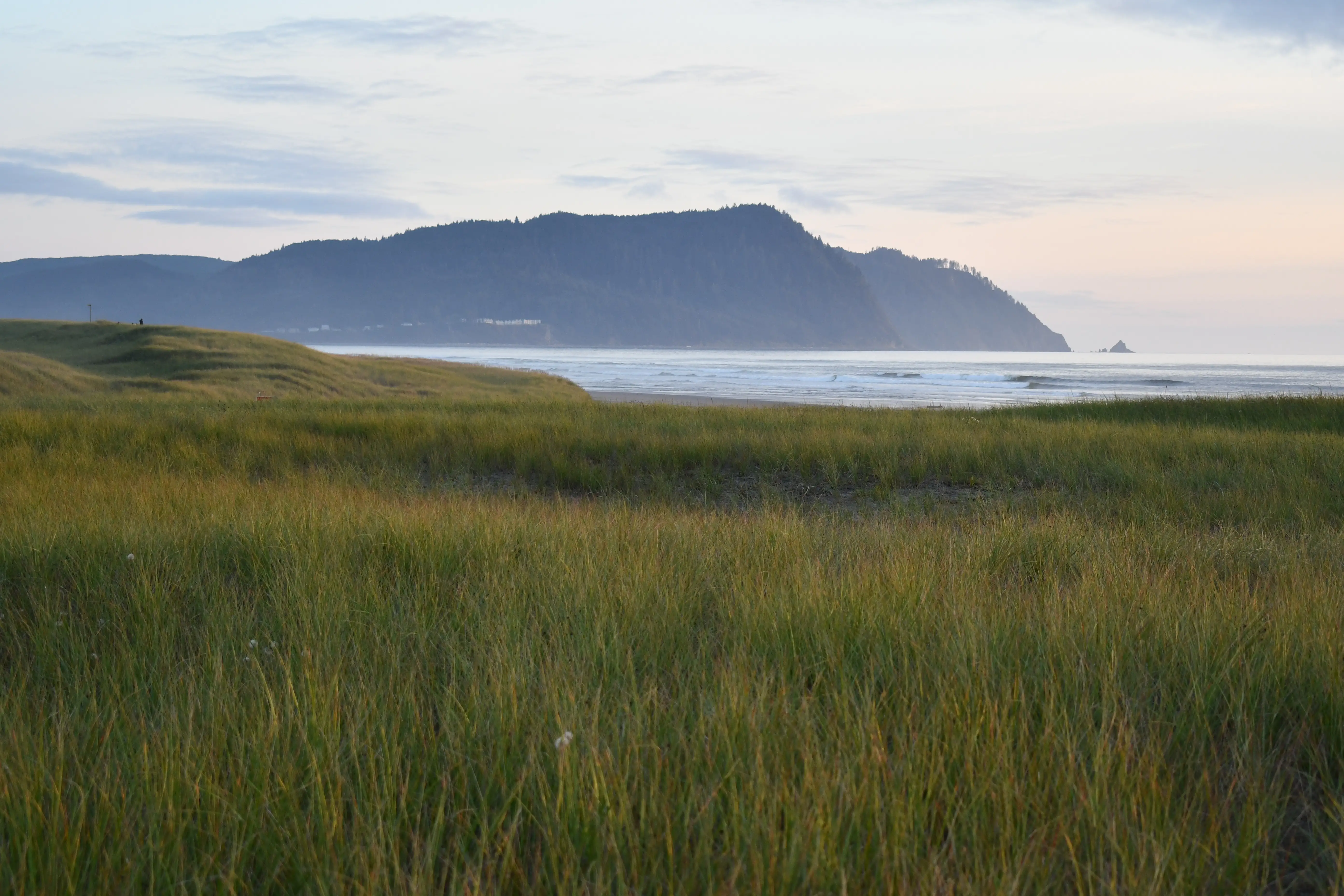
Daily life here runs on a slower clock than California, and that is not a marketing phrase — it is a practical reality. Major grocery chains and urban amenities require a drive. A serious shopping trip means heading to Portland or ordering online. The coast averages around 185 rainy days a year, and the stretch from November through March is overcast by default. Gearhart gets 124 sunny days a year, which is fewer than most California transplants expect. What it offers instead is a town where the Gearhart Golf Links — the oldest golf course in the Pacific Northwest — sits minutes from the water, where the Necanicum Estuary runs along the eastern edge, and where the biggest scheduling conflict on a Tuesday morning is whether to walk Gearhart Beach or the Del Rey Beach State Recreation Site.
Whether you're under contract already or just running the numbers, the sections below break down what Gearhart's home prices and tax picture actually look like for a California buyer, what the lifestyle adjustment genuinely involves, what the schools and local scene offer, and what experienced buyers say they wished they'd known before making the move.
The Home Price Comparison: What Your California Equity Actually Buys
The most important number for a California seller landing in Gearhart isn't Gearhart's price — it's the gap between what you sold for and what you're buying into. Gearhart's typical home price stands at $619,942 (Zillow ZHVI, July 2026). California's statewide typical home value of $773,735 puts the two in the same general tier, which surprises buyers who assumed coastal Oregon would be dramatically cheaper. It's noticeably less expensive, but Gearhart is not a bargain market.
What shifts the calculus is where in California you're coming from. A seller from inland or Central Valley California may find Gearhart prices closer to what they sold. A seller from the Bay Area or coastal Southern California typically arrives with equity that stretches further here than almost anywhere else on the West Coast that has actual ocean access, a functioning town center, and quiet streets.
The housing stock in Gearhart skews upscale relative to its size. The Highlands at Gearhart and Pinehurst Estates draw buyers who want larger lots and golf-oriented settings. Gearhart East and Shamrock Pines offer more modest older construction. West Gearhart and Del Rey Beach sit closest to the water and price accordingly. For a detailed look at what each neighborhood actually offers, the neighborhoods guide covers the character of each area without the guesswork.
What the Entry Points Look Like
Gearhart's range is meaningful. Smaller homes and older construction can come in below the typical figure; ocean-view properties, gated communities, and newer builds push well above it. The town's concentration of upscale inventory means there are fewer true entry-level options here than in nearby Seaside, which prices noticeably lower. Cannon Beach, to the south, prices noticeably higher than Gearhart — which is useful context if you've been browsing the whole Oregon Coast.
Warrenton, to the north, prices noticeably lower and offers more practical day-to-day retail access, but lacks Gearhart's beach-town character. Most California buyers who are serious about Gearhart have already ruled out both — Gearhart's specific combination of quiet, golf, and beach proximity is what they're paying for, and the market reflects it.
| Factor | California | Gearhart, OR |
|---|---|---|
| Typical Home Value | California's statewide typical home value of $773,735 | $619,942 (Zillow ZHVI, July 2026) |
| Property Tax Rate (effective) | California's effective property tax rate of 0.71% (statewide avg); new buyers often pay 1.1%–1.3% under Prop 13 + local bonds | 0.71% effective rate; capped growth under Oregon Measure 50 |
| Sales Tax | California's statewide base sales tax rate of 7.25% (avg combined ~8.99%) | None — Oregon has no sales tax |
| State Income Tax (top rate) | California's top state income tax rate of 13.3% | 4.75%–9.9%; compressed brackets hit six-figure earners hard |
| Social Security Taxed? | Not taxed at state level | Not taxed at state level |
| Federal Tax Subtraction | Not available | Available; phases out above ~$290K joint AGI |
* California property tax rate for new buyers reflects Proposition 13 base plus typical voter-approved bond additions. Oregon rate reflects Measure 50 assessed-value cap of 3% annual growth after purchase.
The Tax Picture: Where Oregon Wins and Where It Doesn't
The sales tax elimination is the clearest financial win for any California buyer moving to Gearhart. Oregon is one of only five states with zero sales tax. California's statewide base sales tax rate of 7.25% — with local additions pushing the combined average to roughly 8.99% — means a household spending meaningfully on taxable goods every year has been quietly subsidizing that difference for a long time. That stops the day you become an Oregon resident.
Income tax is more complicated, and this is the part California buyers most often get wrong. The assumption is that leaving California — with California's top state income tax rate of 13.3% — automatically means a lower income tax bill. California's top state income tax rate of 13.3% applies only to the highest earners. Oregon's top rate of 9.9% sounds lower, but Oregon's brackets are steeply compressed: the state collects near its maximum rate from anyone earning six figures. A California household earning $150,000 may find their Oregon income tax bill higher than their California one was, because California reserves its upper rates for incomes far beyond that level.
The Offset That Matters
Oregon offers one meaningful offset that California does not: residents can subtract a portion of their federal income taxes paid from Oregon taxable income. This directly reduces what Oregon taxes. The benefit phases out for joint filers with federal adjusted gross income above $290,000, so it helps middle-income earners most and disappears entirely for high earners.
Retirees have a cleaner story. Oregon does not tax Social Security benefits at the state level — the same treatment California provides. But pension distributions, IRA and 401(k) withdrawals, and investment income that remained subject to California's higher rates on a large California income get taxed at Oregon's lower effective rates instead. For a retiree drawing from a combination of those sources, the move to Gearhart can represent a genuine reduction in annual state tax liability. For a remote worker earning a strong tech salary, run the numbers with an Oregon CPA before assuming the same.
Property Tax: More Familiar Than You'd Think
Gearhart's effective property tax rate of 0.71% will feel familiar to California buyers, because California's effective property tax rate of 0.71% is essentially the same statewide average figure. The difference shows up for buyers purchasing at current market prices in California: under Proposition 13, the base rate is 1% of assessed value at purchase, and most California jurisdictions layer voter-approved local bonds on top, pushing new-buyer effective rates to roughly 1.1%–1.3% of assessed value. Oregon's Measure 50 caps annual assessed-value growth at 3% per year after purchase — a structure California buyers will recognize as similar to Prop 13's 2% cap, and similarly rewarding for buyers who intend to stay.

The Lifestyle Adjustment: What No One Tells You in Month Three
Most California transplants spend their first few weeks in Gearhart describing it as peaceful. By month three, some of them start describing it as quiet in a way that has more edge to it. Gearhart has a population of 1,872. There is one grocery option in the town center and a handful of independent shops and restaurants. The dining and coffee scene is real — McMenamins Gearhart Hotel, Grandma's Corner Restaurant, El Trio Loco, McMenamins Sand Trap Pub, Prep Kitchen Deli & Catering, King Tide Bakery, and By The Way all hold their own — but when you've exhausted the local options, the next step is Seaside, and after that it's Portland, about 95 minutes away.
The rain is the other adjustment nobody fully prices in from California. The North Oregon Coast averages around 185 rainy days a year. November through March is overcast by default, and Gearhart gets 124 sunny days a year — considerably fewer than even the cloudier parts of California. Buyers who move here without spending a January or February on the coast first sometimes find the winter harder than they expected.
What the Town Actually Is
Gearhart has no traffic lights. The streets are wide enough for bikes and built to a pace that matches that. Gearhart Beach and the Del Rey Beach State Recreation Site are accessible on foot from most of the town, and the Necanicum Estuary runs along the eastern edge for kayaking and bird-watching. The Gearhart Golf Links — the oldest golf course in the Pacific Northwest — is central to the town's social fabric in a way that goes beyond the sport: it's where people see each other.
The resident mix skews toward retirees and remote workers, with a smaller population of locals tied to the hospitality economy. That demographic reality shapes the social scene. Gearhart is not a starter-family town in the way that inland Oregon cities are. It's a town where people have made a deliberate choice about how they want to live, and the community reflects that intentionality.
What You Give Up
A serious shopping run means driving out of town. Specialist care and advanced treatment require a drive as well — health insurance premiums run noticeably below California levels, though you will travel farther for specialist appointments. The parks and recreation guide covers the outdoor options in detail, but the broader point is that Gearhart's amenities are natural rather than commercial. If a restaurant-dense, walkable urban core is part of your daily routine, Gearhart will disappoint. If what you want is the beach two blocks away and the golf course around the corner, you will not find a closer equivalent on the entire Oregon Coast.
Looking to buy in Gearhart? Estimate your payment.
Enter your numbers to see an estimated monthly mortgage payment.
Estimate only. Excludes HOA fees and mortgage insurance. The interest rate above is a starting point, not a quoted rate — replace it with your own to see real numbers. Insurance is a flat placeholder, not a Gearhart quote.
Schools, Neighbors, and What the Community Is Actually Like
Gearhart is served by the Seaside School District 10, which holds a C+ rating, according to Niche. On 2024-25 state assessments, 27.6% of students reached math proficiency and 44% reached reading proficiency — numbers that are below Oregon state averages and worth knowing honestly. The district has 1,425 students enrolled in 2025-26, which gives it a genuinely small-district character. The district's athletics programs are active and the community turns out for Friday night events in the way that small coastal towns do. For a full look at the schools picture, the schools guide covers the district in detail.
Families with school-age children moving from strong California school districts should enter with clear eyes on the academic performance data. Gearhart is a town where the school district is adequate and the community is engaged, but it is not a town people move to for the schools. It is a town people move to for the beach, the quiet, and the tax environment — and then figure out schooling from there, sometimes including private options in Seaside or Astoria.
Who Your Neighbors Will Be
The community skews older. Retirees from California and Portland make up a significant portion of recent buyers. Remote workers — particularly those in tech and professional services who no longer have a reason to pay for proximity to an office — have become a growing presence. The median household income of $85,682 reflects a mix of higher-earning remote workers and retirees drawing from investments, alongside locals working in the coast's service economy.
No 55+ communities were found in Gearhart, but the town's character suits that life stage naturally: low traffic, accessible beach walks, a golf course, and a social scene that doesn't require nightlife. The retiring in Gearhart guide covers the retiree picture more fully, including healthcare access and what downsizing into a coastal home actually involves financially.
The Migration Context
Gearhart is not the only destination for California transplants — Oregon as a whole ranked first for inbound moves in 2025, according to United Van Lines' National Movers Study, with 65% of moves into the state being inbound. California was the single largest source of new Oregon residents in 2024. In a town of under 2,000 people, that statewide trend concentrates quickly: it is genuinely common to meet neighbors who sold in the Bay Area or Southern California and deployed that equity into a Gearhart beach house, often mortgage-free or close to it.
Making the Decision: What Experienced California Buyers Say
The buyers who feel best about the move tend to share a few things. They spent time in Gearhart in the winter before committing — not just a summer weekend when the coast is at its best. They ran their income tax numbers with an Oregon CPA before assuming the move was a tax win across the board. And they were honest with themselves about how often they actually used the urban amenities in California that they'd be giving up.
The buyers who struggle tend to underestimate the distance. About 95 minutes to Portland is the drive when the coast and the city both need to happen in the same week. That works fine for occasional trips. If your work, your doctors, your family, or your social life is in Portland or beyond, the drive becomes the cost of living here — and it matters more than any tax calculation.
The Financial Case, Summarized
Oregon's zero sales tax is real, consistent, and immediate. The property tax rate is comparable to what California buyers have been paying at the statewide average, and Oregon's Measure 50 cap provides long-term predictability similar to Proposition 13. The income tax trade-off is real and worth computing, not assuming. Retirees drawing from retirement accounts typically come out ahead. Six-figure remote workers in Oregon's steep bracket structure may not.
The price gap between Gearhart's $619,942 typical home (Zillow ZHVI, July 2026) and California's statewide typical home value of $773,735 is meaningful but not transformative on its own. What makes the math work for most California buyers is the equity they're bringing — the gap between what they sold and what they're buying. That gap, invested or carried mortgage-free, is what makes Gearhart feel affordable in a way the raw price comparison doesn't fully capture.
The One Thing to Do Before You Make an Offer
Drive US-101 in February. Not the coastal highway in July when the light is gold and the traffic is manageable — in February, when the rain is horizontal and the drive from Portland takes longer than the GPS says. If you step out of the car in Gearhart and feel settled rather than stranded, you will do well here. That gut check is worth more than any spreadsheet, and it's the one thing almost no out-of-state buyer does before signing. The living in Gearhart guide covers the day-to-day reality of the town in more depth for buyers still in the research phase.

Local Expert Takeaway: Gearhart rewards California buyers who arrive with real equity, a realistic read on Oregon's income tax brackets, and a genuine appetite for coastal quiet. The sales tax elimination is immediate and consistent. The property tax rate is essentially what California buyers have been paying. The income tax picture depends entirely on your income source and level — retirees drawing from retirement accounts generally come out ahead, while high-earning remote workers should model it before assuming a win. The beach, the Golf Links, and a town with no traffic lights are what you're actually buying. If that trade is what you want, Gearhart is one of the few places on the West Coast where it's still possible to make it.
Quick Takeaways & FAQs
✅ Oregon has zero sales tax — the clearest and most immediate financial win for any California buyer moving to Gearhart.
⚠️ Oregon's income tax brackets are steeply compressed, hitting six-figure earners near the top rate — don't assume leaving California automatically means a lower income tax bill.
📍 Gearhart has no traffic lights and gets 124 sunny days a year; plan a winter visit before buying, because November through March is the real test of whether coastal quiet suits you.
Is Gearhart actually cheaper than California for housing?
What happens to my income taxes when I move from California to Oregon?
How does Oregon's property tax compare to what I was paying in California?
What is the biggest lifestyle adjustment Californians make when moving to Gearhart?
What are the schools like in Gearhart for families moving from California?
Moving to Oregon?
Tell us what you need help with and we'll connect you with local resources.
