
Maybe you've priced yourself out of Portland, or a grown child moved to the Salem area and you followed the map west. Maybe you've just spent a week in the Willamette Valley and the pace felt right. Dallas, Oregon — population 17,531 — sits on the valley's western edge, where the flat farmland starts to fold into the Coast Range foothills. OR-223 carries most of the traffic. Salem is about 20 minutes away by car, which means a full regional hospital system, a Costco run, and a commercial airport are all reachable on a Tuesday morning without it feeling like an expedition. That access is the single most important thing to understand about retiring here.
Dallas is a working-class Willamette Valley city, not a resort town or a college-town retirement magnet. The Dallas School District, Polk County government, the city itself, West Valley Hospital, and Walmart anchor the local economy. That mix keeps the community grounded and the cost of living moderate — the typical home price sits at $481,280 (Zillow Home Value Index, July 2026), which is noticeably below what Salem commands and dramatically below Portland. Retirees who move here tend to be drawn by exactly that affordability, plus the quiet: 17,531 people, a genuine downtown historic district, and vineyards in the surrounding Eola-Amity Hills just beyond the city limits.
On a fixed income, the Oregon tax picture matters as much as the home price. Oregon does not tax Social Security benefits at any income level, the effective property tax rate here runs approximately 0.82%, and the state's income-qualified property tax deferral program gives qualifying seniors a meaningful safety valve. Daily costs — groceries, gas, dining — run at small-city Oregon prices, which means cheaper than the Portland metro but not dramatically different from Salem. For the full cost-of-living picture, see the cost of living in Dallas page.
Whether you're considering a move or just running the numbers, the sections below cover healthcare access, the retiree tax picture, what staying active actually looks like, downsizing options, and how Dallas stacks up against the other Willamette Valley towns on a retiree's short list.

Why Retirees Are Choosing Dallas
The case for Dallas starts with price and proximity in the same sentence. At a typical home price of $481,280 (Zillow Home Value Index, July 2026), buyers coming from the Portland suburbs or the California coast find equity left over after the purchase — equity that can fund a decade of travel, home upgrades, or simply a more comfortable cash cushion. Combined with about 20 minutes to Salem, that price point represents something genuinely rare in western Oregon: a town small enough to feel like a community and close enough to a city to feel safe.
The retirees who thrive here tend to be self-sufficient drivers who value quiet over walkable density, are comfortable with a small-town dining and shopping scene, and prioritize proximity to nature over proximity to a theater district. The Eola-Amity Hills wine country sits practically at the city's edge. The 2,492-acre Baskett Slough National Wildlife Refuge — with roughly 5 miles of trail through wetlands, oak forest, and upland prairie — is the kind of place you can visit twice a week and see something different each time. The Dallas Downtown Historic District and the Polk County Historical Museum give the city a sense of place without requiring a car to reach.
The honest caveat: if your retirement vision depends on walkable errands, a dense café culture, or proximity to advanced specialty medical care beyond what a critical access hospital provides, Dallas will disappoint. The city has 156 sunny days a year — valley gray dominates the winter — and the dining and shopping options are those of a mid-sized Oregon county seat, not a destination. Retirees who want a vibrant arts scene or a large peer social network will find Salem or Corvallis a better fit. Dallas suits people who have already made peace with small-town Oregon and see the valley's pace as the point, not a compromise.
Healthcare & Medical Access in Dallas
West Valley Hospital — part of the Salem Health system — sits inside Dallas city limits, making it the nearest hospital and the only hospital in Polk County. It has served the community for more than 100 years and houses Polk County's only 24-hour emergency department. For a city of 17,531, that is a meaningful asset: you are not driving 20 minutes to reach an ER.
The hospital operates as a critical access hospital, which is the designation the federal government gives to rural facilities that maintain emergency and inpatient capacity that would otherwise disappear. In practical terms, that means West Valley Hospital handles the things a retiree actually encounters most: imaging, general surgery, rehabilitation, a skilled nursing and transitional care unit on site. The specialty clinic program reaches further than most critical access facilities — cataract surgery, glaucoma management, knee replacement, urology, and a general surgery program that covers colonoscopy, hernia repair, and cancer-related procedures. For routine and moderately complex care, most retirees will not need to leave town.
Where the honest distance reality bites is in advanced specialty care. Cardiac surgery, oncology treatment programs, neurology, and complex orthopedic reconstruction belong to the Salem Health main campus, about 20 minutes east. That drive is not a crisis — it is what living in a smaller city means — but retirees managing a serious chronic condition should plan their care around Salem rather than assuming everything they need is locally available. The gap is real; knowing it in advance means it stays manageable.
The on-site skilled nursing and transitional care program at West Valley Hospital matters more than most retirees initially think. Post-surgical recovery and short-term rehabilitation without a hospital transfer is a genuine quality-of-life advantage, and it is not something every community this size can offer.

The Retiree Budget in Dallas
Oregon's treatment of retirement income is one of the better-kept secrets in the Pacific Northwest. Social Security is entirely exempt from Oregon state income tax, regardless of how much you receive. Seniors 65 or older receive an additional standard deduction on the state return. Those 62 or older receiving taxable retirement income — pension distributions, IRA withdrawals — may qualify for Oregon's retirement income credit, which reduces the tax bite further. The net result is that a retiree living primarily on Social Security pays no Oregon income tax on that income at all.
The effective property tax rate on a Dallas home runs approximately 0.82%, which sits well below what most West Coast cities charge. Oregon also runs an income-qualified senior property tax deferral program worth understanding: homeowners age 62 or older who fall below the income threshold can defer their property taxes entirely — the state pays on their behalf, and the deferred amount accrues at 6% simple interest until the home is sold or passes to heirs. Dallas's median household income of $71,549 means many retirees drawing primarily on Social Security and modest investment income will land below the qualifying threshold, depending on how their income is structured. If you're near the line, the composition of your income — what counts as taxable versus exempt — is worth reviewing with a tax professional before you assume you do or don't qualify.
One bill worth watching: Oregon's 2025 legislative session introduced House Bill 3755, which would create an escalating property tax exemption for qualifying senior homeowners. Check current status with the Oregon Legislature before making it part of your planning.
On the daily cost side, groceries, gas, and services in Dallas run at standard small-city Oregon prices — meaningfully below the Portland metro, broadly comparable to Salem. Oregon has no statewide sales tax, which adds up over a year of purchases. The engine's calculator below can help you model what a purchase at Dallas's typical price level looks like month to month at current rates. For the full tax and utility picture, see the cost of living in Dallas page.
Looking to buy in Dallas? Estimate your payment.
Enter your numbers to see an estimated monthly mortgage payment.
Estimate only. Excludes HOA fees and mortgage insurance. The interest rate above is a starting point, not a quoted rate — replace it with your own to see real numbers. Insurance is a flat placeholder, not a Dallas quote.
Walkability, Community & Staying Active in Dallas
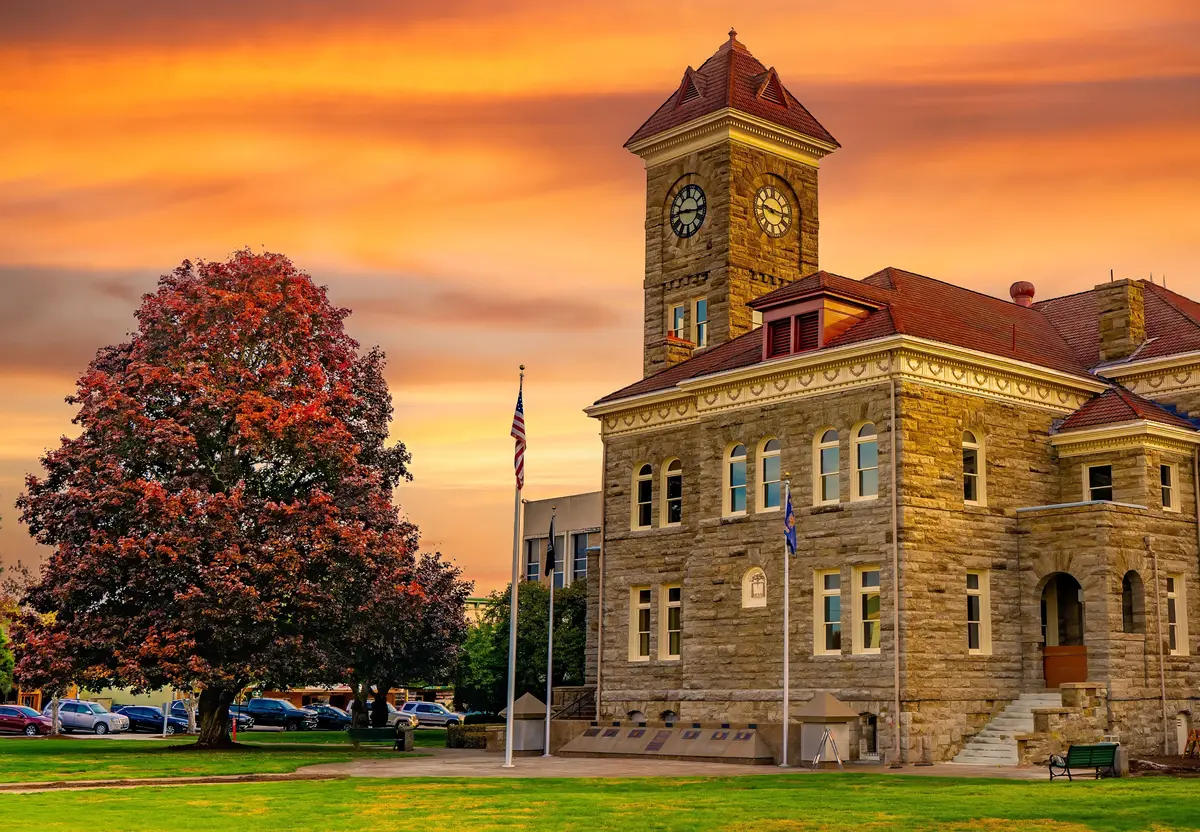
Dallas is a car-dependent small city, and the honest framing matters: most errands require driving. The downtown historic district is compact and genuinely walkable once you are in it — the Polk County Courthouse, the Polk County Historical Museum, and the main-street commercial corridor sit within easy walking distance of each other — but reaching a grocery store or pharmacy from most residential neighborhoods means getting in the car. If car-free retirement is the goal, Dallas is not the right answer.
For retirees who drive, the active-outdoor picture is surprisingly good. The Rickreall Creek Trail runs through the city and gives you a low-impact, paved walking option that doesn't require a trailhead drive. Dallas City Park is the community's social anchor — the kind of place where people show up on a dry afternoon without a specific reason. Just outside the city, Baskett Slough National Wildlife Refuge offers roughly 5 miles of trail through some of the most varied bird habitat in the Willamette Valley; over 250 species have been recorded there, and the refuge draws serious birders from across the region. The surrounding Eola-Amity Hills wine country adds a leisure layer — an afternoon visiting vineyards is the kind of retirement activity that doesn't feel like exercise but is.
The city's social infrastructure is that of a working Oregon county seat: community events centered on the downtown historic district, local service organizations, and the kind of neighbor-to-neighboring that happens naturally when 17,531 people share a small geography. Dallas Retirement Village — a non-profit continuing care retirement community that has operated for more than 75 years — runs social programming through its 25,500 square foot Lodge amenity center, including fitness classes and hobby groups, that extends beyond its own residents to the broader community in ways worth exploring.
One thing newcomers from larger cities underestimate: the social life here is what you build, not what you stumble into. Volunteering with Polk County, attending events at the Polk County Historical Museum, or becoming a regular at Karma Coffee Bar and Bakery or Brooks & Terry's Espresso are how people actually connect here. The crowd at Washington Street Steakhouse on a weekend evening or a morning at Tater's Cafe will introduce you to more long-term Dallas residents than any newcomer meet-up.
Right-Sizing: Downsizing in Dallas
The downsizing calculus in Dallas is different from what retirees face in Portland or Salem. At a typical home price of $481,280 (Zillow Home Value Index, July 2026), entry-level single-level homes are accessible to buyers who have built equity in a larger market — but the inventory of purpose-built retirement-friendly housing is limited relative to what larger cities offer. Single-level ranch homes exist throughout neighborhoods like Sunrise Meadows and Forest Ridge, but they move and the pool isn't deep. If single-level living is a firm requirement, patience is part of the process.
For age-restricted communities specifically, Dallas has two: Ceres Gleann and Eden Gleann. Both are the 55+ options in the city; neither should be confused with the continuing care model that Dallas Retirement Village operates under. Ceres Gleann and Eden Gleann serve the active-adult buyer who wants age-restricted community living without the full continuum-of-care structure.
Dallas Retirement Village occupies a different category entirely. As a non-profit Life Plan Community that has operated for more than 75 years, it offers the full spectrum under one roof: independent living, assisted living, memory care, and skilled nursing. The Lodge — a 25,500 square foot wellness and amenity center — anchors the community's social programming. Accommodations run from studio units through three-bedroom apartments, with utilities included. For retirees who want to make one housing decision that covers them through potential future care needs, this is the relevant option in Dallas.
The rental side gives flexibility before committing. A two-bedroom in Dallas runs in the $1,440–$1,760 range, which gives someone relocating from out of state a way to spend a year in the city before deciding whether to buy. That strategy makes particular sense in a market where the single-level inventory is thin — renting buys time to find the right property rather than settling for the first available option.
One realistic friction point: the gap between Dallas's median household income and the income needed to comfortably carry the typical home price here is real, and it affects what's available at the entry level. For a more detailed look at neighborhood character and housing stock by area, the neighborhoods page covers the full picture.
Dallas vs Nearby Retirement Destinations
Before committing to Dallas, it's worth understanding how it stacks up against the other towns on a Willamette Valley retiree's list. The table below uses Dallas as the anchor and compares it against the most relevant nearby options.
| City | Cost vs Dallas | Primary Hospital | Walkability | Senior Living Depth | Overall Retirement Fit |
|---|---|---|---|---|---|
| Dallas, OR | Anchor | West Valley Hospital (Salem Health) — in city, 24-hr ER | Car-dependent; walkable downtown core | Dallas Retirement Village (CCRC), Ceres Gleann, Eden Gleann | Strong for budget-conscious, nature-oriented retirees |
| Salem | Noticeably pricier | Salem Health main campus — full regional system | More walkable; transit options available | Multiple CCRCs, assisted living, active-adult communities | Better for medical-complex needs or walkable-density preference |
| Monmouth | About the same | Relies on Salem or Dallas for hospital care | Small college-town core; mostly car-dependent | Limited; smaller market | Good for university-adjacent culture; less senior infrastructure |
| Independence | Somewhat lower | Relies on Salem for hospital care | Compact downtown; Riverview park access | Limited options | Appealing entry price; quieter than Dallas; thinner services |
| Rickreall | Somewhat lower | Rural; relies on Dallas or Salem | Minimal — rural crossroads | Very limited | Rural lifestyle only; not suited to retirees needing services |
| Falls City | Generally lower | Rural; relies on Dallas or Salem | Very limited | Very limited | Deepest rural feel in the area; suited to self-sufficient retirees only |
Salem is the straightforward upgrade on nearly every axis — more complete hospital system, deeper senior living inventory, more transit and on-foot access — but it costs noticeably more to buy in, and the city scale comes with city noise and city traffic.
Monmouth's college-town atmosphere appeals to retirees who want lectures, arts programming, and a younger energy in the surrounding community, but it offers less senior infrastructure than Dallas. Independence comes in at a somewhat lower price point and has a pleasant small-town riverfront feel, though the compromise is even thinner services and no local hospital at all.
Rickreall and Falls City are for retirees who want genuine rural Oregon — quiet roads, larger lots, and a pace that makes Dallas feel metropolitan. Both lean heavily on Dallas or Salem for anything beyond the most basic services, which works only if driving is not a constraint.
For most retirees weighing this specific corner of the valley, the real decision is Dallas versus Salem: whether the cost savings and the small-town pace justify the thinner local amenities and the 20-minute gap to the full regional hospital system. That gap is the honest trade-off, and it is the right question to ask before making an offer.
Local Expert Takeaway: Dallas, Oregon rewards retirees who go in clear-eyed: a modest home price, a hospital inside city limits, no state tax on Social Security, and wine country practically at the edge of town — but you will need a car for almost everything, winter gray is the default setting for months at a time, and advanced specialty care means a drive to Salem. The retirees who love it here are the ones who wanted a real small town in the Willamette Valley, not a suburb that happens to be affordable. Dallas Retirement Village, Ceres Gleann, and Eden Gleann give you meaningful housing options within the city itself. If that picture fits, this is one of the more affordable and genuinely well-served small cities left in western Oregon.
Quick Takeaways & FAQs
✅ West Valley Hospital sits inside Dallas city limits and is the only 24-hour emergency department in Polk County — a meaningful advantage for a city this size.
⚠️ Oregon does not tax Social Security at any income level, but the state's income-qualified property tax deferral program has an income threshold that some Dallas retirees will fall just above, depending on how their retirement income is structured.
📍 The Baskett Slough National Wildlife Refuge — a 2,492-acre federal refuge with roughly 5 miles of trail and over 250 recorded bird species — sits just outside Dallas and is the outdoor anchor most active retirees here end up using at least weekly.
Is Dallas, Oregon a good place to retire on Social Security?
What hospital serves Dallas, Oregon retirees?
Does Oregon have a property tax break for seniors?
What 55+ and senior living communities are in Dallas, Oregon?
How does Dallas, Oregon compare to Salem for retirement?
Moving to Oregon?
Tell us what you need help with and we'll connect you with local resources.
