
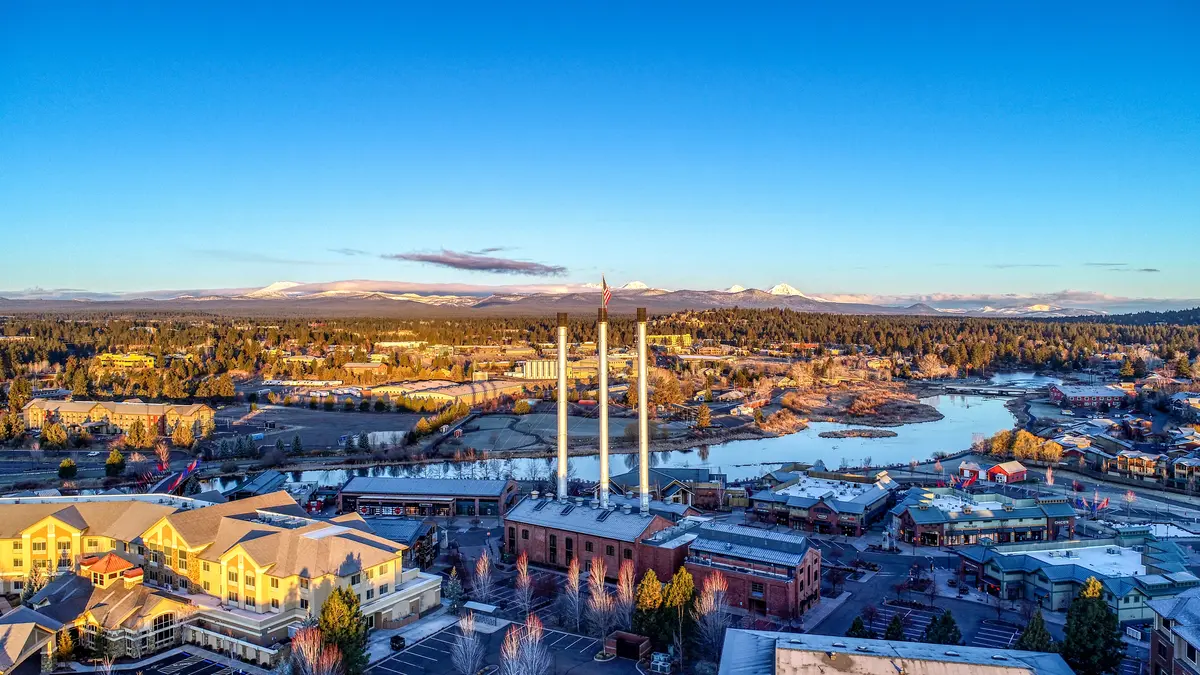
Maybe you've been watching Bend from a distance — reading about the Deschutes River, the 162 sunny days a year, the mountain bike trails and the brewery scene — and wondering whether it's a retirement fantasy or a practical reality. The honest answer is: it depends on your financial position. Bend's typical home price sat at $732,894 in July 2026, which puts it well above what most Oregon retirees moving from smaller towns expect. It is a genuinely desirable place to spend the second half of life, and it prices like one. The Cascade Range frames the western skyline, US-97 carries you north toward Portland or south toward California, and a city of 106,926 people gives you the amenities of a real regional hub without the congestion of a metro.
What actually drives retirement life here is St. Charles Health System, which functions as both the city's medical anchor and its largest employer. Having Oregon's only Level II Trauma Center east of the Cascades inside city limits is not a minor detail for a retiree weighing healthcare access — it is, for many, the deciding factor. The Bend-La Pine School District, the college, Deschutes County government, and the city itself round out the employment ecosystem, and that stable institutional base keeps the local economy from boom-bust volatility. Retirees come for the outdoors and the healthcare and tend to stay because the social fabric around those two things is genuinely strong.
Oregon's no-sales-tax environment means every grocery run, hardware purchase, and restaurant meal costs less than it would across the border in Idaho or Washington. Social Security income is fully exempt from Oregon income tax, which matters for the majority of retirees whose monthly check anchors their budget. The catch is that pension and IRA withdrawals face Oregon's regular income-tax rates, which climb steeply, and housing costs are real. For a fuller picture of daily costs, the cost of living page breaks down utilities, groceries, and the tax picture in depth.
Whether you're considering a move or just stress-testing the idea, the sections below cover Bend's retirement fit, healthcare access, the retiree budget, walkability and community, downsizing options, and how Bend compares to nearby retirement destinations across Central Oregon.

Why Retirees Are Choosing Bend
The retirees who land in Bend and never look back tend to share a profile: they want outdoor access that remains genuinely usable into their seventies, they want a medical system they can trust, and they have enough financial cushion that a $732,894 typical home price (July 2026) doesn't require a financial miracle to manage. Many arrive from the Bay Area or Southern California, having sold a home at a price that makes Bend feel almost affordable by comparison. Others have been in Central Oregon for decades and are right-sizing from a larger property. Both groups find a city that takes active living seriously in a way most retirement destinations don't.
Bend genuinely rewards the retiree who stays active. The Deschutes River Trail runs through the heart of the city. Pilot Butte is a short drive or a strenuous walk that earns a 360-degree view of the Cascade peaks. Smith Rock State Park sits close enough for a regular morning outing. The social infrastructure around these places — the clubs, the guided hikes, the paddleboard rentals — is built for adults who intend to keep moving, not just look at mountains from a patio. For those reasons, Bend draws retirees who are young at the time they move and tend to age well in place.
The retiree for whom Bend is the wrong call is usually the one who underestimates the car-dependence. Most daily errands require a vehicle, winters bring genuine cold and ice, and the altitude — Bend sits at roughly 3,600 feet — affects some people more than they expect in the first year. Budget-constrained retirees whose income is mostly pension or IRA withdrawals face Oregon's income tax at rates that can reach 9.9%, and housing costs leave little margin for error on a tight fixed income. For them, La Pine or Prineville may deliver a more comfortable financial cushion without sacrificing the Central Oregon setting.
Healthcare & Medical Access in Bend
St. Charles Health System is the healthcare story in Bend, and it is a genuinely good one for a city this size. Headquartered in Bend, the system operates four hospitals and more than 40 outpatient clinics across Central Oregon, with more than 5,600 caregivers. The Bend medical center holds the distinction of being Oregon's only Level II Trauma Center east of the Cascades — which means that if something serious happens, you are not immediately airlifted to Portland. Both the Bend and Redmond campuses are accredited by The Joint Commission.
For routine and specialty care, the depth is real. Cardiology, orthopedics, oncology, and neurology all have dedicated programs in Bend, which is meaningful when you consider that most cities of comparable size in the Mountain West send specialty cases to a much larger metro. Where Bend reaches its limit is in the most complex tertiary procedures — organ transplants, certain cancer protocols, advanced cardiac surgery. For those, Oregon Health & Science University in Portland remains the referral destination, and the drive over the Cascades is subject to winter closures on the mountain passes. Retirees with pre-existing complex conditions should build that reality into their planning.
The Medicare Advantage picture deserves close attention. St. Charles dropped Humana, HealthNet, and WellCare from its network beginning in 2024, affecting thousands of seniors in Central Oregon. Plans that remained in-network at St. Charles as of that change included Providence, PacificSource, Regence Blue Cross, and Moda. Traditional Medicare paired with a Medigap supplement and a Part D drug plan remains an option that sidesteps network concerns entirely. Network arrangements change, and open enrollment decisions here carry more consequence than in a city with multiple competing health systems — verify your plan's status directly with St. Charles before you enroll or move.
Cascades East Transit's Dial-A-Ride paratransit service covers qualifying seniors within Bend city limits, and fixed-route buses connect the Old Mill District, NorthWest Crossing, and St. Charles Medical Center. For retirees who reach a point where driving is no longer practical, that connection to the hospital is not nothing — though Bend's overall car-dependence means transit should be a supplement, not a primary plan.
The Retiree Budget in Bend
Oregon's tax treatment of retirement income is genuinely split. Social Security and Railroad Retirement benefits are fully exempt from Oregon income tax — the exemption applies regardless of how high your other income climbs, which is the right kind of unconditional. That is the good news for the majority of retirees whose Social Security check is their largest monthly income source. The harder news is that pension distributions, IRA withdrawals, and 401(k) income face Oregon's regular graduated rates, which start at 4.75% and rise to 9.9% at the top bracket. There is no general retirement-income exclusion to soften that.
Oregon also levies an estate transfer tax on estates valued at $1,000,000 or more, at graduated rates from 10% to 16%. The threshold has not been indexed to inflation since 2012, which means a Bend home purchased decades ago — or any appreciated real estate — can push an estate over the threshold even when it would escape the federal estate tax entirely. Retirees with significant property equity should discuss this with an estate planning attorney before they finalize their move.
On the positive side of the ledger, Oregon has no statewide sales tax, which produces real daily savings on groceries, household goods, and services. The effective property tax rate in Bend is approximately 0.60% — among the lower rates in the western United States — and Oregon offers a property tax deferral program for homeowners aged 62 and older who meet income thresholds. Under that program, the state pays the county property taxes each year, with repayment triggered only when the home is sold or transferred. For retirees who are asset-rich but cash-flow-constrained, it is a meaningful tool worth applying for early. For a full breakdown of taxes and daily living costs, see the cost of living in Bend page.
Redmond Municipal Airport (RDM), about 17 miles from Bend, offers nonstop service to Portland, Seattle, San Francisco, Los Angeles, Denver, and Phoenix. For retirees visiting family across the West, that connectivity is a practical quality-of-life factor that a more isolated Central Oregon location cannot match.
Looking to buy in Bend? Estimate your payment.
Enter your numbers to see an estimated monthly mortgage payment.
Estimate only. Excludes HOA fees and mortgage insurance. The interest rate above is a starting point, not a quoted rate — replace it with your own to see real numbers. Insurance is a flat placeholder, not a Bend quote.
Walkability, Community & Staying Active in Bend
Bend's citywide walkability is low — most errands require a car, and there is no getting around that. The city's street layout was built around the automobile, and the distances between commercial nodes are real. That said, walkability is not evenly distributed. River West, Old Bend near Drake Park, and NorthWest Crossing are the pockets where daily life on foot is genuinely feasible — a short walk to coffee, to the river trail, to a pharmacy. Retirees who want to minimize driving should prioritize those areas specifically when choosing a neighborhood.
Cascades East Transit runs fixed-route buses connecting major destinations including St. Charles Medical Center, the Old Mill District, and NorthWest Crossing. The Dial-A-Ride paratransit service is available for qualifying seniors within city limits. That structure is designed to be accessible for seniors on fixed budgets, and it matters most for medical appointments when driving is no longer an option.
The active-adult social scene in Bend punches above the city's size. The Bend Pickleball Club at Pine Nursery Park has more than 1,500 active members and a waitlist of more than 500, with 16 dedicated outdoor courts — the club hosts the USA Pickleball-sanctioned Pacific Northwest Classic tournament. For winter months when outdoor play is impractical, Pickleball Zone Bend operates a 55,000-square-foot indoor facility with eight dedicated courts, a pro shop offering instruction through the Oregon Pickleball Academy, and a lounge with views of eleven Cascade peaks. That one sport alone anchors an entire social ecosystem for many retirees.
Beyond pickleball, the Deschutes River Trail and Shevlin Park offer flat and gently rolling terrain well-suited to walking and cycling as you age. The Northwest Crossing Saturday Farmers Market and the Bend Farmers Market draw regulars who treat them as much a social appointment as a grocery run. Volunteer networks tied to the arts, the parks district, and conservation organizations keep retirees engaged in ways that go beyond recreation — and the Council on Aging of Central Oregon operates as a resource hub for older adults navigating benefits, transportation, and community connections.
Right-Sizing: Downsizing in Bend
The downsizing conversation in Bend is honest: the city does not have a large, amenity-heavy, resort-style 55+ development of the type you find in Sun City or similar communities. What it does have is a real and varied set of options across several categories, and the inventory is more substantial than many relocating retirees expect.
At the manufactured-home end of the market, five age-restricted communities operate in Bend: Cascade Village, Four Seasons Mobile Home Park, Rock Arbor Villa Mobile Home Park, Snowberry Village, and Suntree Village Mobile Home Park. These are smaller communities rather than sprawling campus-style developments, and they represent the most accessible price point in the Bend market for buyers who want single-level living without the cost of a conventional detached home in the city's general housing stock.
Independent living is covered by several established communities. Whispering Winds Retirement and Cascades of Bend Retirement Community — which offers both independent and assisted living — are among the five independent-living communities US News identified in Bend as of 2025. Affinity at Bend targets the 62-plus renter specifically: studio, one-bedroom, and two-bedroom apartments on an all-inclusive basis, oriented toward an active lifestyle without day-to-day care services. It fills the gap for retirees who want to own less rather than more, stay close to restaurants and entertainment, and avoid the responsibilities of homeownership entirely.
For retirees considering a conventional detached home, single-level construction is available but not dominant in Bend's housing stock — this is a mountain-influenced market where split-levels and multi-story homes are common. Buyers who need single-level living for mobility reasons should make that a hard filter early in their search. Patio homes and smaller condominium units exist in several of the city's established neighborhoods, and they tend to appeal to downsizers who want the ownership structure without the maintenance of a larger property. The neighborhoods page covers which areas have the right housing stock for this stage of life.
Bend vs Nearby Retirement Destinations
| City | Cost vs Bend | Primary Hospital | Walkability | Senior Living Depth | Overall Retirement Fit |
|---|---|---|---|---|---|
| Bend | Anchor | St. Charles Bend — Level II Trauma Center | Car-dependent citywide; walkable pockets in River West and NorthWest Crossing | Moderate — manufactured-home parks, independent living, active-adult apartments | Strong for active, financially secure retirees |
| Redmond | Noticeably cheaper | St. Charles Redmond — Joint Commission–accredited | More compact downtown core; still car-dependent | Limited — smaller market with fewer options | Good value for retirees who work at or near the airport corridor |
| Sisters | Comparable to Bend, sometimes pricier per square foot | Relies on St. Charles Bend for hospital care | Genuinely walkable small-town core on a good day | Thin — very small market | Best for retirees who prioritize small-town character and outdoor access over medical proximity |
| Sunriver | Pricier for resort properties; varies widely | Relies on St. Charles Bend for hospital care | Within the resort: bike-path connected; outside it: fully car-dependent | Very limited as a full-time retirement market | Strong second-home or part-time retirement option; thin as a full-time community |
| La Pine | Noticeably cheaper | Relies on St. Charles Bend for hospital care | Minimal — a rural community built around the highway | Minimal | Best for budget-conscious retirees who accept rural trade-offs and can drive to Bend for medical care |
| Prineville | Significantly cheaper | Pioneer Memorial Hospital (critical access level) — complex care routes to Bend | Small-town walkable core; limited overall | Limited | Lowest-cost Central Oregon option; right for retirees who want affordability and don't require regular specialist access |
The comparison comes down to two variables: how much healthcare access matters to you right now, and where your budget sits relative to Bend's housing costs. Bend wins outright on medical depth — no nearby community matches St. Charles's Level II Trauma Center and specialty breadth. Redmond is the closest competitor on cost and shares the same health system, making it the most practical alternative for retirees who want to stay in the St. Charles network without paying Bend home prices. Sisters delivers the most appealing small-town texture but accepts a real compromise on medical proximity and senior housing inventory. La Pine and Prineville make sense only if cost is the overriding priority and the retiree is in good health and comfortable driving 30 to 45 minutes for specialist care. Sunriver is a legitimate part-time retirement destination — the resort infrastructure is real — but it functions less well as a full-time community for someone who needs services, transit, and aging-in-place support.

Local Expert Takeaway: The retirement case for Bend rests on three concrete things: St. Charles Health System's Level II Trauma Center inside city limits, 162 sunny days a year that make outdoor activity genuinely year-round, and a no-sales-tax state that softens daily fixed costs. The case against it rests on one: the typical home price was $732,894 as of July 2026, and most of the city requires a car for daily errands. Retirees who move here and thrive tend to have made a deliberate neighborhood choice — River West or NorthWest Crossing for on-foot access, or a 55-plus community like Cascade Village or Affinity at Bend for lower-maintenance living — rather than landing anywhere and hoping it works. Verify your Medicare Advantage plan's status with St. Charles before you enroll, and look into Oregon's property tax deferral program at age 62. Those two steps alone can materially change the financial picture.
Quick Takeaways & FAQs
✅ St. Charles Bend is Oregon's only Level II Trauma Center east of the Cascades — retirees here have serious medical access that most small-city retirement destinations can't match.
⚠️ Oregon fully exempts Social Security from income tax, but pension and IRA withdrawals face rates as high as 9.9%, and Bend's typical home price of $732,894 (July 2026) makes this a financially demanding retirement choice.
📍 St. Charles dropped Humana, HealthNet, and WellCare from its Medicare Advantage network in 2024 — verify your plan's in-network status directly with the hospital before you move or enroll.
Is Bend, Oregon a good place to retire?
How is the healthcare in Bend for retirees?
Does Oregon tax retirement income?
Are there 55+ or active-adult communities in Bend?
How does Bend compare to Redmond or Sisters for retirement?
Moving to Oregon?
Tell us what you need help with and we'll connect you with local resources.
