
People moving to Bend from larger Oregon cities — Portland, Eugene, Salem — almost always say the same thing in the first month: the city feels smaller and calmer than they expected, and the crime conversation they braced for simply never comes up the way it did back home. That instinct matches the data. With a violent crime rate of 2 per 1,000 residents and a property crime rate of 14 per 1,000 residents (Bureau of Justice Statistics, Crime Known to Law Enforcement, 2024), Bend sits meaningfully below both Oregon and national averages. For a city of 106,926 people that has grown explosively over the past decade, that is not an accident — it is a pattern that has held across multiple years of FBI reporting.
The more honest safety conversation in Bend is not about violent crime — it is about where property crime concentrates, what the environmental hazards are that newcomers underestimate, and why the city's DUI arrest numbers deserve more attention than its burglary statistics. Bend is home to one of the densest concentrations of breweries and taprooms of any mid-sized city in the Pacific Northwest, and the downstream effect on late-evening driving is something the police chief himself has called unacceptable. This guide walks through all of it without sugarcoating: the citywide numbers, the neighborhood-level picture, what the police department is and is not doing well, and the non-crime safety factors that actually shape daily life here.
For context on what brings people to Bend in the first place — the job market, the outdoor access, the cost of owning a home at a typical home price that sits well above the Oregon median — those sections live elsewhere in this guide. The sections below focus specifically on what the crime data shows, how it breaks down by neighborhood, what residents who have lived here a few years actually worry about, and how to research safety at the street level before choosing where to land.
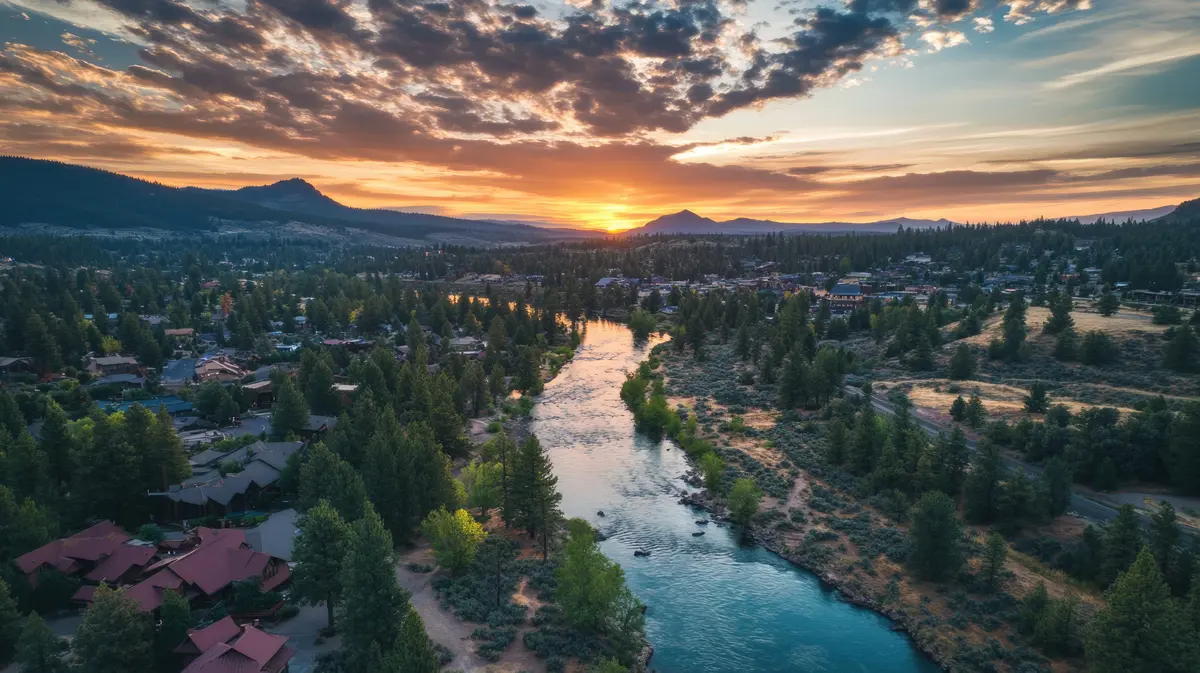
How Bend's Crime Rates Compare to Oregon and the Nation
The short version: Bend has a violent crime rate of 2 per 1,000 residents, which is well below the Oregon state rate of 3.3 per 1,000 and noticeably below the national rate of 3.7 per 1,000. On property crime, Bend has a property crime rate of 14 per 1,000 residents, substantially below the Oregon rate of 24.5 per 1,000 and below the national rate of 18.4 per 1,000.
Both figures come from the Bureau of Justice Statistics, Crime Known to Law Enforcement, 2024 (tables 2 and 3) — the same reporting series used for the state and national benchmarks, which matters. Mixing different reporting series can make a gap look larger or smaller than it actually is; these comparisons are apples to apples.
Bend Police Chief Mike Krantz, in the department's 2024 annual report, put it plainly: "Bend is a very safe community. We are a very safe area." That is a department head quoting data, not writing a tourism brochure.
Larceny and theft drive the bulk of the property crime number — and even there, Bend runs below the national average for that specific category. The property crime that residents actually encounter in day-to-day life is concentrated in a narrow pattern: auto break-ins in high-turnover parking areas near the US-97 commercial spine and downtown. That is a very different picture from the diffuse property crime profile of a genuinely troubled city.
Where Crime Concentrates in Bend — and Where It Doesn't
Bend's citywide crime rate is only half the story. Within any city of 106,926 people, crime is rarely distributed evenly, and Bend is no exception. The practical safety picture depends heavily on where you are, particularly after dark.
Heat-map analysis consistently places the central and downtown commercial corridor as the zone with the highest concentration of property crime incidents. This is where the highest foot traffic, the most parking turnover, and the densest cluster of bars and restaurants all converge — and it is where auto break-ins are most likely to occur. The southwest quadrant of the city, by contrast, sees the fewest overall crimes of any part of Bend.
That spread is meaningful when you are deciding which side of US-97 to buy on. The central commercial corridor and the quieter southwest represent genuinely different day-to-day safety environments, and the difference is consistent across multiple years of local crime data.
The Neighborhood Safety Picture
Among Bend's residential neighborhoods, Awbrey Butte consistently earns the city's strongest safety grades. Sitting above much of the city with larger homes, lower traffic, and streets that are genuinely quiet on weekday evenings, it is the neighborhood most insulated from the commercial-corridor crime pattern. It also sits above the city-wide median on price — the safety premium is priced in.
NorthWest Crossing ranks similarly well. Its planned, walkable layout means less commercial strip activity than the east side, and its residential blocks function as a genuine neighborhood in a way that older strip-development areas do not.
Boyd Acres on the east side carries a harder reputation than the data supports. The residential core — the cul-de-sacs and well-kept subdivisions that make up most of the neighborhood's footprint — sits away from the US-97 commercial activity that generates the bulk of eastside incidents. Buyers who dismiss Boyd Acres purely on reputation are often overlooking genuinely quiet streets, and the neighborhood's price point below the city median reflects old assumptions more than current conditions.
Southwest Bend, River West, and Larkspur all fall in the lower-activity tier. The pattern holds throughout: distance from the US-97 commercial spine and downtown is the most reliable proxy for lower property crime exposure anywhere in the city.
| Neighborhood | Safety Profile | Best For |
|---|---|---|
| Awbrey Butte | Consistently highest safety grades in the city; low-traffic, elevated terrain | Families Quiet |
| NorthWest Crossing | Low commercial-strip exposure; planned residential layout | Families Walkable |
| Southwest Bend | Fewest overall incidents in the city; low-density residential | Quiet Nature |
| River West | Lower-activity residential; close to Drake Park and the Deschutes River Trail | Views Families |
| Larkspur | Residential and away from major commercial corridors | Families Quiet |
| Boyd Acres | Better than reputation; quiet residential cores, activity near US-97 strip | Value First-Time |
| Old Farm District | Established neighborhood; property crime risk tracks proximity to commercial areas | Families Value |
| Mountain View | East-side neighborhood; residential blocks are calmer than nearby commercial strips suggest | Value Commuter |
For a fuller picture of what each neighborhood looks and feels like day-to-day, the neighborhoods page covers character, housing stock, and who each area tends to attract.
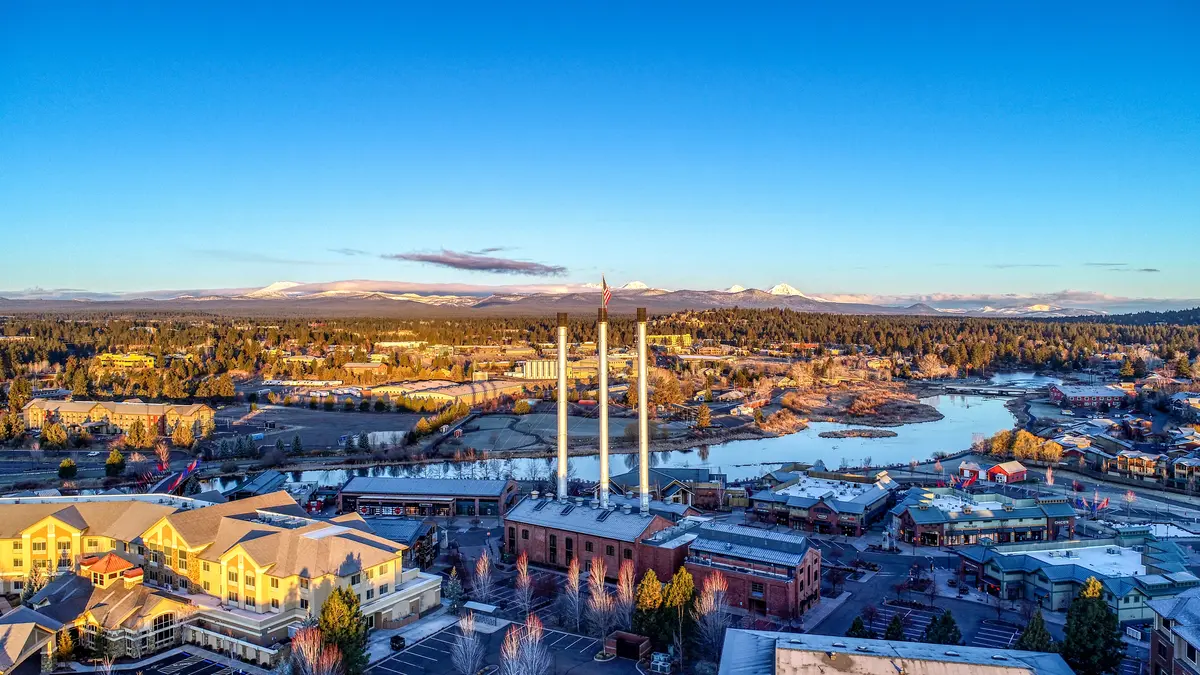
The Bend Police Department — Strengths, Gaps, and What They're Doing About Both
Here is something most Bend safety writeups gloss over: the Bend Police Department is a relatively small agency serving a city that has grown faster than almost any other in Oregon. Chief Krantz has acknowledged the staffing challenge publicly and repeatedly. It is a real constraint.
The department's response has been to lean on technology and alternative-response models rather than simply run understaffed. City Council approved photo enforcement cameras in late 2024 for red-light and speed enforcement. The department also deploys drones and uses Live 911 — a system that allows dispatchers to stream a caller's phone camera to responding officers — to extend the reach of patrol staff.
The more significant innovation is the Community Crisis Response Team, a Deschutes County partnership program that sends mental-health-trained responders to crisis calls rather than patrol officers. Chief Krantz credited the program with helping reduce calls for service in 2024, with officers responding to 75,335 total calls while freeing patrol capacity for proactive policing. Total arrests rose to 3,663 in 2024 — an increase of roughly 300 over the prior year — which the department frames as a sign of more active enforcement, not a crime spike.
The staffing challenge is worth knowing about before you settle in. Response times in lower-density areas of the city — particularly the farther reaches of southwest Bend — can run longer than residents accustomed to larger, fully-staffed departments might expect. That is not a reason to avoid those areas; the crime exposure there is low. But it is part of the honest picture.
Looking to buy in Bend? Estimate your payment.
Enter your numbers to see an estimated monthly mortgage payment.
Estimate only. Excludes HOA fees and mortgage insurance. The interest rate above is a starting point, not a quoted rate — replace it with your own to see real numbers. Insurance is a flat placeholder, not a Bend quote.
The Safety Issues Bend Residents Actually Talk About
Six months after moving to Bend, most newcomers have stopped worrying about the crime statistics and started paying attention to things the relocation guides don't cover. Two of them are environmental. One is behavioral and surprisingly specific to this city.
Winter Driving on the Bend Parkway
US-97 through Bend — the Bend Parkway — carries high-speed traffic through a city that gets real winter weather. Black ice forms on the Parkway during cold snaps, and the combination of elevated speeds and drivers who moved here from California or the Willamette Valley and haven't driven on ice before creates genuine risk. This is not a rare event; it happens every winter and results in accidents that local news covers reliably. If you are moving from a mild-climate city, budget time to actually practice winter driving on quieter streets before you trust yourself on the Parkway at highway speed in January.
Wildfire Smoke
Late summer in Bend — typically August into September — brings wildfire smoke settling into the Deschutes River valley. In bad years, air quality drops to levels that make outdoor exercise inadvisable for days at a stretch, which is jarring in a city people chose partly for outdoor access. Residents who commute by bike, run the Deschutes River Trail regularly, or have respiratory conditions need to factor this in. It is not every year and it is not forever, but it is real and it surprised nearly every outdoor-focused person who moved here without being warned.
The DUI Problem Is Specific and Documented
Bend's brewery and taproom density is genuinely impressive for a city its size — it is a real part of what makes the place feel like Bend. The downstream effect on late-evening driving is also real. Bend records some of the highest DUII arrest rates per capita in Oregon: 587 DUII arrests in 2024. Chief Krantz described the figure as "close to 600 again" and called it "unacceptable."
Residents who have lived here a few years will tell you that late-evening travel on the Bend Parkway on weekends carries a different risk profile than daytime driving. That is not alarmism — it is pattern recognition from a community that has watched the numbers. The practical takeaway is simple: if you are driving home from a night out in the Old Mill District or downtown after 10 p.m. on a weekend, you are sharing the road with a statistically elevated number of impaired drivers. Plan accordingly.
How to Research Safety at the Neighborhood Level Before You Decide
Citywide crime rates tell you whether Bend is safe relative to other cities. They don't tell you whether the specific street you are considering is quieter or busier than average. Here is how to close that gap before settling on a neighborhood.
Use Crime Heat Maps Directionally, Not Literally
CrimeGrade.org and similar tools publish incident heat maps that are updated regularly and cover Bend's neighborhoods. Use them to understand direction — where activity is higher, where it is lower — rather than treating any specific number as precise. The consistent finding across tools is the same: central and US-97-adjacent commercial corridors carry the most incidents; southwest Bend and the hillside neighborhoods carry the fewest. That directional picture is durable even when the specific counts shift year to year.
Walk the Area at Different Times
This sounds obvious and people skip it anyway. The feel of a Bend neighborhood at 9 a.m. on a Tuesday is not the feel of that same neighborhood at 9 p.m. on a Friday. Boyd Acres' residential cul-de-sacs are genuinely quiet on a weekday morning; the nearby commercial strip on US-97 at the same hour is a different story. If you are evaluating an east-side neighborhood, spend time there in the evening, not just during a weekend-afternoon showing.
Talk to Current Residents
The most consistent finding from people who have researched Bend's safety picture is that longtime residents are candid and specific in a way that aggregate data cannot be. The Nextdoor and Facebook groups for specific Bend neighborhoods are active and searchable. Residents will tell you which specific parking areas see the most break-ins, which intersections have the worst black-ice history, and which streets feel genuinely residential versus commercially adjacent.
Consider the Environmental Safety Layer
If wildfire smoke or winter driving are non-starters for you, that changes which parts of Bend make sense. Homes on higher ground — Awbrey Butte most notably — get some relief from valley smoke inversion during bad smoke events, though no location in Bend is fully immune. For winter driving, the southwest side's lower-speed residential grid is more forgiving than the US-97 corridor regardless of where you ultimately live. These are real quality-of-life factors that belong in your neighborhood research alongside the crime maps.
For the broader context on what neighborhoods cost and who they attract, the neighborhoods guide covers each area in full.

Local Expert Takeaway: Bend's crime numbers are genuinely good — a violent crime rate of 2 per 1,000 residents puts it well below both Oregon and national averages, and the data has been consistent across multiple years of FBI reporting. The honest safety conversation here is narrower: keep your car locked near downtown and the US-97 commercial strip, don't drive the Parkway late on a weekend night without thinking about the DUI environment, and get ready for wildfire smoke in August before it catches you off guard. Awbrey Butte and NorthWest Crossing are the two neighborhoods where residents feel most insulated from even the modest property-crime pattern. Boyd Acres is safer than its east-side reputation suggests — the residential cores are quiet, and the US-97 strip is what most people are reacting to when they say it feels rougher. Pick your neighborhood with the commercial corridor map in mind, and Bend's safety picture holds up well.
Quick Takeaways & FAQs
✅ Bend has a violent crime rate of 2 per 1,000 residents — well below the Oregon state rate and the national average, making it among the safer mid-sized cities in the Pacific Northwest.
⚠️ The city's DUI arrest rate is among the highest per capita in Oregon — 587 DUII arrests in 2024 — making late-evening driving on the Bend Parkway a genuine and documented risk.
📍 Property crime in Bend concentrates heavily along the US-97 commercial corridor and downtown; residential neighborhoods even a few blocks off the strip — including the east-side cul-de-sacs of Boyd Acres — see far less activity than the citywide number implies.
What is Bend's violent crime rate compared to the national average?
What kind of crime is most common in Bend?
Which Bend neighborhoods are considered the safest?
Is downtown Bend safe to walk around?
Are there safety concerns in Bend beyond crime statistics?
Moving to Oregon?
Tell us what you need help with and we'll connect you with local resources.
