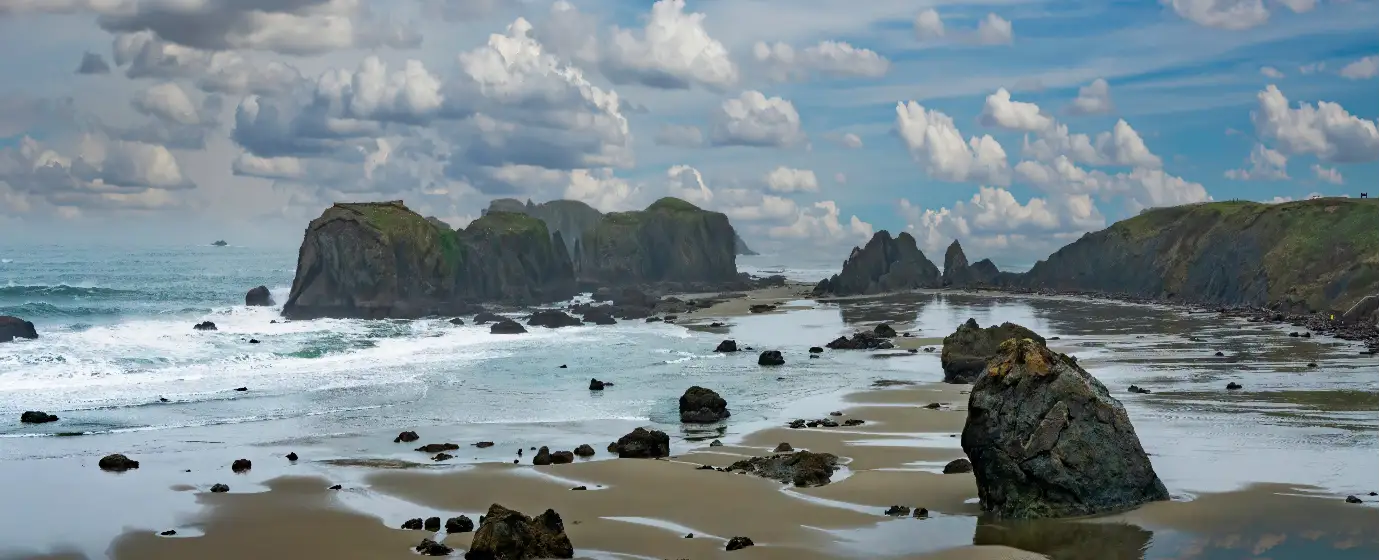
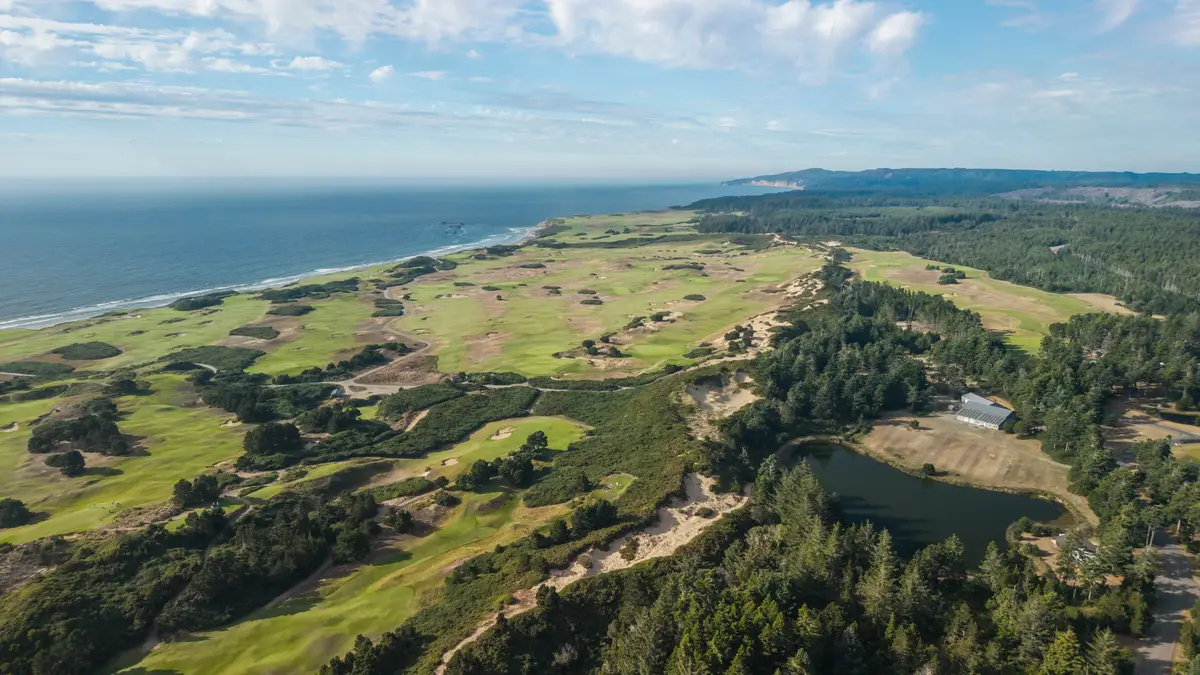
If you've spent any time researching Oregon as a landing spot after California, you've probably encountered the obvious pitch: lower home prices, no sales tax, ocean views, and a slower pace. Bandon delivers on most of that — but it does so on a scale that surprises almost every Californian who arrives. This is a city of 3,311 people on the southern Oregon coast, sitting where the Coquille River meets the Pacific, accessed by US-101 and OR-42S. The nearest significant retail hub is Coos Bay, about 25 minutes to the north. What drives daily life here is not tech or logistics or proximity to a metro — it's the ocean, the Bandon Dunes Golf Resort, commercial fishing, and cranberry agriculture. If you're coming from Sacramento, the Bay Area, or San Diego, the adjustment in scale is real and worth thinking through before you make an offer.
The economic backbone of Bandon is narrower than most California cities its size. Bandon Dunes Golf Resort is by far the dominant economic force, employing hundreds of workers seasonally and year-round across five championship courses. The Bandon School District 54 is a significant local employer, as is the city government itself. Commercial fishing still operates out of the harbor, and Bandon produces roughly 95% of all Oregon cranberries — a genuine agricultural identity, not a marketing angle. The Cranberry Festival has run every September since 1946 and was designated an official Oregon Heritage Tradition in June 2026. Californians who move here for remote work or retirement tend to stay; those who move expecting a job market comparable to what they left often recalibrate quickly.
On cost of living, Bandon sits about 10% above the U.S. national average and about 5% above Oregon's state average — driven by housing, energy, and transportation costs. Food expenses run noticeably below average, which helps. The full cost-of-living breakdown covers utilities and groceries in detail. What a California buyer notices first is the home price gap: Bandon's typical home value stood at $488,995 as of July 2026 (Zillow Home Value Index), well below California's statewide typical home value of $773,735. That difference funds a real lifestyle change for many transplants. Health insurance premiums generally run below California rates, though you will drive farther for specialist care — that honest trade-off is part of moving to a small coastal town anywhere.
Whether you're drawn by the Face Rock sea stacks, the slower pace, or the simple math of a home price that doesn't require a seven-figure income, this guide covers the California-to-Bandon comparison in full: the home price and tax picture, what daily life actually looks like, the neighborhoods, the schools, and the things six-month residents wish someone had told them.

The Home Price Reality: What Your California Equity Actually Buys Here
The most straightforward version of this move is an equity play. California's statewide typical home value of $773,735 means a buyer selling a median-priced California home and arriving in Bandon can often pay cash for a coastal property — or carry a dramatically smaller mortgage. Bandon's typical home value was $488,995 as of July 2026 (Zillow Home Value Index). That is a meaningful gap, and it is the central financial argument for the move.
What that figure buys varies by neighborhood. Old Town and the waterfront blocks carry the strongest demand — walkability to the Coquille River, the historic commercial district, and the fishing harbor comes at a premium. Bandon Heights and Ocean Trails tend to attract buyers looking for established homes with views and more square footage. South Jetty and Seabird Village appeal to buyers who want to be close to the beach without the Old Town price pressure. Sea Pines and Sea Turtle Terrace skew toward quieter residential use. For a deeper look at what each area offers, the neighborhoods guide breaks them down specifically.
One thing California buyers sometimes miss: Bandon's median household income is $49,469, and the typical home price here sits well above what that income can comfortably carry. That affordability gap matters if you're buying on local wages rather than California equity. It also shapes the buyer pool — the people purchasing at the Bandon median are often arriving with outside capital, not financing from a local paycheck.
Oregon's effective property tax rate is 0.71% — the same rate as California's. That's one comparison that doesn't favor either state: both sit below the national average, and the annual carrying cost on a typical Bandon home is in line with what many California buyers were already paying on a less expensive property. For the full property tax picture alongside utilities and other ownership costs, see the cost-of-living page.
If you're weighing Bandon against nearby towns, the cities of Coquille, Coos Bay, and North Bend all come in noticeably lower than Bandon's typical price. That matters if your budget is tight or if proximity to Bandon's coast isn't the priority — but those towns also don't have Bandon Dunes, Face Rock, or the Old Town waterfront, and that trade-off is real in both directions.
Taxes: The Oregon Swap — What You Gain and What You Don't
The sales tax story is the easiest win to explain. Oregon has no state or local sales tax at all. California's statewide base sales tax rate of 7.25% — with local additions pushing the combined average close to 9% — is among the highest in the country. For a household spending $40,000 a year on taxable goods, eliminating that burden is worth roughly $3,600 annually. That's not nothing, especially when you're also adjusting to a smaller income market.
The income tax picture is more complicated, and this is the part that surprises Californians most. California's top state income tax rate of 13.3% applies only to the highest earners — people with incomes well above $1 million. Oregon's top rate is lower at 9.9%, which sounds like a clear win. But Oregon's brackets are compressed and steep, with near-top rates kicking in for six-figure earners. For most middle-income households, Oregon's effective income tax rate is actually higher than California's at the same income level. The sales tax elimination is the larger practical offset for typical earners; the income tax is not the cut you might expect.
There is a partial offset worth knowing: Oregon allows residents to subtract a portion of federal income taxes paid from their Oregon taxable income. This federal deductibility benefit reduces the effective burden for low- and moderate-income earners. It phases out entirely for joint filers with federal adjusted gross income of $290,000 or more, so its value depends heavily on your income level.
| Tax Category | California | Oregon | Practical Impact for Transplants |
|---|---|---|---|
| Sales Tax | California's statewide base sales tax rate of 7.25% (higher with local additions) | None | ~$3,600/year savings on $40K taxable spending |
| Top State Income Tax Rate | California's top state income tax rate of 13.3% | 9.9% | Oregon wins at the top; most middle earners pay more in OR |
| Income Tax Brackets | Gradual; top rates reserved for $1M+ earners | Compressed; near-top rates hit six-figure earners | Counter-intuitive for typical households |
| Federal Tax Deductibility | Not available | Partial subtraction allowed; phases out at $290K AGI (joint) | Helps lower- and mid-income earners most |
| Property Tax Rate | California's effective property tax rate of 0.71% | 0.71% | Effectively equal; neither state wins here |
| Local Sales Tax | Varies by county/city, averages ~1.74% added to state rate | None | Oregon wins cleanly; no local additions either |
The net tax picture for most California transplants to Bandon: you will pay less in sales tax (a clear, immediate gain), roughly the same in property tax, and potentially more in state income tax unless you're in the highest earning brackets. Run your own numbers before assuming the move is automatically a tax cut — for many households it is close to neutral on income tax, with the sales tax savings being the real benefit.
Daily Life in Bandon: The Adjustment That Takes Six Months
Bandon is not a suburb of anywhere. That sentence sounds obvious, but it lands differently once you're living here and realize that a serious shopping trip means driving out of town. Coos Bay is about 25 minutes to the north and provides the nearest concentration of larger retail, chain grocery options, and services that a small coastal town of 3,311 can't sustain locally. Most residents build that drive into their week rather than fighting it.
Old Town is genuinely walkable in the way that matters — the waterfront, the commercial strip, and the trail to Face Rock State Scenic Viewpoint are all accessible on foot. Outside Old Town, most errands mean a drive. Southwest Oregon Regional Airport is about 28 miles away, which means most travel involves planning ahead.
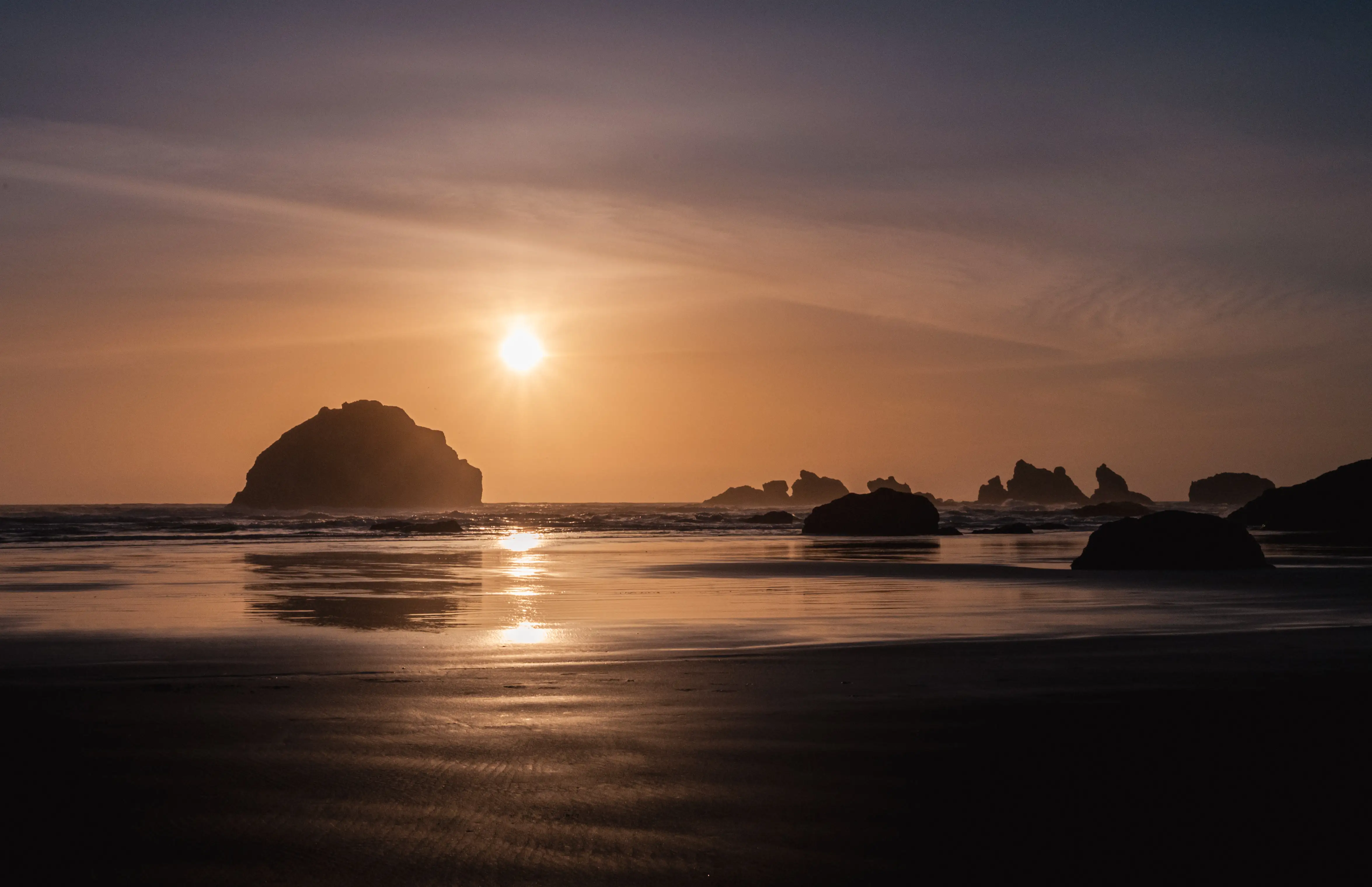
What replaces the urban convenience is the coast itself. Bullards Beach State Park sits just north of town. Coquille Point and the Bandon State Natural Area offer direct beach access with the sea stack formations that make this stretch of coastline one of the most photographed in Oregon. Whiskey Run Beach is a short drive south and rarely crowded. For Californians used to fighting traffic to reach the coast on weekends, being able to walk to a beach in under twenty minutes — on a Tuesday, in the rain, without another person in sight — is the compromise that makes the whole equation feel worth it.
The weather requires an honest conversation. Bandon sits at the northern edge of the Oregon Coast's Banana Belt, which moderates winters relative to inland Oregon — highs can reach into the mid-60s even in winter, and the year-round temperature range runs from the low 40s to the mid-60s. But Bandon averages 62 inches of rain per year, concentrated from fall through spring. The city gets 189 sunny days a year. Californians from coastal areas sometimes adapt easily; those from the Central Valley or Southern California often find the persistent grey harder than expected. Most people figure out by month six whether the light bothers them or not.
The Bandon Cranberry Festival, held every September since 1946, is one of those community anchors that doesn't make sense until you experience it. Bandon produces about 95% of all Oregon cranberries, and the festival — now an official Oregon Heritage Tradition — is genuinely the moment when the town turns out and the seasonal calendar clicks into place. It's the kind of local tradition that exists in very few places and that no amount of urban amenities can manufacture.
Looking to buy in Bandon? Estimate your payment.
Enter your numbers to see an estimated monthly mortgage payment.
Estimate only. Excludes HOA fees and mortgage insurance. The interest rate above is a starting point, not a quoted rate — replace it with your own to see real numbers. Insurance is a flat placeholder, not a Bandon quote.
Schools, Safety, and What Families Should Know
Bandon School District 54 holds a B rating, according to Niche. For a district with 617 students enrolled in 2025-26, that rating reflects a genuinely small, cohesive school community rather than the scale families from California suburban districts are used to. On 2024-25 state assessments, 35.9% of students reached math proficiency and 48.6% reached reading proficiency — figures that track below statewide averages and are worth understanding before families commit to the move. The full picture on the district is on the schools page.
The district runs active OSAA athletics programs, and the community turns out for them. Friday night events fill the stands in a way that only works in a small town where the school is genuinely central to civic life. That community texture is something families from larger California districts sometimes find disorienting at first — and then don't want to leave.
On safety, Bandon's numbers sit well below state and national averages. A violent crime rate of 0.3 per 1,000 residents compares to the Oregon state rate of 3.3 per 1,000 — a significant difference. A property crime rate of 17.1 per 1,000 residents sits below both the Oregon state rate of 24.5 per 1,000 and the national rate of 18.4 per 1,000. For families with school-age children moving from California metro areas, Bandon reads as meaningfully safer on both measures. The safety page has the full breakdown.
One thing families don't always anticipate: the social circle in a town of 3,311 is small and self-selecting. The population skews older, and the activities available to kids outside of school reflect a small coastal economy. Youth sports and activities are covered on the schools page. Families who thrive here tend to be ones who are genuinely drawn to the outdoor, low-key lifestyle — not ones hoping Bandon will eventually feel more like where they came from.
Weekends and Local Favorites: Where Bandon Actually Happens
The rhythm of a Bandon weekend is organized around the waterfront, the beach, and a handful of places that have been serving the community for years. Old Town is the social center — the Coquille River Lighthouse visible across the water, fishing boats at the docks, and the cluster of independent businesses that make a small coastal town feel like a real place rather than a resort staging area.
For seafood, Tony's Crab Shack and Bandon Fish Market are the local anchors that California transplants discover in week one and return to consistently. The Wheelhouse & Crowsnest sits on the waterfront and draws the full range of residents and visitors. Broken Anchor Bar and Grill and Foley's Irish Pub round out the local dining scene — a small but genuine lineup for a city of 3,311. None of these are pretending to be something they're not, which is part of the appeal.
Coffee culture here is real, if compact. Bandon Coffee Cafe and The Human Bean handle the daily commuter traffic. Coastal Mist has a following for its approach to the café experience. The Rolling Pin Bake & Brew and Bandon Baking Co & Deli fill out the morning routine for those who want something made from scratch. Californians used to having fifteen options within a mile will adjust; those who appreciate knowing the staff by name will feel at home quickly.
The outdoor calendar anchors everything else. Face Rock State Scenic Viewpoint is the landmark — the sea stacks are genuinely extraordinary, and the trail connecting them to Old Town makes an evening walk feel like something that can't be replicated anywhere inland. Bullards Beach State Park, Coquille Point, the Bandon State Natural Area, and Whiskey Run Beach give residents enough variety that the same coastline doesn't feel repetitive across seasons. The parks and recreation page covers the full outdoor picture.
The one thing California transplants almost universally underestimate: how much of life in Bandon is organized around the weather and the seasons. Locals don't fight the rain — they plan around it, front-load their outdoor time in the dry months, and lean into the community events that run through fall and winter. The September Cranberry Festival is the clearest expression of that seasonal rhythm. By month six, most transplants are either fully converted to the coastal calendar or quietly looking at listings closer to a city.
Local Expert Takeaway: Bandon is one of the few places on the Oregon coast where California equity genuinely transforms a buyer's situation — a typical California home sale covers the entire Bandon median with room to spare. But the move rewards people who want the town as it actually is: small, coastal, rain-heavy, and built around the ocean, the cranberry harvest, and the Bandon Dunes economy. The tax picture isn't the automatic win Californians often expect — Oregon's income tax runs higher for most middle earners, and the real financial gain is the sales tax elimination and the home price gap. Come for the Face Rock sunsets and the Tony's Crab Shack regulars. Stay because the grey stopped bothering you somewhere around month four.
Quick Takeaways & FAQs
✅ Bandon's typical home value of $488,995 (July 2026) sits well below California's statewide typical home value of $773,735, making California equity one of the most powerful tools a buyer brings to this market.
⚠️ Oregon has no sales tax, but its income tax brackets compress faster than California's — most middle-income earners end up paying more in Oregon state income tax than they would at the same income in California, so the net tax picture is closer to neutral than most transplants expect.
📍 Bandon averages 189 sunny days a year and 62 inches of rain; the town sits in the Oregon Coast's Banana Belt, which moderates winters, but the persistent grey from fall through spring is the adjustment that separates transplants who stay from those who eventually don't.
Is Bandon, Oregon significantly cheaper than living in California?
What is the property tax rate in Bandon compared to California?
What should I know about schools before moving to Bandon with kids?
How far is Bandon from major cities and airports?
What surprises California transplants most about living in Bandon?
Moving to Oregon?
Tell us what you need help with and we'll connect you with local resources.
