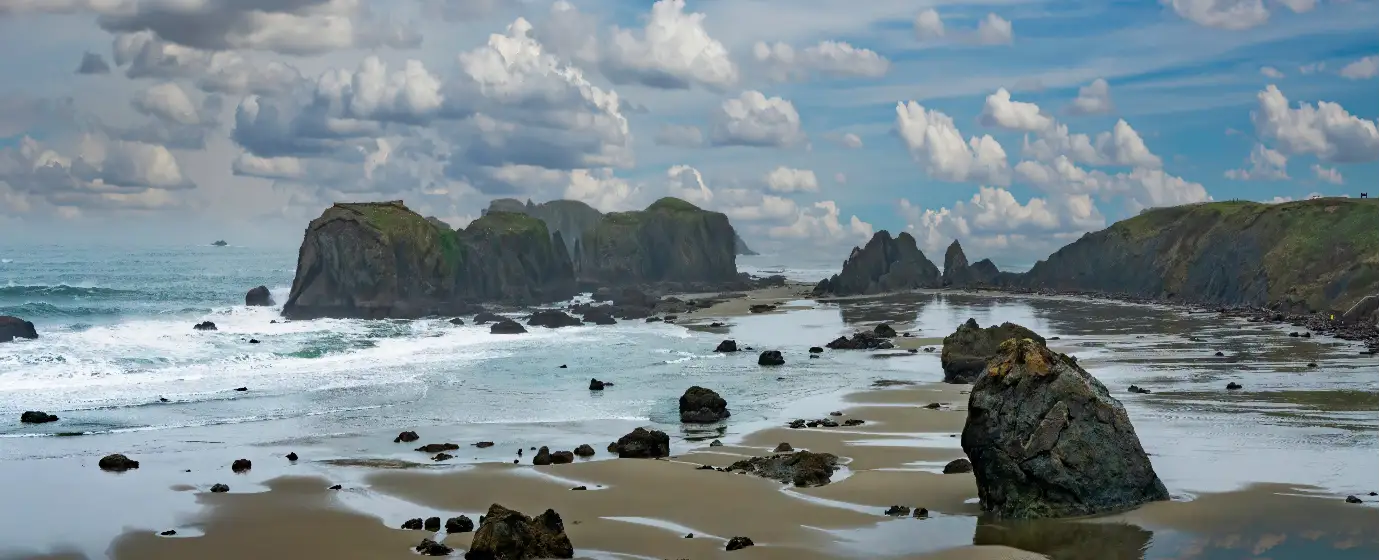
Most people who move to Bandon know about the sea stacks before they arrive — the photographs sell themselves. What takes longer to absorb is how much of this 3,311-person town is essentially a front-row seat to a working coastline. The beaches are not manicured or cordoned off. They shift with the tide, close seasonally to protect nesting birds, and draw gray whales closer to shore than most Oregon towns can claim. US-101 and OR-42S are your connectors to the wider region, but daily life in Bandon runs on Beach Loop Drive — the road that threads together the state parks, headlands, and surf breaks that define the place.
Outdoor access here is not an amenity tacked onto the city — it is the city's central fact. Bullards Beach State Park anchors the north end of town with nearly 1,300 acres of coastal forest, dunes, and rivermouth habitat. Face Rock State Scenic Viewpoint and Coquille Point frame the southern stretch. Bandon State Natural Area fills the middle. The Oregon Coast Trail runs through all of it, connecting the pieces on foot. For buyers weighing coastal Oregon options, the neighborhood breakdown gives the full picture of how proximity to these corridors shapes where people choose to live.
The honest caveat: Bandon gets 189 sunny days a year, and the rest of the calendar is overcast, foggy, or actively raining — which, depending on your disposition, is either a dealbreaker or the whole point. Beachcombers, birders, surfers, and storm watchers genuinely thrive here. People expecting a California-style outdoor lifestyle with warm sand and dry trails year-round tend to recalibrate within a season. The cost of entry to this lifestyle is meaningfully lower than most Oregon Coast towns — see the cost-of-living page for how the numbers compare — though the median household income here sits well below what it takes to carry the typical home price.
This guide covers what the parks and recreation landscape actually looks like in Bandon: the signature state parks, the trail network along the beach and dunes, the water-based activities on the Coquille River and open coast, and what the seasons bring — including the ones most newcomers underestimate.
Bullards Beach State Park: The Anchor at the North End
Two miles north of Old Town, Bullards Beach State Park sits at the mouth of the Coquille River and covers nearly 1,300 acres of dunes, coastal forest, open meadow, and river frontage. It is not a day-use-only park — it functions more like a small outdoor campus, with over 200 campsites across three loops, all with at least water and electrical hook-ups, plus 13 reservable yurts, six of which are pet-friendly.
The trail network alone justifies a visit. Approximately 11 miles of hiking and biking routes wind through the park's ecosystems, with two named paths connecting the campground to the beach. The Beach Trail is a mostly paved 1¼-mile multi-use path — practical for strollers, bikes, and anyone who does not want to scramble through sand. Pearl's Trail covers three-quarters of a mile through a dune ecosystem and seasonal wetlands, and it rewards the detour: snowy plovers, red-tailed hawks, and a rotating cast of shorebirds depending on the season.
The ocean beach itself stretches 4.5 miles north from the Coquille River Lighthouse — wide, flat, and largely empty outside summer weekends. The Coquille River Lighthouse is the endpoint worth orienting to: it stands at the tip of the jetty and frames every photograph taken from this stretch of coast. The boat launch inside the park gives direct access to the river for fishing, crabbing, kayaking, and canoeing, and the launch sees steady traffic during summer and fall.
What Bullards does differently from most Oregon state parks is accommodate almost every style of outdoor user in one place. Equestrian campers have a dedicated horse camp with beach and dune access. The hiker/biker camp was recently refurbished with solar-powered USB charging lockers — a detail that matters when you are three days into a coastal trail section and your navigation battery is dying. Sand sledding on the dunes is genuinely popular with families, and it requires nothing more than a piece of cardboard and a hill.
| Feature | Details |
|---|---|
| Total acreage | Nearly 1,300 acres |
| Trail network | Approximately 11 miles (hiking and biking) |
| Ocean beach | 4.5 miles from Coquille River Lighthouse north |
| Named trails | Beach Trail (1¼ mi, paved); Pearl's Trail (¾ mi, dune/wetland) |
| Camping | Over 200 campsites; 13 yurts (6 pet-friendly); horse camp; hiker/biker camp |
| Water access | Boat launch on Coquille River; fishing, crabbing, kayaking, canoeing |
| Other activities | Sand sledding, wildlife viewing, horseback riding |
For residents, the practical advantage is year-round access with no day-use fee for non-campers on the trail and beach sections. Bullards is where Bandon locals go on a Tuesday morning when the weather clears for two hours — not a weekend-tourist destination in the way it reads on a travel blog.
Face Rock, Coquille Point, and the Signature Sea-Stack Coast
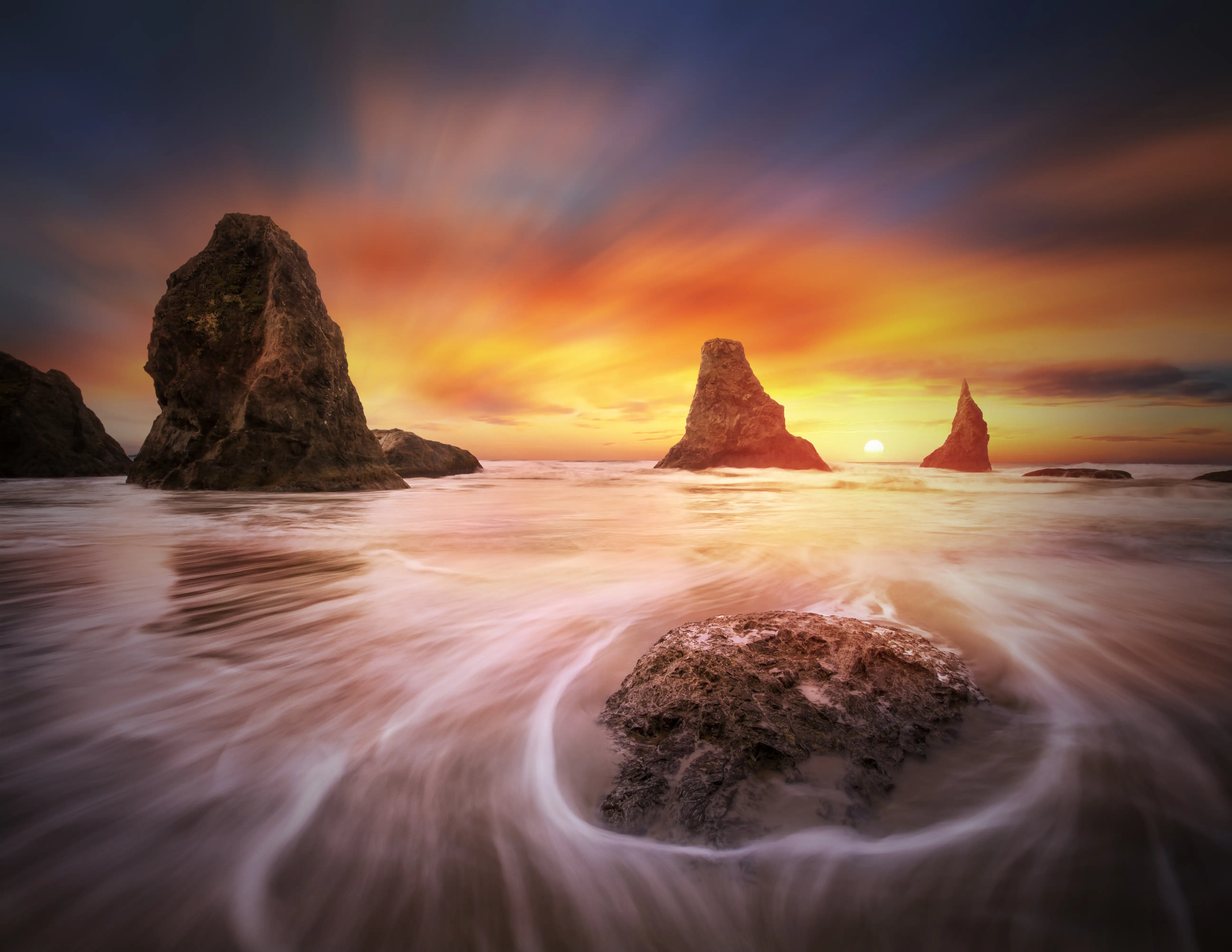
Face Rock State Scenic Viewpoint is one of the most-visited spots on the southern Oregon Coast — which means it can feel crowded on a summer afternoon and absolutely empty on a February weekday. The trade-off is worth understanding before you decide whether to time your visits or simply go early. The paved clifftop overlook on this 14.84-acre headland gives an unobstructed view of the offshore monolith that the Coquille people's oral history places at the center of a cautionary legend about a chief's daughter. A stairway and trail lead down to the beach, and a viewing scope on the bluff lets you pick out detail in the rock formations without binoculars.
The intertidal areas below are the less-discussed draw. At low tide, the rocky shelves around Face Rock expose anemones, urchins, and tidal pools that hold actual variety — not the thin pickings of a heavily-visited coast. The adjoining rocks and tidal flats are part of the Oregon Islands National Wildlife Refuge, and more than 300 bird species have been recorded in the area. Tufted puffins, Brandt's cormorants, and common murres are among the regulars in nesting season.
Coquille Point sits a short distance from Face Rock and occupies a different ecological register entirely. It is the only mainland unit of the Oregon Islands National Wildlife Refuge, and its 19-acre headland carries a short paved trail under half a mile, interpretive signage, benches, and a picnic area. From the overlook, Elephant Rock and Table Rock are directly in view — and in spring and summer, thousands of seabirds use those rocks for nesting. Harbor seals haul out on the lower rocks with enough regularity that first-time visitors often mistake the shapes for boulders until something moves.
Both sites are among Bandon's most reliable spots for gray whale watching. The southbound migration runs from mid-December through mid-January; northbound from late March through June. Resident whales are present June through October, and humpbacks occasionally appear in late summer and early fall alongside — on rarer days — orcas. For a town of 3,311 people, the wildlife calendar here is genuinely unusual.
The Oregon Coast Trail connects these headlands to each other and to the broader beach. Hikers can cover a 3.3-mile route through the sea-stack formations, extend that to a 7.4-mile beach hike taking in Face Rock and Wizard's Hat, or walk the full 4-mile stretch from the Coquille River South Jetty Trailhead to Devils Kitchen Trailhead, passing every major sea stack along the way. Dogs are welcome off-leash on most of this beach, with one significant exception: the stretch south of Face Rock closes to dogs from March 15 through September 15 to protect nesting snowy plovers. Newcomers who have not read the signage carefully get caught by this every spring.
Bandon State Natural Area, Whiskey Run, and the Wildlife Refuges
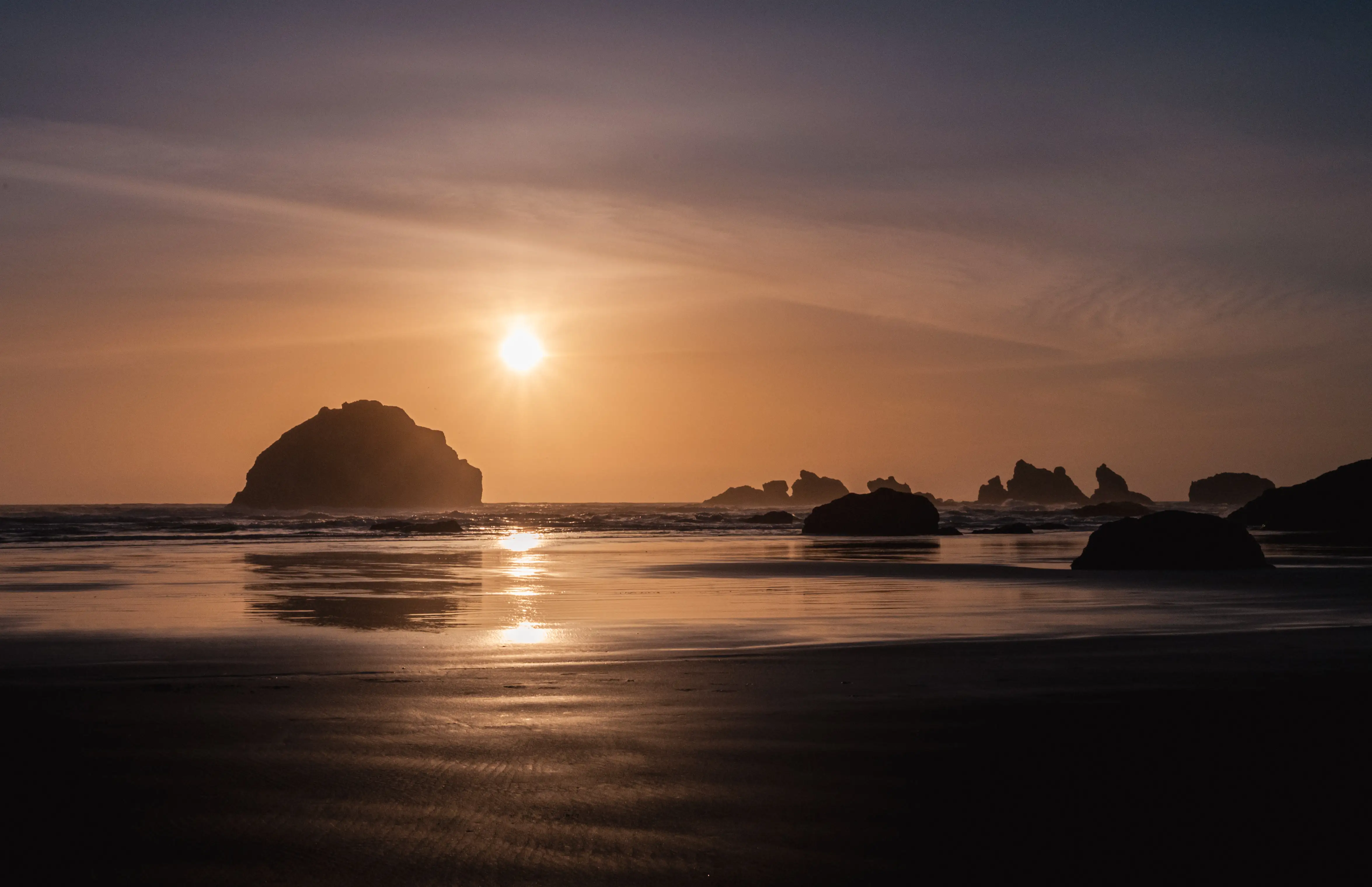
Bandon State Natural Area covers 879 acres along Beach Loop Drive and draws a steady but manageable stream of day users throughout the year — far fewer than Face Rock draws on a summer weekend, which means the parking areas here feel genuinely manageable most of the year. The Oregon Coast Trail runs through the park, and the amenities are straightforward: beach access, hiking trails, restrooms, parking, picnic tables, and reliable birdwatching. It is the everyday park for people who live nearby and want a beach walk without the viewpoint-crowd energy.
The same snowy plover restrictions that apply at Face Rock are in effect at Bandon State Natural Area — the stretch south of China Creek closes from March 15 through September 15. Plan your off-leash beach time accordingly if you are moving here with a dog.
Whiskey Run Beach offers something different from the rest of Bandon's coast: a 2.5-mile stretch of flat sand beneath crumbly sandstone bluffs, with a character that leans toward surf culture, rockhounding, and solitude rather than viewpoint tourism. Surfers and windsurfers use the break with some regularity. At low tide, the flat extends far enough that rockhounds work the wet sand for agates, jasper, and petrified wood — material that washes down from the bluffs above. Tidepools along the base of the bluffs hold anemones, sea stars, and small crabs when the water pulls back.
The gold rush history of Whiskey Run adds an odd footnote that residents tend to know and visitors rarely do: miners were working these bluffs in the mid-1850s following a coastal gold discovery. The gold is largely gone; the petrified wood is not.
Two wildlife refuges round out Bandon's non-beach recreation. Bandon Marsh National Wildlife Refuge, adjacent to the south bank of the Coquille River near Old Town, is the region's strongest draw for birders during migration — thousands of shorebirds and waders move through in season, and resident species include grebes, mergansers, buffleheads, and several raptors year-round. The proximity to Old Town makes it genuinely walkable as a birding destination for anyone in that part of the city.
| Site | Acreage | Primary Draw | Best For |
|---|---|---|---|
| Bandon State Natural Area | 879 acres | Oregon Coast Trail, beach access | Nature Families |
| Whiskey Run Beach | 2.5-mile beach | Surfing, rockhounding, tidepools | Nature Quiet |
| Bandon Marsh NWR | River corridor | Shorebird migration, raptors | Nature |
| Coquille Point | 19 acres | Seabird nesting, whale watching | Views Nature |
| Face Rock State Scenic Viewpoint | 14.84 acres | Sea stacks, tidepools, whale watching | Views Families |
| Bullards Beach State Park | Nearly 1,300 acres | Camping, trails, river access, dunes | Families Nature |
Looking to buy in Bandon? Estimate your payment.
Enter your numbers to see an estimated monthly mortgage payment.
Estimate only. Excludes HOA fees and mortgage insurance. The interest rate above is a starting point, not a quoted rate — replace it with your own to see real numbers. Insurance is a flat placeholder, not a Bandon quote.
Seasons, Storm Watching, and What Newcomers Miss
Bandon's recreation calendar does not pause in winter — it shifts. From roughly November through March, powerful Pacific storms roll in from the southwest with enough force that watching them from the shoreline at Face Rock or Coquille Point has become its own recognized activity. Bandon has been called the Storm Watching Capitol of the World, and while the title is self-awarded, the storms earn it. Seas that would close most beaches simply look different here, and a critical mass of residents genuinely go out in it rather than waiting for the weather to improve.
The flip side — and this is the thing that surprises people after six months — is how consistently gray the sky stays from October through April even on days that are not storming. Bandon gets 189 sunny days a year. The rest of the calendar is overcast, drizzly, or actively socked in with coastal fog. People who moved from inland Oregon or California expecting the weather to break in March are often still waiting in May. The outdoor life here is real, but it is a wet-weather outdoor life, and having rain gear that actually works is not optional.
Spring and early summer bring the whale migration back through, seabird nesting kicks into gear on the offshore rocks, and the beaches south of Face Rock and China Creek reopen to dogs after September 15. By late summer, the fog tends to pull back in the afternoons, and the sea-stack beach gets as close to warm and clear as Bandon gets. September brings the Cranberry Festival — a community event running since 1947 that marks the harvest with a parade, a cranberry eating contest, a fun run, and live music. It is the social anchor of the fall calendar for a town this size.
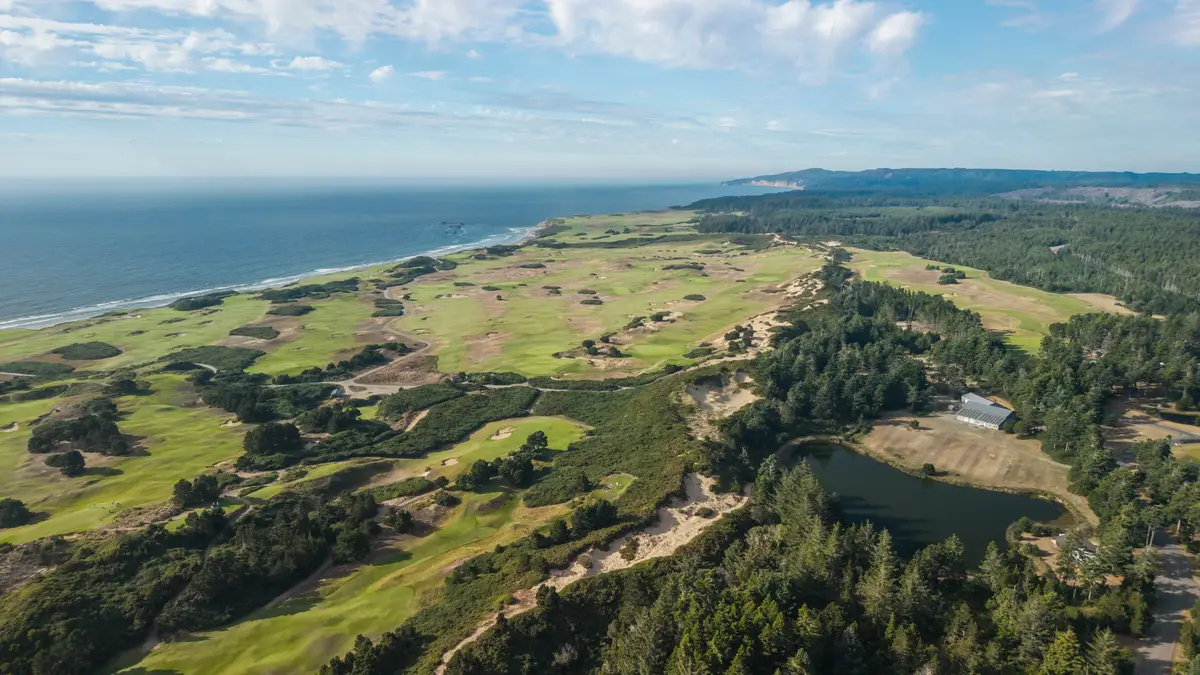
One thing worth stating directly for anyone considering Bandon as a relocation destination: the outdoor recreation here is almost entirely non-motorized and water-adjacent. There are no ski areas, no golf courses open to the general public beyond the Bandon Dunes Golf Resort (which is world-class and priced accordingly), no mountain biking trail networks, and no climbing within a practical drive. What the town does have — sea-stack beaches, coastal wildlife refuges, a navigable river, 11 miles of dune trails, and a working lighthouse — is specific enough that it either fits your life or it does not. Most buyers who stay long-term knew which side they were on before they made an offer.
For buyers thinking about which neighborhood puts them closest to these parks, the neighborhoods page maps the distances. For how the cost of a Bandon home compares to nearby coastal towns, the cost-of-living page has the full comparison.
Local Expert Takeaway: Bandon's parks are not a selling point layered on top of the city — they are the city's structure. Bullards Beach State Park, Coquille Point, Face Rock, Bandon State Natural Area, and Whiskey Run Beach together account for more protected coastline and wildlife habitat than most Oregon towns three times Bandon's size. What buyers need to calibrate before moving here is the weather: 189 sunny days a year is the honest number, and the outdoor life between October and April is a rain-jacket-and-go lifestyle rather than a fair-weather one. People who embrace that find the whale migrations, the storm season, and the near-empty winter beaches to be the best parts of living here. People who do not tend to move within two years.
Quick Takeaways & FAQs
✅ Bullards Beach State Park alone offers nearly 1,300 acres, over 200 campsites, 11 miles of trails, a boat launch, and 4.5 miles of open ocean beach — within two miles of downtown Bandon.
⚠️ Bandon gets 189 sunny days a year, and the outdoor recreation between October and April is genuinely wet — buyers expecting a dry coastal lifestyle will find the climate a significant adjustment.
📍 The snowy plover nesting closure shuts the stretch south of Face Rock and south of China Creek in Bandon State Natural Area to off-leash dogs from March 15 through September 15 each year — a detail that catches a lot of dog owners by surprise in their first spring.
Is Bullards Beach State Park worth visiting year-round, or mainly a summer destination?
Can I bring my dog to the beaches in Bandon?
What wildlife can I realistically expect to see in Bandon's parks?
Is the Oregon Coast Trail accessible from Bandon without a car shuttle?
What seasonal recreation does Bandon offer beyond the beach?
Moving to Oregon?
Tell us what you need help with and we'll connect you with local resources.
