
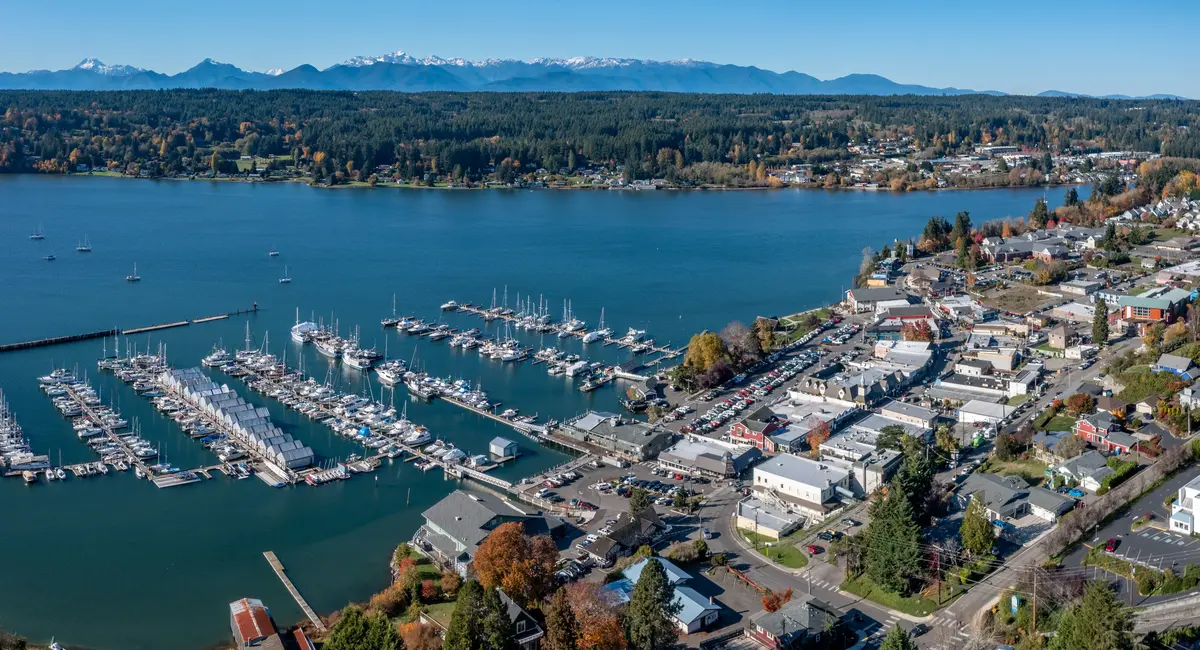
You've probably already done the math on paper. No state income tax. Home prices below what you paid for a condo in Walnut Creek. A ferry ride from Seattle instead of a freeway crawl through the 405. What the spreadsheet doesn't capture is what Poulsbo actually feels like: a small Scandinavian-heritage waterfront town of about 12,500 people on the Kitsap Peninsula, 60 minutes from downtown Seattle via Washington State Ferries, surrounded by fir trees and tidal inlets and almost nothing that resembles the California you're leaving. That gap between the numbers and the reality is worth understanding before you make an offer.
The economic anchor here is not a tech campus or a startup corridor. Naval Base Kitsap and defense contractor BAE Systems set the tone — steady, federal-adjacent employment that barely flinched during the layoff cycles Californians watched ripple through Silicon Valley. The North Kitsap School District holds a B+ rating, according to Niche, and serves Poulsbo directly. The people moving here from California tend to fall into two categories: remote workers who realized they no longer needed to be within driving distance of an office park in Santa Clara, and military families rotating through Kitsap who decided to buy instead of rent and never rotated out.
Poulsbo's cost of living runs roughly 59% below San Francisco's — a figure that lands differently depending on where in California you're coming from, but that is meaningful even for transplants arriving from Sacramento or San Diego. The Zillow Home Value Index puts the typical home value at $672,676 (2026), noticeably below the California statewide median. Day-to-day living sits about 19% above the U.S. national average, so it is not cheap in absolute terms — the Pacific Northwest commands a premium — but the income-tax savings alone reframe the monthly math for most working households. For a deeper look at grocery, utility, and transportation costs, the Poulsbo cost of living page runs those numbers in full.
Whether you are weighing a move from the Bay Area, Los Angeles, or the Sacramento Valley, this guide covers the specific financial and lifestyle differences California residents encounter when they land in Poulsbo: the tax comparison, the home purchase math, the cultural shift, the commute reality, and the honest trade-offs that most relocation articles skip entirely.
The Tax Picture: Where Californians Actually Save
The headline is real. Washington levies no broad state income tax on wages or salaries. California taxes ordinary income at rates up to 13.3%, which means a dual-income household earning $200,000 in California could be sending $15,000–$20,000 or more to Sacramento each year that simply disappears in Poulsbo.
One nuance worth knowing: Washington signed a new 9.9% tax on household income exceeding $1 million in March 2026, taking effect January 1, 2028. It faces expected legal challenges and is not yet in force. For the overwhelming majority of California transplants, it is irrelevant — but very high earners planning a move should track it.
What the Numbers Look Like Side by Side
| Tax Category | California | Poulsbo / Washington | California Buyer's Takeaway |
|---|---|---|---|
| State income tax (wages) | Up to 13.3% | None (under $1M) | Major annual savings for most households |
| Capital gains tax | Up to 13.3% (ordinary income) | 7% excise; 9% above $1M (enacted May 2025) | Substantially lower — timing your move matters for appreciated assets |
| Effective property tax rate | ~0.75% (post-reassessment) | 0.80% (Poulsbo) | Nearly identical — not the driver of savings here |
| Combined sales tax | 9.5%–10.75% (most metro areas) | 9.3% (2026, Q3) | Comparable or slightly lower than CA urban rates |
| Estate / inheritance tax | None at state level | Washington estate tax applies above $2.193M threshold | Relevant for high-net-worth estate planning |
Property tax deserves a direct statement because it surprises Californians: Poulsbo's effective rate of 0.80% and California's effective rate of roughly 0.75% are close enough that property tax is not a meaningful savings lever when you move here. Both states reassess at purchase price. The income tax gap is where the real money moves.
The Capital Gains Timing Question
If you are sitting on appreciated company stock, a rental property, or a business stake, when you establish Washington residency relative to when you realize those gains matters enormously. California taxes capital gains as ordinary income at up to 13.3%. Washington's new capital gains excise tax runs 7% on gains up to $1 million and 9% above that. The math on a $500,000 gain is not subtle. A tax professional who understands Washington's residency rules should be part of your planning process before you list the California house — not after you close on the Poulsbo one.
Sales tax is the one area where Californians sometimes expect bigger relief than they find. Poulsbo's combined rate of 9.3% (Washington's 6.5% state rate plus 2.8% city) is roughly comparable to what most Bay Area or Los Angeles residents were paying. It is not a shock, but it is also not a win.
Home Prices: What Your California Equity Buys Here
The typical home value in Poulsbo is $672,676 (Zillow Home Value Index, 2026). California's statewide median consistently exceeds $800,000 — and in the Bay Area or coastal Southern California, the gap is far wider than that single comparison suggests.
For most California sellers arriving with equity from a home they bought five or ten years ago, Poulsbo is one of the few markets where they can pay cash or carry a modest loan on a genuinely good house. That dynamic shifts both the emotional and financial calculus of the purchase entirely.
What the Equity Gap Looks Like in Practice
A Californian selling a modest Bay Area home in the $1.1–$1.3 million range — not unusual for a three-bedroom in the East Bay or South Bay — arrives in Poulsbo with enough equity to buy at the local typical price and have significant reserves left. Even a Sacramento seller who bought in 2019 typically carries enough appreciation to enter the Poulsbo market with a down payment that removes most of the monthly financing pressure.
The entry point for older construction or townhome-style homes in Poulsbo runs below the city-wide typical figure. Newer builds in areas like Olhava and Bond Road reach above it. For neighborhood-level price detail, the Poulsbo neighborhoods page breaks down the character and price ranges across the city's distinct areas.
What Californians Tend to Underestimate
Two things catch California buyers off guard once they are actually shopping here. First, Poulsbo's inventory is genuinely small — this is a town of 12,500 people, not a sprawling suburb. The number of homes on the market at any given time is limited, and well-priced listings near Liberty Bay Waterfront Park or downtown Front Street move quickly.
Second, the inspection process in Washington is buyer-heavy in a way that differs from hot California markets where buyers sometimes waived inspections entirely. Reintroducing a full inspection contingency is possible here — in fact, expected in most transactions — and that changes how you structure an offer. The Poulsbo homebuyer guide covers the mechanics of the local buying process in full detail.

The Lifestyle Shift: What Little Norway Is and Isn't
Poulsbo's Historic Downtown on Front Street — known locally as Little Norway — is the clearest cultural signal that you have left California behind. The Sons of Norway Poulsbo Lodge, one of the largest on the West Coast, anchors an identity that is genuinely local, not theme-park Scandinavian. Viking ship prows on storefronts, a working marina steps from the bakeries, hand-painted rosemaling on building facades. It is small and walkable and nothing like a California downtown.
JJ's Fish House on Front Street NE is the kind of place that tells you where you are: fresh Puget Sound seafood, unpretentious, the sort of restaurant that's been a local reference point long enough that people stop noticing how good it is. The brewery scene is real too — Rainy Daze Brewing on NW Bovela Lane is an active taproom where you will recognize faces within six months of moving here. Poulsbo's independent dining scene is small but genuine.
The Marina Comparison
Poulsbo Marina's 130 guest slips with permanent and transient moorage, a bathhouse, laundry, and marine fuel represent something Californians with boats understand immediately: access. California's oversubscribed marina markets carry waitlists measured in years. Poulsbo is not a guaranteed slip the day you arrive, but it is a fundamentally different situation from Dana Point or Sausalito.
What Surprises People After Six Months
The rain is discussed constantly before the move and understood correctly by almost no one until they live through a November. It is not dramatic — Poulsbo averages more overcast days than downpour days — but the grey is persistent in a way that catches Bay Area transplants off guard. People who moved from San Diego or a comparably sunny coastal California climate report that the light change between October and March is the thing nobody warned them about adequately.
The other surprise is social: Poulsbo's community is genuinely organized around the waterfront, the American Legion Park, and the Downtown district in a way that rewards showing up in person. Liberty Bay Waterfront Park draws families on weekends year-round, not just in summer. The Hood Canal Bridge — described as the world's longest floating bridge over tidal water — opens Olympic National Park as a genuine weekend destination, not a four-hour drive. Most California transplants report that they recreate more, not less, after moving here.
What You Give Up
Diversity of cuisine, cultural programming, and urban density are honest losses. Poulsbo has independent restaurants and local breweries, but it does not have the food culture of even a mid-sized California city. Silverdale, a few miles south, adds big-box retail. Seattle, an hour away via ferry, fills most gaps — but an hour each way means you go deliberately, not casually.
Looking to buy in Poulsbo? Estimate your payment.
Enter your numbers to see an estimated monthly mortgage payment.
Estimate only. Excludes HOA fees and mortgage insurance. The interest rate above is a starting point, not a quoted rate — replace it with your own to see real numbers. Insurance is a flat placeholder, not a Poulsbo quote.
The Commute Reality for California Transplants
Sixty minutes from Poulsbo to downtown Seattle sounds like a California commute until you understand that the 60 minutes includes a Washington State Ferries crossing — and ferry time feels nothing like freeway time. You sit. You watch water. You read. Remote workers and hybrid employees who go into Seattle two or three days a week consistently describe the ferry as the unexpected upside of the commute, not a drawback.
The mechanics: a 20–25 minute drive from Poulsbo to the Bainbridge Island ferry terminal, then the crossing to downtown Seattle's waterfront. Walk-on passengers can connect from the Bainbridge terminal to Poulsbo via Kitsap Transit's Route 390, which matters if you prefer not to drive to the terminal every day. The full picture of ferry schedules, costs, and Kitsap Transit options lives on the living in Poulsbo page.
Who This Commute Works For — and Who It Doesn't
California transplants who were driving 60–90 minutes each way on I-280 or the 101 typically find this commute a genuine quality-of-life improvement. The ferry schedule enforces a hard stop — you either catch the boat or you don't — which restructures the workday in ways most people come to appreciate.
It does not work well if your employer is on the Eastside: Bellevue, Redmond, or Kirkland. From Poulsbo, reaching the Eastside adds a full Seattle crossing and then the 520 or I-90 bridge, turning 60 minutes into something closer to 90–100 minutes on a good day. If your job is at a tech campus in Redmond, Poulsbo is the wrong base — Bainbridge Island or even Silverdale would be a better fit for an Eastside-focused commute.
For fully remote workers — the largest category of California-to-Poulsbo movers right now — none of this is a daily calculation. They moved here because they could, and the ferry is a weekend pleasure trip to Pike Place Market rather than a commute at all.
The Honest Trade-Off Sheet: California vs. Poulsbo
Every relocation comparison has a version of this section that lists wins and glosses over the losses. This one won't. Poulsbo is genuinely the right move for a specific kind of California household — and a poor fit for others.
| Category | California (typical) | Poulsbo | Net for CA Transplant |
|---|---|---|---|
| State income tax | Up to 13.3% on wages | None (wages under $1M) | Major Win |
| Typical home price | Statewide median exceeds $800,000; Bay Area far higher | $672,676 (ZHVI, 2026) | Win — especially with CA equity |
| Property tax rate | ~0.75% post-reassessment | 0.80% | Neutral — nearly identical |
| Sales tax | 9.5%–10.75% (most metros) | 9.3% | Slight edge to Poulsbo |
| Urban density / amenities | High (most CA metros) | Low — Seattle is 60 min away | Trade-off |
| Outdoor access | Varies; often crowded | Olympic National Park, Hood Canal, Puget Sound waterfront | Win |
| Weather / sunshine | High (most regions) | Persistent grey Oct–Mar | Loss for sun-dependent movers |
| School district | Varies widely | North Kitsap SD, strongly rated | Solid |
| Job market proximity | On-site, typically | Military/defense base nearby; Seattle requires ferry | Depends on your employer |
| Health insurance premiums | Among the highest in the U.S. | Noticeably lower statewide | Win — though specialist care requires more driving |
* ZHVI = Zillow Home Value Index.
Who Should Move Here
Remote workers, military families, and households carrying significant California home equity who want to own a real house near water without a seven-figure purchase price. Parents with school-age children who want a stable, small-town school district and outdoor access as a daily reality rather than a weekend drive. Anyone who found California's income-tax burden a persistent frustration and whose career can function without physical proximity to a California office.
Who Should Think Twice
People who depend on urban density for work, social life, or cultural programming will find Poulsbo's size a sustained limitation — not just an adjustment. If your entire social infrastructure in California was built around restaurants, live music, and late-night options, Poulsbo will feel quiet in ways that accumulate over months. Households relocating from the Eastside tech corridor to work in Redmond or Bellevue should look carefully at the commute math before committing to the Kitsap Peninsula. And anyone who has never experienced a Pacific Northwest winter without the compensating density of Seattle should spend a February in Poulsbo before signing a purchase agreement.
For everything from neighborhood character to Poulsbo's safety profile to the parks and trails that make the rainy months tolerable, the full guide sections below fill in the picture that this cost comparison starts.
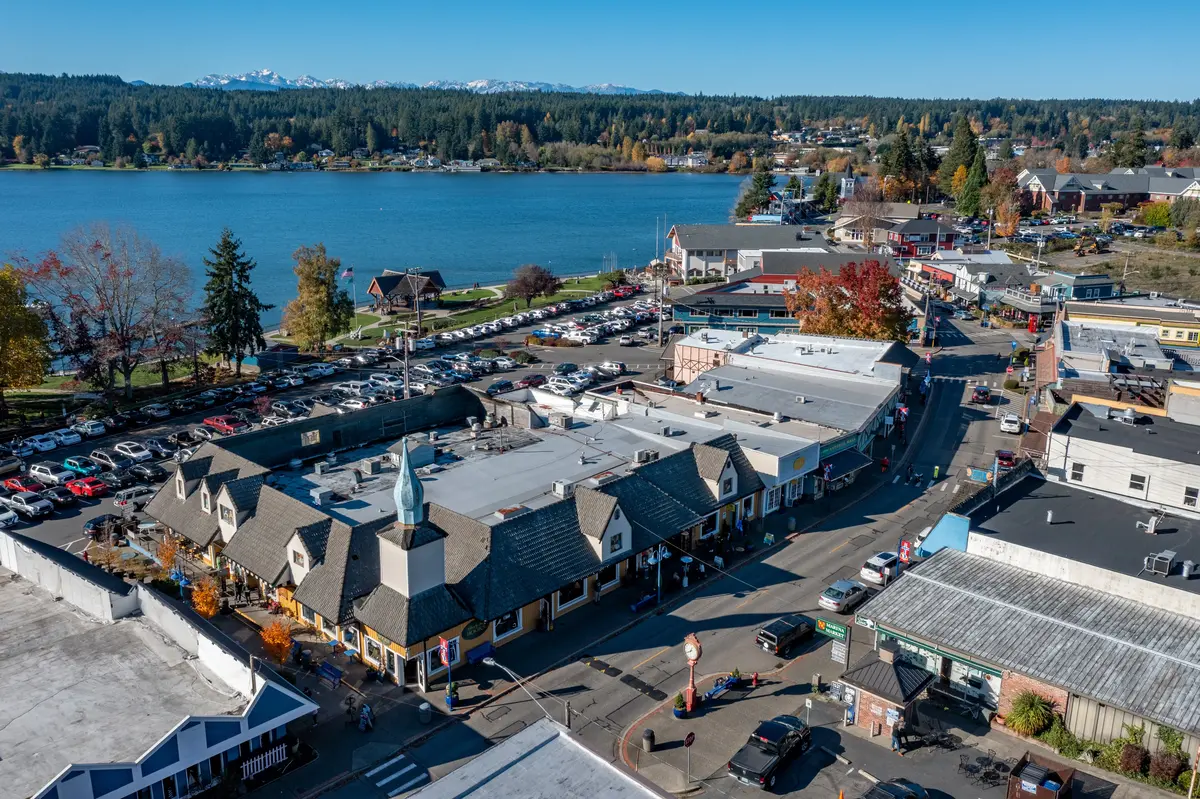
Local Expert Takeaway: The income-tax math is real and it is the primary financial reason California households move to Poulsbo — not property tax, which is nearly identical to California's post-reassessment rate, and not sales tax, which is comparable to most California metro areas. What the numbers don't tell you is that Poulsbo is genuinely small: the Front Street waterfront, Poulsbo Marina, Liberty Bay, and a handful of local taprooms like Rainy Daze Brewing are the social infrastructure. If you are leaving a California city of a million people expecting a scaled-down version of that, you will be surprised. If you are leaving because you wanted something smaller, quieter, and waterfront — with Olympic National Park reachable via Hood Canal Bridge on a Saturday morning — Poulsbo tends to stick.
Quick Takeaways & FAQs
✅ Washington's lack of state income tax on wages saves most California households more each year than any other single line item in the move.
⚠️ Poulsbo's typical home value of $672,676 (Zillow Home Value Index, 2026) is below the California statewide median, but inventory is tight in a town of 12,500 — well-priced homes near the waterfront move fast.
📍 The ferry commute to Seattle via Bainbridge Island runs about 60 minutes door-to-door, but Eastside tech employers in Redmond or Bellevue add significant time — know your office location before choosing Poulsbo as your base.
Will I really save on taxes by moving from California to Poulsbo, Washington?
How do Poulsbo home prices compare to California?
What happens to my California capital gains if I move to Poulsbo?
Is commuting from Poulsbo to Seattle practical for someone used to a California commute?
What do California transplants find hardest about adjusting to Poulsbo?
Moving to Washington?
Tell us what you need help with and we'll connect you with local resources.
