
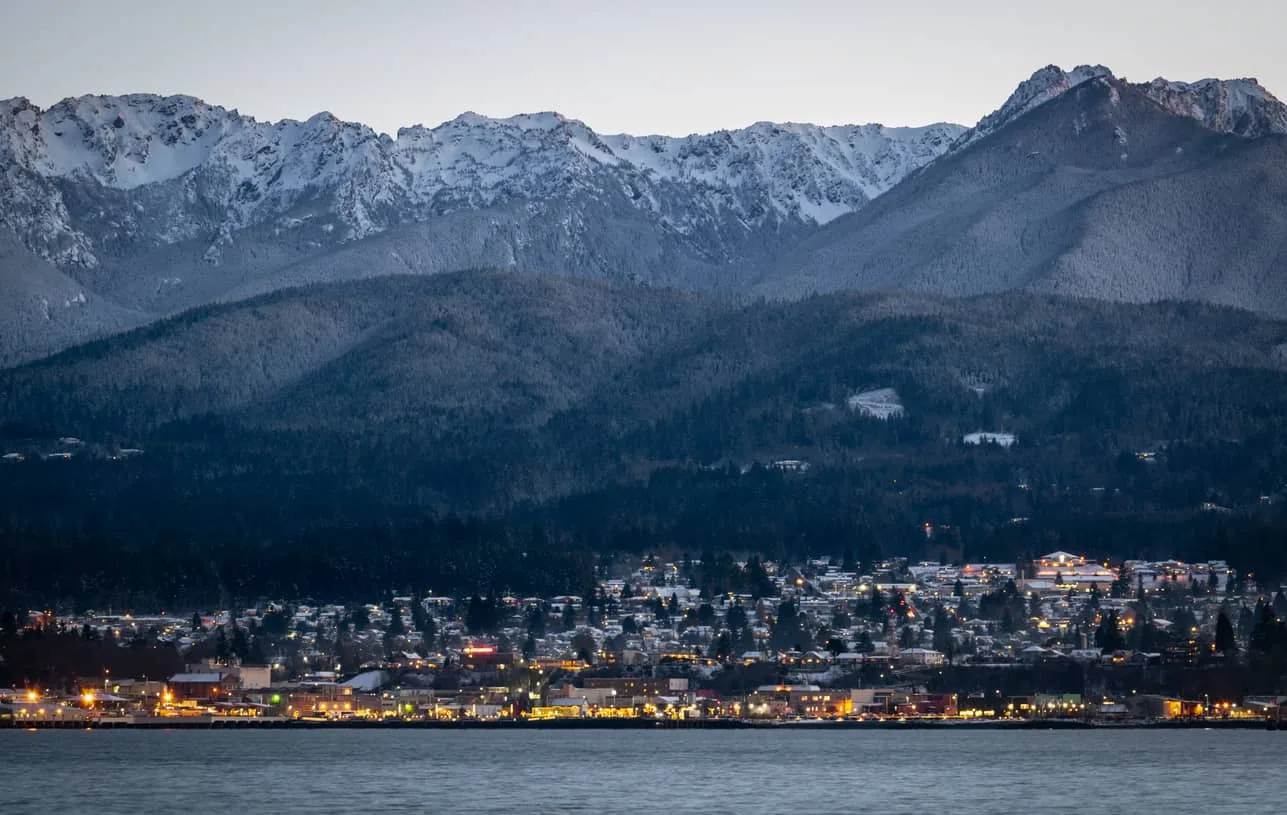
Most people discover Port Angeles one of two ways: they drove through on the way to Olympic National Park and never forgot the view of the Strait of Juan de Fuca, or a friend who moved here from the Puget Sound side kept describing a place where ferry horns carry across the water at dawn and the mountains are genuinely right there. What surprises them later — after they've looked at the numbers — is that Port Angeles isn't just scenery. It's a functioning small city with a real hospital, a ferry to Victoria, and home prices that sit noticeably below the Washington state average, all packed onto a peninsula that takes genuine effort to reach from Seattle.
The effort is the point, and also the catch. Port Angeles sits about 150 minutes from Seattle by the fastest route — a calculation that includes a ferry crossing or a long loop around Hood Canal — and that distance shapes everything from specialist medical access to the kind of social self-sufficiency retirement here requires. The local economy leans on Olympic Medical Center, Clallam County government, and Peninsula College, which collectively give the city more institutional depth than its population of roughly 20,000 would suggest. For retirees who want a small town that can actually support them, that infrastructure matters.
On a fixed income, Port Angeles performs well. The Zillow Home Value Index for the city stood at $432,551 as of July 2026 — well below comparable waterfront communities in Washington. Washington State levies no personal income tax, so Social Security, pension checks, and IRA withdrawals clear the state entirely. The 13-mile Olympic Discovery Trail threads through town, Chestnut Cottage Restaurant on E Front Street draws a loyal breakfast crowd of longtime residents, and the Coho Ferry terminal puts Victoria, BC within reach for a day trip without booking a flight. The lifestyle is genuinely available here in a way it isn't at the same price point anywhere closer to Seattle.
Whether you're weighing a move from the east side of the state, aging in place after decades in the Pacific Northwest, or comparing Port Angeles against Sequim or Port Townsend, the sections below break down healthcare access, the retiree tax picture, daily costs, walkability, downsizing inventory, and how Port Angeles stacks up against its Olympic Peninsula neighbors.

Why Retirees Are Choosing Port Angeles
Port Angeles fits a specific kind of retiree: someone who wants genuine outdoor access — trails, water, mountains — without paying Puget Sound prices for it, and who is comfortable trading proximity to a major metro for a slower, more self-contained daily life. The Zillow Home Value Index here stood at $432,551 as of July 2026, which means a retiree downsizing from a Seattle-area home can often buy here outright or close to it. That financial breathing room changes the retirement math considerably.
The city also suits people who want a real town, not just a retirement enclave. Downtown Port Angeles has a working waterfront, an independent arts scene supported by local galleries and community arts organizations, a farmers market that runs through the growing season, and the kind of foot traffic that comes from a city that handles actual commerce rather than tourism alone. Retirees who need to feel embedded in civic life — volunteering, attending city council meetings, joining a trail advocacy group — find Port Angeles more engaging than smaller Peninsula towns.
Who should look elsewhere? Retirees who need frequent access to specialist care beyond what a 126-bed community hospital can provide — advanced cardiac procedures, major oncology treatment, neurosurgery — will be managing that care from a 150-minute distance to Seattle. That's manageable for routine monitoring but genuinely stressful for active treatment. Similarly, retirees who want walkable urban density, a Trader Joe's within a mile, or a major airport under an hour away will find Port Angeles's geography limiting. The Peninsula's isolation is real, and it's better to name it plainly than to discover it six months in.
Healthcare & Medical Access in Port Angeles
Olympic Medical Center: What It Can and Can't Do
Olympic Medical Center at 939 Caroline Street is the healthcare anchor for the entire northern Olympic Peninsula — a 126-bed community hospital and, notably, one of only two Level III trauma centers in Washington State. That designation matters: it means the facility can stabilize and initially manage serious trauma on-site rather than immediately transferring patients. For a community this geographically isolated, it's a meaningful distinction.
Day-to-day, Olympic Medical Center covers a genuinely broad range of services for a community hospital its size. Inpatient surgical care, emergency services, outpatient cardiac care, cancer care, diagnostic imaging, physical therapy, and rehabilitation services are all available on the Peninsula. The organization employs over 1,500 people — a footprint that reflects the depth of its service lines, not just a single emergency department.
Where the Gaps Show Up
The honest reality for retirees is that advanced subspecialty care — complex cardiac interventions, major neurosurgery, high-acuity cancer treatment — routes to Seattle, which is approximately 150 minutes away. That trip involves either a ferry crossing or the long loop south around Hood Canal, neither of which is a quick drive to a second opinion. Retirees managing chronic but stable conditions generally navigate this well; those expecting to require frequent specialist involvement should think carefully about what that travel pattern looks like in a difficult year.
Port Angeles also has primary care clinics, dental practices, and physical therapy providers outside the hospital system, so routine and preventive care is genuinely accessible. The Olympic Medical Center campus on Caroline Street includes outpatient specialty clinics that handle a wider range of conditions than most community hospitals its size. Many retirees here describe the system as more than adequate for their actual day-to-day needs — it's the tail-risk scenario, not the daily experience, that requires planning.
Practical Steps Before You Move
Before committing to Port Angeles, call your current specialists and ask whether they have any referral relationships on the Olympic Peninsula. Establish care with an Olympic Medical Center primary care physician before you need it — new-patient wait times can stretch in a market this size. And if you're on a Medicare Advantage plan, verify that Olympic Medical Center and its affiliated clinics are in-network under your specific plan, as Peninsula coverage maps don't always match Puget Sound assumptions.
The Retiree Budget in Port Angeles
Washington's Tax Picture for Retirees
Washington State levies no personal income tax — full stop. Social Security benefits, pension distributions, 401(k) and traditional IRA withdrawals, and Roth conversions all clear the state tax line entirely. For retirees whose income comes primarily from those sources, Washington is about as favorable as any state in the country on this dimension.
One nuance worth understanding: Washington does impose a 7% capital gains tax, but it applies only to long-term gains above an annually adjusted threshold and explicitly exempts retirement accounts (401(k), IRA, Roth IRA, defined-benefit plans) and home sales. A retiree drawing on those sources never encounters it. If you hold a large taxable brokerage account and plan to do significant rebalancing after moving, talk to a tax advisor about timing — but for most retirees funding retirement from the standard mix of accounts, the capital gains tax is a non-issue.
Property Taxes and Daily Costs
Port Angeles's effective property tax rate is approximately 0.90% — below the Washington statewide average and well below coastal California or Oregon comparables. Washington also offers a senior property tax exemption program for homeowners over 61 who meet income thresholds; it can meaningfully reduce the annual burden and is worth applying for through the Clallam County Assessor's office as soon as you establish residency.
The one tax line that stings is sales tax. The combined rate in Port Angeles is 8.9% — 6.5% state plus 2.4% city — which is noticeable on larger purchases. Groceries and prescription drugs are exempt, which softens the impact on a fixed-income household. For a retiree spending on everyday necessities rather than discretionary goods, the sales tax exposure is real but manageable. See the full cost of living breakdown for how daily expenses stack up across categories.
What a Fixed Income Actually Covers Here
Breakfast at Chestnut Cottage Restaurant on E Front Street runs in the range you'd expect from a beloved local spot rather than a tourist trap — a useful signal about the everyday price environment downtown. The waterfront dining at Downriggers on the Water on E Railroad Avenue sits at a middle price point for a Pacific Northwest seafood restaurant, not fine-dining territory. Independent grocery options and the local farmers market give fixed-income households real flexibility that doesn't exist in more tourist-saturated Peninsula towns.
Looking to buy in Port Angeles? Estimate your payment.
Enter your numbers to see an estimated monthly mortgage payment.
Estimate only. Excludes HOA fees and mortgage insurance. The interest rate above is a starting point, not a quoted rate — replace it with your own to see real numbers. Insurance is a flat placeholder, not a Port Angeles quote.
Walkability, Community & Staying Active in Port Angeles
The Geographic Reality
Port Angeles is not flat. The downtown waterfront area along Railroad Avenue and Front Street is manageable on foot, and this corridor — the City Pier, Feiro Marine Life Center, the ferry terminal, the farmers market block — is where most retirees find they can run errands and meet friends without a car. Move uphill toward the Mount Angeles or Westside neighborhoods and the terrain becomes more demanding. Driving to the grocery store is the realistic expectation for most residents; walking to it from anything except the very center of downtown is aspirational rather than practical for most of the city's footprint.
That said, the 13-mile Olympic Discovery Trail multi-use path is a genuine asset. It threads through Port Angeles and connects to the broader Peninsula trail system — flat enough along the waterfront segments for walking and cycling at any fitness level, and long enough to sustain a regular outdoor habit without repeating the same quarter-mile loop. Retirees who prioritize daily movement over walkable errands often find the trail more meaningful than the street-level walk score would suggest.
Senior Centers and Community Life
The North Olympic Peninsula has an established senior services infrastructure built around its older-than-average population. The Clallam County Senior Center serves Port Angeles residents with programming, fitness classes, lunch service, and social events — it's the kind of place that fills a genuine social function in a small city without much commercial third-place infrastructure. Peninsula College's continuing education offerings draw retirees into structured learning environments year-round.
Volunteering runs deep here. The Olympic National Park Visitor Center, the Feiro Marine Life Center on the City Pier, and numerous trail advocacy and conservation organizations all rely heavily on retiree volunteers. For the right person, Port Angeles offers more ways to be genuinely useful to the community than a city this size usually supports. That sense of purpose is something longtime residents consistently mention as what keeps them here past the initial appeal of the scenery.
What Locals Know About Winter
The first winter surprises almost everyone who moves from the east side of the mountains. Port Angeles sits in a rain shadow relative to the rest of the Olympic Peninsula, so it's significantly drier than Forks or even Seattle — but the gray sky from November through March is persistent, and the short days at this latitude are real. Retirees who've lived in Seattle acclimate quickly; those arriving from Arizona or California often underestimate the psychological weight of a Pacific Northwest winter. Building a social structure before the rain season starts is not optional — it's the single most useful thing you can do in your first months here.
Right-Sizing: Downsizing in Port Angeles
What the Inventory Actually Looks Like
Port Angeles is not a market saturated with purpose-built 55+ communities or active-adult developments. The downsizing inventory here skews toward older single-family homes, a modest condo market concentrated near downtown and the waterfront corridor, and a limited number of manufactured-home communities — some of which are age-restricted and offer the land-lease structure that produces the lowest entry prices on the Peninsula. If you're arriving expecting to choose from several polished active-adult communities with clubhouses and pickleball courts, you'll need to adjust expectations.
What does exist: single-level ramblers and ranchers built from the 1960s through the 1990s, scattered throughout Eastside, Westside, and the lower edges of the Mount Angeles area. These represent the most realistic downsizing path for most buyers — a manageable footprint, one-floor living, and prices that reflect their age. Buyers who want newer construction in a true single-level layout typically look at Sequim, where the active-adult development market is meaningfully deeper.
Condos and Smaller Footprints
The downtown Port Angeles condo market is small but real. Units along or near the waterfront offer the combination of walkable access to the Railroad Avenue and Front Street corridor and views across the Strait that retirees consistently rank as the primary lifestyle driver for choosing Port Angeles over the interior Peninsula. Inventory turns slowly in this segment, and when units come available they tend to move — buyers who want waterfront-adjacent condo living should be prepared to act on short timelines.
For the lowest maintenance burden, some retirees look at townhomes and smaller newer builds in the Port Angeles East area along the Highway 101 corridor heading toward Sequim. This area sits between the two cities' downtowns and offers more recent construction at prices reflecting the less central location. The practical access to both Port Angeles services and Sequim's retail corridor makes it a reasonable compromise for couples who disagree about which city they actually want to live in.
The Honest Downsizing Calculus
If single-level living in a purpose-built 55+ community with organized amenities is your priority, Sequim is the stronger market — it has more of that inventory and the infrastructure to match. Port Angeles makes the most sense for downsizers who want a smaller, lower-maintenance home in a real working city, value proximity to Olympic Medical Center, and prioritize the waterfront lifestyle over community-amenity programming. Those two profiles are different enough that spending time in both cities before buying is genuinely worth the trip.
Port Angeles vs Nearby Retirement Destinations
| City | Cost vs Port Angeles | Primary Hospital | Walkability | Senior Living Depth | Overall Retirement Fit |
|---|---|---|---|---|---|
| Port Angeles | Anchor | Olympic Medical Center (Level III trauma, 126 beds, on-site) | Moderate — waterfront corridor walkable, most errands need a car | Limited; condos, older ramblers, some manufactured-home communities | Nature Quiet Strong for outdoors-focused, medically stable retirees |
| Sequim | Noticeably pricier | Olympic Medical Center (15–20 min east) | Improving; newer commercial corridor but still car-dependent | Deepest on the Peninsula; multiple active-adult communities | Active Adult Views Best if 55+ community amenities and sunnier weather matter most |
| Port Townsend | Pricier | Jefferson Healthcare (critical access hospital; Olympic Medical Center 60+ min) | Best downtown walkability on the Peninsula; Victorian district on foot | Thin; mostly older single-family, few dedicated senior communities | Walkable Arts-forward; right for culturally active retirees comfortable with limited on-site hospital depth |
| Forks | Noticeably cheaper | Forks Community Hospital (critical access; Olympic Medical Center 90+ min) | Very limited; small downtown, nearly everything needs a car | Very thin; small inventory, minimal senior-specific development | Privacy Nature Fits off-grid-minded retirees comfortable with very limited services |
| Joyce | Cheaper | Olympic Medical Center (30+ min east) | Rural; no meaningful walkable core | Essentially none; acreage properties and rural residences only | Privacy Best for retirees who want land, solitude, and low overhead |
| Elwha | Cheaper | Olympic Medical Center (20–25 min east) | Rural; no walkable commercial area | Minimal; scattered rural homes near the river corridor | Nature Appeal is entirely the Elwha River restoration landscape; not a town in any conventional sense |
Sequim beats Port Angeles on senior-community depth and sunshine hours — if you want a purpose-built active-adult development with organized amenities, that's where the inventory is. Port Townsend wins on walkability and arts-scene density, but its hospital is a critical-access facility, and anyone who values Olympic Medical Center's Level III trauma designation should weight that difference carefully.
Forks and Joyce make financial sense for retirees who are genuinely self-sufficient and have strong health, but the service gap is real — rural Peninsula living at 90 minutes from a full-service hospital is a different risk tolerance than most retirees are comfortable with in their seventies. Port Angeles sits at the practical sweet spot: real hospital, real town, real outdoor access, and a price point that leaves room in the budget for the life you're actually trying to live.

Local Expert Takeaway: Port Angeles rewards retirees who do their homework on the healthcare distance trade-off and then commit to the lifestyle rather than treating the Peninsula as a compromise. The combination of Olympic Medical Center's on-site Level III trauma capability, Washington's zero income tax on Social Security and retirement accounts, the Olympic Discovery Trail threading through town, and a home price well below the state average is genuinely hard to replicate anywhere on the water in Washington. The retirees who struggle here are the ones who underestimated the winter gray or assumed Sequim-style active-adult community inventory would appear — it mostly won't. The ones who thrive are at breakfast at Chestnut Cottage on E Front Street by 8am, on the Discovery Trail by 10, and across the Strait to Victoria on the Coho Ferry by the weekend. That life is available here, at a price point that makes it financially sustainable.
Quick Takeaways & FAQs
✅ Olympic Medical Center is one of only two Level III trauma centers in Washington State — serious on-site emergency capability for a city this size and this remote.
⚠️ The Peninsula's 150-minute distance from Seattle means advanced specialist care requires genuine planning — retirees with active complex conditions should map that travel pattern before committing.
📍 Washington levies no state income tax on Social Security, pensions, or IRA withdrawals, and the Coho Ferry at the foot of downtown puts Victoria, BC within reach for a day trip without ever booking a flight.
Is Social Security taxed in Port Angeles / Washington State?
How good is the hospital in Port Angeles for retirees?
Are there 55+ or active-adult communities in Port Angeles?
How does the property tax rate compare in Port Angeles?
Is Port Angeles or Sequim better for retirees?
Moving to Washington?
Tell us what you need help with and we'll connect you with local resources.
