
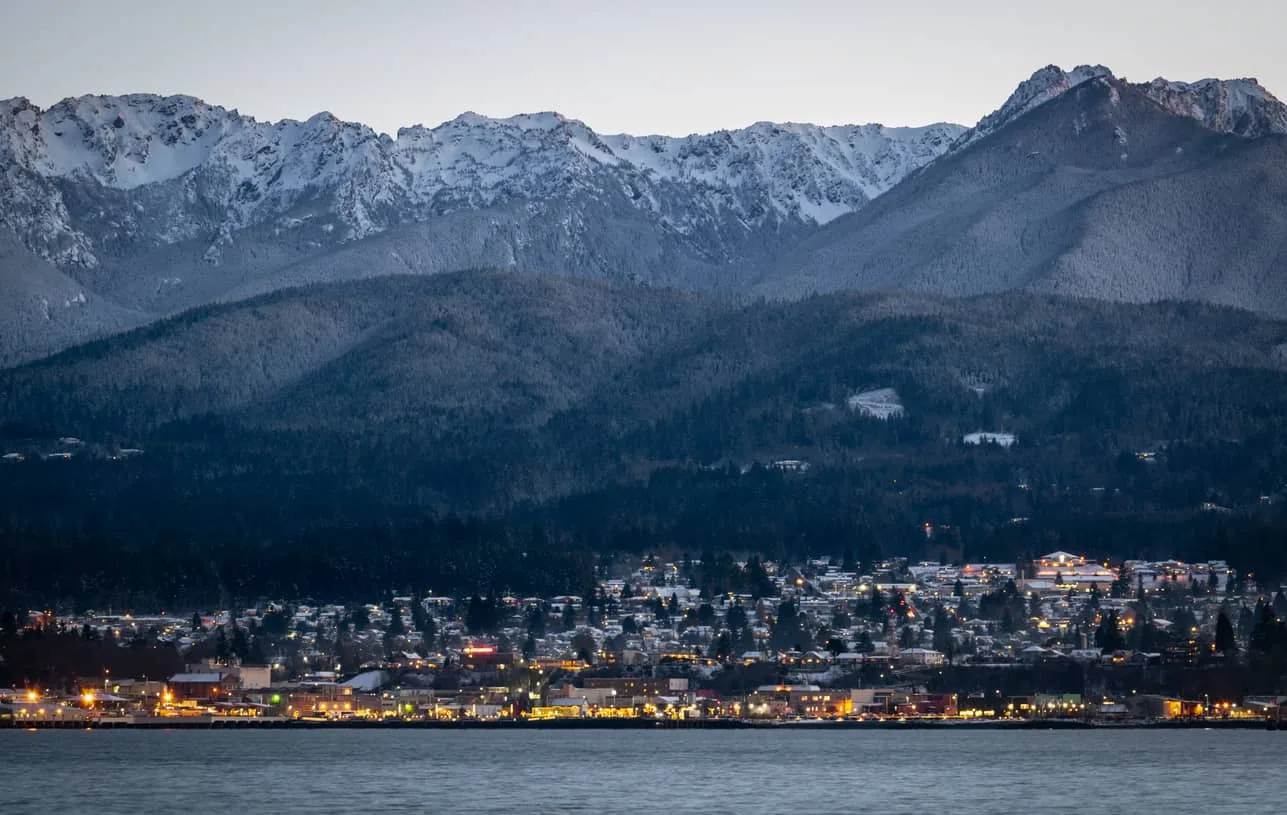
Maybe you've been priced out of the Bay Area or the Southland and someone mentioned a small city on the Olympic Peninsula where you can buy a house for what you'd pay for a parking space in San Francisco. Maybe you found Port Angeles on a map and noticed it sits directly across from Victoria, BC, with Hurricane Ridge rising behind it and Olympic National Park as its literal backyard. Either way, the first surprise for most California arrivals is that Port Angeles is a real, working port city — Nippon Paper Industries, Clallam County government, and a school district of several thousand students give it an economic spine that has nothing to do with tourism — not a weekend-getaway town dressed up as a place to live.
The second surprise is how fast the financial math changes when you cross the state line. Washington levies no broad personal income tax on wages or salaries for the vast majority of residents — a structural difference from California that reshapes every household budget conversation. The city sits at the north end of US-101, roughly 150 minutes from Seattle by ferry and road, which puts it genuinely off the commuter map. That isolation is the whole point for most people who move here deliberately, and the whole dealbreaker for those who don't realize it until month four.
Port Angeles's overall cost of living runs approximately 13% above the national average but noticeably below the Washington state average — meaning it's one of the more affordable cities in a state that is itself considerably cheaper than coastal California to own in. The Olympic Discovery Trail threads through town, the City Pier looks straight out at the water and the mountains beyond, and Clallam Transit currently operates a zero-fare policy on all fixed local routes. Daily life here is quieter, greener, and more self-contained than anything most Californians have experienced outside of a camping trip.
Whether you're weighing an actual offer or just stress-testing the idea, the sections below cover the full California-to-Port-Angeles comparison: the tax picture, the home price reality, the lifestyle trade-offs, what Californians consistently underestimate, and what makes this particular corner of Washington worth the leap.

The Tax Math: What Leaving California Actually Saves You
The headline is real: Washington has no broad personal income tax on wages or salaries for the vast majority of residents. If you've been paying California's graduated income tax — which tops out at 13.3% for high earners and sits at 9.3% for income above roughly $66,000 for single filers — eliminating that line from your return is not a small thing. For a household earning $120,000, the annual savings runs well into five figures.
Washington does levy a capital gains excise tax at 7%, with a graduated top rate of 9% on gains over $1 million (enacted 2025). If you're selling a California home with substantial appreciation and reinvesting those proceeds, that distinction matters — gains from real estate sales are generally exempt, but investment portfolio gains are not. Get specific advice before assuming a full wash.
Washington also signed a new 9.9% tax on household income exceeding $1 million into law in March 2026, though it doesn't take effect until January 1, 2028, and faces expected legal challenges. For the typical Port Angeles relocator, this is background noise — the vast majority of residents earning under $1 million are entirely unaffected, and Washington remains effectively income-tax-free on wages for most households.
Where Washington Gives Some of It Back
Sales tax is the trade-off. Port Angeles's combined rate is 8.9% — 6.5% Washington state plus 2.4% city — confirmed by the Washington Department of Revenue's Q1 2026 rate table. California's base rate is 7.25%, but most counties push it higher; in Los Angeles County the combined rate hits 10.25%, so depending on where you're leaving from, the sales tax delta shrinks considerably or even reverses.
Property tax is genuinely favorable. Port Angeles and Clallam County carry an effective rate of approximately 0.90%. Compare that to California's typical effective rate of around 0.70–0.75% for long-term owners protected by Prop 13 — but if you're buying at today's California prices, your assessed value resets at purchase, and the annual bill on a California home in most coastal counties runs well above what you'd pay on a Port Angeles home at the effective rate here.
| Tax Category | California | Port Angeles / Washington | Net Effect for Most Buyers |
|---|---|---|---|
| State income tax (wages) | 1–13.3% graduated | None for most residents | Major annual saving |
| Capital gains (investment) | Up to 13.3% (taxed as income) | 7% excise (9% over $1M) | Similar or slightly better in WA |
| Sales tax | 7.25–10.25% (varies by county) | 8.9% combined | Roughly comparable; better than LA County |
| Effective property tax rate | ~0.70–1.1% (reset at purchase) | ~0.90% (Clallam County) | Comparable; WA rate is stable |
| Capital gains on home sale | Taxed as ordinary income above federal exclusion | Real estate gains generally exempt from WA cap gains tax | Advantage Washington |
| State estate / inheritance tax | None | Washington estate tax above $2.193M | Disadvantage Washington for large estates |
Washington does levy an estate tax on estates above $2.193 million — California does not. If estate planning is part of your picture, that's a conversation for your attorney before you move.
Home Prices: The California-to-Port-Angeles Reality Check
The typical home price in Port Angeles is $432,551, per the Zillow Home Value Index (2026). That number lands differently depending on where in California you're leaving. From the Bay Area or Silicon Valley — where the median sold price for a single-family home runs well north of $1.4 million — it looks like a different planet. From Sacramento or the Inland Empire, the gap is real but narrower than most people expect.
California's coastal markets have median home prices that dwarf what you'll find here. Homes in desirable San Diego or Los Angeles County neighborhoods routinely clear seven figures; on the Peninsula south of San Francisco, the figures run higher still. Port Angeles isn't competing on square footage or luxury finishes — it's offering a functional, affordable entry point in a genuinely beautiful location, without the bidding-war culture that defines most California metros.
What Your California Equity Buys Here
If you're arriving with equity from a California sale, $432,551 is achievable in many parts of Port Angeles — and a meaningful step up in quality or space is possible in the $500,000–$600,000 range. Buyers coming in cash-heavy from California sales often find they can eliminate a mortgage entirely or carry a very modest one, which reshapes the monthly budget conversation completely.
Entry-level inventory — older homes, smaller lots, properties needing cosmetic work — starts in the $300,000s. The upper end of the market, including newer construction or homes with mountain and water views, can push toward $700,000 and occasionally above. For neighborhood-by-neighborhood character and which parts of town suit which buyer types, see the Port Angeles neighborhoods guide.
What Californians Underestimate About the Market
Port Angeles is a small city with limited inventory. That means when a well-priced home hits the market, it moves — sometimes within days, occasionally with multiple offers. The frantic pace of a Silicon Valley market isn't the norm here, but the assumption that you'll have six weeks to decide is also wrong. Coming in pre-approved and knowing your neighborhoods before you arrive matters more than many California buyers expect from a city this size.
The rental market is tight relative to local incomes, and inventory is limited enough that finding something to lease while you search for a home to buy can take longer than expected. If your plan is rent-first, start your search before you arrive on the peninsula. The full cost-of-living breakdown has utilities, groceries, and transportation in detail.
The Lifestyle Shift: What Actually Changes on the Peninsula
Port Angeles is 20,000 people on the north end of the Olympic Peninsula. The city is not pretending to be Seattle or Portland. There are no freeway on-ramps, no light rail, no Trader Joe's — the nearest one is on the other side of Puget Sound. What it has is a working waterfront, a ferry terminal with daily service to Victoria, BC, and Olympic National Park as a literal neighbor: the park visitor center sits at the edge of town, and Hurricane Ridge is a 45-minute drive straight up the mountain.
The Ferry and the Daily Rhythm
The Coho Ferry to Victoria runs year-round from the downtown terminal, which gives Port Angeles a small-city feel with an unexpected international connection. For Californians used to regional air travel, this becomes a recreational asset rather than a commute tool — a day trip to Victoria is genuinely convenient in a way that surprises most newcomers.
Clallam Transit currently operates a zero-fare policy on all fixed local routes (excluding the Route 123 Strait Shot intercity express and the seasonal Hurricane Ridge Shuttle), following service restructuring that took effect in March 2026. Free local transit is not something most California cities offer at any scale.
What You Give Up, Honestly
Specialist medical care requires travel. Health insurance premiums tend to run noticeably below what most Californians were paying, but you will drive farther for specialist care and advanced treatment — the honest trade-off of living in a smaller, more remote city. Plan for it rather than be surprised by it.
Restaurant variety is limited by California standards. There are independent spots worth returning to — breakfast at Chestnut Cottage Restaurant on E. Front St. has a loyal following for a reason — and Mighty Pine Brewing on E. 8th St. offers a neighborhood taproom experience that's become a gathering point since opening. But if your mental baseline is a city with four dozen dinner options on any given night, the adjustment is real.
The gray season is longer than most Californians expect. Port Angeles receives over 50 inches of rain annually, and the period from October through March involves sustained overcast that goes beyond what coastal California fog seasons prepare you for. People who stay past year two typically say they made peace with it by month eight. People who leave often say they never did.
Looking to buy in Port Angeles? Estimate your payment.
Enter your numbers to see an estimated monthly mortgage payment.
Estimate only. Excludes HOA fees and mortgage insurance. The interest rate above is a starting point, not a quoted rate — replace it with your own to see real numbers. Insurance is a flat placeholder, not a Port Angeles quote.
Who Moves to Port Angeles from California — and Who Leaves
The Californians who land in Port Angeles and stay tend to share a few characteristics: they wanted out of density, they were willing to trade convenience for space and quiet, and they had either remote income, retirement assets, or a specific job lined up locally. The Olympic Peninsula's relative isolation is a feature for them, not a bug they're hoping to fix.
The Profiles That Work
| Buyer Type | Why Port Angeles Works | Best Fit |
|---|---|---|
| Remote workers from CA metros | Eliminates state income tax; home price well below Bay Area; outdoor access immediate | Nature Value |
| Early retirees with CA equity | Cash-out from CA sale often covers purchase outright; lower cost of living; no income tax on retirement distributions | Quiet Views |
| Families with school-age kids | Outdoor-first lifestyle; smaller school environment; housing budget goes further | Families School |
| First-time buyers priced out of CA | Entry-level homes still exist here; no state income tax helps savings rate; no bidding-war culture | First-Time Value |
| Outdoor recreationalists | Olympic National Park access, Hurricane Ridge, Olympic Discovery Trail, fishing, kayaking — all immediately local | Nature Privacy |
| Maritime / trade industry workers | Active port, paper mill employment, peninsula economy; housing costs low relative to wages | Commuter Value |
Who Leaves — and Why
The California transplants who move back or move on tend to cite three things: the gray winters broke them, the distance from family in California became unsustainable, or they couldn't find meaningful local employment in their field. Port Angeles's economy is anchored in healthcare, education, government, and manufacturing — it is not a remote-tech hub, and professional opportunities in law, finance, media, or tech are thin on the ground.
A specific pattern worth naming: people who move here assuming they'll "drive to Seattle when we need something" underestimate what 150 minutes each way actually costs in time and ferry logistics. Seattle is not Port Angeles's suburb. It's a day trip with planning.
The families who thrive here long-term are the ones who plugged into the Olympic Discovery Trail community, found the Friday night gathering spots along the waterfront, and stopped comparing the restaurant scene to their old ZIP code. The ones who left kept the comparison running too long. For a deeper look at who Port Angeles suits, the hub page covers employer landscape and buyer profiles in full.
The Practical Checklist: Before You Make the Move
Moving from California to Port Angeles is not a weekend decision. The geographic reality of the Olympic Peninsula — a long drive or a ferry crossing from any major metro — means that a visit or two is not enough due diligence. Most Californians who move here successfully spent at least a week on the ground across different seasons before committing.
Financial Steps Specific to This Move
Close your California tax year cleanly. If you're a high earner, California will assert continued tax residency aggressively — the state tax authority has a reputation for auditing high-income departures, and your departure date, domicile establishment in Washington, and any remaining California income sources all matter. Get a tax professional who has done CA-to-WA transitions before, not just a general CPA.
If you're selling a California home to fund the Port Angeles purchase, understand Washington's capital gains excise tax before you move your investment proceeds. Real estate sale gains are generally exempt, but stock or fund liquidations above the annual exclusion are not. That 7% rate on investment gains (9% above $1 million) is materially different from California, where capital gains are taxed as ordinary income — Washington may actually be better for most sellers, but the structure is different enough to warrant specific advice.
Logistics That Catch Californians Off Guard
Internet connectivity varies meaningfully by address. Some parts of Port Angeles have fiber; others are still on cable or fixed wireless. If your income depends on reliable high-speed internet, verify the specific address before you close — not the neighborhood, the address. This is the kind of thing that comes up in month two and creates real problems for remote workers who assumed it was a solved problem.
Vehicle ferries between the peninsula and the broader Puget Sound area require planning around schedules and seasonal demand. If you're bringing two cars and expecting both to make the crossing together regularly, build that logistics reality into your mental model of what weekends and family visits look like.
Washington requires new residents to obtain a Washington driver's license within 30 days of establishing residency and to register vehicles promptly. Washington has no smog check requirement — a genuine relief for anyone who has spent time in a DMV line behind a 1998 truck that barely passed California's test.
One Thing Worth Doing First
Spend a February in Port Angeles before you commit. Not a summer weekend — a February week. The Olympic Discovery Trail in the rain, the light on the water in January, the pace of the city when tourist season is completely over: that is the place you're actually moving to. If you like it in February, you'll love it in July. The reverse is not always true.
For the buying-process mechanics specific to Washington — including loan programs and what first-time buyers in particular should know — see the Port Angeles first-time homebuyer guide. For schools and district details before you pick a neighborhood, see the Port Angeles schools page.

Local Expert Takeaway: The California-to-Port-Angeles move pencils out financially for most households — no state income tax on wages, a typical home price of $432,551 versus seven-figure California medians, and an effective property tax rate of 0.90% that doesn't reset painfully at purchase. What the spreadsheet doesn't capture is the Peninsula's genuine isolation: Seattle is 150 minutes away on a good day with a ferry crossing, Trader Joe's doesn't exist on this side of the water, and February is long and gray. The Californians who stay are the ones who came for the Olympic National Park access, the working waterfront, the pace, and the quiet — and stopped waiting for the city to become something it isn't. The ones who leave are the ones who moved here hoping the trade-offs would feel smaller once they were settled. They don't. Know which one you are before you make an offer.
Quick Takeaways & FAQs
✅ Washington levies no broad state income tax on wages for most residents — a structural financial advantage over California that compounds every year you stay.
⚠️ Port Angeles is genuinely remote: Seattle is roughly 150 minutes by ferry and road, specialist care requires travel, and the gray season from October through March is longer and darker than most Californians expect.
📍 Clallam Transit currently operates a zero-fare policy on all fixed local bus routes in and around Port Angeles — free public transit is a real day-to-day perk that most California cities don't offer at any scale.
Do I really pay no income tax if I move from California to Washington?
How do Port Angeles home prices compare to where I'm leaving in California?
Is Port Angeles too remote for someone used to living near a major California city?
What should I know about selling my California home and buying in Port Angeles?
What surprises California transplants most after six months in Port Angeles?
Moving to Washington?
Tell us what you need help with and we'll connect you with local resources.
