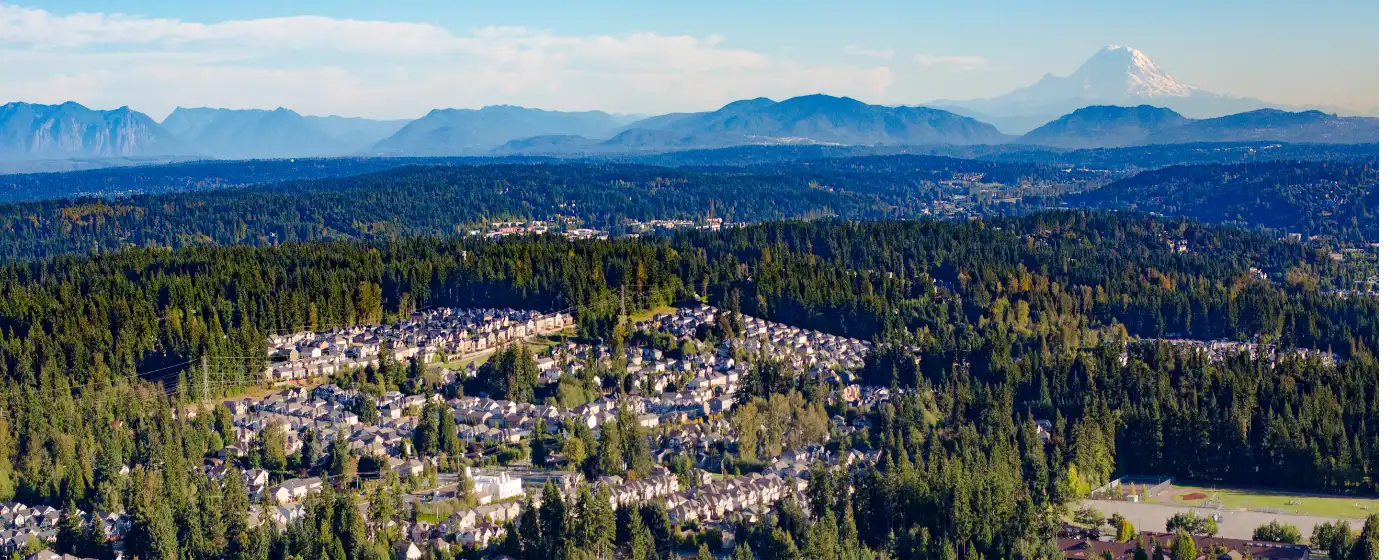
Most people moving to the Seattle metro focus on commute times and school ratings. What they don't realize until they're here is that Bothell's outdoor infrastructure is genuinely extraordinary for a city of 51,000 — not "nice suburban park" extraordinary, but "leave the car at home on a Saturday" extraordinary. Two regional trail systems converge inside city limits. Five salmon species spawn in a creek that runs through a neighborhood forest. You can rent a kayak downtown and paddle to the next city and back before lunch.
The geographic backbone of all of this is the Sammamish River, which cuts along Bothell's western edge and connects the city's two signature parks — the Park at Bothell Landing in the south and Blyth Park about a mile upstream. Both sit directly on the water, and both link to trail networks that extend well beyond Bothell's borders. The river is calm enough for beginners to paddle without a guide and scenic enough that herons, bald eagles, and beavers show up routinely. That combination — accessible water, real wildlife, paved trails to other cities — is what separates Bothell from comparable suburbs in this price range.
Away from the river, the North Creek corridor adds a completely different character: wetland boardwalks, old-growth-feeling forest, and a trail that runs north toward Mill Creek. The 64-acre North Creek Forest supports five anadromous fish species. These aren't amenities bolted onto a suburb as an afterthought — they're woven into the city's layout in ways that affect which neighborhoods people choose and how residents actually spend their free time.
Whether you're considering a move or researching what daily life here looks like, the sections below break down Bothell's signature parks, its trail network, water recreation on the Sammamish River, and how the city's outdoor calendar shifts by season.
The Park at Bothell Landing and Blyth Park: The Riverside Anchors
If you only visit two parks before deciding whether to move here, make it these two. They sit roughly a mile apart along the Sammamish River, they're connected by trail, and together they explain why residents in neighborhoods like Riverside and Downtown Bothell rarely feel the need to drive anywhere on a weekend morning.
The Park at Bothell Landing
This 6-acre riverfront park packs more onto a small footprint than most parks three times its size. The restored historic buildings give it a different visual character than a standard municipal greenspace — you're walking past century-old structures, not just turf and a parking lot. A pedestrian bridge spans the river and drops you directly onto the Sammamish River Trail, which is the gateway to everything else in this guide.
The hand-carried boat launch is where the kayak rental operation sets up — more on that in the water section. The amphitheater hosts summer programming that draws residents from across the city. And in December, the free Lights at the Landing display transforms the park into something genuinely worth making a trip for: the second annual event ran December 1, 2025 through January 5, 2026, and it has quickly become the kind of local tradition that people mention when they talk about why they stay.
For daily use, the Bothell Landing Trail is a 3.1-mile easy out-and-back with just 104 feet of elevation gain — rated 4.6 stars from over 1,090 AllTrails community reviews. Locals run it before work, walk it after dinner, and bird it year-round. Herons work the shallows just off the pedestrian bridge with regularity.
Blyth Park
At over 40 acres, Blyth Park is the largest in the city — and it holds a geographic distinction that matters to anyone who cares about connected trail networks. This is the exact point where the Burke-Gilman Trail ends and becomes the Sammamish River Trail. That junction makes Blyth the hub of Bothell's entire non-motorized transportation system.
The amenities here go beyond trails. The 10-hole disc golf course draws a consistent crowd on dry afternoons. Two reservable picnic shelters with grill access make it the practical choice for organized gatherings. Volleyball courts, a playground, and multi-use trails round out the offering. Wildlife sightings — birds, beavers, otters — are common enough that regulars barely mention them.
The Blyth Park and Tolt Pipeline Trail combination is the route to reach Norway Hill: a 2.5-mile moderately challenging out-and-back with 534 feet of elevation gain. It's the sharpest workout available inside city limits without driving anywhere, and it ends at views over the valley that most newcomers don't know exist until a neighbor mentions it.
| Park | Size | Key Features | Trail Connection | Best For |
|---|---|---|---|---|
| Park at Bothell Landing | 6 acres | Boat launch, amphitheater, historic buildings, gazebo, playground | Sammamish River Trail (direct) | Walkable Families |
| Blyth Park | 40+ acres | Disc golf, picnic shelters, volleyball, multi-use trails | Burke-Gilman / Sammamish River Trail junction | Nature Families |
| North Creek Park | — | Floating wetland boardwalk, wetland habitat | North Creek Trail | Nature Quiet |
| North Creek Forest | 64 acres | Second-growth forest, 7 streams, 9 wetlands, salmon spawning | North Creek corridor | Nature Privacy |
| North Creek Sportsfields | — | 3 synthetic turf fields, 1 grass field, reservable | North Creek neighborhood | Families |
Each park serves a different version of outdoor life in Bothell — which means residents rarely feel like they're choosing between river access and forest access. They're usually within a short drive of both.
Trail Networks: How Far You Can Go Without a Car
The trail infrastructure here is the part that genuinely surprises people after they move. The Sammamish River Trail and the Burke-Gilman Trail form a continuous non-motorized corridor that runs from Bothell's riverfront all the way to Golden Gardens in Seattle — and Bothell sits at one end of it.
The Sammamish River Trail
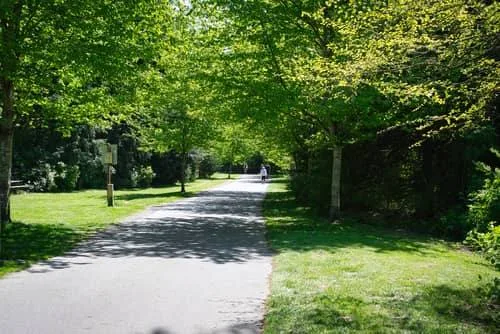
The 10.1-mile paved Sammamish River Trail runs south from Bothell to Marymoor Park in Redmond, tracing the river the entire way. King County Parks considers it one of the most popular trails in the county, and on a dry Saturday you'll understand why: the surface is smooth enough for road bikes, the grade is gentle throughout, and the river corridor keeps it green even when surrounding neighborhoods feel suburban.
Access from the Park at Bothell Landing is direct — cross the pedestrian bridge and you're on it. The trail passes through Kenmore and Woodinville territory before reaching Redmond, making it genuinely useful for cyclists who want distance without dealing with vehicle traffic.
The Burke-Gilman Connection
At Blyth Park, the Sammamish River Trail connects seamlessly to the Burke-Gilman Trail, which runs another 18.8 miles southwest to Golden Gardens on Seattle's Puget Sound waterfront. This is not a parks-and-rec talking point — it means a Bothell resident can commute by bicycle to parts of Seattle, or plan a full-day ride with a destination, without touching a road. Few suburbs at this distance from Seattle can make that claim credibly.
The North Creek Trail Corridor
Running in a different direction entirely, the North Creek Trail heads north from Bothell toward Mill Creek. Its southern terminus connects to the Sammamish River Trail at the University of Washington Bothell and Cascadia College campus — making the campus a natural midpoint for residents combining a trail run with an errand in either direction.
The trail passes through the North Creek corridor, where the 64-acre North Creek Forest sits alongside 7 streams and 9 wetlands. Five species of anadromous fish — chum, coho, sockeye, chinook, and steelhead — spawn in North Creek. Locals who walk this corridor in late fall sometimes stop to watch salmon moving upstream in water that runs through what looks, from the trailhead, like a quiet suburban greenbelt.
The Tolt Pipeline Trail
Less traveled than the river trails, the Tolt Pipeline Trail climbs from Blyth Park up to Norway Hill, gaining 534 feet over 2.5 miles. It's the route that regulars use when they want elevation instead of distance — and the views at the top, looking back toward the Sammamish River valley, are the kind of thing that doesn't show up in listing photos but influences where people decide to buy.
| Trail | Length | Surface | Elevation Gain | Connects To |
|---|---|---|---|---|
| Sammamish River Trail | 10.1 miles | Paved | Minimal | Marymoor Park, Redmond |
| Burke-Gilman Trail | 18.8 miles (from Blyth) | Paved | Moderate | Golden Gardens, Seattle |
| North Creek Trail | Regional, multi-mile | Paved / multi-use | Low | Mill Creek, UW Bothell campus |
| Bothell Landing Trail | 3.1 miles out-and-back | Paved | 104 ft | Sammamish River Trail |
| Blyth Park + Tolt Pipeline | 2.5 miles out-and-back | Mixed | 534 ft | Norway Hill |
| North Creek Park Boardwalk | Short loop | Floating boardwalk | Flat | North Creek wetland marsh |
The honest caveat: these trails get genuinely crowded on sunny weekends, particularly the Sammamish River Trail between Bothell Landing and Kenmore. If you want solitude, the Tolt Pipeline climb or the North Creek Forest are where you'll find it.
Water Recreation on the Sammamish River
The Sammamish River is calm in a way that makes it approachable for people who've never paddled before — and interesting enough for people who have. During summer paddling season, the current is minimal, the banks are lined with willows and cottonwoods, and the wildlife doesn't seem particularly bothered by boats.
Rentals and the Kenmore Float
WhatsSup operates kayak, canoe, and paddleboard rentals directly at the Park at Bothell Landing. The most popular route is straightforward: put in at the boat launch, paddle downstream to Log Boom Park in Kenmore, lock your boat, pick up the Burke-Gilman Trail, and ride or walk back to Bothell Landing — a 4.5-mile round trip. It's the kind of afternoon that feels like a full adventure without requiring any gear ownership or significant planning.
What you'll see along that corridor: great blue herons working the shallows, common mergansers moving in groups, egrets standing motionless in the reed beds, and bald eagles overhead more often than you'd expect this close to a suburb. Beaver activity is visible at multiple points — look for gnawed stumps along the bank and lodge structures in the side channels.
What the River Is and Isn't
The Sammamish is not a whitewater river. There are no rapids, no significant technical sections, and no real navigation decisions to make. That's a feature for families with younger kids and absolute beginners, not a limitation — the placid surface is the point. Experienced paddlers sometimes find it too calm, and they're not wrong. For those wanting moving water, the options require driving east toward the Snoqualmie or north toward the Skykomish.
The hand-carried boat launch at Bothell Landing is the practical access point. There's no ramp for motorized craft, which keeps the river corridor genuinely quiet — no wake, no noise, no competition for space on the water with powerboats.
What Locals Know About Timing
The river corridor in late fall — October through November — is when the salmon spawning run through North Creek makes this whole watershed feel like something more than a suburban amenity. North Creek drains into the Sammamish River near Bothell, and during peak spawn years, fish counts in North Creek have surprised residents who moved here without knowing it was happening. It doesn't require any equipment or planning: park at North Creek Park, walk the floating boardwalk through the wetland, and look down.
Summer weekends at the boat launch can mean a wait for rentals on the best weather days. Going on a weekday, or arriving before 10 a.m. on a Saturday, solves it. This is the kind of thing six-month residents figure out that newcomers don't expect.
Looking to buy in Bothell? Estimate your payment.
Enter your numbers to see an estimated monthly mortgage payment.
Estimate only. Excludes HOA fees and mortgage insurance. The interest rate above is a starting point, not a quoted rate — replace it with your own to see real numbers. Insurance is a flat placeholder, not a Bothell quote.
Seasonal Recreation and the Outdoor Calendar
Bothell's outdoor calendar doesn't shut down in winter — it shifts. The Pacific Northwest's reputation for rain is real, and the trails don't close when it's wet. What changes is who's on them and what they're doing.
Spring and Summer
The Sammamish River Trail peaks in late May through August, when the corridor is fully green and the light stays until nearly 9 p.m. This is when the WhatsSup rental operation runs at full capacity, when the Blyth Park picnic shelters need to be reserved well in advance for weekend gatherings, and when the Park at Bothell Landing amphitheater hosts its summer programming lineup. Disc golf at Blyth draws consistent play from late spring through early fall.
North Creek Sportsfields — three synthetic turf multi-purpose fields and one grass field reservable through Bothell Parks and Recreation — see heavy organized use through spring and summer. Families with kids in the area will find youth leagues and programs running on these fields from March through November. The synthetic surface means games don't get rained out the way grass fields do.
Fall
October is arguably the best month to be on the trails here. The deciduous trees along the Sammamish River corridor turn, the crowds thin relative to summer, and the salmon run in North Creek begins. Locals who have been here more than a year tend to plan their North Creek walks specifically for late October through mid-November. It's not publicized the way a ski area or a festival would be — it's just something residents know to look for.
The Tolt Pipeline climb to Norway Hill is particularly good in fall: the elevation gives you views of color across the valley that aren't visible from the river corridor.
Winter
The trails stay open. The paved surfaces of the Sammamish River Trail and Burke-Gilman Trail are passable year-round for cyclists and walkers willing to dress for rain. The main adjustment is footwear — the off-pavement sections of the Tolt Pipeline and North Creek Forest trails get genuinely muddy from November through March.
December brings Lights at the Landing to the Park at Bothell Landing — the free holiday display that has become the city's most visible seasonal event. The 2025–2026 event ran through January 5, which means it stretches past the holidays into the first week of the new year. For families who've just moved here in fall, it's often the first time they realize the park serves a social function beyond recreation.
The Honest Trade-Off
Everything described in this guide requires tolerance for rain and gray skies from October through April. The trails don't disappear in winter, but the experience of being on them is genuinely different from a dry-climate outdoor lifestyle. People who move here from California or Colorado sometimes underestimate how much that shift affects their motivation to get outside — and overestimate how much they'll use the trails from November through February. Gear investment (waterproof layers, proper footwear) matters more here than it would in a drier climate, and residents who adapt tend to be the ones who buy rain gear in September rather than waiting to see if they need it.
After a full year in Bothell, most residents land in one of two places: either the outdoor access becomes a defining feature of why they stay, or it's something they appreciate in the abstract but underuse. The city's trail network is genuinely exceptional — but it delivers for people who show up for it across all four seasons, not just the three sunny months.
Local Expert Takeaway: The two things that surprise people most after moving to Bothell: how far you can get without a car once you're on the Sammamish River Trail or Burke-Gilman, and the salmon run through North Creek in late October. Neither shows up in listing descriptions. The Park at Bothell Landing is where most people start — rent a kayak from WhatsSup, float to Kenmore, and bike back — and it's genuinely one of the better Saturday afternoons available in the Seattle metro for a city that isn't Seattle.
Quick Takeaways & FAQs
✅ Bothell sits at the junction of the Sammamish River Trail and Burke-Gilman Trail, creating a continuous non-motorized corridor that reaches Golden Gardens in Seattle — one of the most connected trail networks in the entire metro.
⚠️ The trails get genuinely crowded on sunny weekends, and winter rain from October through April requires real gear investment — residents who underestimate the wet season tend to underuse the outdoor access they moved here for.
📍 Five species of salmon — chum, coho, sockeye, chinook, and steelhead — spawn in North Creek each fall, visible from the floating boardwalk at North Creek Park, which sits inside city limits in the North Creek neighborhood.
Can you kayak the Sammamish River in Bothell without your own boat?
How long is the Sammamish River Trail and where does it go from Bothell?
What is the largest park in Bothell?
Do salmon actually spawn in Bothell?
Are Bothell's parks and trails usable year-round?
Moving to Washington?
Tell us what you need help with and we'll connect you with local resources.
