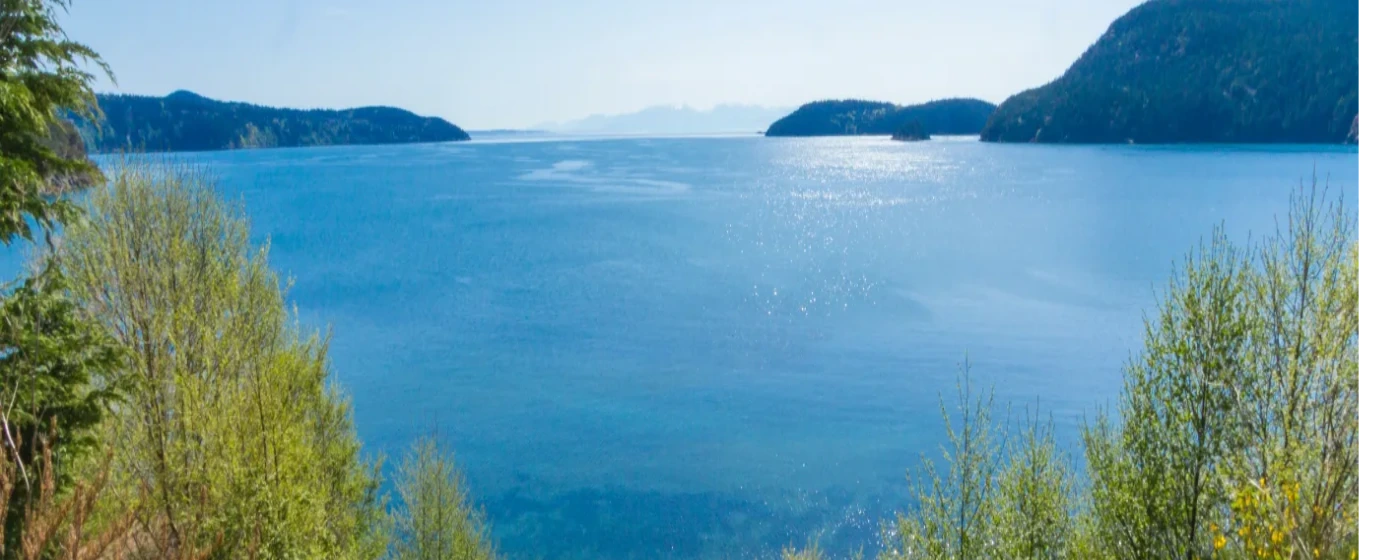
If you've priced out Seattle and watched Bellingham creep toward the same range, Anacortes can look like a reasonable alternative — waterfront access, a small-town pace, and a price point that sits noticeably below the metro. That read is correct as far as it goes. What it misses is that Anacortes sits on Fidalgo Island, with a geographic reality that shapes almost every line item in your monthly budget: a smaller grocery and retail footprint than any comparable-sized mainland city, ferry fares that become a real cost for anyone commuting to the San Juans, and a housing market propped up by refineries, shipbuilding wages, and steady demand from retirees and remote workers who want water views without Island County prices.
The economic backbone here is industrial in a way that surprises people expecting a purely tourism-driven town. HF Sinclair and Marathon Petroleum both operate petroleum refineries on the March Point peninsula, and Dakota Creek Industries runs a working shipyard. Those employers anchor mid-to-upper-income households that support local retail, and they keep the unemployment rate low enough that rents don't soften much even when inventory rises. Families from across Skagit County seek out Anacortes for its schools, adding housing demand from that direction too.
Overall, plan for a cost of living approximately 14–20% above the U.S. national average, and roughly 3% above Washington State's own average. That sounds modest until you see where the gap concentrates: housing. Groceries run 7–10% above average, utilities are actually a relative bargain thanks to the region's hydroelectric grid, and Washington's zero personal income tax is a genuine offset — meaningful enough to change the calculus if you're relocating from California or Oregon. The city is not cheap, but the costs are not evenly distributed across every category, which matters when you're building a real budget.
Whether you're deciding between renting and buying, comparing Anacortes to Mount Vernon or Oak Harbor, or trying to figure out what a realistic monthly number looks like, the sections below break down Anacortes's housing market, everyday costs, a side-by-side city comparison, and the full tax picture.

What It Really Costs to Live in Anacortes
The single biggest driver of Anacortes's above-average cost of living is housing. The Zillow Home Value Index puts the typical home price at $690,991 as of mid-2026 — roughly 2.5 times the national median. That figure reflects a market where supply is structurally constrained: Fidalgo Island has finite buildable land, and the city's boundaries mean new inventory doesn't appear at the rate it does in sprawling mainland cities like Mount Vernon or Burlington.
The price-to-income ratio tells the harder story. With a median household income of $91,951, a buyer putting 20% down faces a ratio of roughly 7.5× income — well above the 3–4× threshold most financial planners consider affordable. That gap is bridged in practice by dual-income refinery and maritime households, remote workers importing higher salaries, and buyers cashing out equity from pricier West Coast markets. If none of those descriptions fit you, the math is genuinely difficult.
On the non-housing side, the picture is more mixed and worth understanding before you assume the worst. Electricity at roughly 13.81 cents per kilowatt-hour (January 2026) runs well below national rates, a benefit of the Pacific Northwest's hydroelectric infrastructure. Groceries cost more than in a larger city with competing retailers, but not dramatically so. And Washington's absence of a personal income tax is a real, recurring offset that doesn't show up in index comparisons but shows up in your paycheck every month.
Housing: Rent vs Buy in Anacortes
The Buying Side
Entry-level homes in Anacortes — typically older construction on smaller lots, or condos — start in the low-to-mid $400,000s, with the city-wide typical price sitting at $690,991 (Zillow Home Value Index, mid-2026). The spread between entry-level and median is wide enough that what you can afford and what's available at that price are often two different conversations. For neighborhood-by-neighborhood detail on where the lower price points cluster, see the Best Neighborhoods guide.
The effective property tax rate is approximately 0.79% of assessed value — one of the lower rates in Washington State, and meaningfully below what King County buyers pay. State law caps the city's annual levy increase at 1%, which limits how fast that bill climbs year over year. Use the mortgage calculator below to model your actual monthly ownership cost; this section intentionally stops at rates and ratios.
The Renting Side
Average monthly rent in Anacortes runs approximately $2,094, which sits well above the national average for a city of this size. The rental market here is tight because inventory is limited and because the same structural constraint that pushes home prices up — finite island land — keeps rental supply constrained too. A two-bedroom apartment in a standard complex runs roughly $1,900–$2,300 depending on location and amenities.
Renting makes more financial sense than it does in many Pacific Northwest cities because the buy-vs-rent math is unusually unfavorable here. When a median home costs 7.5× the median income, the monthly cost of ownership consistently exceeds rent even after accounting for equity building. That said, many buyers accept the stretch because of what Anacortes ownership delivers that a lease can't: water views, stability in a market where rentals turn over quickly, and a foothold in a market where supply isn't growing.
The Ferry Factor
One cost renters and buyers alike often underestimate: if your work or lifestyle involves regular trips to the San Juan Islands, Washington State Ferry fares become a recurring budget line. The Guemes Island Ferry — a short, frequent crossing operated by Skagit County — is a separate fare again. Neither is expensive per trip, but for daily or weekly commuters the annual total adds up in a way a mainland city resident never has to consider.
Everyday Costs Beyond Housing in Anacortes
Utilities are the pleasant surprise. Electricity at roughly 13.81 cents per kilowatt-hour (January 2026, EIA-sourced data) runs well below national rates, and natural gas costs in the Pacific Northwest stay moderate compared to the Northeast or Midwest. That said, January 2026 brought a utility rate increase of approximately 2.8% across water, sewer, solid waste, stormwater, and the city's fiber internet service — and the city council simultaneously raised the municipal tax on water, sewer, and stormwater from 7% to 9%, the first such increase since 1973. The electricity advantage is real; the water and sewer side is getting more expensive.
Groceries are the less pleasant reality. Anacortes's island-adjacent geography means fewer competing retailers than you'd find in Bellingham or even Mount Vernon, and that limited competition keeps prices 7–10% above the national average. Stocking up on a trip to Burlington or Mount Vernon is a habit many Anacortes households develop within the first few months of living here — it's a small but telling example of how island life shapes everyday logistics in ways that don't show up in a cost index.
| Category | Typical Monthly Cost | Notes |
|---|---|---|
| Housing (2BR rent) | $1,900–$2,300 | Rental estimate; owners: use the mortgage calculator above for ownership costs |
| Electricity & Gas | $110–$160 | Electricity below national avg (~13.81¢/kWh); gas moderate; rates rose ~2.8% Jan 2026 |
| Water, Sewer & Waste | $90–$130 | Municipal utility tax increased to 9% effective January 2026 |
| Groceries | $500–$750 | Roughly 7–10% above national avg; many households supplement with trips to Burlington |
| Transportation & Gas | $250–$400 | Car-dependent; Mount Vernon ~20 min; add ferry fares if commuting to San Juans |
| Phone & Internet | $100–$160 | City fiber available; competitive with regional averages |
| Misc / Discretionary | $300–$600 | Dining, recreation, subscriptions; local options more limited than Bellingham |
These are estimates for a single adult or couple renting a two-bedroom unit; a family's grocery and transportation lines will run higher.
Looking to buy in Anacortes? Estimate your payment.
Enter your numbers to see an estimated monthly mortgage payment.
Estimate only. Excludes HOA fees and mortgage insurance. The interest rate above is a starting point, not a quoted rate — replace it with your own to see real numbers. Insurance is a flat placeholder, not a Anacortes quote.
Anacortes vs Nearby Cities: Cost Comparison
| City | Median Home Price | Typical 2BR Rent | Cost vs Anacortes |
|---|---|---|---|
| Anacortes | $690,991 (ZHVI, mid-2026) | ~$1,900–$2,300/mo | — Baseline — |
| Bellingham | ~$575,000–$610,000 | ~$1,700–$2,000/mo | Noticeably cheaper |
| Mount Vernon | ~$490,000–$530,000 | ~$1,500–$1,800/mo | Meaningfully cheaper |
| Burlington | ~$480,000–$520,000 | ~$1,450–$1,750/mo | Meaningfully cheaper |
| Oak Harbor | ~$430,000–$480,000 | ~$1,400–$1,700/mo | Considerably cheaper |
| Sedro-Woolley | ~$430,000–$490,000 | ~$1,400–$1,700/mo | Considerably cheaper |
* ZHVI = Zillow Home Value Index. Non-Anacortes figures are approximate ranges drawn from available 2025–2026 market data and should be treated as directional, not exact.
The pattern is consistent: every nearby market comes in cheaper, with Oak Harbor and Sedro-Woolley offering the steepest discounts and Bellingham the smallest gap — though Bellingham brings an amenity base that smaller Skagit County communities don't match.
Taxes & the Bottom Line for Anacortes
No State Income Tax
Washington levies no personal income tax — none, at any income level. For a household earning the local median of $91,951, that's a meaningful annual difference compared to Oregon (which taxes wages above roughly $10,000 at 8.75–9.9%) or California (where the same income would face a roughly 6–9% marginal rate depending on filing status). The income-tax advantage doesn't reduce what you pay for groceries or a mortgage, but it does change the effective cost of living in a way that raw index comparisons miss.
Sales Tax
The combined sales tax rate in Anacortes is 8.9% — the 6.5% Washington State base plus a 2.4% city add-on. That's lower than Seattle's 10.35% but a touch above the Skagit County average of 8.6% for most incorporated communities. Importantly, groceries and prescription medications are exempt from Washington sales tax, which takes some sting out of the above-average grocery prices discussed earlier.
Property Tax
At an effective rate of approximately 0.79%, Anacortes's property tax burden is relatively contained by Washington standards. State law limiting annual levy increases to 1% means you can model future property tax growth with more confidence than in states where assessed value can jump sharply in a hot market. That predictability is genuinely useful for long-term budget planning.
The Honest Bottom Line
Anacortes fits households that either earn well above the local median, carry substantial equity from a previous home sale, or earn remotely at rates benchmarked to a higher-cost market. The income-tax and electricity advantages are real offsets. The housing price-to-income ratio and above-average grocery costs are real headwinds. Remote workers importing Seattle or Bay Area salaries into Anacortes's cost structure often find it genuinely comfortable; local-wage earners stretching to the city-wide typical home price often find it a sustained financial strain. That tension — attractive lifestyle, structurally constrained supply, incomplete affordability — is the honest shape of the Anacortes cost picture.

Local Expert Takeaway: The number that reframes the Anacortes cost conversation fastest: electricity at roughly 13.81 cents per kilowatt-hour, well below the national rate, thanks to hydroelectric power — while groceries and rent both run above average, partly because Fidalgo Island's limited retail competition gives you fewer options than you'd have in Bellingham or Burlington. Many households end up doing a bigger grocery run in Burlington every week or two, which adds a bit of drive time but trims the food bill. The genuine budget win is Washington's zero income tax; for anyone relocating from Oregon or California, that single line item can offset a meaningful chunk of the housing premium. Anacortes is not a budget destination, but it rewards people who understand where the costs are — and where they aren't.
Quick Takeaways & FAQs
✅ Washington's zero personal income tax is a real financial advantage in Anacortes — for a median-income household relocating from Oregon or California, the annual savings can run into the thousands.
⚠️ The typical home price of $690,991 (Zillow Home Value Index, mid-2026) produces a price-to-income ratio of roughly 7.5× the local median household income — a difficult gap for buyers without outside equity or above-median earnings.
📍 Many Anacortes residents make weekly or biweekly grocery runs to Burlington or Mount Vernon to offset the island-adjacent premium — a small logistics reality that becomes second nature within a few months.
What is the typical home price in Anacortes, WA in 2026?
What is the average rent in Anacortes, WA?
Does Anacortes have a state income tax?
What is the property tax rate in Anacortes, WA?
How do everyday costs like groceries and utilities compare in Anacortes?
Moving to Washington?
Tell us what you need help with and we'll connect you with local resources.
