
You've done the math a dozen times — and every time, the numbers point south. Californians have been making this move in extraordinary numbers: more than 700,000 relocated to Texas between 2020 and 2025, the single largest interstate population shift in the country over that period. Waxahachie, about 40 minutes to Dallas on I-35E, has become one of the more compelling landing spots in that wave — not because it's been marketed heavily, but because the price gap is genuinely hard to ignore when northern DFW suburbs like Frisco and Prosper have pushed past $600,000 and higher. Waxahachie sits at the southern end of the corridor, where Ellis County still has land, and where a small-city identity built around a Victorian courthouse square hasn't yet been bulldozed into strip-mall sameness.
What draws California transplants specifically isn't just price. It's the income-tax elimination. Texas has no state income tax — it is constitutionally prohibited — and for someone leaving a state with California's top state income tax rate of 13.3%, even the middle-income savings compound meaningfully over a decade. The median household income here is $85,723, and the broader economy draws from Waxahachie Independent School District, the City of Waxahachie, Ellis County government, and major employers like Owens Corning and Cardinal IG on the manufacturing side. A regional health system also operates a significant facility here. The community skews toward families and people who want a genuine small-city rhythm — 50,090 residents, enough to have real infrastructure without the sprawl fatigue of a bigger suburb.
The cost-of-living contrast is real enough to be jarring in the best way. Groceries and transportation run at or below national averages, and Texas's exemption of food from sales tax adds meaningful relief for household budgets. The typical home value here was $371,652 as of July 2026 — see the full breakdown on the cost of living page. Utilities run above the national average because Texas summers are brutal and air conditioning is not optional, but transportation costs run noticeably below what Californians from major metros are used to paying. The lifestyle trade-off is more subtle: 232 sunny days a year, a genuine historic downtown, and a pace of life that takes some adjustment if you're arriving from a major coastal metro.
Whether you're already under contract or just starting to research, this guide covers what California movers specifically need to know about Waxahachie — the tax picture, the property mechanics, the cost comparison, what's growing here, and where daily life actually lands after month six.
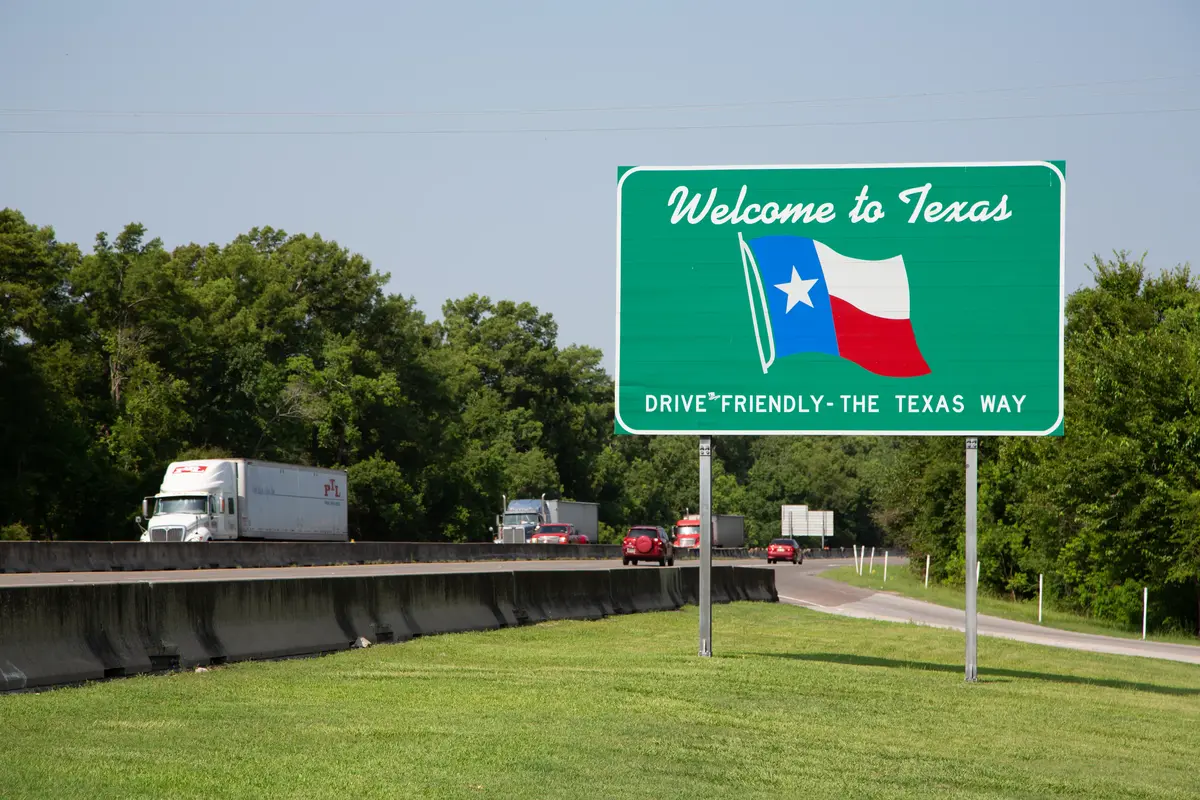
The Tax Shift: What Leaving California Actually Means
The headline is the income tax. Texas has no state income tax — it is constitutionally prohibited. California's top state income tax rate of 13.3% applies only to the highest earners, but the brackets climb steeply: at $100,000 in household income, a California resident pays an effective state rate of roughly 5.8%. In Texas, that line is zero. For a dual-income household, the savings in year one can be substantial enough to cover moving costs outright.
Sales tax is a real trade-off, and Californians should go in with eyes open. California's statewide base sales tax rate of 7.25% is a floor, not a ceiling — many California counties and cities layer additions on top of it. Waxahachie's combined rate is 8.25%, comprising a 6.25% Texas state rate and a 2.0% city add-on. That is higher than California's base rate, and if you were living in a California jurisdiction where the local rate had already pushed above 8.25%, it may not represent much change. The meaningful offset: groceries are fully exempt from Texas state and city sales taxes, which matters for household budgets.
The Property Tax Reality Check
This is the one that surprises almost every California transplant, and it's worth understanding before you close. California's effective property tax rate of 0.71% is held artificially low by California's own Proposition 13, which locks in assessed value and caps annual increases at 2% as long as you own the property. Texas has no equivalent cap — it reassesses annually at current market value, and its effective statewide rate averages around 1.40%.
Waxahachie's effective property tax rate is 1.35%. On a $371,652 home (July 2026 typical value), the annual tax burden is genuinely larger in rate terms than what most California homeowners pay — but because Texas home prices are substantially lower than California's statewide typical home value of $773,735, the absolute dollar difference in your actual tax bill can be narrower than the rate gap makes it look.
There is one critical mechanic to understand: Texas resets assessed value to current market value at every sale. A California buyer accustomed to a tax bill tied to a decades-old assessed value should expect their first full Texas property tax assessment to reflect full market value, with no cap protection in that initial year. The number can be a genuine shock if you are not prepared for it.
The Homestead Exemption (and the Naming Coincidence)
Texas voters approved their own Proposition 13 — officially SB 4 — in November 2025, raising the mandatory school-district homestead exemption from $100,000 to $140,000. This reduces the taxable assessed value used for school-district taxes on your primary residence. Homeowners 65 or older qualify for an additional $60,000 exemption, bringing the combined school-district reduction to $200,000. The naming coincidence is worth noting: two states, two Proposition 13s, two completely different mechanisms — one caps value growth, the other removes a chunk of assessed value from the school-district calculation. They are not the same, and the Texas version does not protect you from market-value reassessment at sale.
Home Prices: The Number That Drives the Move
The typical home value in Waxahachie was $371,652 as of July 2026 (Zillow Home Value Index). California's statewide typical home value of $773,735 is the right comparison — not a metro-level number, but the statewide figure from the same Zillow series, so the two are genuinely comparable. The gap is large enough to reshape what a California buyer can own.
What that gap buys in Waxahachie is real square footage on real land. Entry-level homes — older construction in areas like Indian Hills, which sits below the city median in price tier — can bring you into the market for less. Saddlebrook Estates lands at roughly the city median. The neighborhoods page walks through the character and feel of each area; the range from the historic Downtown District to newer master-planned pockets on the city's edges is wider than you might expect for a city of 50,090.
What $371,652 Gets You Here vs. There
In California, that figure is a down payment conversation in many markets. In Waxahachie, it is the median purchase. That means a four-bedroom house with a yard, in an established neighborhood, within practical driving distance of Dallas — the kind of purchase that has become structurally impossible for median-income buyers in most California metros.
The honest caveat: the median household income of $85,723 sits below the income level needed to comfortably carry the typical home here at current rates. Waxahachie is not an inexpensive market by Ellis County historical standards. It has grown substantially since the 2020 census, and that growth has moved prices. Californians arriving with equity from a coastal sale are often in a fundamentally different position than local first-time buyers — the equity story is real, but it has already started to reshape the local market around you.
What's Being Built — and What It Means for Buyers
The biggest development signal is the Minto Communities USA project: in January 2026, the Waxahachie City Council approved a 3,170-acre master-planned community west of I-35E, calling for 13,270 homes, roughly 1,400 multi-family units, and 400 acres of open space and parks, with plans for multiple schools. A separate 75-acre mixed-use project called Palmetto Road, near downtown, was poised to break ground in mid-2026 with a first phase estimated at $35 million that would include multifamily and single-family rental units along US-287.
For a California buyer weighing whether Waxahachie has runway or has already peaked: the scale of approved development is the clearest signal available. That is not a guarantee of appreciation, but it is a signal that the city is not finished building. For the buying process mechanics, including what to expect at offer and closing in this market, see the dedicated page.

Cost of Living: Beyond the Headline Numbers
Californians arriving from major metros almost universally describe the same reaction after month three: the money goes further in ways they did not fully anticipate even after running comparisons. That shift is real, and it shows up in specific line items rather than an abstract index.
Groceries and transportation are where the relief is most felt. Grocery costs here run close to or below national averages, and Texas's exemption of food from sales tax adds to that. Transportation costs run noticeably below what Bay Area or LA residents are used to — less parking, lower gas prices, no metro-area toll accumulation. Utilities are the offset: Texas summers mean air conditioning runs hard for five or six months, and electric bills in July and August can be substantially higher than anything a California coastal resident has experienced. Budget for it.
What Californians Get Wrong About the Trade-Off
The tax elimination is real. But it does not mean Waxahachie is inexpensive in absolute terms. A household earning $85,000 — the local median — still finds the typical home a stretch at current rates. The California-to-Waxahachie move works best financially when it involves a meaningful equity transfer: selling a California home and arriving with a down payment that changes the monthly math entirely.
The lifestyle adjustment is harder to quantify. Waxahachie has 232 sunny days a year, and its summers are genuinely hot and humid in a way that coastal California does not prepare you for. The flip side: winters are mild enough that outdoor life continues year-round, and the city's greenspace, anchored by Getzendaner Park and Lake Waxahachie, gives people somewhere to actually be. For the full utilities and cost breakdown, the cost of living page covers it in detail.
Six Months In: What Nobody Warned You About
Two things tend to surprise California transplants after they've settled. First, the property tax bill — not because they weren't warned, but because seeing a number that reflects full current market value, with no Proposition 13 protection, hits differently in practice than in a spreadsheet. Second, the dining and retail footprint. Waxahachie has real local options — independent coffee shops, a farmers market, a genuine downtown — but if you are accustomed to the density of a California metro, the adjustment to a city of 50,090 takes a few weeks. A serious shopping trip may mean driving out of town. You will be ordering online for anything the local shops don't carry.
Looking to buy in Waxahachie? Estimate your payment.
Enter your numbers to see an estimated monthly mortgage payment.
Estimate only. Excludes HOA fees and mortgage insurance. The interest rate above is a starting point, not a quoted rate — replace it with your own to see real numbers. Insurance is a flat placeholder, not a Waxahachie quote.
Growth, Infrastructure, and the I-35E Corridor Story
The reason Waxahachie is on California buyers' radar in 2025 and 2026 is not marketing — it is arithmetic. As northern DFW suburbs like Frisco and Prosper approach build-out with median prices well above $600,000, the growth that powered them has started moving south along I-35E into Ellis County. Waxahachie is one of the primary beneficiaries of that shift, and buyers arriving from California are part of a pattern the city's planners are actively building around.
The Minto development approved in January 2026 — 3,170 acres, 13,270 homes, multi-year buildout — is the largest single signal of that trajectory. The Palmetto Road project near downtown adds a mixed-use layer closer to the city's core. Both represent decisions that have already been made; neither is speculative at the planning level, though multi-year buildouts always carry execution risk. What a California buyer should understand is that Waxahachie at 50,090 people and Waxahachie at a significantly larger population are genuinely different cities, and the version you are buying into is in transition.
The Commute Reality
I-35E and US-287 are the two primary routes out of Waxahachie, and both carry real weekday traffic heading toward Dallas. The commute reference figure is about 40 minutes to Dallas — that is the baseline, not rush-hour. If your job is in the southern Dallas employment corridors, that figure is workable. If you are commuting to a northern Dallas or Plano office, add meaningful time. The growth happening along I-35E also means that commute pattern will get more complicated before the infrastructure catches up. For remote workers, this matters less — and a notable share of people making the California-to-Waxahachie move are either fully remote or in hybrid arrangements that make the drive a one-or-two-day-a-week consideration rather than a daily one. For full commute detail, see the living in Waxahachie page.
Airport Access
Dallas Love Field is the nearest major airport, 32 miles from Waxahachie. Dallas-Fort Worth International is also within reasonable reach. For Californians who travel frequently for work or plan regular trips back to family — which is nearly everyone who makes this move — the airport access is an honest positive.
Weekends, Local Life, and Whether Waxahachie Sticks
California transplants who leave Waxahachie after a year or two usually cite the same things: missing the density of options, missing the coast, and — occasionally — finding the summer heat genuinely incompatible with how they want to live. The people who stay tend to say the same thing: they found community faster here than they expected, and the lower financial pressure changed the texture of daily life in ways that are hard to fully anticipate from a spreadsheet.
The city's social fabric is built around its historic core. The Ellis County Courthouse — a landmark courthouse that was the backdrop for a dozen films, most famously Bonnie and Clyde — anchors a downtown that still functions as a gathering place rather than a nostalgia prop. The Chautauqua Auditorium and the Ellis County Museum (housed in the 1889 Masonic Temple) give the city a civic identity that newer suburbs in the DFW corridor have not had time to build. The 1889 truss bridge hike and bike trail gives residents a genuine outdoor amenity tied to the city's own history.
Where Locals Actually Spend Time
Getzendaner Park is the city's main green anchor — large enough to feel like a real park, central enough that it shows up in the rhythm of a regular week. Lake Waxahachie draws people on weekends, particularly in the shoulder seasons when the heat is manageable. The Waxahachie Farmers Market is a genuine weekly gathering point, not a tourist overlay.
For coffee and food, the local options are stronger than a city of this size might suggest. Campuzano's Fine Mexican Food has been a Waxahachie institution long enough that regulars have strong opinions about it. Cajun Bros brings a menu that would feel at home in southeast Texas. Tuscan Slice, Rockett Cafe & Club, and College Street Pub round out the casual dining scene with enough variety that the downtown core can sustain a Friday night out without driving. On the coffee side, Fresh Market Coffee, Three Rivers Coffee Co, Peaberry Coffee, VITA COFFEE HOUSE, and Bloom & Pour give the city a genuinely local café culture — independent shops, not chains. For someone arriving from a California city with a strong coffee identity, it is a better situation than you might expect.
Schools: The Honest Picture
Waxahachie Independent School District, with 11,170 students enrolled in 2025-26, holds a C rating, according to the Texas Education Agency. On 2024-25 state assessments, 40% of students reached math proficiency and 51% reached reading proficiency — figures that are below where most California parents arriving from higher-rated districts will be accustomed to. The district has active UIL athletics programs, and Friday night football at Waxahachie High School draws the kind of community turnout that is genuinely different from the California suburban high school experience. For the full picture on individual campuses and what the rating means in practice, the schools page covers it. Families with strong academic priorities should read it before making a final decision.
Safety is a real point in Waxahachie's favor for California transplants accustomed to urban crime rates. The safety page has the full breakdown, with comparison data. For retirees making this move, the retiring in Waxahachie page covers what that transition specifically looks like.

Local Expert Takeaway: The California-to-Waxahachie move pencils out most cleanly for buyers arriving with equity from a coastal sale — the price gap relative to California's statewide typical home value of $773,735 is large enough to change the entire financial picture, and the income tax elimination is immediate and permanent. What slows people down is the property tax rate and its mechanics: at 1.35%, assessed at full market value with no cap at purchase, it is not the benign line item California homeowners are accustomed to. Factor that into your monthly math before you fall in love with a house. The city itself is more cohesive than its size suggests — a genuine courthouse-square downtown, Getzendaner Park as a real anchor, and a local restaurant and coffee scene that rewards exploring. The Minto development approved in January 2026 is the most consequential long-term signal about where this city is headed; buying now means buying into a Waxahachie that is still in the earlier chapters of a growth story that the approved development pipeline suggests has significant runway.
Quick Takeaways & FAQs
✅ Waxahachie's typical home value of $371,652 (July 2026) sits well below California's statewide typical home value of $773,735 — and Texas's zero state income tax compounds the savings from day one.
⚠️ The property tax rate of 1.35% is assessed at full current market value with no Proposition 13-style cap at purchase, which surprises nearly every California transplant when the first bill arrives.
📍 The Minto Communities USA development — 13,270 homes approved in January 2026 on 3,170 acres west of I-35E — is the largest residential project in the city's history and a major signal about where Waxahachie is headed.
How much do California homeowners actually save on taxes by moving to Waxahachie?
Is Waxahachie's property tax really that different from California's?
What's the realistic commute from Waxahachie to Dallas?
How are the schools in Waxahachie compared to what I left in California?
Is Waxahachie still growing, or has the California buyer wave already priced it up?
Moving to Texas?
Tell us what you need help with and we'll connect you with local resources.
