San Antonio Metro · Cost of Living · 2026
Cost of Living in San Antonio Metro, Texas — Every City Ranked
Cities ranked by what it actually costs to buy and live here, from working-town pricing to Hill Country premiums.
Cities ranked by what it actually costs to buy and live here, from working-town pricing to Hill Country premiums.
If you're weighing a move somewhere in the San Antonio orbit, the first thing you learn is that 'the metro' covers a lot of different financial realities. A Bexar County suburb built around a military base plays by completely different rules than a Kendall County Hill Country town or a Gonzales County agricultural community an hour out on the highway. The corridors connecting these places — I-10 toward Boerne, I-35 toward New Braunfels, US-181 toward Floresville — don't just carry traffic; they mark real transitions in what a dollar buys and what kind of life you're buying into.
The spread across these cities is wide, and what drives it is rarely a mystery. Proximity to the San Antonio city limits and the Bexar County job base pulls prices upward in places like Live Oak, Converse, and Universal City, even when those cities feel decidedly suburban. Step into Kendall County or into an established inner-ring enclave and the premium reflects school districts, topography, and the specific gravitational pull of the Hill Country. Head out toward Gonzales, Pleasanton, or Floresville and you're in genuinely different economic territory — smaller-town wages, bigger lots, and home prices that still reflect a working-town reality rather than commuter demand. The sections below break down what each city actually costs, what drives that price, and which kind of buyer tends to find it worth it.
All prices reflect 2026 market data sourced from Zillow and cross-referenced with our individual city guides. County tax rates are verified effective rates.
Ranked by overall affordability. Click any city to jump to the full breakdown.
| # | City | Home Price | Monthly PITI | Income to Buy | Est. Rent |
|---|---|---|---|---|---|
| 1 | Gonzales Gonzales County | $249,933 | $1,690/mo | $58,026/yr | $1,050/mo |
| 2 | Live Oak Bexar County | $244,551 | $1,659/mo | $79,806/yr | $1,482/mo |
| 3 | Converse Bexar County | $243,003 | $1,647/mo | $80,282/yr | $1,650/mo |
| 4 | Leon Valley Bexar County | $264,962 | $1,798/mo | $80,847/yr | $1,235/mo |
| 5 | Universal City Bexar County | $266,030 | $1,845/mo | $82,561/yr | $1,450/mo |
| 6 | Seguin Guadalupe County | $274,107 | $1,894/mo | $85,378/yr | $1,200/mo |
| 7 | Floresville Wilson County | $357,825 | $2,324/mo | $89,725/yr | $1,150/mo |
| 8 | Selma Bexar County | $287,687 | $2,002/mo | $90,715/yr | $1,400/mo |
| 9 | Pleasanton Atascosa County | $260,145 | $1,854/mo | $90,925/yr | $1,244/mo |
| 10 | Schertz Guadalupe County | $315,578 | $2,083/mo | $97,336/yr | $1,593/mo |
| 11 | New Braunfels Comal County | $351,190 | $2,357/mo | $101,225/yr | $1,650/mo |
| 12 | Cibolo Guadalupe County | $336,323 | $2,271/mo | $102,563/yr | $1,650/mo |
| 13 | Boerne Kendall County | $562,046 | $3,640/mo | $153,232/yr | $1,577/mo |
| 14 | Alamo Heights Bexar County | $739,289 | $5,127/mo | $210,548/yr | $1,950/mo |
#1 Most Affordable · Gonzales County
Best for buyers who want genuine small-town Texas pricing
Gonzales sits at the intersection of US-90A, US-183, and SH-97, well east of the metro's commuter belt — and that distance is exactly what keeps its pricing anchored to local reality rather than San Antonio spillover. A $249,933 typical home price reflects a genuine small-town economy: Gonzales County agriculture, light local industry, and a historic downtown that hasn't been discovered and repriced yet. This is a place where the cost of housing still tracks what people here actually earn, which makes it genuinely accessible for buyers who don't need to be close to the city's job centers.
Gonzales suits buyers who are either working remotely, retiring on a fixed income, or willing to trade a longer drive for a fundamentally different price floor. It's a working town with small-town character — not a suburb with small-town prices. Buyers expecting suburban amenity density alongside the lower costs tend to be disappointed; the trade-off is real and worth understanding before you make an offer.

#2 Military-Adjacent Inner Ring · Bexar County
Best for buyers who need Bexar County access on a modest budget
Live Oak sits inside Bexar County with I-35 running through it and Loop 1604 marking its edge — which means it carries suburban San Antonio pricing despite feeling like a quieter, lower-density community. A $244,551 typical home price reflects its older housing stock and a neighborhood character that hasn't fully been reset by new construction. The proximity to Randolph Air Force Base shapes who buys here and keeps the market more stable than some of its neighbors.
Live Oak fits buyers who want genuine Bexar County access — I-35 connectivity, established neighborhoods, real proximity to the city — without paying the premium that newer master-planned suburbs command. The housing is older, the lots are reasonable, and the commute math actually works. Buyers looking for walkable retail or new construction will find this city doesn't deliver either.
#3 Lowest Home Price · Bexar County
Best for first-time buyers and military families near JBSA
Converse has grown into one of the metro's more substantial suburban cities, sitting east of San Antonio along I-10 and FM 78 with Loop 1604 as its western boundary. A $243,003 typical home price — sustained by a mix of older subdivisions and military-adjacent demand from the Joint Base San Antonio communities nearby — reflects real suburban infrastructure: established schools, city services, and enough retail density to avoid the 'nothing here' problem some outer-ring cities have.
Converse tends to suit first-time buyers and military families who want Bexar County proximity without paying for a trendier zip code. The character is solidly suburban and functional rather than polished, and the highway access is genuinely useful. Buyers comparing Converse with Live Oak will find a similar price point but a denser, more developed suburban feel on the Converse side.
#4 Inner-Loop Enclave · Bexar County
Best for buyers who want inner-loop access without inner-loop prices
Leon Valley is one of the metro's most geographically efficient small cities — entirely enclosed within Bexar County, hugging SH-16 (Bandera Road) and sitting just inside I-410 (Loop 410), which puts it closer to San Antonio's core than most suburbs on this list. A $264,962 typical home price reflects that location premium: you're buying inner-loop access and the convenience that comes with it. The housing stock skews older, which is part of why the price hasn't climbed further, but the bones of the city — established streets, mature trees, genuine proximity — are what buyers are really paying for.
Leon Valley fits buyers who prioritize location over newness and don't want a long drive to reach the city's amenities. The trade-off is aging infrastructure and a more modest commercial strip rather than a curated suburban downtown. It's a practical choice for buyers who've done the drive-time math and decided the commuter suburbs farther out don't actually save them money once fuel and time are counted.
#5 Base-Community Suburb · Bexar County
Best for buyers tied to Randolph and the northeast corridor
Universal City sits at the northeastern edge of San Antonio's suburban ring, where FM-78, SH-218 (Pat Booker Road), and Loop 1604 converge near Joint Base San Antonio — Randolph. A $266,030 typical home price reflects the military-community demand that has always anchored this part of the metro: stable, consistent, and tied to a population that moves in and out on predictable cycles. The city is small but fully suburban in feel, with the kind of retail and services you'd expect from a community that exists partly to support the base.
Universal City suits buyers who want established northeast San Antonio access and value proximity to Randolph above other considerations. The character is closer to Live Oak than to Schertz — more settled, less aggressively growing. Buyers expecting a lot of new development will find Universal City's pace more measured.

#6 River Town With Industry · Guadalupe County
Best for buyers who want a real downtown and their own county seat
Seguin is the seat of Guadalupe County and carries a noticeably different character than the Bexar County suburbs on this list — it's a real city with its own economic identity, not a community that exists to serve San Antonio commuters. I-10 and US-90 run through it, TX-123 and TX-130 branch off it, and the result is a city with genuine regional connectivity. A $274,107 typical home price reflects a mix of local-economy demand and growing commuter interest, with local manufacturing and the Guadalupe County economy grounding prices in something other than pure San Antonio spillover.
Seguin fits buyers who want a city with its own downtown, its own civic identity, and more housing variety than you'd find in a master-planned suburb. The Guadalupe River, a walkable historic square, and a real local economy give it staying power that some commuter towns lack. Buyers comparing Seguin with Cibolo will find a more established, less purely residential character in Seguin.
#7 Quiet Wilson County Seat · Wilson County
Best for buyers seeking semi-rural Wilson County character
Floresville is Wilson County's seat, positioned along US-181 and the Floresville Loop well southeast of San Antonio's center. A $357,825 typical home price is notable for a small town of its size and character — it's driven not by density or amenities but by demand from buyers seeking rural-feel acreage properties and newer construction on larger lots, which commands a premium that the town's working-town economy alone wouldn't sustain. The result is a price that surprises some buyers who expect deep discount for the distance.
Floresville suits buyers who genuinely want the semi-rural Wilson County lifestyle — open land, a small-town center, and a real separation from the suburban ring — and are prepared to drive for city-level services. It is not the choice for buyers expecting small-town pricing alongside small-town character; the land premium here is real. Buyers weighing Floresville against Gonzales are really weighing two different versions of small-town Texas, with meaningfully different price outcomes.
#8 Freeway-Junction Suburb · Bexar County
Best for buyers who want new suburban infrastructure and freeway access
Selma sits at the junction of I-35 and Loop 1604 in Bexar County — one of the metro's most commercially active intersections — and its cost of living reflects that location. A $287,687 typical home price is a function of newer construction, strong retail access, and the kind of freeway visibility that draws both residents and employers. The city is small in population but punches above its size in terms of commercial density and highway connectivity.
Selma fits buyers who want modern suburban infrastructure, easy freeway access to both San Antonio and the I-35 corridor north toward New Braunfels, and a community that feels newer and more polished than the metro's older inner-ring suburbs. It's a trade-up from Converse or Live Oak in both price and feel. Buyers who prioritize access over space tend to find Selma's trade-offs work in their favor.
#9 South Texas Ranch Town · Atascosa County
Best for remote workers or retirees drawn to South Texas quiet
Pleasanton is the seat of Atascosa County, sitting along US-281 and TX-97 south of the metro's main suburban mass. A $260,145 typical home price reflects a town that straddles two demand drivers: a working agricultural and energy-sector economy on one side and growing interest from buyers seeking lower-cost South Texas acreage on the other. The price is genuinely accessible by metro standards, but the distance from San Antonio's job centers means the calculation only works for remote workers, retirees, or people tied to local employment.
Pleasanton suits buyers who want Atascosa County's quieter, more rural character and are honest with themselves about the drive. It's a self-contained small city with its own services, a courthouse square, and a local economy that doesn't depend on San Antonio for its identity. Buyers comparing Pleasanton with Gonzales are looking at two small-county seat towns with different highway alignments and similar financial profiles.
#10 Established Guadalupe Suburb · Guadalupe County
Best for buyers who want a complete, established Guadalupe suburb
Schertz has grown into one of Guadalupe County's most established suburban cities, connected by I-35, I-10, and a network of farm roads including FM-78, FM-1518, and FM-3009 that give it genuine access to both San Antonio and the Hill Country corridor. A $315,578 typical home price reflects its position as a fully built-out suburb with strong schools, newer construction, and enough retail density that most daily needs stay in-city. Scenic Hills is the one established 55+ community here, giving it an option most cities on this list don't offer for that buyer.
Schertz fits buyers who want a complete suburban package — newer homes, city services, good freeway access — and who prioritize a well-organized community over a lower price point. The trade-off is a price that has moved with demand and a character that is decidedly suburban rather than small-town. Buyers comparing Schertz with Cibolo are essentially comparing two well-developed Guadalupe County suburbs, with Schertz carrying a longer track record.
#11 Hill Country River City · Comal County
Best for buyers who want Hill Country character and a real city
New Braunfels is one of the fastest-growing cities in Texas and carries pricing that reflects both its Hill Country access and its position on I-35 between San Antonio and Austin. A $351,190 typical home price is the product of sustained in-migration, a real tourism economy anchored by the Guadalupe and Comal rivers, and a historic German-heritage downtown that gives the city genuine character beyond its suburban growth. SH-46 and Loop 337 add highway connections that make it useful for commuters running either direction.
New Braunfels fits buyers who want a city with its own identity — a real downtown, a river culture, and a sense of place that doesn't disappear when you get off the freeway — and who can absorb a price that reflects that demand. It's not a quiet bedroom community; it draws visitors and new residents in volume. Buyers weighing New Braunfels against Seguin are comparing two Guadalupe-area cities with real downtowns, but New Braunfels brings a substantially larger city footprint and more services.
#12 Fast-Growing Master-Planned City · Guadalupe County
Best for buyers prioritizing newer construction and square footage
Cibolo sits in Guadalupe County at the intersection of I-35 and I-10, with FM-78 and FM-1103 providing neighborhood-level connectivity across a city that has grown rapidly from a small community into a substantial suburb. A $336,323 typical home price reflects newer construction, master-planned subdivisions, and the kind of buyer demand that comes with strong Guadalupe County school access and easy freeway reach. The growth has been fast enough that infrastructure and retail are still catching up in some parts of the city.
Cibolo fits buyers who want newer homes, larger floor plans, and a community that's still building its identity rather than one that's fully established. The trade-off is a more suburban-in-progress feel compared with a city like Seguin or New Braunfels. Buyers comparing Cibolo with Schertz are choosing between two well-connected Guadalupe County suburbs — Cibolo's newer stock tends to attract buyers who want more square footage as a priority.
#13 Hill Country Small City · Kendall County
Best for buyers making a deliberate choice to pay for Hill Country living
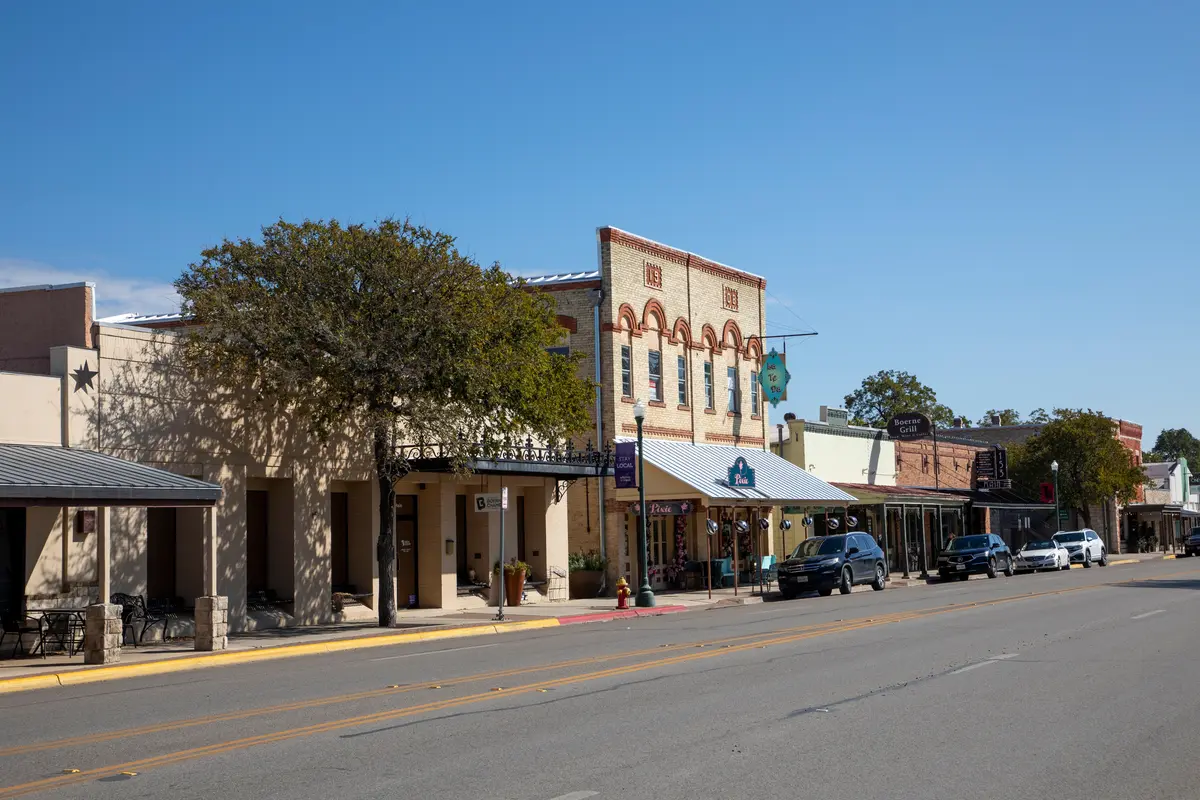
Boerne is where the San Antonio metro runs into the Texas Hill Country in earnest, and the price reflects both the geography and the lifestyle it delivers. A $562,046 typical home price is sustained by Kendall County's topography, a genuine Main Street downtown along the business route through town, and sustained demand from buyers who want Hill Country living with I-10 access back to San Antonio. The city is small but complete — a real town with its own economy, not just a suburb with a scenic backdrop.
Boerne fits buyers who have made a deliberate choice to pay for place: the cedar and limestone hills, the Cibolo Creek greenway, a walkable downtown with independent shops, and a community character that feels genuinely different from the Bexar County suburbs. The income required to buy comfortably here is real, and buyers who underestimate it tend to feel stretched. It is the clearest example on this list of a place where the premium has a specific, nameable reason behind it.

#14 Walkable Inner-City Enclave · Bexar County
Best for buyers who want to live inside the city's fabric, not outside it
Alamo Heights is an incorporated city entirely surrounded by San Antonio, and it operates by its own set of rules. A $739,289 typical home price reflects one of the most in-demand addresses in the entire metro — a walkable, tree-canopied inner-city enclave with its own school district, US-281 access, and an Austin Highway corridor that gives it both urban proximity and a distinct neighborhood identity. The price is driven by scarcity: there is no land left to develop, the housing stock turns slowly, and buyers compete hard for what does come available.
Alamo Heights fits a specific buyer: one who wants to be genuinely inside the city's fabric rather than commuting into it, who values the school district and the neighborhood character as much as the house itself, and who has the financial flexibility the price demands. It is the only city on this list where the cost-of-living equation is almost entirely about location prestige and urban access rather than land or square footage. Buyers comparing it with Boerne are choosing between two premium options with entirely different characters — one urban and walkable, one scenic and small-town.
The San Antonio Metro's biggest cost-of-living mistake is treating it as a single market. Converse and Alamo Heights are technically in the same county and exist on entirely different financial planets — knowing why, and which one fits your life, is what this comparison is built to answer.
Tell us what you need help with and we'll connect you with local resources.
