
What Is Living in Taylor, Texas Like?
You've probably seen Taylor come up on a list of Austin-area cities to watch — and then wondered why a town of 18,402 is attracting this much attention. The short answer is Samsung. The longer answer is that Taylor was already a real place with a real identity long before anyone broke ground on a semiconductor campus: a railroad town with a nine-block historic downtown, a James Beard–winning barbecue institution that's been smoking post oak since 1949, and a median home price that sits meaningfully below what you'll pay in neighboring Hutto, Round Rock, or Georgetown. What's happening now is that those two versions of Taylor — the small Central Texas town and the growth-era city — are colliding in real time, and how you feel about that collision will shape whether this place suits you.
Taylor sits in Williamson County about 40 minutes to Austin via US-79, close enough to the metro to draw commuters but far enough that the pace of daily life still feels like a small Texas city rather than an outer suburb. The Taylor Independent School District serves 2,904 students enrolled in 2025-26 and holds a C rating, according to the Texas Education Agency — a fact worth knowing if schools are central to your decision. The school district is the city's largest institutional employer, alongside City of Taylor municipal government and a major regional health system. And then there's Samsung Austin Semiconductor, whose more than 1,200-acre campus southwest of downtown represents one of the largest private investments in Texas history; the first fabrication facility broke ground and is targeting production by end of 2026, with a second fab groundbreaking also planned by end of 2026 and that building expected online around 2030. The semiconductor investment is already reshaping who moves here and why.
The typical home price in Taylor stands at $283,170 (July 2026), which is the most consequential single number in this guide — it's what puts Taylor on the radar for buyers priced out of the broader Austin metro. The effective property tax rate runs approximately 1.53%, which is worth factoring in alongside that purchase price. The city's typical rent runs $2,218/mo (Zillow ZORI, July 2026), reflecting how quickly demand has moved. Taylor averages 227 sunny days a year, summers are genuinely hot (this is Central Texas, not the Hill Country), and the tradeoff for that affordability is a real commute and a retail and amenity footprint that hasn't fully caught up with the city's ambitions — yet. Roughly 8,500 new homes are planned across the city to accommodate growth, which means the Taylor you move into may look different from the Taylor that exists in five years.
Whether you're weighing a move from California, considering an upgrade from a rental, or researching the area for the first time, the sections below break down Taylor's neighborhoods, housing market, daily life, commute realities, local favorites, and what you actually need to know before making an offer here.

Taylor at a Glance
Looking to buy in Taylor? Estimate your payment.
Enter your numbers to see an estimated monthly mortgage payment.
Estimate only. Excludes HOA fees and mortgage insurance. The interest rate above is a starting point, not a quoted rate — replace it with your own to see real numbers. Insurance is a flat placeholder, not a Taylor quote.
Why Are People Moving to Taylor?
The case for Taylor has become easier to make with each passing year, and it starts with a number: a typical home price of $283,170 (July 2026) in a Williamson County city that is noticeably more affordable than its neighbors. Buyers priced out of Round Rock, Georgetown, and Hutto arrive here and find elbow room — on price and literally, because lots in established neighborhoods are generous by suburban standards.
The Samsung effect is real and still unfolding. The semiconductor campus southwest of downtown is one of the largest private investments in Texas history, and the economic ripple extends well beyond construction workers and engineers. The Taylor Economic Development Corporation is actively courting defense and aerospace companies, advanced manufacturing, logistics, and rail-served industries — a deliberate strategy to build a diversified local economy rather than a single-employer town. That trajectory is why the city hired Freese & Nichols in August 2025 to update its Comprehensive Plan: the goal is to absorb growth without losing the community texture that made people want to live here in the first place.
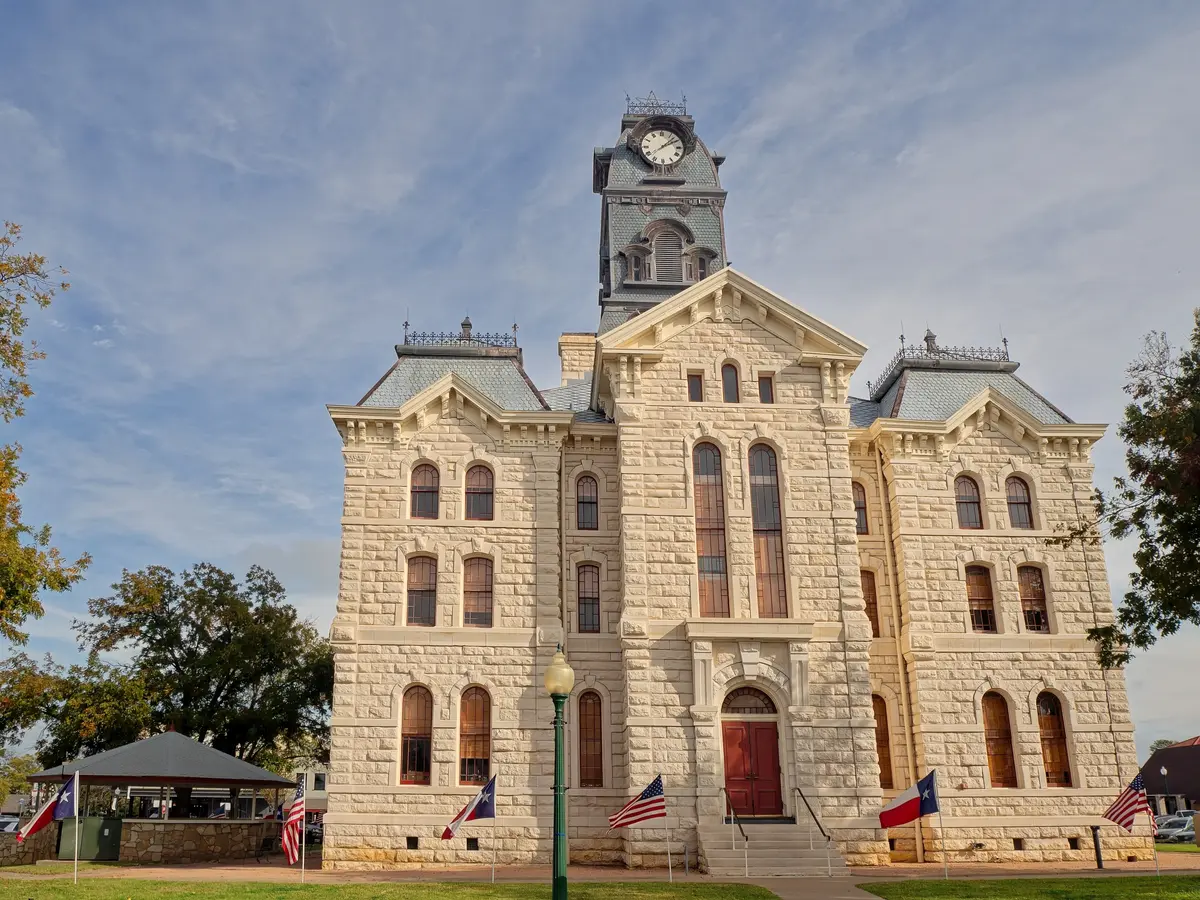
Taylor's railroad roots give it something newer Austin suburbs simply don't have: a real downtown. The nine-block Historic Downtown Taylor district has an actual street grid, century-old storefronts, Heritage Square Park at its center, and the Taylor Amtrak Station still receiving passengers on the Texas Eagle route. The Bill Pickett Statue, the Moody Museum, and the Farmers Pavilion at Heritage Square all anchor a civic core that feels earned rather than engineered. The 2025 Downtown Master Plan was completed to guide continued investment in that district — a signal that the city is betting on downtown as a long-term anchor, not a placeholder.
What draws people here, in practice, is a combination of price, proximity to Austin, and a small-city feel that hasn't been fully overwritten yet. If you're the kind of buyer who sees 8,500 planned homes and thinks "future equity," Taylor rewards that instinct. If you're expecting the amenity density of a fully built-out suburb on day one, you'll find some gaps — and you'll want to read the sections below carefully before you decide.
Who Moves Here
Remote workers and hybrid commuters make up a significant share of recent arrivals — people who need Austin access a few days a week but don't want to pay Austin-adjacent prices every day. Families with school-age children weigh the affordability against the school district's current ratings and often land here because the math on housing wins. Samsung and its supply-chain contractors are bringing engineers and technicians who want to live near where they work. And a growing cohort of longtime Central Texas residents — from Elgin, Thrall, and rural Williamson County — are moving into Taylor's newer subdivisions as the city builds out its amenity base.
Taylor also draws buyers who simply like a Texas town that still feels like one. The Friday night energy around UIL athletics, the hunting and outdoor sporting community, the fact that Louie Mueller Barbecue has a line out the door and always has — these things matter to a specific kind of buyer, and that buyer tends to stay.
What Daily Life Feels Like in Taylor
The honest version of daily life in Taylor involves more driving than most people expect when they first look at the map. The retail footprint is still catching up to the growth: a serious shopping trip means driving out of town, and you will be ordering online for anything the local shops don't carry. That's a real adjustment if you're coming from a denser suburb. But the things Taylor does have, it does well.
The Downtown Rhythm
Historic Downtown Taylor is a genuine gathering place, not a redevelopment project. Heritage Square Park sits at the center of it, with the Farmers Pavilion hosting the Heritage Square Farmers Market as a recurring community anchor. The Taylor Amtrak Station is an active civic node rather than a decorative one — the Texas Eagle route connects the city to Austin and San Antonio to the south, and to Temple and Chicago to the north.
The downtown streets have an unhurried quality on weekday mornings and a social energy on weekends that feels organic. Families with kids show up for farmers market days; longtime residents stake out the same spots at the same coffee counters every week. It's the kind of place where people still say hello to strangers, and where the barbecue joint's pitmaster has been at it for three generations.
The Samsung Era, Day to Day
Newcomers who arrived in 2023 or 2024 are already noticing what longtime residents predicted: more traffic on US-79, more faces at local restaurants, more construction on every edge of the city. The transformation is visible. What's less visible but equally real is that the community is actively trying to shape it — the updated Comprehensive Plan emphasizes walkability, mixed housing, and preserving community character, not just absorbing growth.
Six months in, the thing that surprises most people is how much of the old Taylor still operates alongside the new one. The high school fills its stands on Friday nights for UIL football. Louie Mueller still has a line. The pace of social life hasn't matched the pace of construction, and for many residents, that's exactly the right order of priorities.
Climate and Outdoor Life
Taylor averages 227 sunny days a year, and Central Texas summers are genuinely hot — not a surprise to anyone who's spent time in the region, but worth naming plainly if you're relocating from somewhere with milder summers. The parks system softens that with options: Murphy Park, Heritage Square Park, and Bull Branch Park all serve different corners of the city, and the Taylor Regional Park and Sports Complex hosts national tournaments in multiple sports. A swimming pool, splashpads, a skatepark, and walking trails round out what the city's Parks & Recreation department maintains. For a more detailed look at outdoor recreation, see the parks and recreation page.
The median household income of $75,508 tells you something important about who lives here now: this is largely a working-to-middle-class city, and the community has that texture. Neighbors know each other. The school drop-off line moves at a human pace. The cost-of-living picture — taxes, groceries, utilities — is covered in full on the cost of living page, but the broad read is that Taylor remains one of the more financially accessible cities in the Williamson County growth corridor.
The Taylor Housing Market Right Now
The typical home price in Taylor stands at $283,170 (July 2026, Zillow Home Value Index) — a figure that defines the city's position in the Austin metro as much as any other single fact. Every neighboring city in Williamson County runs noticeably higher, which is the primary reason buyers end up here after getting quotes elsewhere.
That price point does come with a context worth understanding. The median household income of $75,508 sits below the income needed to comfortably carry the typical home here, which means some buyers are stretching. The effective property tax rate of approximately 1.53% adds real carrying costs on top of the purchase price — worth modeling carefully before you make an offer. For a complete breakdown of what ownership costs in Taylor, visit the cost of living page.
What the Inventory Looks Like
Taylor's housing stock is a genuine mix: century-old craftsman homes in the blocks near downtown, 1970s and 1980s brick ranch houses in the established neighborhoods, and large-scale new construction subdivisions on the city's north and east edges. The new-construction side of the market is substantial — approximately 8,500 homes are planned across the city — which means buyers have more leverage in the newer subdivisions than in the tighter inventory of established blocks closer to downtown.
Well-priced homes in established neighborhoods tend not to sit long. The new construction pipeline keeps meaningful supply in the overall market, which has kept conditions more balanced than in the immediate post-pandemic years. It is not a buyer's market, but it is a more measured one. For a detailed breakdown of which neighborhoods suit which buyers, the best neighborhoods page covers each area and its character in full.
The Samsung Premium Question
Buyers sometimes ask whether the Samsung campus has already pushed Taylor prices beyond where they'd otherwise sit. The honest answer is: somewhat. The investment announcement accelerated interest in the city, and prices moved with that interest. What hasn't moved yet — or hasn't moved fully — is the amenity and retail density that would justify a larger premium. The gap between Taylor's current price and its neighbors' prices is still meaningful, and that gap is the real case for buying here before the buildout matures.
The typical rent of $2,218/mo (Zillow ZORI, July 2026) reflects how quickly demand has moved on the rental side as well — well above what longtime renters in the city were paying before the Samsung announcement. Buyers who do the math often find ownership pencils out better than renting at current rates, which is pushing some first-time buyers to act sooner than they'd planned. The first-time homebuyer page covers the buying process and financing options in detail.
Taylor Neighborhoods
Taylor has several distinct areas — each with its own character and appeal. Here’s a breakdown to help you narrow down where to focus your home search.
🏡 Downtown Taylor
The nine-block Historic Downtown district is the civic and cultural heart of the city — railroad-era storefronts, Heritage Square Park, the Amtrak station, and a walkable density of coffee shops and restaurants that feels unlike anywhere else in the growth corridor. It suits buyers who want character and walkable daily life over square footage.
🏠 Doak / Doak Addition
An established residential area with mature trees and mid-century housing stock close to the downtown core, Doak draws buyers who want proximity to Heritage Square and the social energy of downtown without paying a premium for new construction.
🌳 Mallard Park
A family-oriented neighborhood with a quieter suburban feel, Mallard Park suits buyers looking for more space and a neighborhood pace that's a step removed from the busier corridors; it's a practical landing spot for families with school-age children.
🏘 Creekside
As the name suggests, Creekside sits near a natural drainage corridor that gives the neighborhood a slightly more open feel than the city's denser blocks; it appeals to buyers who want a sense of green space close to home without leaving the city.
🏔 Avery Glen
One of Taylor's newer planned communities, Avery Glen offers modern construction and subdivision amenities that appeal to buyers relocating from larger metros who want a familiar suburban format at a price point well below what those metros charge.
🌆 Castlewood / Castlewood South
Castlewood and its southern extension offer an established neighborhood feel with larger lots and a mix of housing generations — an area that suits buyers who want a settled community rather than a recently platted subdivision, with room for gardens and outdoor living.
Pros & Cons of Living in Taylor
The Pros
- Small-town charm with a historic, walkable downtown
- Rapidly expanding job base thanks to the multibillion-dollar Samsung semiconductor plant
- Home prices still well below the greater Austin metro average
- Easy access to Austin, Round Rock, and Georgetown via major highways
The Cons
- Longer commute to core Austin job centers than closer-in suburbs
- School district test scores and ratings lag behind other Williamson County districts
- Housing market is currently soft, with falling prices and homes sitting longer
Getting Around & Commuting in Taylor
Taylor's commute story is defined by US-79, the primary corridor that carries most of the traffic between the city and the broader Austin metro. SH-95 provides a north-south connection for local travel and connects to other Williamson County cities. The drive to downtown Austin runs about 40 minutes under reasonable conditions — a number that changes meaningfully during peak morning and evening rush, particularly along US-79 approaching the metro.
The Commute Reality
Most residents who work in Austin drive. That's the honest answer. A car is essential for daily life here, and the commute is a genuine commitment — plan for it, not around it. The Taylor Amtrak Station on the Texas Eagle route is a real alternative for trips to Austin and San Antonio, but the train schedule does not function as a commuter rail system and can't substitute for daily work trips.
The better news is that the remote-work and hybrid-work shift has made Taylor's commute more manageable for many buyers than it would have been a decade ago. A significant share of recent arrivals describe going into Austin two or three days a week — a pattern that makes the 40-minute drive a reasonable rather than grinding routine. The people who struggle most are those who underestimated how consistently they'd need to be in the office; Taylor works best as a home base when you actually have flexibility about where you work.
Local Employment Is Growing
The calculus on commuting is also shifting as local employment grows. Taylor Independent School District and City of Taylor together employ a large share of the resident workforce locally. A major regional health system operates inside city limits, providing healthcare jobs that don't require an Austin commute. And as Samsung's campus moves toward first-fab production — targeted by end of 2026 — and the supply chain builds out around it, the number of Taylor residents who work within the city is projected to grow substantially. The Taylor Economic Development Corporation's active pursuit of defense, aerospace, and advanced manufacturing is designed to accelerate that trajectory.
Dell Technologies, based in Round Rock, is another major commute anchor for Taylor residents working in the technology sector. Round Rock is closer than Austin proper and the drive via US-79 is shorter, but it still requires getting on the road.
What People Actually Do
Local errands — groceries, school pickup, the hardware store run — are manageable within Taylor and the immediately adjacent area, though a full shopping trip still means driving out of the city. The absence of a dense commercial corridor means most residents plan their errands in batches rather than running out spontaneously. That adjustment surprises people who move from denser suburbs; it becomes routine within a few months, but it's worth naming before the move rather than after.
Austin-Bergstrom International Airport is about 35 miles from Taylor, making it the practical air travel option for residents. The drive to the airport can stretch with traffic, so early-morning flights are the default choice among locals who've learned the hard way.
Schools in Taylor
Families relocating to Taylor have public, private, and higher-education options nearby. Here’s a quick overview.
🎓 School District
Taylor Independent School District serves K–12 students across Taylor and the surrounding area. Rated C (source: Texas Education Agency, 2025 A-F accountability rating (2024-25 school year)).
🏆 Graduation Rate
The 4-year high-school graduation rate here is approximately 95.9%.
📚 Higher Education
Texas’s public universities — the University of Texas at Austin, Texas A&M University, and the University of Houston — offer four-year degrees statewide, with one of the largest community college systems in the country (50+ public community college districts) providing two-year and workforce programs.
🌐 Online Learning
UT Austin Online and Texas A&M University Online offer fully accredited online degrees for remote learners across the state.
Safety in Taylor
A quick look at how Taylor compares on the numbers that matter most when weighing a neighborhood or a move.
🛡 Violent Crime
Approximately 2 per 1,000 residents.
🔒 Property Crime
Approximately 20 per 1,000 residents.
Compared to the most recent national figures from the Bureau of Justice Statistics (2024), Taylor’s violent crime is below the national average (about 3.7 per 1,000), and property crime is above the national average (about 18.4 per 1,000).
Against Texas as a whole, Taylor’s violent crime is roughly half the state average, and property crime is about the same as the state average (Bureau of Justice Statistics, Crime Known to Law Enforcement, 2024 (tables 2 and 3)).
Crime rates can vary a lot within a single city, so the citywide numbers above are only a starting point. Some neighborhoods in Taylor run well below these averages, while others run higher — the kind of block-by-block detail that matters most when you’re actually choosing where to live. The full guide below breaks it down neighborhood by neighborhood.
Working in Taylor
Taylor’s largest employers span several industries — here are some of the anchors of the local job market.
🎓 Taylor Independent School District
Education
🏛 City of Taylor
Municipal government
💻 Samsung Austin Semiconductor
Semiconductor manufacturing
🏥 Baylor Scott & White Medical Center – Taylor
Healthcare
💻 Dell Technologies
Technology, located in Round Rock
Parks & Recreation in Taylor
Some of the outdoor spaces that shape everyday life in Taylor.
🌱 Heritage Square Park
Taylor residents don’t have to go far for green space — spots like Heritage Square Park are part of everyday life here, whether that’s a morning walk, a weekend hike, or just somewhere to unwind outside. The full guide below covers more of what Taylor has to offer for parks and outdoor recreation.
Retiring in Taylor
Taylor draws retirees for its balance of amenities, outdoor access, and cost. Here’s what to weigh.
🌤 Climate
Taylor averages 227 sunny days a year with mild winters and hot summers — highs regularly push past 100°F in July and August. Spring and fall are genuinely pleasant, and winter rarely brings more than a light freeze. The climate suits active outdoor lifestyles for about eight months of the year.
🍴 Lifestyle
Historic Downtown Taylor offers walkable access to coffee shops, the Heritage Square Farmers Market, Louie Mueller Barbecue, and the Moody Museum — a meaningful amenity base for a city of this size. The Taylor Regional Park and Sports Complex adds walking trails and a pool. The pace of daily life is unhurried and community-oriented, with a strong local identity rooted in railroad history and Texas barbecue culture.
🏚 55+ Communities
No 55+ communities were found in Taylor. Retirees considering the area will find a regional health system inside city limits and an active downtown, but those seeking age-restricted community amenities should look at nearby cities in Williamson County.
✈ Getting Around
Most daily travel in Taylor requires a car. The Taylor Amtrak Station on the Texas Eagle route provides rail access to Austin and San Antonio. Austin-Bergstrom International Airport is approximately 35 miles away, making it the practical option for air travel.
🏛 Texas Taxes for Retirees — What to Know
- No state income tax — Texas has no personal income tax — constitutionally protected under Article VIII, Section 24. Social Security, pensions, 401(k)/IRA withdrawals, and annuity payments are all untaxed at the state level, with no state return to file.
- Sales tax is the tradeoff — The state sales tax is 6.25%, and local add-ons bring the combined rate in Taylor to 8.25% (Texas Comptroller of Public Accounts, city sales and use tax rates, July 2026). Groceries and prescription drugs are exempt.
- Property taxes — the real tradeoff — Texas’s effective property tax rate averages about 1.40%, among the highest in the country, since property tax (not income tax) funds most local government and schools.
- Over-65 homestead exemption and school-tax freeze — Homeowners 65+ (or disabled) get an additional $60,000 exemption from their home’s value for school district taxes, on top of the general homestead exemption — $200,000 off school taxable value combined, following November 2025’s Proposition 11 (SB 23), which raised the over-65 exemption to $60,000, and Proposition 13 (SB 4), which raised the general homestead exemption to $140,000. Once claimed, your school district tax bill is frozen at that year’s amount and cannot increase as home values rise, and the ceiling can transfer if you move to a new home within Texas.
- Deferral option if cash is tight — Homeowners 65+ can defer property tax payment entirely for as long as they live in the home, rather than paying it currently — interest accrues, but no forced sale.
- No estate or inheritance tax — Texas has no estate tax, no inheritance tax, and no gift tax.
- No separate capital gains tax — Because Texas has no state income tax, capital gains — including on investments and home sales — are not taxed at the state level at all, unlike states such as Washington that tax capital gains separately from income.
Tax laws change frequently and individual situations vary. This is general information, not tax advice — always consult a qualified Texas tax professional or CPA for personalized retirement tax planning.
Weekends & Local Favorites in Taylor
Taylor's identity as a weekend destination for the broader Central Texas region is built almost entirely on one institution — and that institution is genuinely world-class. Louie Mueller Barbecue, established in 1949 and now in its third generation of family ownership, operates out of a former gymnasium in Historic Downtown Taylor and won a James Beard Foundation America's Classics award in 2006. The New York Times has called it the epitome of Texas barbecue. It uses post oak wood exclusively and draws food travelers from around the world. If you're moving to Taylor and haven't eaten there yet, that changes on your first weekend.
Taylor sits on the Heart of the Texas BBQ Trail, so the barbecue culture runs deeper than one landmark. The dining scene has diversified alongside the city's growth: Sirloin Stockade has been a local fixture for decades, Lucky Duck Café draws a loyal regular crowd, Plowman's Kitchen leans into scratch cooking and local sourcing, and El Corral Lozano anchors the Tex-Mex end of the dining spectrum. The coffee scene has developed real character: Ripple and Rose Cafe, Flake Bakery and Larder, the Texan Cafe & Pie Shop, and Rabbit Coffee Company each have distinct personalities and regulars who treat them as neighborhood anchors. The downtown core is the place to spend a morning on foot — a genuine rarity among smaller Texas cities.
Parks and Community Gathering
Murphy Park, Heritage Square Park, and Bull Branch Park each serve different corners of the city and have different social textures. Heritage Square is where the community converges most visibly: the Farmers Pavilion hosts the Heritage Square Farmers Market as a recurring anchor, and the square itself is the front yard of Historic Downtown Taylor. The Taylor Regional Park and Sports Complex takes the recreational side seriously — it hosts national tournaments across multiple sports, has a swimming pool and splashpads, a skatepark, and walking trails, and functions as a regional draw rather than just a local amenity.
History and Culture
The Moody Museum and the Bill Pickett Statue give the historic downtown a cultural weight that rewards more than a passing visit. The Taylor Amtrak Station, still active on the Texas Eagle route, is itself a piece of living railroad history — the city was platted in 1876 specifically in anticipation of the International & Great Northern Railway's arrival, and the street grid still reflects that original plan. The Historic Downtown Taylor nine-block district feels like a Texas town square that was never torn down and replaced, which makes it genuinely distinctive in a region full of cities that are being built from scratch.
What people discover after a few months is that Taylor's weekend life is quieter than Austin's — intentionally so, for many residents. The pace suits people who want a real community rather than a curated one. The Friday night football crowd at UIL games, the farmers market regulars who know each other by name, the coffee shop where the pitmaster sits before the lunch rush — that's the social fabric here, and it takes a little time to find your place in it, but it holds.
Local favorites in Taylor
Restaurants
- Louie Mueller Barbecue
- Sirloin Stockade
- Lucky Duck Café
- Plowman’s Kitchen
- El Corral Lozano
Outdoors
- Murphy Park
- Heritage Square Park
- Bull Branch Park
Coffee
- Ripple and Rose Cafe
- Haciendo Coffee Roasters
- Flake Bakery and Larder
- Texan Cafe & Pie Shop (Taylor)
- Rabbit Coffee Company - Taylor
Farmers Markets
- Heritage Square Farmers Market
Top Things Locals Say About Taylor
The best intel about a city comes from the people who actually live there. Here’s what Taylor residents say when newcomers ask the questions everyone’s thinking.
“We knew the commute would be real, but what we didn't expect was how much we'd actually use downtown on weekends — the farmers market, the coffee shops, the barbecue. It doesn't feel like a suburb. It feels like a town.”
— Recent Taylor home buyer
“What's the most surprising thing about living in Taylor?”
How much the old Taylor and the new Taylor coexist without one erasing the other — at least so far. The streets around downtown look the same as they did ten years ago, and then you turn a corner and there's a new subdivision going up on land that was cotton fields. The barbecue lines haven't gotten shorter, and the Friday night football crowds haven't changed. The construction is everywhere, but the community texture is still intact.
“What do locals love most about Taylor?”
The fact that it's a real place, not a planned community. Historic Downtown Taylor has streets and buildings with actual history — the railroad grid, the storefronts, Heritage Square. Louie Mueller has been there since 1949 and the pitmaster still works the same smoker. That kind of continuity is hard to find in the Austin metro, and people who grew up here are protective of it.
“What should newcomers to Taylor know?”
Plan your errands. The retail footprint is still developing, and a full shopping run means getting in the car and driving. The US-79 corridor into Austin gets slow during morning rush — leave earlier than you think you need to. And give yourself a few weeks to find your place in the community; it's not a city where everything is immediately visible, but once you start showing up at the farmers market or the park on a Saturday morning, it opens up fast.
“How much do you need a car in Taylor?”
A car is essential for most daily life in Taylor. Groceries, school pickup, most restaurants, and the commute to Austin or Round Rock all require driving. The downtown core is walkable once you're in it — Heritage Square, the coffee shops, Louie Mueller, the Amtrak station — but getting to downtown from most neighborhoods means a short drive. The Amtrak station connects to Austin and beyond, but not on a schedule that works for daily commuting.
Cities Near Taylor
Other communities near Taylor worth a look — each with its own character and price point.
| City | Distance | Best For | Vibe | Median Rent | Median Buy |
|---|---|---|---|---|---|
| Hutto | 12 mi | Families seeking newer subdivisions | Fast-growing, suburban, community-focused | $1,748 | $335,073 |
| Round Rock | 20 mi | Tech workers and established amenities | Polished, larger city, retail-rich | $1,734 | $405,249 |
| Georgetown | 25 mi | Retirees and historic square lifestyle | Upscale, scenic, active 55+ scene | $1,657 | $427,174 |
More Helpful Guides for Taylor
Going deeper on Taylor? Our blog series covers everything from first-time buying to retiring here — explore the guides below.
Local Expert Takeaway: Taylor is genuinely affordable by Austin-metro standards, and that gap is real — but the city is mid-transformation, not fully arrived. Buyers who move here for the price and expect full suburban amenity density on day one will be surprised. Buyers who move here for the price, the downtown character, the Friday night football energy, and the best barbecue in Texas — and who can handle a 40-minute commute to Austin — tend to love it. The Samsung build-out will change the city materially over the next several years; you are buying into that trajectory as much as into the house itself.
Quick Takeaways & FAQs
✅ Taylor's typical home price of $283,170 (July 2026) is noticeably below every neighboring Williamson County city, making it one of the last genuinely affordable entry points in the Austin metro growth corridor.
⚠️ The school district holds a C rating according to the Texas Education Agency, and on 2024-25 state assessments, 26% of students reached math proficiency — a real consideration for families prioritizing academic performance.
📍 Louie Mueller Barbecue — a 1949 James Beard Award winner operating in a former gymnasium in Historic Downtown Taylor — is a legitimate national landmark and a weekly fixture for many residents, not just a tourist stop.
How far is Taylor, Texas from Austin?
What is the housing market like in Taylor TX?
Is Taylor Texas a good place to raise a family?
What is driving growth in Taylor Texas?
Are there 55+ communities in Taylor TX?
Helpful Links for Moving to Taylor
Moving to Texas?
Tell us what you need help with and we'll connect you with local resources.
