What Is Living in El Paso, Texas Like?
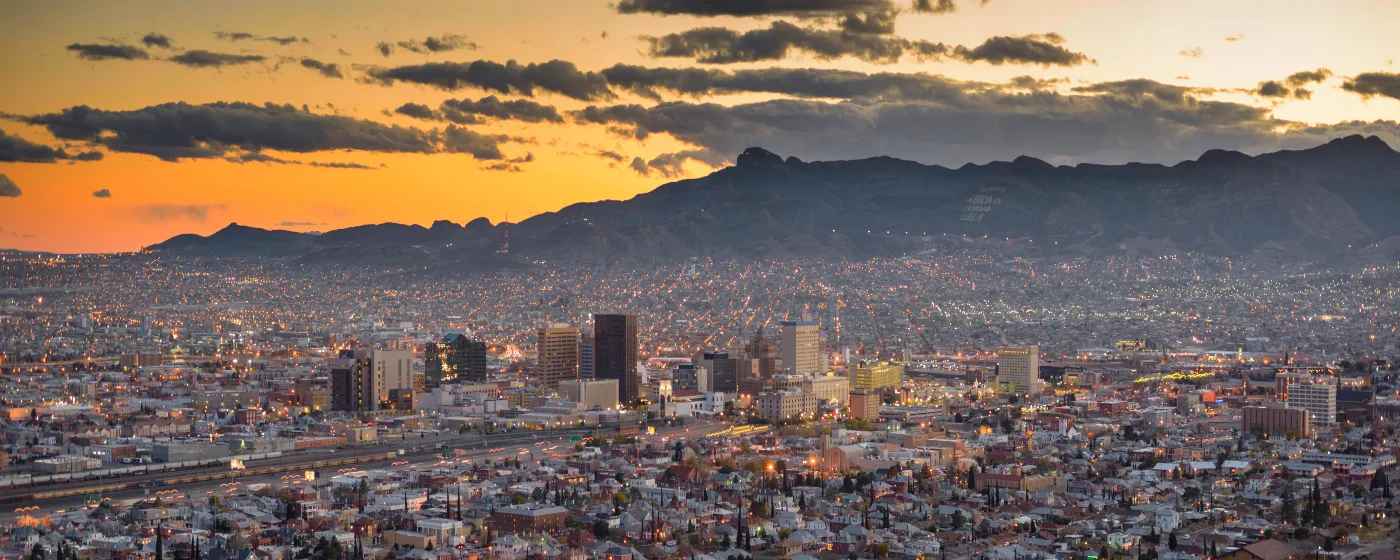
If you've been priced out of Austin or Denver and someone mentioned El Paso, your first reaction was probably skepticism. The second reaction — for most people who actually visit — is that the city doesn't match the mental image at all. El Paso sits at the far western tip of Texas, where I-10 threads between the Franklin Mountains and the Rio Grande, and where the skyline of Ciudad Juárez, Mexico fills the southern horizon. The Franklin Mountains don't frame the city — they split it, creating a physical and psychological divide between the Westside and the rest of town that shapes where people buy, where they commute, and how long they stay. That geography is the first thing to understand before you start looking at listings.
With a population of 683,012, El Paso is the 6th-largest incorporated city in Texas, and its economy is built on a foundation that doesn't follow typical Sun Belt rules. Fort Bliss — one of the largest U.S. Army installations in the country — is the dominant economic anchor, pulling in military families, defense contractors, and federal workers from across the country. The El Paso Independent School District, Socorro Independent School District, the University of Texas at El Paso, and the City of El Paso round out the major public-sector employers. Cross-border trade is the other engine: annualized trade through El Paso's ports reached $151.6 billion in a single measured period, making logistics, customs brokerage, and international commerce a real career path here in a way it simply isn't in most Texas cities. The El Paso ISD holds a B rating, according to the Texas Education Agency, with a student body that makes it one of the larger urban districts in Texas.
The affordability story is the most immediately striking thing for anyone coming from a coastal metro. The typical home price sits at $237,796 (July 2026), and overall costs of living run roughly 12% below the national average — which, combined with 297 sunny days a year and virtually no winter weather to speak of, explains why the city keeps attracting remote workers and retirees even as some locals head to Phoenix or Albuquerque for higher wages. The city's median household income of $59,745 reflects a wage structure that lags the state average — the trade-off being that your dollar genuinely stretches further here than almost anywhere else in a major Texas market. For a fuller breakdown of what things actually cost day to day, see the El Paso cost of living page.
Whether you're weighing a PCS move to Fort Bliss, relocating for a UTEP position, or simply looking for a place where a reasonable salary can buy a real house, the sections below break down El Paso's neighborhoods, housing market, commute patterns, local economy, and what daily life here is really like once you've unpacked.
El Paso at a Glance
Looking to buy in El Paso? Estimate your payment.
Enter your numbers to see an estimated monthly mortgage payment.
Estimate only. Excludes HOA fees and mortgage insurance. The interest rate above is a starting point, not a quoted rate — replace it with your own to see real numbers. Insurance is a flat placeholder, not a El Paso quote.
Why Are People Moving to El Paso?
The case for El Paso is easier to make than most people expect, and harder to explain to someone who hasn't spent time in the city. Start with the price: a typical home at $237,796 (July 2026) in a metro of over a million people is genuinely rare in today's Texas market. That number draws buyers who've been watching Austin or Dallas from the sidelines for years.
Fort Bliss is the single largest driver of relocation to El Paso, and its influence goes well beyond the soldiers who receive orders here. Defense contractors, federal civilian employees, military spouses building portable careers, and families who did one tour and chose to stay — all of them make up a substantial and visible part of the city's fabric. The June 2026 launch of Torch Transit by Sun Metro, a free on-base ride service for soldiers, families, and military ID card holders, signals how tightly the city and the installation have woven themselves together.
The University of Texas at El Paso draws a different kind of mover: faculty, graduate students, researchers, and administrators who find that an academic salary goes considerably further here than in peer cities. UTEP's growing research profile has made the university a real economic engine on the near-Westside, and its campus architecture — a distinctive Bhutanese-inspired style — gives that part of the city a visual identity unlike any other campus in Texas.
Then there's the cross-border economy. If your career is in logistics, customs law, international trade, or supply-chain operations, El Paso is one of the few U.S. cities where that work is genuinely local, not a niche. The ports of entry here process an extraordinary volume of binational commerce, and companies that need people who understand both sides of the border hire here specifically.
Who Tends to Thrive Here
| Buyer Type | Why El Paso Works | Watch Out For |
|---|---|---|
| Commuter Military families | Fort Bliss dominates the northeast; short commutes on US-54 for on-post assignments | PCS cycles mean neighbors turn over frequently in some pockets |
| First-Time Buyers | One of the most affordable entry points in any Texas city this size | Median household income is below what's needed to buy the typical home by about $7,000 |
| Remote workers | Low cost base, fast fiber in newer neighborhoods, Mountain Time Zone | Wage growth is real but average hourly earnings remain well below the Texas state average |
| Families | Young city (median age 34.5), strong community sports culture, room to buy space | Test score proficiency rates are below state averages; district is working on it |
| Outdoor enthusiasts | Franklin Mountains State Park is the largest urban wilderness park in the U.S. | Summer heat regularly clears 100°F — trail timing matters from June through September |
| Value seekers from coastal metros | Costs roughly 12% below the national average; no state income tax | Wage ceiling is real — local salaries often don't match what you left behind |
The honest caveat: El Paso's population has grown slowly since the 2020 census — among its slowest rates in generations. Some people move here for the price and leave within a few years for higher wages in Phoenix or Albuquerque. Knowing that dynamic going in helps you decide whether you're building roots or building equity before the next move.
What Daily Life Feels Like in El Paso
El Paso is a bilingual city in a way that goes deeper than signage and menus. Spanish and English switch mid-sentence in conversations at the coffee counter, at school pickup, and in city council meetings. The cultural identity here is fronterizo — of the border — and that shapes everything from the food scene to the arts calendar to how people think about the city directly across the river.
The Geographic Reality
The Franklin Mountains create a hard east-west divide. The Westside — including Kern Place and the neighborhoods closest to UTEP — has an older, more established feel, with tree-lined streets and independent restaurants within reach on foot. The Northeast and East Side are flatter, newer in places, and more car-dependent, but they're also where Fort Bliss's gravity pulls the most activity. The Upper Valley, along the Rio Grande, runs agricultural and spacious. The Lower Valley is working-class and deeply rooted. Central El Paso carries the historic downtown core, including the restored Plaza Theatre and San Jacinto Plaza. None of these areas feel interchangeable, and choosing the wrong one for your lifestyle is the most common mistake transplants make. The El Paso neighborhoods guide breaks each area down in detail.
What Locals Know
After six months here, most transplants say the same thing: the wind caught them off guard. Spring in El Paso brings sustained gusts that carry dust off the Chihuahuan Desert — the kind that gets into everything and turns an afternoon hike into an unpleasant experience if you didn't check the forecast. Locals schedule outdoor activities around it; newcomers don't, and then they do.
The summer heat is real and worth taking seriously. June through September regularly clears 100°F, and the UV index at this elevation — El Paso sits above 3,700 feet — hits harder than coastal cities at the same temperature. The upside is that the elevation also means nights cool off reliably, making the heat more bearable than Houston's humidity-driven version.
The arts scene has expanded meaningfully in recent years. La Nube STEAM Discovery Center, designed by the architecture firm Snøhetta, and the Mexican American Cultural Center represent a real investment in cultural infrastructure. The Border Biennial — a binational contemporary art exhibition co-produced with Ciudad Juárez — has run since 2008 and drew significant national attention for its 2024 edition. The El Paso Museum of Art actively programs around the city's binational identity. This is not a city waiting for a cultural scene to arrive; it's one that's been building one on its own terms.
Fall evenings mean UIL football, and the stadium crowds here are genuine — not suburban-polite, but loud and community-rooted in the way that high school sports are in Texas cities where professional teams don't compete for attention. For families with school-age children, that community calendar is worth understanding before you pick a neighborhood. The El Paso schools page covers the district landscape in full.
The El Paso Housing Market Right Now
The typical home price in El Paso is $237,796 (July 2026, Zillow Home Value Index) — a figure that looks almost implausible to anyone arriving from a Texas metro where that number wouldn't buy a starter condo. It is real, and it is one of the most compelling financial cases for choosing El Paso over peer cities.
The honest counterweight: the median household income of $59,745 is roughly $7,000 below what's needed to comfortably carry the typical home here, which means first-time buyers often need to look carefully at loan programs and household budget assumptions before assuming the price tag alone makes homeownership easy. For buying-process guidance and financing options, the first-time homebuyer page covers those mechanics in full.
Across the city's neighborhoods, prices vary in character without varying as dramatically as they would in a larger metro. Areas like Kern Place run above the city-wide typical price; Northeast El Paso, the Lower Valley, and Central El Paso come in below it; the East Side tracks roughly at the city median. The detail on what each area offers for that money is on the neighborhoods page.
The effective property tax rate of 1.73% is worth factoring into monthly budget math — it sits above the national average and is a consistent point of sticker shock for buyers arriving from states with lower rates. Texas has no state income tax, which partially offsets this, but the annual property tax bill is a real line item. The cost of living page puts the full picture together.
The rental market offers a city-wide typical rent of $1,529/month (Zillow, July 2026), which gives buyers a genuine rent-vs.-own calculation worth running — in many cases the monthly cost of ownership lands close enough to rent that the math favors buying, particularly for military families who know they'll be here for a defined tour.
El Paso Neighborhoods
El Paso has several distinct areas — each with its own character and appeal. Here’s a breakdown to help you narrow down where to focus your home search.
🏡 West Side (Westside)
The Westside is El Paso's most established residential area, with older tree-lined streets, proximity to UTEP, and a mix of mid-century homes and newer infill — it appeals to faculty, professionals, and longtime El Pasoans who want walkable streets and a neighborhood with roots.
🏠 Northeast El Paso
The Northeast is shaped entirely by Fort Bliss, making it the go-to for military families who want a short hop to the installation via US-54 — the housing stock runs from well-maintained older ranches to newer subdivisions, and the community turns over with PCS cycles.
🌳 East Side (East El Paso)
The East Side is a broad, suburban swath where families with school-age children find some of the city's best value in square footage — it's car-dependent and flat, but the neighborhoods are stable and the community infrastructure is well developed.
🏘 Upper Valley
The Upper Valley runs along the Rio Grande with an agricultural character that feels distinctly un-suburban — larger lots, horse properties, and a slower pace that draws buyers who want space and scenery without leaving city limits.
🏔 Lower Valley
The Lower Valley is one of El Paso's most working-class and deeply rooted communities, with multigenerational families, a strong local identity, and housing that comes in well below the city-wide typical price — it rewards buyers who want authenticity over polish.
🌆 Central El Paso
Central El Paso holds the civic and historic core — San Jacinto Plaza, the Plaza Theatre, and a street grid that actually functions on foot — making it the right fit for buyers who want urban texture and don't mind trading yard space for walkability.
Pros & Cons of Living in El Paso
The Pros
- Very low cost of living relative to income and home prices
- Over 290 sunny days a year
- Strong military, healthcare, and higher-ed job base
- Rich bicultural food and arts scene
The Cons
- Median household income lags the state and national averages
- Intense summer heat with highs near 95°F
- Some school campuses and neighborhoods show wide gaps in academic performance
Getting Around & Commuting in El Paso
El Paso is a driving city in the way most Southwest cities are, but it has more transit infrastructure than its reputation suggests. Sun Metro operates an extensive bus network across the city, and the Brio bus rapid transit system runs on frequent weekday headways — the kind of service that actually functions as a commute option for workers along its corridors. A restored PCC streetcar runs through downtown on a multi-mile route connecting the civic core with nearby neighborhoods and drawing consistent local ridership.
The Fort Bliss Commute
If you're assigned to Fort Bliss, the most relevant commute figure is about 20 minutes to Downtown El Paso and Fort Bliss — but that average masks real variation depending on which gate you use and where you live. US-54 (Patriot Freeway) is the main arterial for Northeast El Paso residents heading on-post, and it earns its rush-hour reputation in the early morning. The June 2026 Torch Transit by Sun Metro launch — a free on-base ride service for soldiers, their families, and all military ID card holders — changes the calculus for families who can reduce to one car.
Driving Patterns and the Mountain Divide
The Franklin Mountains mean there is no straight shot between the Westside and the Northeast. Tunnels and mountain passes are the options, and both carry traffic that stacks at predictable times. Transplants who buy on the Westside for the neighborhood feel and then take a job near Fort Bliss often underestimate this daily friction — it's not the worst commute in Texas, but it is longer and less flexible than a flat-city map makes it look.
I-10 runs the length of the city and connects El Paso to the broader West Texas and New Mexico highway network. Loop 375 circles the metro perimeter and is the route most locals use for cross-city movement. I-110 drops into the downtown core. For drivers making routine cross-city trips, these routes are familiar within a week of arrival — but the mountain geography means detours are rarely short.
The Airport
El Paso International Airport sits just 7 miles from downtown and set a passenger record in 2024 with over four million travelers. Nonstop service reaches major hubs including Dallas-Fort Worth, Phoenix, and Houston, making it practical for business travelers who move frequently. There are currently no scheduled international commercial flights from ELP, so cross-border travel means a ground crossing into Ciudad Juárez or a connection through another hub.
Schools in El Paso
Families relocating to El Paso have public, private, and higher-education options nearby. Here’s a quick overview.
🎓 School District
El Paso Independent School District serves K–12 students across El Paso and the surrounding area. Rated B (source: Texas Education Agency, 2025 A-F accountability rating (2024-25 school year)).
🏆 Graduation Rate
The 4-year high-school graduation rate here is approximately 82.3%.
📚 Higher Education
Texas’s public universities — the University of Texas at Austin, Texas A&M University, and the University of Houston — offer four-year degrees statewide, with one of the largest community college systems in the country (50+ public community college districts) providing two-year and workforce programs.
🌐 Online Learning
UT Austin Online and Texas A&M University Online offer fully accredited online degrees for remote learners across the state.
Safety in El Paso
A quick look at how El Paso compares on the numbers that matter most when weighing a neighborhood or a move.
🛡 Violent Crime
Approximately 3 per 1,000 residents.
🔒 Property Crime
Approximately 15 per 1,000 residents.
Compared to the most recent national figures from the Bureau of Justice Statistics (2024), El Paso’s violent crime is below the national average (about 3.7 per 1,000), and property crime is below the national average (about 18.4 per 1,000).
Against Texas as a whole, El Paso’s violent crime is roughly two-thirds of the state average, and property crime is roughly two-thirds of the state average (Bureau of Justice Statistics, Crime Known to Law Enforcement, 2024 (tables 2 and 3)).
Crime rates can vary a lot within a single city, so the citywide numbers above are only a starting point. Some neighborhoods in El Paso run well below these averages, while others run higher — the kind of block-by-block detail that matters most when you’re actually choosing where to live. The full guide below breaks it down neighborhood by neighborhood.
Working in El Paso
El Paso’s largest employers span several industries — here are some of the anchors of the local job market.
🏛 Fort Bliss
Military
🎓 El Paso Independent School District
Education
🎓 Socorro Independent School District
Education
🎓 University of Texas at El Paso
Higher education
🏥 University Medical Center of El Paso
Healthcare
🏛 City of El Paso
Municipal government
Parks & Recreation in El Paso
Some of the outdoor spaces that shape everyday life in El Paso.
🌱 Franklin Mountains State Park
🌱 Southwest University Park
El Paso residents don’t have to go far for green space — spots like Franklin Mountains State Park and Southwest University Park are part of everyday life here, whether that’s a morning walk, a weekend hike, or just somewhere to unwind outside. The full guide below covers more of what El Paso has to offer for parks and outdoor recreation.
Retiring in El Paso
El Paso draws retirees for its balance of amenities, outdoor access, and cost. Here’s what to weigh.
🌤 Climate
El Paso earns 297 sunny days a year and sees virtually no significant winter weather — typically around three inches of snow per year, with winter days regularly reaching the mid-60s. Summers are hot and dry, with temperatures regularly clearing 100°F from June through September, though the desert elevation means evenings cool reliably. For retirees who are done with ice and grey winters, the climate is a major draw.
🍴 Lifestyle
The city's binational identity makes for a distinctive daily lifestyle: bilingual communities, a deep regional food culture rooted in Chihuahuan and Tex-Mex traditions, and an arts calendar anchored by institutions like the El Paso Museum of Art and the historic Plaza Theatre. Franklin Mountains State Park gives active retirees a vast trail network within city limits, and Ascarate Park provides a more accessible green space for walks and casual outdoor time.
🏚 55+ Communities
No 55+ communities were found in El Paso. Retirees settling here typically buy in established single-family neighborhoods on the Westside or in the Upper Valley, where the pace is quieter and the lots run larger. The full retirement picture — healthcare access, lifestyle amenities, and budget context — is covered on the El Paso retiring page.
✈ Getting Around
Most retirees in El Paso rely on a car for daily errands, though Sun Metro's bus network and the downtown streetcar provide options for those who live closer to the urban core. El Paso International Airport, 7 miles from downtown, offers nonstop service to major hubs including Dallas-Fort Worth, Phoenix, and Houston — making it easy to visit family in other parts of the country without a connection.
🏛 Texas Taxes for Retirees — What to Know
- No state income tax — Texas has no personal income tax — constitutionally protected under Article VIII, Section 24. Social Security, pensions, 401(k)/IRA withdrawals, and annuity payments are all untaxed at the state level, with no state return to file.
- Sales tax is the tradeoff — The state sales tax is 6.25%, and local add-ons bring the combined rate in El Paso to 8.25% (Texas Comptroller of Public Accounts, city sales and use tax rates, July 2026). Groceries and prescription drugs are exempt.
- Property taxes — the real tradeoff — Texas’s effective property tax rate averages about 1.40%, among the highest in the country, since property tax (not income tax) funds most local government and schools.
- Over-65 homestead exemption and school-tax freeze — Homeowners 65+ (or disabled) get an additional $60,000 exemption from their home’s value for school district taxes, on top of the general homestead exemption — $200,000 off school taxable value combined, following November 2025’s Proposition 11 (SB 23), which raised the over-65 exemption to $60,000, and Proposition 13 (SB 4), which raised the general homestead exemption to $140,000. Once claimed, your school district tax bill is frozen at that year’s amount and cannot increase as home values rise, and the ceiling can transfer if you move to a new home within Texas.
- Deferral option if cash is tight — Homeowners 65+ can defer property tax payment entirely for as long as they live in the home, rather than paying it currently — interest accrues, but no forced sale.
- No estate or inheritance tax — Texas has no estate tax, no inheritance tax, and no gift tax.
- No separate capital gains tax — Because Texas has no state income tax, capital gains — including on investments and home sales — are not taxed at the state level at all, unlike states such as Washington that tax capital gains separately from income.
Tax laws change frequently and individual situations vary. This is general information, not tax advice — always consult a qualified Texas tax professional or CPA for personalized retirement tax planning.
Weekends & Local Favorites in El Paso
Franklin Mountains State Park is where El Paso residents go when they need to remember why they live here. At over 26,000 acres inside city limits, it is the largest urban wilderness park in the United States, and the trail network it holds — varying from casual ridge walks to serious technical climbs — is used constantly by locals who treat it as an extension of their backyard. McKelligon Canyon, carved into the eastern face of the Franklins, draws hikers and rock climbers and hosts the city's outdoor amphitheater. Ascarate Park anchors the Lower Valley with a lake, athletic fields, and a genuine community gathering energy on warm weekends. Rio Bosque Wetlands Park, along the Rio Grande, is the counterpoint — quiet, birding-focused, and a reminder that the river corridor was once a broader ecosystem.
The food scene reflects the city's identity honestly. L & J Cafe has been serving the kind of red and green chile that people make long drives for — it is one of the oldest Mexican restaurants in the city and the standard by which newcomers measure everything else. Corralito Steak House brings a ranching-culture steakhouse tradition that belongs to West Texas specifically. West Texas Chophouse and Weso Steakhouse represent the current generation of the same instinct. Kona Grill rounds out the options for nights when you want something outside the regional tradition.
The independent coffee culture has real depth. 787 Coffee, The House Coffee Shop, The Hive Java Lounge, Global Coffee Roasters, and District Coffee Co. collectively give the city a coffee scene that would hold its own in cities twice the size. These are not chains filling a gap — they are locally owned operations with their own regulars and their own character.
Sun City's Vendor Market is the gathering point for local producers, makers, and small-batch food vendors — the kind of weekly market that becomes a social institution for residents who show up as much for the people as for the goods.
Downtown's Plaza Theatre — a 1930 atmospheric movie palace restored to full operation — hosts live performances that draw audiences from across the metro. San Jacinto Plaza, in the civic heart of downtown, has anchored public life in El Paso for well over a century. The Border Biennial and the El Paso Museum of Art's binational programming give the arts calendar a genuinely distinctive character that you won't find in most Texas cities. For retirees weighing the lifestyle picture, the retiring in El Paso page covers the full amenity landscape.
Local favorites in El Paso
Restaurants
- Corralito Steak House (5800 Doniphan)
- L & J Cafe
- Kona Grill - El Paso
- West Texas Chophouse
- Weso Steakhouse
Outdoors
- Franklin Mountains State Park
- McKelligon Canyon
- Ascarate Park
- Rio Bosque Wetlands Park
Coffee
- 787 Coffee
- The House Coffee Shop
- The Hive Java Lounge
- Global Coffee Roasters
- District Coffee Co.
Farmers Markets
- Sun City's Vendor Market
Top Things Locals Say About El Paso
The best intel about a city comes from the people who actually live there. Here’s what El Paso residents say when newcomers ask the questions everyone’s thinking.
“I grew up hearing El Paso was just a stopover city, so I expected to feel that way when I got here. What I didn't expect was how fast the mountains became part of how I think about the whole place — which side you live on genuinely changes your life here, and nobody told me that before I signed a lease on the wrong side for my commute.”
— Recent El Paso home buyer
“What's the most surprising thing about living in El Paso?”
The spring wind. Nobody warns you about it, and then March arrives and you're finding desert dust in places you didn't know dust could reach. Longtime residents just check the wind forecast the same way they'd check for rain anywhere else — it becomes second nature, but that first spring catches almost every newcomer off guard.
“What do locals love most about El Paso?”
The mountains and the light. Franklin Mountains State Park is essentially inside the city, and on a clear evening — which is most evenings — the way the sun hits the rock face from San Jacinto Plaza or anywhere on the Westside is genuinely striking. People also talk about the food culture: the red and green chile, the family-run spots that have been here for generations, and the fact that the culinary identity here is completely its own and doesn't borrow from anywhere else.
“What should newcomers to El Paso know?”
Understand the mountain divide before you pick where to live. The Franklins are beautiful and they will add real time to your commute if you buy on the wrong side for your job. Also: summer heat here starts earlier than people expect and the elevation makes the UV index punishing — locals hike early in the morning from June through September, not at noon. And learn to love the bilingual city; it's not a barrier, it's the actual texture of daily life here.
“How much do you need a car in El Paso?”
A car is essential for most of the city. The Northeast, East Side, and Upper Valley are entirely car-dependent for daily errands. The Westside near UTEP and parts of Central El Paso are more manageable on foot for short trips, and Sun Metro's Brio rapid transit is a real option for commuters along its routes. Downtown has the streetcar, which residents actually use. But if you're moving to a typical single-family neighborhood anywhere outside the urban core, plan on driving for most of what you need.
Cities Near El Paso
Other communities near El Paso worth a look — each with its own character and price point.
| City | Distance | Best For | Vibe | Median Rent | Median Buy |
|---|---|---|---|---|---|
| Socorro | 8 mi | Families seeking newer construction | Flat, growing, suburban | $1,548 | $209,849 |
| Horizon City | 15 mi | Budget buyers, young families | Quiet, spread-out, affordable | $1,737 | $223,740 |
| Canutillo | 12 mi | Rural feel, Rio Grande proximity | Agricultural, spacious, low-key | $1,250 | $230,000 |
More Helpful Guides for El Paso
Going deeper on El Paso? Our blog series covers everything from first-time buying to retiring here — explore the guides below.
Local Expert Takeaway: El Paso's affordability is real, but the city rewards buyers who understand its geography before they commit. The Franklin Mountains aren't just scenery — they determine your commute, your neighborhood's feel, and how connected you'll be to the rest of the city. Military families near Fort Bliss almost always land in the Northeast for good reason. UTEP faculty and remote workers tend to gravitate toward the Westside and Kern Place. First-time buyers who stretch into the Lower Valley or East Side get the most square footage for their dollar. The one thing that surprises nearly everyone: how genuinely livable the city is once you stop comparing it to somewhere else and start experiencing it on its own terms — 297 sunny days a year, a walkable downtown core anchored by the Plaza Theatre and San Jacinto Plaza, and a food and coffee scene that reflects the city's binational identity in ways that keep locals proud.
Quick Takeaways & FAQs
✅ El Paso's typical home price of $237,796 (July 2026) makes it one of the most affordable large cities in Texas, with costs running roughly 12% below the national average.
⚠️ Wages here lag the Texas state average noticeably, and some residents eventually leave for higher-paying markets in Phoenix or Albuquerque — go in knowing the salary ceiling.
📍 The Franklin Mountains physically split the city: buying on the Westside while commuting to Fort Bliss in the Northeast means navigating mountain passes daily, which adds real time that a flat map doesn't show.
Is El Paso a safe city to live in?
What is the cost of living like in El Paso compared to other Texas cities?
What is the El Paso school district like?
Do you need a car to live in El Paso?
What is it like to live near Fort Bliss in El Paso?
Helpful Links for Moving to El Paso
Moving to Texas?
Tell us what you need help with and we'll connect you with local resources.
