
Maybe your kids settled in the Houston suburbs and you've been watching the neighborhood from visits for years. Maybe you've been priced out of California or the Northeast and someone ran the Texas numbers for you. Either way, Katy keeps showing up on the list — and the reasons are more concrete than the marketing suggests. The city sits along I-10 about 40 minutes to Downtown Houston, putting a major medical center within reach while keeping you well outside the congestion of the Loop. At 28,373 residents, it is large enough to have real amenities and small enough that people still wave at the farmers market.
The economic backbone here is the Katy Independent School District, the City of Katy itself, and a commercial corridor anchored by retail, distribution, and manufacturing. That matters in retirement because it means a stable local tax base — the kind of municipal footing that keeps parks funded and services consistent. The same master-planned infrastructure that attracted young families over the past two decades has aged into something genuinely useful for retirees: flat terrain, wide sidewalks, accessible shopping, and a well-equipped local hospital that is actively expanding.
On the cost side, the typical home price in Katy sits at $337,000 (July 2026), which is noticeably below what you would pay in Fulshear, Cypress, or Sugar Land. Texas collects no state income tax, which means your Social Security check, pension, and IRA withdrawals arrive intact. The property tax rate is real — approximately 2.09% effective — but the state's senior exemptions have grown substantially, and for many retirees the net bill is far lower than the headline rate implies. For full detail on everyday costs in Katy, see the cost-of-living page.
The sections below walk through what actually matters when you are weighing a retirement move: who Katy genuinely fits, what healthcare looks like on the ground, how the retiree budget holds up, what daily life and community look like without a car, how downsizing works here, and how Katy stacks up against the most relevant nearby options.
Why Retirees Are Choosing Katy
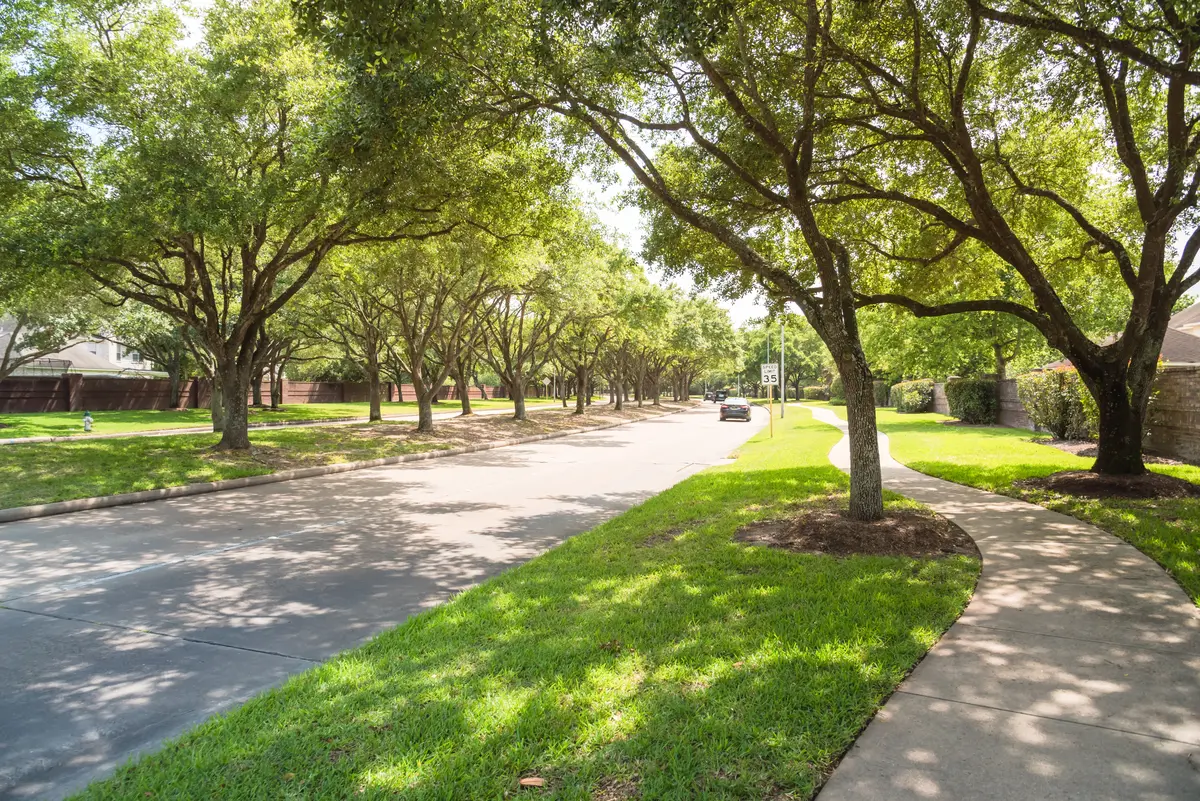
Katy fits a specific kind of retiree well: someone who wants proximity to a major city without paying for it daily, who values a well-stocked medical corridor, and who does not need a walkable downtown scene to feel at home. The master-planned neighborhoods — Grand Lakes, Kelliwood, Nottingham Country — were built for families, but their single-level floor plans, HOA-maintained exteriors, and lake-centered green space translate naturally into retirement living. If your version of retirement involves a morning walk around a neighborhood lake, easy access to LaCenterra at Cinco Ranch for lunch, and a short drive to a full-service hospital, the fit is strong.
Who should look elsewhere? Retirees who want a genuinely walkable, café-lined downtown will be frustrated. Old Town Katy has real character and a growing dining scene, but most of Katy's commercial life is car-dependent strip retail along the I-10 corridor. If you plan to give up driving entirely, Katy is a difficult place to age into. The city also lacks the dedicated 55+ community infrastructure — age-restricted neighborhoods with clubhouses, pools, and organized social calendars — that some retirees specifically seek.
The financial case is real but not unlimited. The typical home price here of $337,000 (July 2026) gives you genuine value relative to the Houston suburbs immediately to the west and south, and Texas's tax posture for retirees is among the most favorable in the country. Still, Katy is not cheap by national standards, and the property tax rate requires active management of exemptions to keep the bill reasonable on a fixed income. Retirees who arrive informed about the senior exemption stack tend to be pleasantly surprised; those who don't can face a jarring first bill.
Healthcare & Medical Access in Katy
What You Have Right Here
Memorial Hermann Katy Hospital sits about 4 miles from the city center and is the closest hospital to Katy. It is a 303-bed acute care facility and a Level III Trauma Center — with a formal application underway, as of July 2025, to achieve Level II designation. For a suburban community hospital, the breadth of services is notable: a full emergency department, surgical services, a dedicated rehabilitation program, and a neuroscience program that handles both stroke and neurological care.
The stroke program in particular matters for retirees. Memorial Hermann Katy earned recognition from national stroke quality organizations for stroke protocol quality in both 2024 and 2025, and carries Primary Stroke Center designation from DNV Healthcare. That certification level means organized, protocol-driven stroke response — the kind of thing that changes outcomes in the first hours. For a community hospital rather than a downtown academic center, that is a meaningful credential.
A $282.5 million expansion project is actively enlarging the emergency center and surgical department. The project was announced and funded through Memorial Hermann Health System's own capital commitment, which means it is a health system priority, not a speculative plan. When it is complete, Katy's on-the-ground acute care capacity will be substantially larger.
What Requires a Drive
Advanced subspecialty care — complex cancer treatment, high-acuity cardiac surgery, major neurosurgery, transplant medicine — remains concentrated in the Texas Medical Center, one of the largest medical complexes in the world and about 40 minutes away under normal conditions. That drive is manageable for scheduled appointments and very real for emergencies. Retirees with conditions that require frequent specialist oversight should be clear-eyed about that distance before committing. I-10 westbound at rush hour is not a comfortable ride when you are not feeling well.
Katy also has a growing network of outpatient clinics, imaging centers, and specialist offices that have expanded as the population has grown — cardiology, orthopedics, oncology follow-up, and primary care are all represented locally. You may rarely need to go into Houston for routine specialist visits, even for managed chronic conditions. But when you do need the Texas Medical Center's full depth, the infrastructure to get there exists.

The Retiree Budget in Katy
The Texas Tax Advantage Is Real
Texas levies no personal income tax. That means your Social Security benefits, pension distributions, IRA and 401(k) withdrawals, and investment income all arrive without a state-level haircut. For retirees moving from California, New York, or any other high-income-tax state, the difference shows up immediately in monthly cash flow. Texas also imposes no estate or inheritance tax, which matters if you are thinking about what passes to children or grandchildren.
The property tax rate — approximately 2.09% effective — is the trade that Texas makes for having no income tax. On the typical Katy home, that is a meaningful annual obligation. But for homeowners 65 and older, the exemption picture shifted significantly after voter-approved legislation in November 2025: seniors now receive a combined $200,000 in school district exemptions (a $140,000 general homestead exemption stacked with a $60,000 over-65 exemption), which eliminates school district taxes entirely for homes appraised at or below $200,000. For homes above that threshold, the savings are still substantial. The City of Katy adds a 20% homestead exemption on its own portion of the tax bill, stacking on top of the county and school district relief.
The Freeze That Matters Most
Beyond the exemption dollar amounts, Texas offers a school tax freeze for homeowners 65 and older: once in place, the school district portion of your tax bill cannot rise above the level set in the year you turned 65 or filed the exemption — regardless of how much home values appreciate afterward. In a market where values have been moving, that freeze is worth understanding before you buy. File the exemption paperwork immediately after closing; it does not apply retroactively to bills already issued.
On daily costs, Katy's grocery options, fuel prices, and general retail are consistent with the wider Houston metro — moderate by national standards, slightly above rural Texas. The full cost-of-living breakdown covers groceries, utilities, and transportation in detail. On a fixed income, the practical reality is that most errands require a car and gas spending adds up; this is not a city where you walk to the pharmacy or the grocery store from most neighborhoods.
Looking to buy in Katy? Estimate your payment.
Enter your numbers to see an estimated monthly mortgage payment.
Estimate only. Excludes HOA fees and mortgage insurance. The interest rate above is a starting point, not a quoted rate — replace it with your own to see real numbers. Insurance is a flat placeholder, not a Katy quote.
Walkability, Community & Staying Active in Katy
The Honest Walkability Picture
Most of Katy is car-dependent for daily errands. The outer master-planned subdivisions — Elyson, Sunterra, Grand Lakes — were designed around the car, and a retiree without reliable transportation would find life genuinely difficult in those areas. Old Town Katy and the I-10 retail corridor score better: the city's overall walkability is somewhat serviceable in the accessible core, but that does not reflect the subdivisions. The terrain, at least, is flat throughout — no hills, no elevation changes that complicate mobility as you age.
Where Katy succeeds is in its parks system. Mary Jo Peckham Park, Willow Fork Park, and George Bush Park all offer paved walking paths, lake views, and accessible green space that is well-suited to daily exercise. These are not token amenities — George Bush Park in particular is a significant regional park with extensive trail mileage. Retirees who build their activity around outdoor walks rather than urban strolling find Katy genuinely accommodating.
Community and Social Life
The social infrastructure here skews young — Katy grew as a family destination, and the community calendar reflects that. Friday night UIL football is a real community event; the Farmers Market on Grand Parkway and the Old Katy Farmers Market at The Dryer draw a mixed-age crowd and serve as genuine gathering points. LaCenterra at Cinco Ranch has become something of a town square for the western side of Katy, with outdoor seating, dining, and foot traffic that creates a social scene without requiring you to drive into Houston.
Volunteer opportunities exist through the Katy Area Chamber of Commerce, local faith communities (numerous and active), and the school district — which welcomes mentors and classroom volunteers at scale given its 95,295 students enrolled in 2025-26. Retirees who invest in the community through these channels tend to find the social integration they are looking for. Those who wait for a dedicated senior social calendar may find it thinner than they expected. Katy does not yet have the concentrated senior amenity infrastructure of larger planned retirement communities, and that gap is something newcomers notice in their first year.
Right-Sizing: Downsizing in Katy
What the Housing Stock Actually Offers
No 55+ communities were found in Katy. That is worth stating plainly, because it shapes the downsizing calculus in a specific way: you are buying into the general market, in neighborhoods primarily designed for families, rather than into an age-restricted community with built-in social programming, maintenance services, and neighbors at the same life stage. For some retirees that is fine — better, even, if you prefer a mixed-age neighborhood. For others, the absence of a dedicated active-adult community is a dealbreaker worth knowing before you start touring homes.
What Katy does offer is a meaningful inventory of single-level homes. The master-planned subdivisions built over the past two decades include large numbers of ranch-style and single-story layouts, and many of the patio-home configurations that work well for downsizers — smaller square footage, lower-maintenance lots, HOA-managed exteriors. Neighborhoods like Nottingham Country and Kelliwood have mature tree canopies and established street layouts that feel settled rather than newly constructed. Sunterra and Elyson, being newer, offer more modern construction and newer mechanicals, which matters when you are thinking about deferred maintenance on a fixed income.
The Practical Downsizing Decision
The typical home price in Katy is $337,000 (July 2026), which gives a retiree selling a paid-off home in a higher-cost market genuine equity to work with. Entry-level single-story homes in older established areas start below that figure; newer construction in master-planned communities runs above it. Condos and attached townhomes exist but represent a smaller share of the overall inventory than in more urban markets — Katy is fundamentally a single-family city.
One thing retirees discover after a few months: the HOA fee structure varies dramatically across neighborhoods, and what it covers matters enormously for a fixed-income budget. Some HOAs cover exterior maintenance, lawn care, and community amenities; others collect dues and deliver little. Reviewing the HOA financials and reserve fund before closing is not optional in Katy — it is the step that separates a comfortable downsizing move from an expensive surprise. For a detailed look at which neighborhoods offer what, the neighborhood guide breaks down the character of each area.
Katy vs Nearby Retirement Destinations
| City | Cost vs Katy | Primary Hospital | Walkability | Senior Living Depth | Overall Retirement Fit |
|---|---|---|---|---|---|
| Katy | Anchor | Memorial Hermann Katy Hospital (4 mi, Level III Trauma, expanding) | Somewhat walkable in core; car-dependent in subdivisions | No 55+ communities; strong parks; growing outpatient network | Strong for healthcare proximity, Texas tax benefits, flat terrain |
| Fulshear | Noticeably higher | Relies on Katy-area hospitals; no hospital in city | Mostly car-dependent; newer development, minimal walkable core | Newer master-planned communities with some active-adult amenities | Good fit for retirees wanting newer construction; budget must be higher |
| Cypress | Noticeably higher | Area regional hospitals; no hospital in city center | Car-dependent throughout; similar suburban profile to Katy | Some 55+ and active-adult options in master-planned areas | Comparable lifestyle to Katy but at a premium; slightly more senior programming |
| Sugar Land | Noticeably higher | Regional acute care hospital; strong specialist network nearby | Better walkable core near Town Square; otherwise car-dependent | More robust senior living spectrum; established independent living communities | Best fit for retirees who want a walkable town center and deeper senior amenities |
| Richmond | About the same or slightly lower | OakBend Medical Center; smaller acute care footprint | Modest walkable historic downtown; otherwise car-dependent | Limited dedicated senior living inventory | Appeals to retirees wanting small-town character; fewer healthcare resources locally |
| Houston | Varies widely; inner-loop much pricier; outer areas comparable | Texas Medical Center — unmatched specialist depth | Highly walkable in select inner-loop neighborhoods; car-dependent elsewhere | Full spectrum of senior living from independent to memory care | Best for retirees who prioritize specialist healthcare access and walkable neighborhoods; trade-off is cost and congestion |
Sugar Land is the strongest rival to Katy for retirees who want a more developed senior-living ecosystem and a genuinely walkable town center, though you pay for it. Richmond wins on price and small-town feel but gives back ground on healthcare depth — OakBend Medical Center is a capable community hospital, but it does not match what Memorial Hermann Katy offers in stroke care and surgical services. Cypress and Fulshear offer comparable suburban lifestyles at a meaningful price premium with no clear healthcare advantage over Katy.
Houston proper is in a different category: if advanced specialist care is your primary concern — a managed cancer case, a cardiac condition requiring frequent subspecialty visits — living closer to the Texas Medical Center in an inner-loop neighborhood may be the right call even at higher cost. For retirees who are broadly healthy and want value, strong local acute care, and flat terrain, Katy makes a more practical case than any of its immediate neighbors.

Local Expert Takeaway: Katy's retirement case rests on three things working together: Memorial Hermann Katy Hospital is actively expanding and already credentialed for stroke care at a level uncommon for a community hospital; Texas's senior property tax exemptions — especially the school tax freeze filed at 65 — can meaningfully reduce the headline 2.09% rate for a homeowner who acts quickly; and the flat, park-connected terrain of neighborhoods like Grand Lakes and Nottingham Country gives active retirees daily walkable green space without needing a car for it. The gap is the absence of any 55+ community, which means you are building your own social infrastructure rather than buying into one. Retirees who come in knowing that tend to thrive; those expecting a ready-made active-adult scene are usually the ones who leave.
Quick Takeaways & FAQs
✅ Texas collects no state income tax on Social Security, pensions, or retirement account withdrawals — one of the most retirement-friendly tax structures in the country.
⚠️ No 55+ communities exist within Katy proper, so retirees who want age-restricted community amenities and organized social programming will need to look at nearby cities or the broader Houston metro.
📍 Memorial Hermann Katy Hospital — about 4 miles away — is a designated Primary Stroke Center and was actively pursuing Level II Trauma designation as of July 2025, with a $282.5 million expansion underway.
Is Katy, Texas a good place to retire?
What hospital do Katy retirees use, and how good is it?
How do property taxes work for seniors in Katy?
Are there 55+ or active-adult communities in Katy?
Can you get around Katy without a car in retirement?
Moving to Texas?
Tell us what you need help with and we'll connect you with local resources.
