
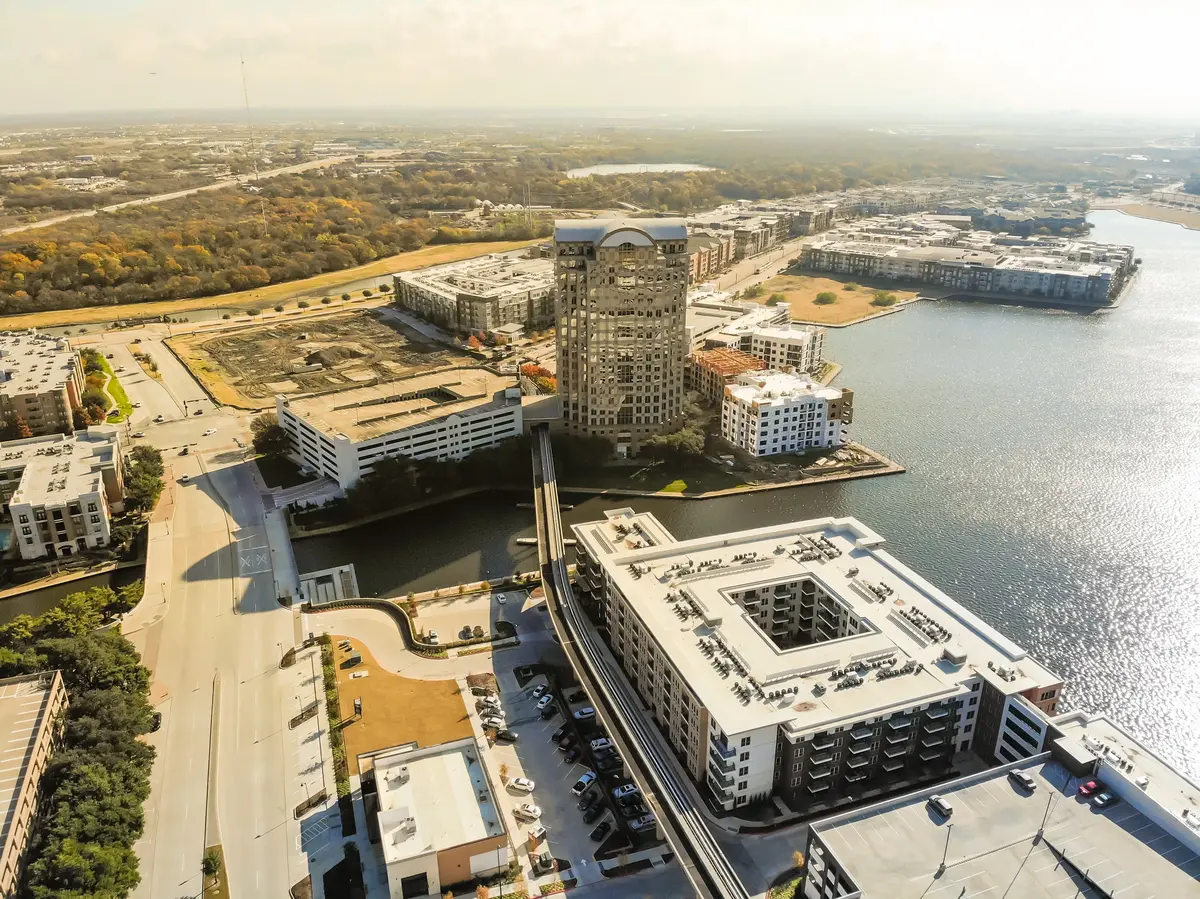
Irving is the city that keeps surprising people who've done their research. You expect a generic DFW suburb, and what you find instead is a 257,076-person city with light rail, a corporate campus skyline along Lake Carolyn, and a median home price that sits noticeably below what buyers are paying a few miles away in Coppell or Grapevine. The city's position — bracketed by I-635, SH-114, and SH-183, with Dallas/Fort Worth International Airport effectively on its doorstep — means the infrastructure of a major metro at a price point that still has room to breathe.
The economic backbone here is corporate: Fluor Corporation, Caterpillar Inc., and Kimberly-Clark all anchor significant operations in the city, and Las Colinas has drawn regional headquarters for decades. That employment concentration matters for the cost picture because it keeps the rental market competitive and supports the kind of retail density that holds grocery prices close to the national average. The Irving Independent School District, with 29,212 students enrolled in 2025-26, is the other major employer — and the district's presence shapes housing demand in ways worth understanding before you make an offer.
On the overall numbers, Irving lands almost exactly at the national cost-of-living average. That's a different story than most of its DFW neighbors, which have drifted well above it. Texas's structural advantages — no state income tax, grocery staples exempt from sales tax — work in your favor here the same as anywhere in the state. What partially offsets those advantages is an effective property tax rate of 1.55% and summer electricity bills that climb higher than the utility averages suggest, because 233 sunny days a year means serious air conditioning load from June through September.
Whether you're weighing a first purchase, comparing Irving against Dallas or Coppell, or just trying to build an honest monthly budget before signing a lease, the sections below break down Irving's housing market, everyday costs, tax structure, and how this city stacks up against the places buyers most often compare it to.

What It Really Costs to Live in Irving
Irving's cost of living sits at approximately 100.2 on the BestPlaces index — effectively at the national average, which is an unusual position for a city this close to a major metro's commercial core. That number is roughly 6% above the Texas state average, meaning you give up a little of the state's affordability advantage by choosing Irving over a smaller Texas city, but you're buying proximity to DFW Airport and downtown Dallas that smaller cities simply can't offer.
The housing market is the biggest variable. The typical home price of $343,364 (Zillow Home Value Index, July 2026) sits noticeably below what buyers pay in Coppell or Grapevine, and roughly in line with — or slightly above — Dallas proper depending on the submarket. That price point is what keeps Irving in range for dual-income households, though the median household income of $81,830 does fall short of what's needed to comfortably carry the typical home here. The gap is real, and buyers should stress-test their numbers before assuming the sticker price is the whole story.
What drives the overall number in Irving's favor is the tax structure: zero state income tax, groceries largely exempt from sales tax, and transportation costs that run meaningfully below the national average. What nudges it back toward average is the property tax rate and the summer utility load. The honest read is that Irving is a city where the headline cost-of-living number is fair — but the details, especially around property taxes and electricity, deserve a close look before you sign anything. For a full breakdown of how neighborhood character and location affect what you'll actually pay, see the neighborhoods guide.
Housing: Rent vs Buy in Irving
The typical home price in Irving stands at $343,364 (Zillow Home Value Index, July 2026). Entry-level homes — older construction, smaller footprints, occasionally needing updates — are available below that figure in parts of the city that haven't seen the same corporate investment as Las Colinas or Valley Ranch. For specifics on which neighborhoods run above or below that city-wide figure, the best neighborhoods guide covers that in detail.
The effective property tax rate is approximately 1.55%. Texas has no state income tax, so property tax is doing a lot of the civic funding work here — that rate is worth factoring into any purchase decision, and the interactive calculator below will give you a clearer monthly picture once you plug in your down payment and loan assumptions.
Renting remains a real option in Irving, and the city-wide typical rent of $1,611 per month (Zillow ZORI, July 2026) reflects genuine range across the market. Las Colinas and Valley Ranch — with their walkable urban center, Lake Carolyn frontage, and proximity to corporate campuses — rent above that city-wide median. Bear Creek sits at it. If your priority is keeping housing costs predictable while you learn the city, renting in a mid-tier corridor for a year before buying is a strategy many Irving transplants use and rarely regret.
The honest buying calculus here comes down to income gap and timeline. The median household income falls short of what's needed to carry the typical home comfortably — not by a disqualifying amount, but enough that first-time buyers should be clear-eyed about their debt-to-income picture. For buyers with stronger income or a larger down payment, Irving's price point relative to Coppell and Grapevine makes it one of the more compelling entries into the DFW market. The first-time homebuyer guide covers the mechanics of financing in more depth.
Everyday Costs Beyond Housing in Irving
| Category | Typical Monthly Cost | Notes |
|---|---|---|
| Housing (typical rent) | $1,611/mo | City-wide typical rent. Buying? Use the calculator above for a mortgage estimate. |
| Utilities | $190–$290/mo | Electricity, gas, water, sewer, trash |
| Groceries | $550–$750/mo | Food at home, household of 2–3 |
| Transportation & Gas | $170–$300/mo | Fuel, and transit where it is a real option |
| Phone & Internet | $110–$180/mo | Mobile plan plus home broadband |
| Misc / Discretionary | $250–$500/mo | Dining out, entertainment, subscriptions |
Non-housing figures are estimates for a household of two to three, not a sourced index; housing is the city-wide typical rent (Zillow ZORI, July 2026). Refreshed with the rest of the city data.
The single biggest non-housing line item for most Irving residents is electricity. Irving's electricity market is deregulated, meaning you choose your own retail electric provider from a competitive field — Oncor Electric Delivery handles the wires, but the rate you pay for supply is negotiable. Electricity costs here run below the national average, and shopping your retail electric provider can push that figure lower still. The catch is consumption: Irving's heat load from June through September is serious, and a moderate estimate of 1,000 kWh per month balloons in summer for households running central air around the clock. Plan for higher bills than the annual average suggests during the hottest months.
Grocery prices run approximately 2% below the national average, and Texas's sales tax exemption on most staples means your everyday food purchases aren't subject to the city's combined 8.25% sales tax rate. Transportation costs — gas prices, commute distances — run about 11% below the national average, which reflects both Texas fuel prices and the fact that Irving's highway network gives most residents reasonably direct routes to work. DART's Orange Line light rail connects Irving to both DFW Airport and downtown Dallas, the Trinity Railway Express stops in the Heritage District and west Irving, and the city's Irving Connector service launched in 2026 to fill gaps left by discontinued DART bus routes — so car-free living is genuinely possible here, though most residents drive.
Looking to buy in Irving? Estimate your payment.
Enter your numbers to see an estimated monthly mortgage payment.
Estimate only. Excludes HOA fees and mortgage insurance. The interest rate above is a starting point, not a quoted rate — replace it with your own to see real numbers. Insurance is a flat placeholder, not a Irving quote.
Irving vs Nearby Cities: Cost Comparison
| City | Typical Home Price | Typical Rent | Cost vs Irving |
|---|---|---|---|
| Irving (this city) | $343,364 | $1,611/mo | — |
| Dallas | $309,590 | $1,605/mo | 10% lower |
| Grapevine | $554,188 | $1,770/mo | 61% higher |
| Coppell | $621,362 | $2,032/mo | 81% higher |
Source — home prices: Zillow ZHVI, July 2026; rent: Zillow ZORI, July 2026. Nearby-city figures are the same series, refreshed together.
Irving holds a real price advantage over its northern and western neighbors — Grapevine and Coppell both run noticeably higher on typical home prices — while Dallas comes in somewhat lower, making the comparison between those two cities a question of what you're buying beyond the number.
Taxes & the Bottom Line for Irving
The Texas Tax Advantage
Texas levies no state income tax — that's a structural win that applies across the board, whether you're a salaried employee at one of Irving's corporate anchors or a remote worker who relocated here for the cost savings. It's real money back in your pocket compared to states like California, Colorado, or Oregon, and it's one of the most common reasons out-of-state buyers land in the DFW market in the first place. For the full picture on what that means for California transplants specifically, see the moving from California guide.
Sales Tax and Groceries
Irving's combined sales tax rate is 8.25% — that's the 6.25% Texas state base plus a 1% city tax and a 1% special district tax. That rate applies to most retail purchases, but Texas exempts most grocery staples, which takes the sting out of the rate for everyday household spending. Restaurants, clothing, electronics, and most other purchases are fully taxed at the combined rate, so factor that into your lifestyle math if you dine out frequently or make large retail purchases locally.
Property Tax and the Bottom Line
The effective property tax rate of approximately 1.55% is the number that most often surprises buyers coming from lower-tax states. At the home-price level discussed earlier in this guide, it's a meaningful annual obligation — and unlike income tax, it doesn't disappear in retirement. Texas's Homestead Exemption does provide some relief for owner-occupants, so confirm your eligibility once you close.
The honest bottom line: Irving fits comfortably for dual-income households earning above the city's median, for remote workers bringing higher-cost-of-living salaries to a Texas price point, and for buyers who want DFW access without paying Coppell or Grapevine prices. It's a stretch for single-income households near the median, and the property tax rate means the monthly payment on that typical home is higher than the purchase price alone suggests. Buyers who run the full numbers — including taxes, utilities, and the summer electricity premium — and still find Irving pencils out are usually right. The ones who skip that step are the ones who call it a surprise six months in.
Local Expert Takeaway: Irving's cost of living lands almost exactly at the national average, which sounds neutral but is actually a strong position for a city with light rail to DFW Airport, corporate campuses along Lake Carolyn, and a typical home price noticeably below what Coppell or Grapevine ask. The real watch items are the 1.55% property tax rate and summer electricity bills that climb well above the annual average — budget for both before you finalize your numbers. The no-income-tax advantage is genuine, grocery costs run below the national average, and transportation costs are favorable. For most dual-income households relocating from higher-cost markets, Irving's math works; for single-income buyers near the city median, it's worth running the full monthly picture carefully.
Quick Takeaways & FAQs
✅ Irving's typical home price of $343,364 (July 2026) sits noticeably below nearby Coppell and Grapevine, making it one of the more accessible entry points into the DFW market.
⚠️ The 1.55% effective property tax rate is a meaningful ongoing cost — and because Texas funds schools and services through property taxes rather than income taxes, it doesn't shrink in retirement.
📍 Irving's electricity market is deregulated, so shopping your retail electric provider can meaningfully lower your bill — but summer cooling loads in a hot DFW climate will push costs higher than conservative annual estimates suggest.
Is Irving, TX an affordable place to live?
What is the typical rent in Irving, TX?
How high are property taxes in Irving, TX?
Does Irving have a state income tax?
How do utility costs in Irving compare to the national average?
Moving to Texas?
Tell us what you need help with and we'll connect you with local resources.
