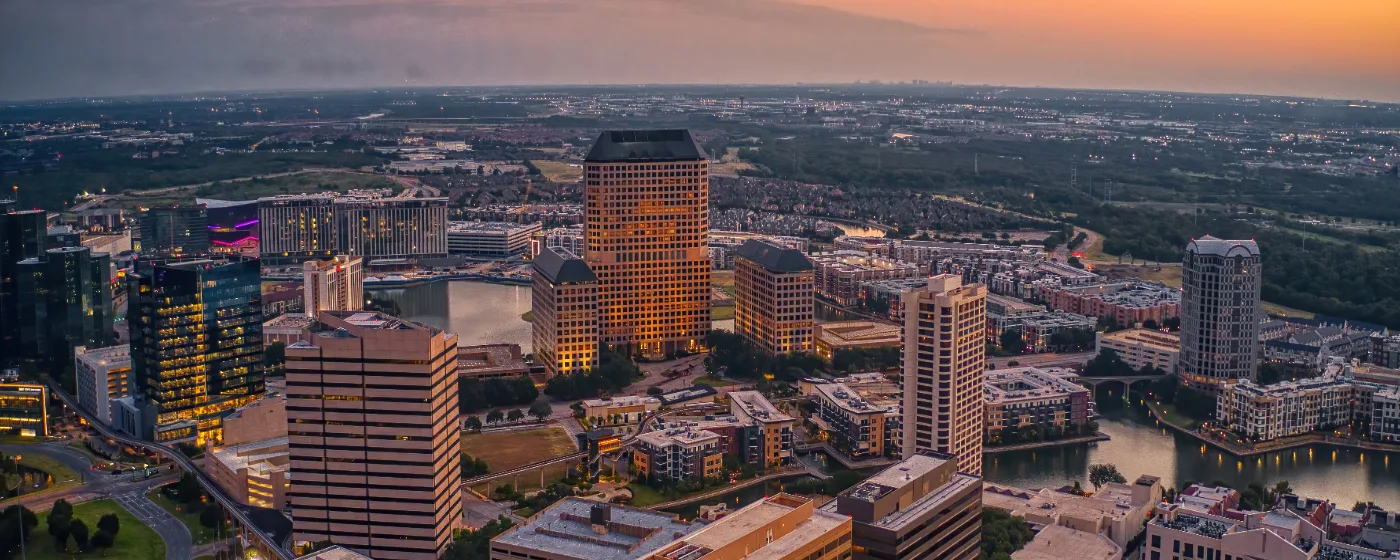
Irving sits inside one of the busiest real estate markets in the country, and for first-time buyers, that cuts two ways. The typical home price of $343,364 (Zillow Home Value Index, July 2026) puts ownership within range for many households — well below what buyers face in Coppell or Grapevine to the north and west. But Irving is also a city where roughly six in ten housing units are rentals, driven by apartment density around Las Colinas and the airport corridor, which means the owner-occupied inventory that first-timers compete for is thinner than it looks from the outside.
The city's economic backbone runs deep. Major employers include Fluor Corporation, Caterpillar Inc., and Kimberly-Clark, alongside the City of Irving itself and Irving Independent School District. Dallas/Fort Worth International Airport is about 8 miles away and anchors a significant share of the regional employment base. The DART Orange Line light rail connects Las Colinas and the Convention Center area to downtown Dallas, and the Trinity Railway Express commuter rail serves the Heritage District. For a first-time buyer weighing commute cost and convenience, Irving's access points — I-635, SH-183, SH-114, and SH-161 — give it a genuine edge over suburbs that require longer surface-street drives to reach the metro core.
The affordability picture is honest but not discouraging. The median household income in Irving is $81,830, which sits below what it takes to comfortably carry the city's typical home at current rates — something the budget section below addresses directly. Texas has no state income tax, and a voter-approved expansion raised the school district homestead exemption to $140,000 of appraised value, which meaningfully reduces a primary-residence owner's taxable base. The effective property tax rate runs approximately 1.55%, which is meaningful but not unusual for the Dallas-Fort Worth area. For a fuller cost-of-living comparison, see the Irving cost of living page.
Whether you are making the leap from renting in Las Colinas or moving from out of state, this guide walks through what Irving's entry-level market actually looks like, how the buying process works here step by step, how to frame your budget before you ever tour a home, and the specific mistakes that cost first-timers in this market.

The Irving First-Time Buyer Reality
The typical home in Irving is priced at $343,364 as of July 2026 — which sounds accessible until you account for property taxes, insurance, and the cash you need at closing. First-time buyers nationally have faced a compressed entry-level tier after years of price appreciation, and Irving reflects that pattern: the owner-occupied inventory that first-timers can realistically afford is thinner than the overall listing count suggests.
In Irving specifically, the neighborhoods most accessible to first-time buyers cluster around the city median. Bear Creek, on the western side of the city, offers a mix of older and newer single-family homes with access to Northwest Park and the Campion Trail, and its price tier sits at the city median — making it one of the more realistic starting points. Las Colinas and Valley Ranch both run above the city median and tend to attract buyers who already have equity from a prior sale. For a deeper look at how these neighborhoods compare on character and fit, see the Irving neighborhoods guide.
The income gap is worth naming plainly: the median household income in Irving is $81,830, and it falls short of what it takes to comfortably purchase the typical home here at current rates — by roughly $19,000. That does not mean buying is impossible, but it does mean most first-timers need either a strong second income, a careful budget, or both. FHA financing is fully available here — the FHA loan limit for Dallas County covers well above Irving's typical price point — so the financing options are not the constraint. The constraint is the cash to close and the monthly carrying cost once you get there.
Irving's market has come back toward balance from the frenzied pace of the early pandemic era. Well-priced homes in move-in condition still attract interest, but buyers today have more room to negotiate and more time to conduct due diligence than they did a few years ago.
The Homebuying Process in Irving, Step by Step
Step 1: Get Pre-Approved Before You Tour Anything
This is the step first-timers most often skip or delay, and it costs them. In the DFW market, sellers routinely decline to accept offers that arrive without a pre-approval letter. More importantly, pre-approval tells you what you can actually spend — not what a mortgage calculator suggests — because it accounts for your credit profile, debt obligations, and the loan product you qualify for.
Pre-approval is not the same as pre-qualification. Pre-qualification is an estimate based on self-reported numbers. Pre-approval involves a lender pulling your credit and verifying your income and assets. Get the real one before you schedule a single showing.
Step 2: Clarify Your School District Early
Irving is served by three separate school districts: Irving ISD covers most of the city, but Carrollton-Farmers Branch ISD and Coppell ISD reach into the northern and western edges. District boundaries do not follow zip code lines. Buyers who assume their address automatically falls inside a particular district — especially parents targeting Coppell ISD's attendance zone — sometimes close on a home only to find it falls in a different district. Confirm the district assignment for any specific property through the district's own attendance-zone lookup before you make an offer. For more on Irving's school options, see the Irving schools guide.
Step 3: Make Offers With a Realistic Picture of Competition
Inventory has improved relative to the pandemic era, but well-maintained homes in Bear Creek and similar mid-tier neighborhoods still attract multiple interested buyers when priced correctly. Your agent should pull recent comparable sales — not list prices, sold prices — before you settle on an offer number. Escalation clauses can help in competitive situations, but understand the ceiling you are setting before you write one in.
Step 4: Do Not Skip the Inspection or Underestimate the Appraisal
Texas summers are hard on roofs, HVAC systems, and foundation slab construction. A thorough general inspection is non-negotiable — and in Irving's older stock, a foundation inspection deserves its own line item. The appraisal matters separately: if a home appraises below your contracted price, you will need to negotiate a price reduction, make up the gap in cash, or walk away. Know which of those you are prepared to do before you go under contract.
Step 5: Budget the Full Closing Process, Not Just the Down Payment
Texas closing costs typically run 2% to 5% of the purchase price and include lender fees, title insurance, prepaid homeowners insurance, prepaid property taxes, and escrow setup. Budget for all of it, not just the down payment. The section below breaks down what that looks like at several realistic Irving price points.
Step 6: File Your Homestead Exemption After Closing
Texas law allows primary-residence owners to file a homestead exemption that reduces their taxable appraised value — including a school district exemption that was raised to $140,000 through a voter-approved constitutional amendment. The exemption must be filed through the Dallas Central Appraisal District and applies only to a primary residence. Filing it is one of the highest-value administrative tasks a new homeowner in Irving can complete — and many first-timers simply forget. Put it on the calendar for the January after you close.
How Much Home Can You Afford in Irving
The table below shows what different purchase prices require in cash at the table, using estimates for closing costs and standard down payment tiers. These are illustrative ranges — your actual closing costs will depend on your lender, your title company, and the specifics of the transaction. The interactive mortgage calculator below this section will let you model monthly payments at current rates.
| Scenario | Purchase Price | Down Payment | Est. Closing Costs (2–4%) | Est. Cash Needed at Table |
|---|---|---|---|---|
| FHA (3.5%) — entry point | $275,000 | $9,625 (3.5%) | $5,500–$11,000 | ~$15,125–$20,625 |
| Conventional (3%) — entry point | $275,000 | $8,250 (3%) | $5,500–$11,000 | ~$13,750–$19,250 |
| FHA (3.5%) — city median | $343,364 | $12,018 (3.5%) | $6,867–$13,735 | ~$18,885–$25,753 |
| Conventional (3%) — city median | $343,364 | $10,301 (3%) | $6,867–$13,735 | ~$17,168–$24,036 |
| Conventional (5%) — mid-range | $380,000 | $19,000 (5%) | $7,600–$15,200 | ~$26,600–$34,200 |
| Conventional (10%) — above-median | $425,000 | $42,500 (10%) | $8,500–$17,000 | ~$51,000–$59,500 |
Closing costs in Texas include title insurance (which buyers typically pay here, unlike some states), prepaid property taxes, and prepaid homeowners insurance in addition to lender fees — so the higher end of the 2–4% range is a safer planning figure for most first-timers.
Two tax provisions change the long-term math for primary-residence buyers. Texas caps the annual increase in a homestead's assessed value at 10% per year, regardless of how fast the market rises. And the school district homestead exemption — raised to $140,000 through a voter-approved constitutional amendment — meaningfully reduces your taxable base. Together, these mean your effective tax burden grows more slowly than your home's market appreciation, a genuine protection in a metro that has seen sustained price growth. The effective property tax rate in Irving runs approximately 1.55%, but the gross combined rate is higher — the homestead exemption is what brings your taxable base down. For a fuller breakdown of tax costs, see the Irving cost of living page.
Looking to buy in Irving? Estimate your payment.
Enter your numbers to see an estimated monthly mortgage payment.
Estimate only. Excludes HOA fees and mortgage insurance. The interest rate above is a starting point, not a quoted rate — replace it with your own to see real numbers. Insurance is a flat placeholder, not a Irving quote.
Common First-Time Buyer Mistakes in Irving
Assuming the Zip Code Tells You the School District
This is the most consequential mistake buyers make in Irving, and it is almost entirely avoidable. Three districts serve the city, and their boundaries cut across zip codes and neighborhoods in ways that are not intuitive. A home two streets over from a property you toured may fall in a different district entirely. Verify through the district's official attendance-zone tool for every property you seriously consider — not once at the start of your search, but for each specific address.
Touring Homes Before Getting Pre-Approved
It feels like the logical order: look first, figure out financing second. In practice, touring before pre-approval means you may fall in love with a home you cannot finance at its list price, or lose a home to a buyer who was already pre-approved when you were still gathering documents. DFW sellers and their agents treat pre-approval as a baseline, not a formality. Get it done first, and make sure it is a full credit-verified pre-approval, not a soft pre-qualification.
Underbudgeting the Cash Needed at Closing
First-timers frequently plan for the down payment and forget that closing costs in Texas are substantial and partially buyer-borne. Title insurance, escrow setup, prepaid taxes, and prepaid insurance add up fast. At Irving's typical price point, the cash needed at the table can run $18,000 to $26,000 even on a 3.5% FHA loan — and more if the seller is not contributing to closing costs. Build the full cash requirement into your savings target from the beginning, not after you are already under contract.
Skipping the Foundation Inspection
Irving sits on expansive clay soil — the same geology that affects much of the DFW area — which means foundation movement is a genuine and common issue, particularly in older homes. A standard general inspection may flag concerns, but a dedicated foundation inspection by a structural engineer gives you a clearer picture of whether any movement is cosmetic, stable, or ongoing. This is not the place to save a few hundred dollars. If a seller pushes back on a foundation inspection contingency, that resistance is itself useful information.
Letting the Commute Be an Afterthought
Irving is about 20 minutes to Downtown Dallas under normal conditions, and the DART Orange Line provides a rail option from Las Colinas and the Convention Center area. But your commute depends on exactly where you live in Irving and where you work — the city spans enough geography that two addresses with the same zip code can produce materially different drive times at rush hour. Test your actual route at actual commute hours before you commit. For a fuller picture of how daily commuting works here, see the living in Irving guide.
Local Expert Takeaway: Irving's entry-level market is real but requires preparation that most first-timers underestimate. Bear Creek offers the most accessible price tier for buyers working near the city median, while Las Colinas and Valley Ranch price above it. The biggest financial surprise for buyers coming out of renting is closing cash — at Irving's typical price point, you can easily need $20,000 or more at the table even with a low-down-payment loan. File your homestead exemption with the Dallas Central Appraisal District the January after you close; it is the single highest-value administrative task a new Irving homeowner can do, and a surprising number of first-timers simply let it slip.
Quick Takeaways & FAQs
✅ Irving's typical home price of $343,364 (July 2026) sits well below nearby Coppell and Grapevine, giving first-time buyers a realistic entry point into the Dallas-Fort Worth metro.
⚠️ Three school districts serve Irving — Irving ISD, Carrollton-Farmers Branch ISD, and Coppell ISD — and boundaries do not follow zip codes, so confirming district assignment for every specific address is essential before closing.
📍 Texas caps the annual increase in a homestead's assessed value at 10% per year, and a voter-approved constitutional amendment raised the school district homestead exemption to $140,000 — two protections that meaningfully reduce long-term tax exposure for primary-residence buyers.
What is the typical home price for first-time buyers in Irving, TX?
How much cash do I need to buy a home in Irving as a first-time buyer?
Which school district serves my Irving address?
Is FHA financing available in Irving, and does it make sense here?
What is the homestead exemption in Irving and how do I file it?
Moving to Texas?
Tell us what you need help with and we'll connect you with local resources.
