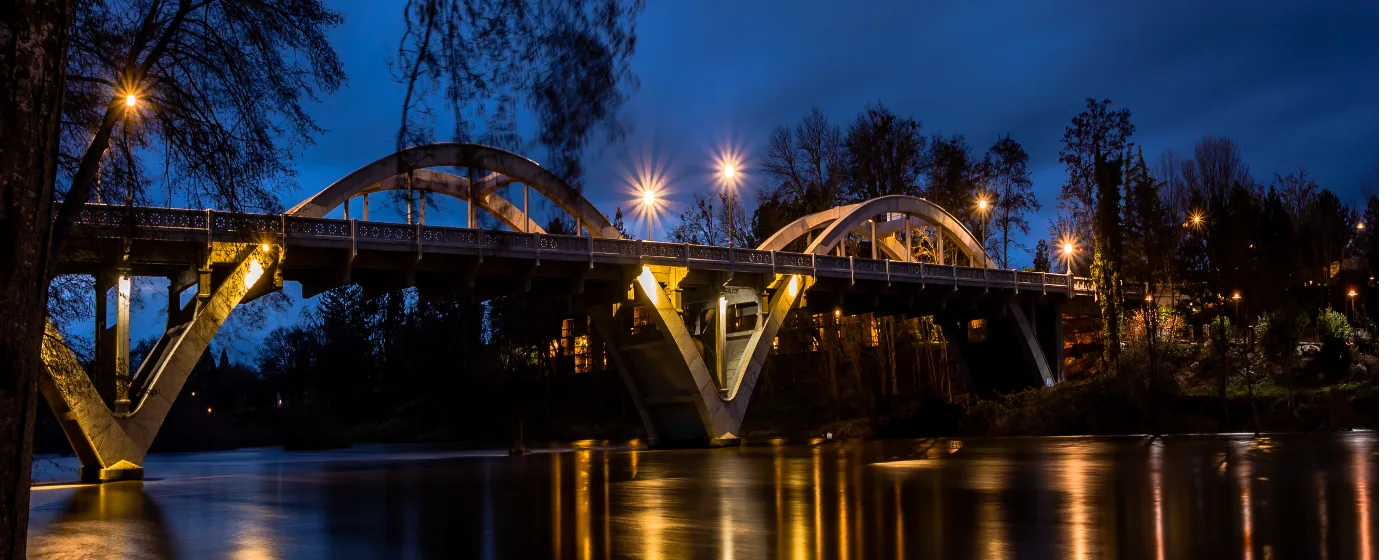
Grants Pass is a city that looks uniform from the interstate but divides sharply once you start driving its streets. The Rogue River cuts through the middle, the historic core sits close to the water, and within eleven or twelve square miles you can go from a Victorian bungalow two blocks from the Caveman Bridge to a Craftsman on a half-acre with a well, a septic system, and mountain views in every direction. That range is the defining feature of this market — and the reason choosing a neighborhood here matters more than it would in a larger city where more areas feel roughly similar.
With a population of 39,311, Grants Pass is the 14th-largest incorporated city in Oregon, large enough to have real neighborhood distinctions but small enough that every part of town is within a short drive of everything else. The Grants Pass School District 7 holds a B- rating, according to Niche, and serves 5,562 students enrolled in 2025-26. Major employers include Josephine County, the school district itself, the City of Grants Pass, and Asante Three Rivers Medical Center — a relatively compact public and healthcare job base that means many residents commute or work remotely. The drive to Medford is about 30 minutes to Medford via I-5, which is where many of the region's larger employers and services are concentrated.
The typical home price sits at $404,270 (Zillow Home Value Index, July 2026), noticeably below what buyers face in the Willamette Valley metro markets, and well below the California prices that drive a significant share of in-migration here. The catch is that the median household income — $59,646 — falls well short of what's needed to carry a purchase at that price level, so the market is more accessible than Portland but still a stretch for many local earners. The effective property tax rate of approximately 0.60% is among the lower rates in Oregon, which helps offset carrying costs. For a fuller breakdown, see the cost of living page.
Whether you're weighing a move from California, relocating within Southern Oregon, or buying your first home in Josephine County, the sections below break down Grants Pass's eight established neighborhoods, compare them by buyer type, flag the mistakes relocating buyers most commonly make, and identify the best areas to rent while you figure out where you want to land long-term.
The Grants Pass Reality
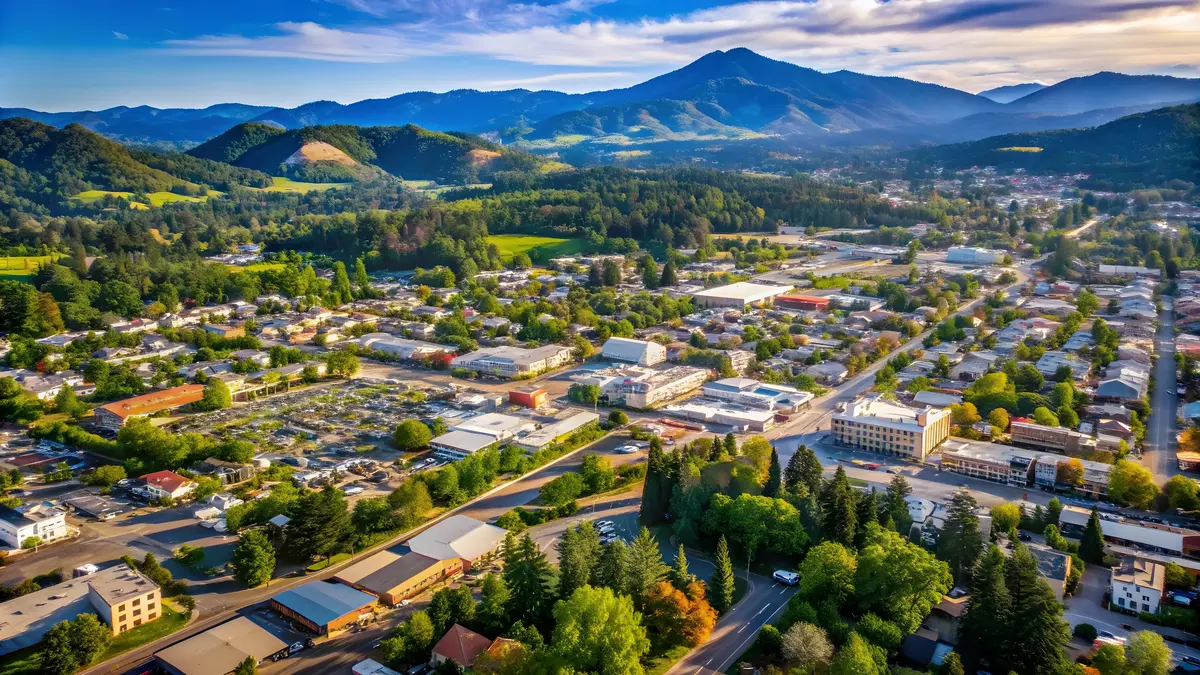
The single most important thing to understand about Grants Pass geography is the divide between the historic in-town core and the edge-of-city corridors — and how little distance separates them. The city is only eleven or twelve square miles, but a home near the Riverside Park and the Rogue River Pedestrian Bridge feels fundamentally different from one in a newer subdivision off US-199. Walkability, lot size, housing age, and neighborhood density all shift within a mile or two.
The northwest corridor along US-199, the Redwood Highway, has absorbed most of the city's newer residential growth. Neighborhoods above and adjacent to that corridor — including West Hills and parts of Redwood — tend to have larger lots, newer construction, and a quieter suburban character, but they are car-dependent for everything. The south side of the city, including Fruitdale and Colonial Valley, carries a more rural feel with flat, tree-lined streets and properties that shade toward equestrian and agricultural use at the edges.
School boundary lines within Grants Pass School District 7 are the other variable that catches buyers off guard. The district serves 5,562 students enrolled in 2025-26, and which elementary school a given address feeds into depends on exact location — not just the general neighborhood name. If a particular school assignment matters to your family, verify the boundary before making an offer, not after. The schools page has the full district breakdown.
Neighborhoods at a Glance
| Neighborhood | Best For | Vibe |
|---|---|---|
| Downtown Grants Pass | Walkable First-Time | Historic storefronts, public art, bungalows on small lots; the most on-foot access in the city |
| Fruitdale | Families Quiet | South-side semi-rural feel, flat streets, tree cover, modest to mid-range single-family homes |
| Redwood | Nature Privacy | Craftsman and newer homes on larger lots, some with equestrian land; scenic hill and wildlife views |
| Cathedral Hills | Nature Views | Trail-adjacent living with direct access to a 400-acre BLM trail system; rugged and outdoors-oriented |
| West Hills | Commuter Quiet | Elevated western edge of city, newer suburban character, convenient to US-199 and I-5 |
| Meadow Wood | Families School | Established subdivision with view lots, good lot sizes, and a reputation for holding value |
| Colonial Valley | Privacy Nature | Rural-feel edge neighborhood with mountain and valley views, gardening and outdoor culture |
| Starlight | Value Renter | South-side edge-of-city pocket, late 20th-century housing stock, car-dependent but accessible |
Grants Pass typical home price: $404,270 (Zillow ZHVI, July 2026). Typical rent: $1,621/mo (Zillow ZORI, July 2026). Neighborhood tiers on this page are relative to these figures.
Best Neighborhood by Buyer Type
| Buyer Type | Best Neighborhood | Why |
|---|---|---|
| First-Time Buyer | Downtown Grants Pass | Small lots and older housing stock bring entry points closer to reach, and you get genuine walkability as a trade for square footage. |
| Luxury Buyer | Meadow Wood | Hilltop view lots with full city utilities and an established neighborhood that consistently holds its value make this the most aspirational address in the city. |
| Walkability Seeker | Downtown Grants Pass | It's the only neighborhood where the historic core, Riverside Park, restaurants, and galleries are genuinely reachable on foot. |
| Families with Kids | Fruitdale or Meadow Wood | Both are the neighborhoods most consistently cited by parents with school-age children for their low-traffic streets and community feel. |
| Commuters | West Hills | The northwest corridor along US-199 and I-5 access make the drive to Medford — about 30 minutes to Medford — as efficient as Grants Pass allows. |
| Large-Lot Buyers | Redwood or Colonial Valley | Both areas offer acreage-scale properties with equestrian potential and rural character still inside city limits or just beyond. |
| Renters | Downtown Grants Pass or Starlight | These two areas offer the widest mix of apartment conversions, duplexes, and smaller rentable units relative to the rest of the city. |
Looking to buy in Grants Pass? Estimate your payment.
Enter your numbers to see an estimated monthly mortgage payment.
Estimate only. Excludes HOA fees and mortgage insurance. The interest rate above is a starting point, not a quoted rate — replace it with your own to see real numbers. Insurance is a flat placeholder, not a Grants Pass quote.
Most Popular Neighborhoods
Downtown Grants Pass
Living downtown means Victorian and Craftsman homes on small lots, with the Caveman Bridge, Riverside Park, and the Historic Downtown Grants Pass National Historic District all within a short walk. The century-old "It's the Climate" sign is your neighbor. The trade-off is lot size and parking — properties here are dense by Grants Pass standards, and any exterior change on homes within the historic overlay requires navigating design-review guidelines that slow renovation timelines.
Best for: Buyers who want walkable streets and historic character over square footage.Fruitdale
Fruitdale delivers on the Southern Oregon fantasy of flat, quiet streets surrounded by trees and hills without fully leaving the city behind — services and shopping are a short drive away. The housing stock runs from mid-century ranches to modest single-family homes built through the 1990s, with some newer custom properties mixed in at the edges. The south-side location means it sits slightly farther from the I-5 interchange, which is a minor friction point for daily commuters compared to the northwest corridor neighborhoods.
Best for: Families with kids and retirees who want a semi-rural feel without sacrificing proximity to town.Redwood
Redwood is where you go when you want scenic hill views, wildlife out the back window, and enough land to keep a horse — some properties here run on septic and well water rather than city systems, which is both the appeal and the due-diligence item that buyers sometimes underestimate. Newer construction from 2000 onward mixes with 1970s and 1980s ranches, and Craftsman-style builds including recent construction add to the variety. The infrastructure difference — city utilities versus private well and septic — can meaningfully affect both resale and ongoing maintenance costs, so ask specifically before you fall in love with a listing.
Best for: Buyers who want larger lots, nature-adjacent living, and don't mind the infrastructure variability.Cathedral Hills
Cathedral Hills is the neighborhood for people who want a trail system as a backyard amenity rather than a weekend drive. The Cathedral Hills Park trail system covers 400 acres and 10 miles of routes managed by BLM and Josephine County, used by hikers, mountain bikers, horseback riders, and trail runners — two trees within the system are listed in the Oregon Big Tree Registry. The downside is that homes here are close to rugged terrain and those views come with the reality of limited flat land, meaning yard space and level driveways can be in short supply.
Best for: Outdoor enthusiasts who want trail access as a daily feature, not a weekend trip.West Hills
West Hills occupies the elevated western edge of the city, above the US-199 corridor where most of Grants Pass's recent residential growth has concentrated. The character is quieter and more suburban than the downtown core, with newer housing stock and straightforward access to both the Redwood Highway and I-5. The honest trade is that it's fully car-dependent — there's nothing walkable about the hillside portions — and the elevated terrain means some lots have limited usable outdoor space despite the views.
Best for: Commuters and buyers who want newer construction with easy highway access and don't need to walk anywhere.Meadow Wood
Meadow Wood is the neighborhood most consistently mentioned when Grants Pass buyers talk about holding value — established landscaping, reasonable lot sizes, and a final development phase of hilltop view lots with full city utilities that was still active as of 2025-26. Families with school-age children show up disproportionately in conversations about this area. Homes here run above the city median, which is the honest starting point for any conversation about this address — it's not the entry point into the market.
Best for: Families and buyers looking for a subdivision with longevity and Rogue Valley views.Colonial Valley
Colonial Valley reads as the most genuinely rural of Grants Pass's eight neighborhoods — a mix of farmland and homes, mountain and valley views in multiple directions, and a neighborhood culture built around gardening, hiking, and being outside rather than proximity to retail. The catch is that Colonial Valley sits at the edge of where the city's infrastructure thins out, which means buyers should verify utility connections and road maintenance responsibilities before committing. It rewards buyers who specifically want that separation from urban activity.
Best for: Large-lot buyers, gardeners, and people who want a rural character with a Grants Pass address.Starlight
Starlight is among the south-side edge-of-city residential pockets, with late-20th-century housing stock and the car-dependent patterns common to Grants Pass neighborhoods away from the downtown core. Coverage and community data on this area are thinner than for Fruitdale or Meadow Wood, which makes it harder to characterize with precision — that thinness is itself worth knowing, because it often signals a neighborhood still finding its footing. Highway access is reasonable, but there's less neighborhood identity here than in the city's more established pockets.
Best for: Buyers and renters focused on value and access who don't need a strong neighborhood anchor.Common Mistakes Buyers Make in Grants Pass
Treating the City as One Uniform Market
Grants Pass is small enough that buyers sometimes assume neighborhood differences are negligible. They're not. A home in the Redwood area on a well and septic system has fundamentally different carrying costs and resale dynamics than a comparable-square-footage home on city utilities near the downtown core. Vetting infrastructure — not just price and size — is the step that saves the most post-closing surprises here.
Underestimating the Infrastructure Variable in Outer Neighborhoods
Redwood and Colonial Valley both include properties on private well and septic systems. Buyers moving from California or Willamette Valley metros often haven't dealt with this before. A well inspection and a septic evaluation aren't optional extras on these properties — they're the due diligence that determines whether the rural character you're paying for is actually functional. Budget the inspections; skip them and you're guessing on the most expensive systems on the lot.
Ignoring School Boundary Lines Within the District
Grants Pass School District 7 is the only district in play here, but the elementary assignment your address feeds into varies by exact location within each neighborhood. Buyers who rely on general neighborhood reputation — "Fruitdale is good for families" — without verifying the specific boundary for their address can end up in a different school zone than they planned. Confirm the assignment at the district level before closing, not after move-in.
Chasing Square Footage Over Location
Because the typical home price in Grants Pass — $404,270 as of July 2026 — is genuinely lower than what many buyers are coming from, there's a temptation to maximize square footage for the budget. Buyers who do that often land in Starlight or outer Colonial Valley pockets where they get the space but sacrifice the neighborhood infrastructure, walkability, and resale liquidity that the closer-in neighborhoods provide. In a city this size, the difference in commute time between the best and worst location is minutes, but the difference in neighborhood character and long-term value is real.
Best Areas to Rent in Grants Pass
| Area | Ideal For | Trade-off |
|---|---|---|
| Downtown Grants Pass | Renters who want on-foot access to the historic core, restaurants, and Riverside Park | Units tend to be smaller — condo conversions and duplex-style older stock — and parking can be limited on narrower in-town lots |
| Fruitdale | Families and renters wanting quiet, tree-lined streets with a semi-rural feel | You'll need a car for most errands; rental inventory is thinner here than in the downtown corridor |
| West Hills / US-199 Corridor | Commuters who want newer apartment-style units close to highway access | Fully car-dependent; the hillside character means limited walkable amenities of any kind |
| Redwood | Renters looking for space, privacy, and natural surroundings with a longer-term lease | Some units rely on well and septic systems; fewer traditional apartment options compared to the urban core |
| Starlight | Value-focused renters who prioritize affordability and don't need neighborhood walkability | Limited community infrastructure and thinner neighborhood identity; fully car-dependent |
The city-wide typical rent runs $1,621 per month (Zillow ZORI, July 2026), with two-bedroom units generally landing in the $1,490–$1,820 range — see the cost of living page for the full rental breakdown. Rental inventory in Grants Pass is genuinely limited outside the downtown core, which means well-priced units in Fruitdale and Meadow Wood move quickly when they do appear.
Local Expert Takeaway: Grants Pass is compact enough that no neighborhood is a bad commute, but the difference between buying downtown and buying in the outer corridors is larger than the mileage suggests. If you want the historic character — Victorian bungalows near the Rogue River Pedestrian Bridge, a walk to Riverside Park, public art on the main street — you're trading square footage and lot size for it, and that's a reasonable trade in a city this size. If you want acreage, views, and rural quiet, Redwood and Colonial Valley deliver, but verify the well and septic before you fall for the scenery. Families consistently point to Fruitdale and Meadow Wood, and those neighborhoods' reputations hold up in the data — they're not marketing copy. The one mistake that costs people the most here is assuming any Grants Pass address is interchangeable because the prices are close; at this price level, infrastructure and school boundaries matter more than the dollar difference between streets.
Quick Takeaways & FAQs
✅ Grants Pass offers genuine neighborhood variety — walkable historic bungalows downtown to rural acreage in Redwood — within eleven square miles, giving buyers real options at a typical home price of $404,270 (July 2026).
⚠️ Several outer neighborhoods in Redwood and Colonial Valley include homes on private well and septic systems rather than city utilities — a due-diligence item that catches buyers from urban markets off guard and can affect resale.
📍 Fruitdale and Meadow Wood are the two neighborhoods most consistently named by families with school-age children, but school boundary assignments within Grants Pass School District 7 depend on your exact address, not just the neighborhood name.
What is the most walkable neighborhood in Grants Pass?
Which Grants Pass neighborhoods are best for families with kids?
Are there neighborhoods in Grants Pass where homes sit on wells and septic systems?
What is the typical home price in Grants Pass, and which neighborhoods run above or below it?
What should renters know before looking for an apartment in Grants Pass?
Moving to Oregon?
Tell us what you need help with and we'll connect you with local resources.
